
Tag Archives: Theology

New York church makes space for non-Christians to ask questions

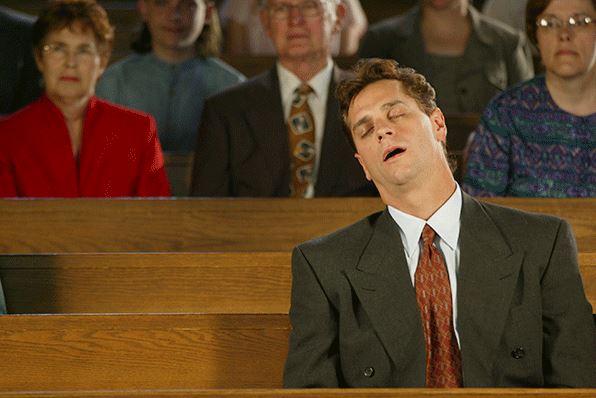
Church sucks, that's why men are bored there
Is church boring? How can you make it more interesting for people?

This is from the radically leftist New York Times, of all places.

It says:

When Craig Ellis was growing up, he picked up the sort of adventure book meant for a boy looking to serve God. The book, “Shadow of the Almighty,” told the story of Jim Elliot, a young American evangelist killed while doing mission work in Ecuador.

The narrative of this Christian martyr did for Mr. Ellis what a superhero comic might have done for his peers: It got him pondering purpose, struggle and sacrifice. The book also provided a model for how a Christian should spread the news of salvation while working in treacherous territory, at great personal risk.

Very little in “Shadow of the Almighty,” however, prepared Mr. Ellis for where he stood on a recent Tuesday, in a room with industrial carpet and a dropped ceiling at Redeemer Presbyterian Church on the Upper West Side of Manhattan, where people lined up on Sunday morning are more likely awaiting a table for brunch than taking communion.

Mr. Ellis, 39, welcomed the dozen men and women seated before him. “This is a space,” he said, “for people who consider themselves non-Christian and are coming in from the outside.”

His weekly sessions, called the WS Café in a reference to the neighborhood, are at a new frontier of evangelism, one that seeks converts among a fervent and growing number of atheists in this country. The sessions started in September as a push by Redeemer Presbyterian’s prominent pastor, the Rev. Tim Keller, to preach the gospel to skeptics.

How are they doing it?

By not quoting the Bible as if it were inerrant to people who don’t think it is. But using evidence from outside the Bible to explain what’s in the Bible.

More:

On that recent Tuesday evening, Mr. Ellis, the pastor’s assistant, was sharing a lectern with the Rev. Bijan Mirtolooi, the assistant pastor for the 83rd Street church. In the chairs around them sat people like Frank Ying, 33, who works for a technology start-up. Brought up in the Dallas area by immigrant parents who had been raised amid the official atheism of the People’s Republic of China, Mr. Ying tried exploring Christianity with his high school classmates, even accompanying them to megachurches, only to be put off by their fundamentalism.

“You have all these questions,” he recalled. “And you have all these long, drawn-out conversations. ‘What do you believe? How much of the Bible do you take literally?’ And these people stop short and say, ‘You’ve just got to have faith.’ But I’ve always been more pragmatic, so that wasn’t good enough.”

Mr. Ying heard about Redeemer Presbyterian from a few acquaintances after moving to Manhattan several years ago. He dipped his toe slowly, watching a YouTube video of Dr. Keller in conversation with a journalist and a historian, emissaries of the secular world. By now, Mr. Ying is a regular at the WS Café, not because he believes, but because his doubts get heard.

Each session has a central topic, and on the recent Tuesday it was about why Jesus needed to be crucified. As part of framing a wide-open conversation, a list of quotations on the subject even included this zinger from Mr. Hitchens: “I find something repulsive about the idea of vicarious redemption.”

Mr. Ellis and Mr. Mirtolooi cited popular culture (movies like “The Revenant,” “Inside Out”) and real-life examples (the way a parent sacrifices free time to raise a child) in order to make palpable the concept of suffering leading to the remission of sin. Very deliberately, they did not lean heavily on Scripture.

“The difference with the Café is what you’re using as your authorities,” Mr. Ellis said later. “Typically, in a Christian class, the Bible is your authenticity. To this group, the Bible is just another book. You can use it, but it’s just one piece of the puzzle. You rely on those your listeners would find credible — scientists, philosophers, authors — and you show how Christianity makes sense.”

[…]The point of their exchange was not winning a soul now as much as keeping a mind open to the possibility someday. “Now I find that I’m very comfortable going to church on a Sunday, listening to the sermons,” Mr. Ying said. “I can explore more and not have religious people put down their foot and say, ‘This is how it is.’ ”

This reminds me of the conversation I had when I went to work for a tech start-up right out of college. You had to have a graduate degree to work in this company. I remember talking to a buy who had a PhD from Northwestern, and my boss who had his undergrad from UIUC and his Masters from Purdue. I had just answered one of their questions, and then apologized for taking the conservative point of view – hoping I hadn’t offended them. I said “I’m a fundamentalist”. And the PhD guy said, “you’re not a fundamentalist. You have your view, but you know all the other views, too”.

I think that in the workplace or in the school, it’s important to know all the other views, too. We don’t want to play into this stereotype that the secular leftists have of us. We should be able to sit still and listen, and put their view forward better than they can themselves. You won’t learn how to do that in church, though. Church teaches you to only be able to talk to people about your faith if they assume that the Bible is the inerrant Word of God (which it is, but non-Christians don’t believe that!) You have to learn how to speak to non-Christians effectively on your own, by reading and watching debates. Sad, but true.

New study: scientists and the general public similar in religious practices

Christianity and the progress of science

Rice University reports on a new study conducted by sociologist Elaine Howard Ecklund.

Excerpt:

The public’s view that science and religion can’t work in collaboration is a misconception that stunts progress, according to a new survey of more than 10,000 Americans, scientists and evangelical Protestants. The study by Rice University also found that scientists and the general public are surprisingly similar in their religious practices.

The study, “Religious Understandings of Science (RUS),” was conducted by sociologist Elaine Howard Ecklund and presented today in Chicago during the annual American Association for the Advancement of Science (AAAS) conference. Ecklund is the Autrey Professor of Sociology and director of Rice’s Religion and Public Life Program.

“We found that nearly 50 percent of evangelicals believe that science and religion can work together and support one another,” Ecklund said. “That’s in contrast to the fact that only 38 percent of Americans feel that science and religion can work in collaboration.”

The study also found that 18 percent of scientists attended weekly religious services, compared with 20 percent of the general U.S. population; 15 percent consider themselves very religious (versus 19 percent of the general U.S. population); 13.5 percent read religious texts weekly (compared with 17 percent of the U.S. population); and 19 percent pray several times a day (versus 26 percent of the U.S. population).

[…]RUS is the largest study of American views on religion and science.

What would be interesting is to find out what specific arguments scientists who believe in God would appeal to, and which specific arguments scientists who don’t believe in God would appeal to.

Personally, I think the scientific evidence is there for people who are open-minded, and who do not have a pre-commitment to behaviors that would have to change, should they become a Christian. Most of the atheists I know are atheists because they don’t want to live like Christians. And even if they don’t have major adjustments to make, they don’t want to live in a society where Judeo-Christian values dominate. So, for example, a successful, married atheist with children who lives mostly like a Christian still will champion abortion and gay marriage, because he simply doesn’t want Judeo-Christian values to dominate in a society.

Atheism is the “anything goes” worldview. Do what pleases you, squash those who get in your way, like unborn babies or Christian business owners who don’t want to celebrate your gay wedding. It is a major adjustment for atheists to start living like Christians. And it is these behavior concerns that motivate their refusal to wrestle with and accept the abundant scientific evidence for a Creator and Designer. Atheism makes life easier – you get to do what you want to feel good, and moral oughts are just fashions and customs, that vary by time and place. Nothing to be concerned about. And when you die, there’s no judgment. What’s not to like? It’s easier. As long as you are able to ignore / deny the progress of science.

On the flip side of the issue, no Bible-believing Christian chooses Christianity because it’s easier (especially the Christians in China, Africa, Muslim countries and atheist countries like North Korea). The founder of the religion gives his life for others, in obedience to God. That does not sound like fun to anyone. People become Christians because it’s true. It’s actually not very fun at all compared to what the atheists get to do with their lives.

Positive arguments for Christian theism


William Lane Craig talks about the book “Contending With Christianity’s Critics”

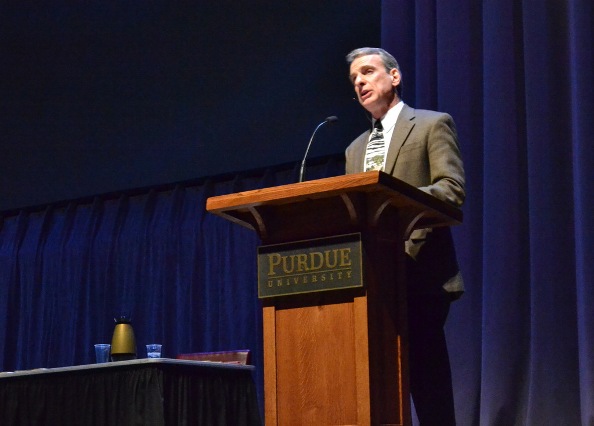
William Lane Craig lecturing to university students
William Lane Craig lecturing to students and faculty at Purdue University

Note: This book is currently on sale for only 99 cents (Kindle edition). Get it! Sorry if the price has changed by the time you read this post.

A series of three interviews from the “Reasonable Faith” podcast about the essay collection “Contending with Christianity’s Critics: Answering New Atheists and Other Objectors“.

Here is the first MP3 file.

Topics:

  • About the editor Paul Copan, (the nicest Christian apologist)
  • 1: Responding to Dawkins’ argument “Who designed the designer?”
  • 2: Responding to the multiverse counter to the fine-tuning argument
  • 3: The argument that rationality and consciouness require theism
  • 4: The evidence for humans being hard-wired for belief in God
  • 5: Responding to naturalism’s claim to rationally ground morality
  • 6: Responding to Dawkins’ idea that the universe looks undesigned

Here is the second MP3 file.

Topics:

  • 7: The criteria that historians use to establish historical reliability
  • 8: Did Jesus think that he was the Son of Man in Daniel
  • 9: A time line for the resurrection of Jesus from the early sources
  • 10: Responding to scholarly distortions of the historical Jesus
  • 11: Responding to Bart Ehrman’s claim that the NT text is corrupted
  • 12: The evidence for Jesus divine self-understanding

Here is the third MP3 file.

Topics:

  • 13: The logical coherence of the concept of God
  • 14: The logical coherence of the doctrine of the Trinity
  • 15: The logical coherence of the doctrine of the Incarnation
  • 16: The logical coherence of the doctrine of the Atonement
  • 17: The logical coherence of the doctrine of the Hell
  • 18: Responding to objections to God’s knowledge of the future

My favorite chapters in this book are the ones by Mark Linville on evolution and morality, and the chapter by Robert H. Stein on historical criteria and methodology. This is not an introductory book, this book is an intermediate-level book. You want to read the two Jim Wallace books and the Lee Strobel “Case For” books before you tackle this one.

Much of the book is philosophy and philosophy of religion and philosophical theology. Well, I guess everyone knows that I hate non-STEM disciplines, and I only read philosophy because it’s useful for Christian apologetics. If you are like me, and think that only STEM disciplines have value, then this book is for you. You will be able to make use of it in your case-making adventures. It. Works. This is the stuff that gets William Lane Craig invited to all the best universities to debate against all the best atheists. And he beats them all up with it, too.