Tag Archives: Teacher Union

Republicans introduce new federal legislation to expand school choice

If I were giving advice to the Republican party about how to win in 2020, I would advise them to focus on three priorities. Lowering unemployment, reforming the criminal justice system, and expanding school choice. They should also paint the Democrats as the party of infanticide, Green New Deal and elimination of private health insurance.

So far, Trump has done an excellent job of encouraging private sector job creators to create millions of new jobs. Unemployment is at a record low, and that’s important for persuading Black and Hispanic voters to vote for smart policies instead of tribal identity and envy. I don’t agree with with reforming criminal justice to favor criminals, but that will help with minority voters as well. But what we really need to do is provide Black and Hispanic voters with a way to get their children out of failing public schools. Public schools are filled with lazy, unionized Democrat teachers and administrators who care more about indoctrinating kids with Democrat propaganda than teaching them job skills that will make them independent, self-sufficient adults.

The Republican party knows that school choice is a win for them, and they are doing something about it.

Here’s the latest from the American Enterprise Institute, a think tank that promotes fiscally conservative policies:

Today, Secretary of Education Betsy DeVos joined Senator Ted Cruz (R-TX), and Rep. Bradley Byrne (R-Ala.), to announce new federal legislation that would establish a federal tax-credit expanding school choice. The proposal would give dollar-for-dollar tax credits to individuals and corporations who donate to state designated scholarship granting organizations (SGOs). While its particulars bear scrutiny, the “Education Freedom Scholarship” (EFS) proposal’s overall design is a solid attempt to walk a tightrope of backing state efforts at school choice while protecting against federal meddling now and in the future. Unfortunately, a number of critics on the right are too quick to react on their fears, and too slow in remembering what is holding back school choice.

Some conservatives and libertarians worry that solving the problem of underforming schools from the top down is a political overreach, but the AEI policy analyst writing the article says that the Republican bill doesn’t have that problem:

As I wrote back in 2017, backing state developed tax-credit scholarships is the best, and probably only, way the federal government could support state efforts without overreaching.  It would not be a federal program, but a tax credit that supports programs where states are explicitly responsible for policy particulars.

[…]No doubt, the bill would need to be explicitly structured to ensure the states’ primary role, and durably prevent federal overreach; fortunately defending states’ role is a paramount feature of the bill’s design.

School choice is a nice issue for Republicans, because it allows them to point out the hypocritical nature of Democrat politicians. Democrat politicians are essentially hypocritical. They want to ban guns for you, but they have armed security to protect themselves. It’s the same thing for education. They want to ban private schools for your children, but their own children all attend private schools.
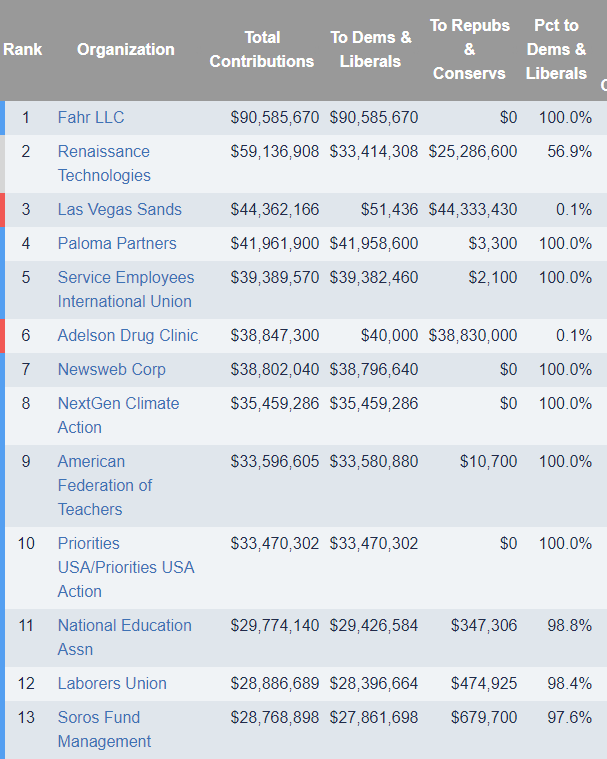
Top Political Contributors in 2016 election cycle
The top Political Contributors in 2016 election cycle includes two teacher unions

Democrats are obligated by teacher unions, (e.g. – the National Education Association and the American Federation of Teachers), to vote against parents who want their children to get a better education. That’s because teacher unions are some of the biggest Democrat donors. Teacher unions just want more salary and bigger benefits, despite the evidence that clearly shows that more education spending doesn’t produce better student achievement.
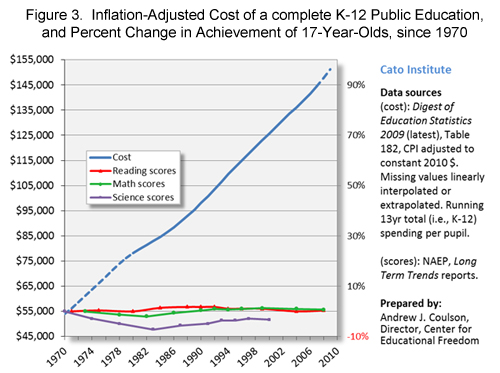
Education spending has tripled since 1970

Here’s a study from 2012 published in the journal “Education and Urban Society“. It says:

The possibility is examined that school choice programs could be a means to reducing the achievement gap. Data based on meta-analytic research and the examination of nationwide data sets suggest that school choice programs that include private schools could reduce the achievement gap by 25%. The propounding of this possibility is based on research indicating that the achievement gap in faith-based schools is generally 25% narrower than one finds in public schools. Results of these studies suggest that both the racial achievement gap and the socioeconomic achievement gap are reduced by the same degree (25%). The significance of these results is discussed, especially as it pertains to the attitudes that people frequently have toward school choice.

Not only do children do better in non-public schools, but the competition forces public schools to focus less on leftist indoctrination, and more on reading, writing and math.

This study from the on-partisan National Bureau of Economic Research (NBER) explains why.

It says:

A school that is more productive is one that produces higher achievement in its pupils for each dollar it spends. In this paper, I comprehensively review how school choice might affect productivity. I begin by describing the importance of school productivity, then explain the economic logic that suggests that choice will affect productivity, and finish by presenting much of the available evidence on school choice and school productivity. The most intriguing evidence comes from three important, recent choice reforms: vouchers in Milwaukee, charter schools in Michigan, and charter schools in Arizona. I show that public school students’ achievement rose significantly and rapidly in response to competition, under each of the three reforms. Public school spending was unaffected, so the productivity of public schools rose, dramatically in the case in Milwaukee.

School choice makes public schools perform better because competition between providers always lowers the cost and increases the quality of services and products being provided to the consumers. Consumers always suffer when there is a monopoly. This is why people are more satisfied purchasing goods from Amazon and Netflix than they are lining up at the post office or the department of motor vehicles. The free market serves the consumer.

I was raised in a poor background, and I am a visible minority. If Republicans want to get the votes of people in my community, it makes sense to put in place policies that allow people like me to get a good education so we can get good jobs and do better than our parents did. Republicans should be all about equipping people to be independent and self-sufficient. These are conservative goals.
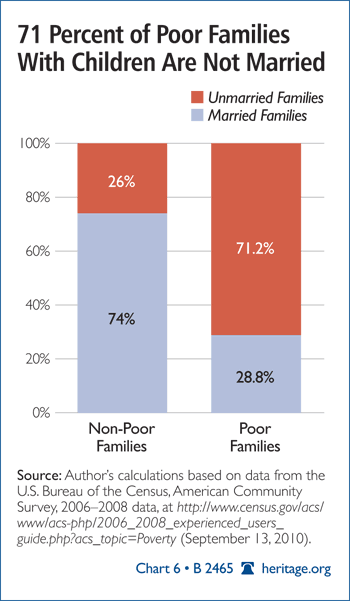
Five liberal Democrat policies that hurt minorities

Marriage and Poverty

The five policies are:

  • higher minimum wage rates
  • opposition to school voucher programs
  • releasing criminals from jail
  • affirmative action
  • single mother welfare

This article is by Jason L. Riley, and it appeared in the Wall Street Journal.

Excerpt:

At the urging of labor unions, President Obama has pushed for higher minimum wages that price a disproportionate percentage of blacks out of the labor force. At the urging of teachers unions, he has fought voucher programs that give ghetto children access to better schools.

Both policies have a lengthy track record of keeping millions of blacks ill-educated and unemployed. Since the 1970s, when the federal government began tracking the racial achievement gap, black test scores in math, reading and science have on average trailed far behind those of their white classmates. And minimum-wage mandates have been so effective for so long at keeping blacks out of work that 1930, the last year in which there was no federal minimum-wage law, was also the last year that the black unemployment rate was lower than the white rate. For the past half-century, black joblessness on average has been double that of whites.

Last week the Justice Department said it would release some 6,000 inmates from federal prison starting later this month. The goal, according to the White House, is to ease overcrowding and roll back tough sentencing rules implemented in the 1980s and ’90s.

But why are the administration’s sympathies with the lawbreakers instead of their usual victims—the mostly law-abiding residents in low-income communities where many of these inmates eventually are headed? In dozens of large U.S. cities, violent crime, including murder, has climbed over the past year, and it is hard to see how these changes are in the interest of public safety.

The administration assures skeptics that only “nonviolent” drug offenders will be released, but who pays the price if we guess wrong, as officials have so often done in the past?

When Los Angeles asked the Rand Corp. in the 1990s to identify inmates suitable for early release, the researchers concluded that “almost no one housed in the Los Angeles jails could be considered non-serious or simply troublesome to their local communities” and that “jail capacity should be expanded so as to allow lengthier incarceration of the more dangerous.”

A 2002 federal report tracked the recidivism rate of some 91,000 supposedly nonviolent offenders in 15 states over a three-year period. More than 21% wound up rearrested for violent crimes, including more than 700 murders and more than 600 rapes. The report also noted the difficulty of identifying low-risk inmates. Auto thieves were rearrested for committing more than a third of the homicides and a disproportionate share of other violent offenses.

Keep in mind that when criminals are release, they don’t go move into wealthy progressive neighborhoods. It’s not the wealthy leftists elites who have to deal with the released inmates. It’s the poor, low-income minority neighborhoods that have to deal with them.

By the way, I covered the minimum wage argument here, and I covered the school choice argument here.

That covers the first 3 policies. This article from The College Fix covers the fourth policy, affirmative action.

It says:

A UCLA law professor critiques affirmative action as detrimental to the very people it strives to aid: minority students.

Professor Richard Sander, though liberal-leaning, has deemed affirmative action practices as harmful, a notion that contradicts a liberal view in college admissions, said Stuart Taylor, a nonresident senior fellow at the Brookings Institution.

[…]Sander began teaching law at UCLA in 1989. After a few years he garnered an interest in academic support and asked permission to analyze which strategies most effectively assist struggling students.

After reviewing statistics on performance, especially those of students with lower academic merit, he noticed correlations between race and academic success.

“I was struck by both the degree to which it correlated with having weak academic entering credentials and its correlation with race,” Sander said in a recent interview with The College Fix. “And as I looked into our admissions process I realized that we were giving really a large admissions preference.”

Sander noticed that students admitted into the law school with lower academic credentials than their peers had significantly lower percentages of passing the Multistate Bar Examination, Sander said. This especially pertained to minority students who were given special consideration in the admittance process due to their race rather than their academic preparedness.

He then began thinking about whether or not these students would have better chances of succeeding if they went to a less elite university, he said.

He called this discrepancy a mismatch; when minority students with lower credentials than their peers are accepted into more challenging universities and then suffer academically as a result.

And the fifth policy is welfare. Welfare encourages women to not marry the men that they have sex with, since they will lose their single mother benefits if they do. Children who are raised fatherless are more likely to struggle in a number of areas, and they are especially likely to be poor. What we should be doing (if we really want to help the poor) is paying people to get married and stay married. But Democrats are opposed to that. The connection between welfare, fatherlessness, poverty and crime is explained in a previous post.

New study: discipline in schools is more effective than increased government spending

Education spending has tripled since 1970
Education spending has tripled since 1970 – but where are the results?

New study reported by Phys.org. (H/T Mark)

Excerpt:

Discipline in schools has a greater impact and is more important to educational performance when compared to monetary investment, a new study from Macquarie University has found.

The study found that school performance was overwhelmingly determined by how schools are run, while in comparison the amount of money spent on schools as a percentage of GDP had a minor influence on educational performance.

“Monetary investment in education is not sufficient to boost educational performance. Discussion on education policy often centres on funding, but this study now establishes that a much more effective ‘tool’ to improve education performance and ultimately the competitiveness of a nation, is to focus on school discipline,” said co-author Associate Professor Chris Baumann of the study, published in the International Journal of Educational Management.

In analysing educational performance, the research assessed data from the Organization for Economic Co-operation and Development’s (OECD) Programme for International Student Assessment (PISA), World Bank data on Government Expenditure, and World Economic Forum (WEF) data on competitiveness.

Thanks to Obama and his allies in the House and Senate, we now have a $20 trillion national debt, and $1.3 trillion of outstanding student loan debt from students. He left the Republicans with a mess, because his first, last and only solution to feeling unpopular was to borrow and spend more money – even if that never solved any problems.

Another important factor in the educational performance of children is whether they have married opposite-sex parents in the home.

The Orlando Sentinel reports:

In fact, our new study, “Strong Families, Successful Schools,” by the Institute for Family Studies, provides evidence that families play an important role in the performance and character of schools in counties across Florida. We found that the share of married-parent families in a county is one of the strongest predictors of high-school graduation rates for Florida counties; indeed, it’s a more powerful predictor than family income, race or ethnicity.

Across the state’s counties, graduation rates are 4 percentage-points higher for every 10 percentage-point rise in married-couple families.

We also found that counties that have strong and stable families tend to enjoy safer schools. In our research, the strongest predictor of school-suspension rates in counties across the state was the share of married parents in a county. County trends in family structure proved to be more important than county trends in parental education, family income, race and ethnicity. The suspension rate was lower by 3.5 points for every 10 percentage points that the proportion of married-couple families in a county was higher.

Our research is particularly timely because it compliments new research from MIT economist David Autor and his colleagues. Their study of more than 1 million Florida children indicates that poor boys, more than poor girls, are being hit particularly hard by single parenthood. After comparing brothers and sisters from father-absent homes, Autor and his colleagues concluded that the “boy-girl gap in suspensions is far smaller in families where children are born to married parents” and that the gender gap in high-school graduation is smaller for children whose parents are married.

Previously, I blogged about a Canadian study which concluded that children of same-sex parents have negative educational outcomes compared to children of opposite sex married parents.

Are Democrats in favor of opposite-sex marriage?

Democrats want to pay women welfare for having children out of wedlock, which not only lowers the academic performance of the children, but it introduces lack of discipline and disruption into the schools. Although Democrats claim they want to improve educational outcomes, (by borrowing and giving more money to their allies in the unionized public school system), their policies actually harm children. That is the result, whatever their pious intentions. And we all know that it was Democrats who pushed same-sex marriage on children, depriving children of either their mother or their father.

Democrats are also opposed to school choice. School choice allows parents to get their children out of failing public schools. School choice is especially beneficial to poor, minority students. Public schools are so bad, that even Democrat politicians refuse to send their own children to them.

So, for all their pious preening about wanting the best for children, Democrats really achieve two things: 1) worse educational outcomes for children, 2) more taxpayer money given to Democrat administrators and teachers in the failing public school system. When it comes to educating children, Democrats are against it.