Tag Archives: Socialism

In the UK, which crime is worse? Sex trafficking, gang-rape or hate speech?

Scotland Police has time for monitoring social media

Whenever a story about sex-trafficking in the UK comes out, I always make sure to blog about it. Over the years, I must have blogged about a half-dozen sex-trafficking rings. I always point out how the sex-traffickers are ignored by the police, because of their Middle East origins. But the police in the UK aren’t useless. On the contrary, they are busy with more serious crimes.

Here is the latest story from the UK Daily Mail:

The rape and grooming of a vulnerable teenage girl was not investigated until five years after police were first informed, a court has heard.

Nine men, mostly from Sheffield, went on trial today accused of raping the girl when she was aged between 15 and 17 – treating her ‘like a piece of meat’ and abusing her ‘for their own sexual gratification’.

A tenth man is accused of conspiracy to pervert the course of justice.

The abuse was carried out when the teenage victim was drunk or on drugs, supplied by the grooming gang, jurors were told.

The complainant first told police about being raped and used for under-age sex in 2011 but no investigation was carried out or crime recorded, Sheffield Crown Court heard.

When the victim initially disclosed ‘one rape and incidents of sex with adult men as a minor’ to police, no crime was recorded by South Yorkshire Police.

Here are the names of the accused men:

  • Usman Din, 35
  • Tony Juone, 61
  • Kamaran Mahmoodi, 39
  • Shangar Ibrahimi, 30
  • Farhad Mirzaie, 29
  • Kawan Omar Ahmed, 31
  • Saman Mohammed, 41
  • Jasim Sammad Mohammed, 37
  • Nzar Anwar, 40
  • Saba Moussa Mohammad, 41

In the UK, the mass importation of unskilled Middle Eastern immigrants was promoted by the Labour Party (equivalent to our Democrat party) as a way to undo the conservative Christian majority.

Hate speech is a more important crime

Now the police didn’t have any time for the sex-trafficking and gang-raping of a teenage girl, because they were busy with more important things.

The UK Daily Mail report on a recent incident:

A mother was arrested in front of her children and locked up for seven hours after referring to a transgender woman as a man online.

Three officers detained Kate Scottow at her home before quizzing her at a police station about an argument with an activist on Twitter over so-called ‘deadnaming’.

The 38-year-old, from Hitchin, Hertfordshire, had her photograph, DNA and fingerprints taken and remains under investigation.

More than two months after her arrest on December 1, she has had neither her mobile phone or laptop returned…

[…]Writing on online forum Mumsnet, Mrs Scottow – who has also been served with a court order that bans her from referring to her accuser as a man – claimed: ‘I was arrested in my home by three officers, with my autistic ten-year-old daughter and breastfed 20-month-old son present.

‘I was then detained for seven hours in a cell with no sanitary products (which I said I needed) before being interviewed then later released under investigation … I was arrested for harassment and malicious communications because I called someone out and misgendered them on Twitter.’

They needed three police officers to arrest this dangerous criminal, to let her neighbors know how dangerous her hate speech was.

Does this happen a lot in the UK? Well, you just have to go back a few weeks to find another case.

Here is the UK Telegraph to report on another recent incident:

A docker from Humberside has been investigated by police over a limerick he posted on Twitter after an officer claimed it constitutes a ‘hate incident’ against transgender people.

Harry Miller, 53, from Lincoln was contacted on Wednesday by a community cohesion officer following a complaint that had been made about the plant and machinery dealer’s social media posts.

Citing 30 potentially offensive tweets, the PC singled out a limerick Mr Miller had retweeted which questioned whether transgender women are biological women.

[…]Even though no crime was committed, sharing the limerick online was recorded as a ‘hate incident’.

[…]After Mr Miller questioned why the complainant was being described as a “victim” if no crime had been committed, the officer told him: “We need to check your thinking”.

They have “community cohesion” officers, but they don’t have police officers who investigate sex-trafficking and gang-raping of teens. Oh, and you can’t defend yourself from criminals with a firearm , either. That’s illegal in the UK. You just have to let the criminal rape you and kill you. They are a very advanced country – much better than the United States.

UK police ignore underage sex-trafficking

What kinds of crimes might be ignored by the UK police? Here are some previous crimes that were ignored by the police.

The UK Daily Mail reports:

A victim of the ring said she was ‘let down’ by police and the Crown Prosecution Service because the issue of [Middle Eastern immigrant] gangs grooming young white girls was ‘unheard of’ at the time.

The girl, who was 15 when she was targeted by the gang, reported the abuse to police in August 2008 but the CPS decided not to prosecute because they did not believe a jury would find her ‘credible’.

The Evening Standard reports:

The girls, some as young as 11, were drugged, raped, trafficked and used as prostitutes while supposedly in the safe-keeping of the local authority in Oxford.

[…]Today five men of Pakistani origin and two from North Africa were convicted of more than 40 charges spanning eight years.

[…]The charges involved six girls between the ages of 11 and 15 who were abused over nine years in the Cowley area of Oxford.

[…]Girl D told how, at the age of 11, she was branded with a heated hairpin by a trafficker and loaned to other abusers for £600 an hour.

Over five years she was repeatedly raped by large groups of men in what she described as “torture sex”.

[…]Another victim, Girl A, complained of her plight to police on two occasions but no one was charged.

We have to learn what the Democrat party is planning for tomorrow by looking at what similar secular leftists are doing in other countries today. There isn’t a Democrat politician in the USA who doesn’t agree 100% with these UK policies. The only reason they haven’t been enacted here is because they don’t have the majorities in the House and Senate. Yet.
New study: Angus Reid Institute analyzes Canada’s single payer healthcare system

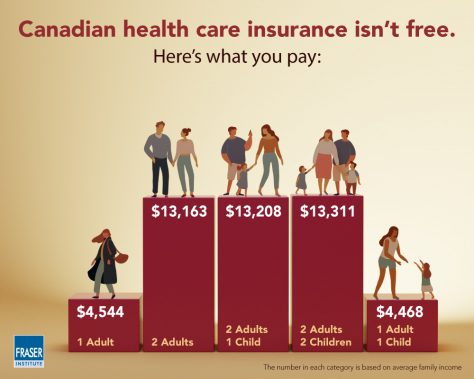
Price of healthcare per Canadian household (Source: Fraser Institute)
The cost of healthcare for average Canadian households

I found two interesting studies from Canada’s Angus Reid Institute describing single payer health care in Canada. I’m very interested in find out what things are like in countries that have true government-run health care. A typical Canadian family pays $13,000+ per year per household for healthcare, or about $585,000 over their working lives. What are they getting for all that money?

Here is the first Angus Reid article:

The study finds more than 2 million Canadians aged 55 and older face significant barriers when accessing the health care system in their province, such as being unable to find a family doctor or experiencing lengthy wait-times for surgery, diagnostic tests, or specialist visits.

Moreover, most Canadians in this age group have at least some difficulty getting the care they want or need in a timely manner.

The study focuses on the health care experiences of older Canadians, as well as their assessments of the quality of care they receive.

According to the article, 31% of respondents (aged 55 and older) rated access to the government’s healthcare system as “easy”. 48% had “moderate” problems with access, and 21% had “major” problems with access.

Remember: in the Canadian system, you pay your money up front in taxes, and then they decide how much healthcare you will get later – and how soon you will get it. If you worked from ages 20 to age 65, then your household will have paid 45 x $13,000 = $585,000 into the system, in order to get “moderate” problems with accessing healthcare after you’re aged 55.

And the Canadian system DOES NOT cover prescription drugs.

The second Angus Reid article explains:

This second part of the study finds one-in-six Canadians (17%) in the 55-plus age group – a figure that represents upwards of 1.8 million people – say that they or someone else in their household have taken prescription drugs in a way other than prescribed because of cost.

One-in-ten (10%) have decided to simply not fill a prescription because it was too expensive, and a similar number (9%) have decided not to renew one for the same reason. One-in-eight (12%) have taken steps to stretch their prescriptions, such as cutting pills or skipping doses.

Some 17 per cent of Canadians 55 and older have done at least one of these things, and that proportion rises among those who have greater difficulty accessing other aspects of the health care system.

In a previous blog post, I reported on how Canadians have to wait in order to see their GP doctor. If that doctor refers them to a specialist, then they have to wait to see the specialist. And if that specialist schedules surgery, then they have to wait for their surgery appointment. The delays can easily go from weeks to months and even years. The MEDIAN delay from GP referral to treatment is 19.5 weeks.

But remember – they paid into the system FIRST. The decisions about when and if they will be treated are made later, by experts in the government. This is what it means for a government monopoly to run health care. There are no free exchanges of money for service in a competitive free market. Costs are controlled by delaying and withholding treatment. And no one knows this better than elderly Canadians themselves. But by the time they realize how badly they’ve been swindled, it’s too late to get their money back out. You can’t pull your tax money out of government if you are disappointed with the service you receive. There are no refunds. There are no returns.

Wayne Grudem debates Richard Glover on the Bible, poverty and foreign aid

Two horses fight it out, may the best horse win!

A great episode of the Unbelievable podcast. This is a great debate. I really enjoyed it. All three speakers were excellent putting forward their points. It’s nice to hear an American voice, a British voice and an Australian voice debating an important issue. HIGHLY RECOMMENDED.

Details:

Wayne Grudem is a theologian known for his conservative approach to both doctrine and economics. His new book “The Poverty of Nations: A Sustainable Solution” (co-authored with economist Barry Asmus) makes the case that pouring aid into developing countries is a failed strategy. Grudem debates whether the Bible supports free market, capitalist economics with Australian economist and theologian Richard Glover who wrote a critique of the book for the Australian Bible Society.

 The MP3 file is here.

Summary:

Grudem:

  • The Bible speaks to all of life, including economics, stewardship, government
  • The study of economics helps us to understand how to take care of the poor
  • My job is to apply the teachings of the Bible to all of life

Brierley:

  • What’s your thesis in the book?

Grudem:

  • A good system is one where the poor have the opportunity to earn and save from their labor
  • Book is a response to a Kenyan couple Grudem met at a London conference on business and Christianity
  • Book is not concerned with how individuals and groups can do charity to help the poor
  • Our church already does that and we support individuals and groups doing charity
  • The book is concerned with how should nations be transformed in order to grow economically
  • What should the laws, policies and cultural beliefs of a nation be in order for it to not be poor?
  • The book lists factors that have moved nations from poverty to prosperity in different times and places
  • The thesis of the book is this: government should set their people free to be able to produce more
  • We advocate freedom in economics: freedom to work, freedom to save, freedom to start businesses
  • We believe that this free enterprise view is consistent with the Bible in a number of places
  • E.g. – private property is good for prosperity (thou shall not steal) but forbidden by communism

Brierley:

  • What about the church sharing in communities in Acts 2 and Acts 4?

Grudem:

  • That is not redistribution of wealth among individuals and businesses by a secular government
  • Those passages showed that there was voluntary sharing among Christians, which is not communism

Brierley:

  • What’s wrong with Grudem’s book?

Glover:

  • The book emphasizes the Bible and the goal is to help the poor in poor countries
  • Criticism 1: the book doesn’t engage with non-free-market perspectives on economics
  • Criticism 2: the book doesn’t survey all that the Bible says about economics

Brierly:

  • For 1) what is one of the views that is not considered?

Glover:

  • Jeffrey Sachs says that nations need a leg up before they can grow economically
  • Ha-Joon Chang says that free enterprise was not how the wealthy nations became wealthy

Grudem:

  • We do engage with other points of view, especially Jeffrey Sachs in the book
  • The trouble with leftist views on economic development is that it does not work in practice
  • NO COUNTRY has even been lifted out of poverty by foreign aid
  • He says we don’t cite enough from the wisdom literature: we have 64 citations in the index
  • He says we don’t cite enough from the gospels: we have 42 citations in the index
  • He says we don’t cite enough from the epistles: we cite 22 of 27 epistles in the index
  • Some economists won’t criticize cultural and moral values that hurt prosperity
  • As Christians, we think that moral and cultural values are part of the problem that needs solving

Brierley:

  • What about foreign aid?

Grudem:

  • Foreign aid doesn’t help: a lot of the money goes into government and rulers can be corrupt
  • Instead of encouraging people to start businesses, it tells people to go into government to get aid money
  • Economists (lists 3) are saying that foreign aid entrenches corrupt government in power, does no good

Brierley:

  • If it’s not working, should we keep doing it?

Glover:

  • When there is an immediate need, we should do it, even if it is not a long-term solution: we need both

Brierley:

  • Should we stop foreign aid completely?

Grudem:

  • Voluntary charitable giving from individuals and churches to help poor countries is good
  • Me and my co-author are both active on our church board that helps poor countries with urgent needs
  • Food and doctors are urgent needs, and we should help, but it doesn’t lift countries out of poverty
  • We need a long-term solution that helps poor countries produce their own food and doctors
  • We are criticizing 1) government to government aid and 2) IMF/World bank to government aid
  • We have had pushback because 500,000 people make a living from this foreign aid industry
  • No country has ever been lifted out of poverty into sustainable prosperity
  • That’s the definition of insanity: continuing to do the same thing that has never worked

Brierley:

  • Does the Bible support free enterprise as a way of creating sustainable prosperity?

Glover:

  • When I said the Bible was absent from his book, absent was a bad choice of words
  • But the hundreds of references he listed were not dealth with *in depth*
  • In the Scriptures, God is the one who provides (e.g. – in Ephesians, Sermon on the Mount)
  • The Bible is less focused on his people making money, and more focus on sharing basics, like food
  • Secular governments should just take it from people who have food and give it to hungry people
  • In 2 Cor 8-9, Paul talks about voluntary sharing so everyone will be equal

Brierley:

  • Does 2 Cor 8-9 undermine the free enterprise system you champion in the book?

Grudem:

  • The sharing in the Bible solves cases of urgent need, it does not lift countries from poverty to sustainable prosperity
  • Some older translations say “equality” in 2 Cor 8:13-14, but newer translations (e.g. – ESV) say “fairness”
  • The Greek word is translated as “fairly” the only other place it appears in the NT (Col 4:1), in every translation
  • God uses the means of human work and productivity to provide (daily bread is baked, doesn’t just fall from Heaven)
  • In general, there’s no provision in Scripture for a person to be dependent on donations for their entire lives
  • God promises Israel fields and mountains to tend and mine, but prosperity is from work, not depending on others

Brierley:

  • Does the Bible support this focus on work?

Grudem:

  • Working is highly praised in Scripture, (lists Bible passages that favor work over dependency)
  • Countries that were exposed to this notion of work and productivity have been more prosperous

Glover:

  • Jeffrey Sachs and other development economists don’t say you can be prosperous through dependence
  • They say that it is a necessary part of leading to nations out of poverty into poverty

Grudem:

  • It’s never worked. What nation has become prosperous through foreign aid?

Glover:

  • There are lots of nations, especially in Africa, where foreign aid has helped lift them out of poverty

Grudem:

  • Name one country in Africa where foreign aud has lifted them out of poverty into sustainable prosperity

Glover:

  • I can’t think of one right now.

Grudem:

  • Our book contains a map of Africa and we looked at every nation’s per capita income
  • No nation has been able to rise out of poverty through dependence on foreign aid
  • The only close one is Botswana, but they have abundant freedoms, Christian morals, less corrupt government
  • So Botswana is the best case and they became prosperous through becoming productive, not foreign aid

Brierley:

  • Is he right to say that charity is a short-term solution, but that it’s not good long-term for prosperity?

Glover:

  • Yes, and work is a very important focus in the Scriptures as he says.
  • But since the Fall work has been much harder, and may not have the outcomes that we would like

Grudem:

  • I also believe in emergency aid for when catastrophies happen, like floods and famines
  • But dependence on foreign aid enriches corrupt rulers and does not create the productivity that leads to sustained prosperity

Brierley:

  • Can foreign aid be used to give poor nations a leg up on becoming prosperous?

Grudem:

  • Dambisa Moyo, Oxford-educated economist from Zambia, says stop the aid, it’s doing more harm than good
  • Jeffrey Sachs’ view is that foreign aid hasn’t worked yet, but just keep trying a bit more
  • What works: limited government, rule of law, fair courts, documented property rights, low taxes, stable currency
  • People are creative and want to work, we just have to get government out of the way and let people work, earn and save

Brierley:

  • Is this free enterprise system supported by the Bible?

Glover:

  • The wealthy nations of the world did not become wealthy through productive work and free enterprise policies
  • Ha-Joon Chang: free enterprise policies have never brought a country from poverty to wealth
  • E.g. – wealth is created through tariffs (not by innovating and by economic freedom?)

Grudem:

  • I’ve read Ha-Joon Chang’s book, and his examples are very selective and limited
  • Index of Economic Freedom: the freest countries are the most prosperous, the least free countries are the most poor
  • When you look at macro data, instead of very selective examples, the free enterprise system is best for prosperity

Glover:

  • The book doesn’t do enough to engage with leftist economists (he doesn’t say which ones)
  • Just because nations who are free are rich, doesn’t mean freedom causes productivity
  • There are parts of the Bible that doesn’t support the free enterprise system (he names none)

Grudem:

  • The Bible is focused on work not dependency, and charity not government redistribution
  • The best way to help the poor in other countries is by encouraging work and productivity