
Tag Archives: Socialism

Should young people vote for Barack Obama and Obamacare?

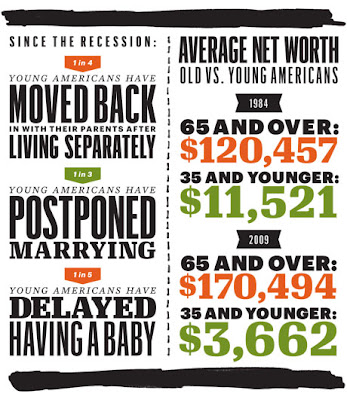
The real inequality: young America and old America

From Donald Sensing at Sense of Events blog.

Excerpt:

Shikha Dalmia, responds to Slate’s Dahlia Lithwick, who was so, “Shell shocked by the shellacking that the Solicitor General Donald Verrilli received at the hearing Tuesday, [that] she went into a deep sulk and threw the intellectual equivalent of a hissy fit.” Shikha observes:

In our current health care system, a mix of taxpayers; (rich) hospitals/providers and (even richer) private insurers are stuck with the tab for uncompensated care. There are many problems with this. But isn’t it at least more compassionate than ObamaCare that would force asset-poor young people – trying to pay off their college debt and hang on to some beer money – to subsidize the coverage of relatively wealthier prospective geezers? If maximizing compassion is the issue, shouldn’t we stick with what we’ve got?

In other words, under Obamacare the young overpay for health insurance in order to subsidize the old, whose medical costs are magnitudes higher than those of the young. That is a key feature of the “individual mandate” that makes it mandatory to buy health insurance under Obamacare. I remember reading during the SCOTUS hearings that men and women younger than 30 (or so) average using about $1,800 of health insurance per year, but will have to pay $5,400.

It’s very important to understand that when government gets involved with spending money on handing out goodies, that it is tempting for them to buy the votes of those who are politically informed with the money taken from those who don’t know a thing about real life.

Now consider these numbers from socialist Europe – where Obama’s plan is a little further along.

Excerpt:

Youth unemployment now exceeds 50pc in both Spain and Greece as the number of people out of work in the eurozone as a whole hit a 15-year high of 17.2m.

The unemployment rate among Spain’s under-25s rose to 50.5pc in January, and to 50.4pc in Greece in December, according to the latest available data from Eurostat, the European Union’s statistics office. It compared with an average eurozone youth unemployment rate of 21.6pc. One of the lowest rates of youth unemployment is in Germany, where it remained at 8.2pc in February.

The rise in Spain and Greece reflects the deep financial woes of both countries, which are in the midst of far-reaching and highly unpopular austerity programmes, considered necessary by the broader EU to reduce huge deficits.

Spain’s unemployment rate now stands at 23.6pc, compared with a eurozone average of 10.8pc. The extent of Spain’s problems are further underlined by a housing market in crisis, with prices expected to fall the most on record this year. One-in-four homeowners in the country owes more than their property is worth.

I find it so sad that kids are brainwashed by unionized public school teachers to support nonsense like global warming, while despising free market capitalism. And then they go out and vote for more and more government, so that their “teachers” can be paid more and more. They will never fix their worldviews until they get out into the real world, and by then it they will have voted in many elections.

Alberta judge rules that it is legal to disagree with homosexuality

Political map of Canada

Good news in Alberta.

Excerpt:

Alberta Court of Queen’s Bench Justice Paul Jeffrey has dismissed a Crown appeal of a decision from a lower court that acquitted Bill Whatcott of trespassing charges for distributing “Truth about homosexuality” pamphlets at the University of Calgary in 2008.

On Friday, March 30, Jeffrey upheld the November 2011 ruling by provincial court Judge John D. Bascom that stated the University of Calgary infringed on Whatcott’s Charter rights to freedom of expression when campus security arrested and detained him for distributing a pamphlet that addressed the “harmful consequences” of homosexuality.

The university had argued that the Charter only applied to “government actors and government actions,” not to the university itself since it was a private entity.

Bascom ruled, however, that the Canadian Charter of Rights and Freedoms applies to the University of Calgary since “the University is not a Charter free zone,” in that it carried out “specific” governmental work by providing post-secondary education to the public in Alberta, making its actions subject to scrutiny under the Charter.

“Mr. Whatcott entered the university property with a purpose to distribute his literature to students, staff and public,” said the judge, adding, “His activity was peaceful and presented no harm to the university structures or those who frequented the campus. … Although Mr. Whatcott’s pamphlet is not scholarly, freedom of speech is not limited to academic works.”

Bascom concluded that “the means used by campus security halted Mr. Whatcott’s distribution of these flyers and violated his right of free expression.”

The judge also lifted the University’s ban against Whatcott that would have indefinitely prohibited him from setting foot on the campus again, stating that the ban was “arbitrary and unfair.”

Do you all remember that the University of Calgary is one of the ones that harassed pro-lifers with armed policemen? That’s still better than Carleton University, which actually had pro-lifers arrested by armed policemen.

This Alberta ruling dovetails nicely with a 2010 ruling from the province of Saskatchewan:

In 2010 Whatcott won an appeal in Saskatchewan when Justice Darla Hunter of Saskatchewan’s Court of Appeal overturned a 2006 Saskatchewan Human Rights Tribunal ruling that found him guilty of violating the province’s human rights code by publicly criticizing homosexuality through a series of flyers he distributed in Saskatoon and Regina in 2001 and 2002.

The tribunal had ordered Whatcott to pay $17,500 and imposed a “lifetime” ban on his freedom to publicly criticize homosexuality.

In her decision Justice Hunter ruled that Whatcott did not violate section 14(1)(b) of the Saskatchewan Human Rights Code by distributing flyers to oppose the teaching of homosexuality in Saskatoon’s public schools.

“It is acceptable, in a democracy, for individuals to comment on the morality of another’s behaviour. … Anything that limits debate on the morality of behaviour is an intrusion on the right to freedom of expression,” Justice Hunter had remarked.

Alberta and Saskatchewan are the two most conservative provinces in Canada. Let’s hope that other provinces move in the same direction.

Why do the most educated conservatives sometimes doubt scientific consensus?

On some issues, I do doubt the scientific establishment: 1) Darwinism and 2) global warming. Why? Because I think that in those two areas, science takes a back seat to ideology. Specifically, the ideologies of naturalism and socialism. And I’m not alone. Many the most informed conservatives also doubt the pontifications of the scientific establishment.

Reason magazine explains:

The link in the [Instapundit] gloss above goes to a story in the excellent Inside Higher Ed (a must-read for anyone interested in post-secondary education issues, IMO). Here’s the lede of the piece:

Just over 34 percent of conservatives had confidence in science as an institution in 2010, representing a long-term decline from 48 percent in 1974, according to a paper being published today in American Sociological Review.

The paper in ASR draws on attitudes as reflected in the General Social Survey, a “long-term study asking people various demographic and self-identification questions (including political identity) and for their attitudes on certain groups, including confidence in certain institutions.” The author of the paper, a post-doc at University of North Carolina, says:

Less-educated conservatives didn’t change their attitudes about science in recent decades. It is better-educated conservatives who have done so, the paper says.

In the paper, Gauchat calls this a “key finding,” in part because it challenges “the deficit model, which predicts that individuals with higher levels of education will possess greater trust in science, by showing that educated conservatives uniquely experienced the decline in trust.”

[The wording of the key question in the survey]…stresses attitudes toward “the people running these institutions.” It doesn’t ask whether you think science has changed. It’s specifically asking about the folks wearing literal and figurative lab coats who are running joints like the National Science Foundation, testifying before Congress, appearing on The Tonight Show while forecasting famine up the ying-yang and praising coercive population control measures, and who often end up being totally wrong about everything.

If it’s “educated conservatives” who have lost faith in scientists, a fully plausible possible explanation is simply that they recognize what libertarians and crypto-libertarians ranging from Thomas Szasz to Michel Foucault have been pointing out since the early 1960s in works starting with The Myth of Mental Illness and The Birth of the Clinic: That much if not all of what passes for dispassionate scientific discourse is hugely implicated in power struggles that have little or nothing to do with disinterested, true-for-all-times-and-all-places Truths with capital Ts.

So what the most educated conservatives are disagreeing about is not testable, repeatable, observable science.  It’s the politicization of science by the scientific establishment that conservatives are skeptical about. For example, in cases of outright fraud like “archaeoraptor” and “Climategate“, where fake research is used to prop up a philosophy, i.e. – naturalism and socialism respectively.

It doesn’t help when the scientific establishment responds to skepticism with stuff like this: (links removed)

A whole slew of new “research” on conservatives’ and global warming skeptics’ “brains” has hit the academic circuit.

First off, environment and sociology Prof. Kari Norgaard’s new study claims skeptics of man-made global warming fears should be “treated” for their skepticism. The study compares skepticism to man-made climate fears to the struggle against racism and slavery.

Prof. Norgaard’s concept of “treating” those who do not follow the current day’s political or social orthodoxy is, frighteningly, not new. A quick look at the 20th century totalitarian super states reveals many similar impulses.

It’s even more chilling that there is a whole new movement afoot by the promoters of man-made global warming theory to intimidate climate skepticsby using new brain “research.”

Other researchers have attempted to tie conservatism (which is identified with the highest number of climate skeptics) to “low brainpower.”

Some global warming promoters claim it is essentially “unethical” to be a skeptic.

That’s not the evidence we are looking for.