
Tag Archives: Sexual Revolution

New study: college students drink more before casual sex than relationship sex

Sex events measured against intimacy level (for women only)

It turns out that college students use MORE alcohol and drugs when they have sex with strangers, and LESS alcohol and drugs when they have sex with people they are in a relationship with.

This study was reported by the far-left Psychology Today.

Excerpt:

A recent study published in the Journal of Sex Research sheds some light on these questions. A research team headed by Jennifer Walsh analyzed alcohol use in almost 500 casual and 1400 romantic sexual intercourse events that happened to 300 college women on a monthly basis over a period of 12 months. Alcohol use was not very common during romantic sex: 20% of romantic encounters involved some drinking and only 5% involved heavy drinking (defined as four or more drinks). Hookups, on the other hand, were a different story: Women drank during 53% of their hookups, and drank heavily during 38% of all hookups.

But not all hookups are created equal. There was an almost perfect linear relationship between drinking and partner closeness: The less known the partner, the more likely women drank before sex, and the more likely they drank a lot. Look at the graph I created based on their data. When the casual partner was an ex-boyfriend, for example, only 30% of hookups involved drinking and 17% heavy drinking. When the partner was a random stranger, however, 89% of hookups involved drinking and 63% involved four or more drinks!

The writer explains why this happens:

Alcohol also provides an excuse to those who need one. In a world that encourages hooking up but also judges those (especially women) who engage in it too much, many seem to need it. You’re a slut if you hook up with people just because you want to: Good girls don’t actively want to hook up, and being sober means taking full responsibility for your actions. But if you can blame it on the alcohol, you’re absolved of guilt. You can still be a good girl who just happened to make a mistake.

This study agrees with a study I blogged about before from the University of Virginia, which explained that college students drink before hook-ups in order to be able to explain to their friends why it wasn’t their fault:

A Rutgers University student commented, “If you’re drinking a lot it’s easier to hook up with someone… [and] drugs, it’s kind of like a bonding thing… and then if you hook up with them and you don’t want to speak to them again, you can always blame it on the drinking or the drugs.”

Other women observed that being drunk gives a woman license to act sexually interested in public in ways that would not be tolerated if she were sober. For instance, a University of Michigan student said, “Girls are actually allowed to be a lot more sexual when they are drunk…”

A University of Chicago junior observed, “One of my best friends… sometimes that’s her goal when we go out. Like she wants to get drunk so I guess she doesn’t have to feel guilty about [hooking up].”

Now, the first thing I thought of when I saw this article in Psychology Today was: “I wonder what criteria these college students are using in order to decide which strangers they have sex with”. And then I realized. For perfect strangers, it would have to be something obvious, like physical appearance. A study found that it takes a woman 3 minutes to decide if she likes a man or not. Whatever assessment is being made in that 3 minutes surely isn’t adequate for long-term plans for marriage, children and church attendance.

Don’t judge me, it wasn’t my fault

It reminds me of something I read a while back in a Theodore Dalrymple book. Theodore Dalrymple is the famous psychiatrist who writes books about culture in the UK. One of his books about the complete lack of personal responsibility among criminals is actually posted online.

In the chapter “Tough Love“, he talks about the nurses he works with:

All the more surprising is it to me, therefore, that the nurses perceive things differently. They do not see a man’s violence in his face, his gestures, his deportment, and his bodily adornments, even though they have the same experience of the patients as I. They hear the same stories, they see the same signs, but they do not make the same judgments. What’s more, they seem never to learn; for experience—like chance, in the famous dictum of Louis Pasteur—favors only the mind prepared. And when I guess at a glance that a man is an inveterate wife beater (I use the term “wife” loosely), they are appalled at the harshness of my judgment, even when it proves right once more.

This is not a matter of merely theoretical interest to the nurses, for many of them in their private lives have themselves been the compliant victims of violent men. For example, the lover of one of the senior nurses, an attractive and lively young woman, recently held her at gunpoint and threatened her with death, after having repeatedly blacked her eye during the previous months. I met him once when he came looking for her in the hospital: he was just the kind of ferocious young egotist to whom I would give a wide berth in the broadest daylight.

Why are the nurses so reluctant to come to the most inescapable of conclusions? Their training tells them, quite rightly, that it is their duty to care for everyone without regard for personal merit or deserts; but for them, there is no difference between suspending judgment for certain restricted purposes and making no judgment at all in any circumstances whatsoever. It is as if they were more afraid of passing an adverse verdict on someone than of getting a punch in the face—a likely enough consequence, incidentally, of their failure of discernment. Since it is scarcely possible to recognize a wife beater without inwardly condemning him, it is safer not to recognize him as one in the first place.

This failure of recognition is almost universal among my violently abused women patients, but its function for them is somewhat different from what it is for the nurses. The nurses need to retain a certain positive regard for their patients in order to do their job. But for the abused women, the failure to perceive in advance the violence of their chosen men serves to absolve them of all responsibility for whatever happens thereafter, allowing them to think of themselves as victims alone rather than the victims and accomplices they are. Moreover, it licenses them to obey their impulses and whims, allowing them to suppose that sexual attractiveness is the measure of all things and that prudence in the selection of a male companion is neither possible nor desirable.

Often, their imprudence would be laughable, were it not tragic: many times in my ward I’ve watched liaisons form between an abused female patient and an abusing male patient within half an hour of their striking up an acquaintance. By now, I can often predict the formation of such a liaison—and predict that it will as certainly end in violence as that the sun will rise tomorrow.

At first, of course, my female patients deny that the violence of their men was foreseeable. But when I ask them whether they think I would have recognized it in advance, the great majority—nine out of ten—reply, yes, of course. And when asked how they think I would have done so, they enumerate precisely the factors that would have led me to that conclusion. So their blindness is willful.

If Dalrymple’s observations about female patients and nurses can be applied more broadly, then it explains why women initiate 70% of divorces. Women who don’t want to be “forced” to be self-controlled and responsible with their choices will want an easy way to get out of it. According to Dalrymple’s experience, it’s not that women don’t know that bad boys are lousy at marriage and fatherhood. They know it, but they choose to blind themselves to it, because it’s just too much self-denial to have to be serious about making responsible choices with men and sex and marriage.

Right now, we are $20 trillion in debt, half of that thanks to Barack Obama’s administration. I believe that the majority of this debt was accrued because people wanted to do what felt good to them in the moment, and then pass off the costs of their “unpredictable” mistakes onto their neighbors. The truth is that these costs will be paid by generations of young people not yet born. People shouldn’t talk about how much they care about children, if their voting will force all the children of tomorrow into slavery.

One last piece of advice to men. My best friend Dina told me to always evaluate women based on their past choices, not based on the picture of themselves that they paint with words. Wise advice.

My conversation about morality with an atheist millennial man

This is one of the memes from the Wintery Knight facebook page
Congratulations! Your view of what’s moral aligns exactly with your actions!

I spent some time talking to an atheist millennial recently. He considers himself a moral person, and he is very helpful to others. I asked him to define morality, and he said that morality was feeling good, and helping other people to feel good. I was trying to think of a way to punch a hole in his feelings-based utilitarianism. How could I show him that happy feelings are not a good basis for morality?

Now, you’re probably thinking that abortion is the most obvious example of something that is morally wrong – it’s just killing a baby because adults don’t want to take responsibility for their foolish pursuit of pleasure. But atheists typically don’t think of unborn children as people. They usually believe in naturalistic evolution, and they are committed to a view of reality where the universe is an accident, human beings are accidents, there are no objective human rights, and biological evolution progresses because the strong survive while the weak die. So you aren’t going to be able to generate a moral standard that includes compassion for weak unborn children on that scenario. If the rule is “let’s do what makes us happy”, and the unborn child can’t voice her opinion, then the selfish grown-ups win.

Instead, I decided to focus on fatherlessness. I asked him whether he thought that fatherlessness harmed children. Surprisingly, he said that it didn’t, and that he had a relative who was doing a great job raising fatherless kids. I asked him if he had ever looked at the research on what father absence does to children. He hadn’t. Then I asked him if a system of sexual rules based on “me feeling good, and other people around me feeling good”, was likely to protect children. He went silent.

Well, that was the end of that conversation. And I think it was a nice window into how millennials – who are absolutely clueless about what research says about sex, dating, marriage and parenting – think about relationships. They’re making decisions based on their feelings, then acting surprised when their “common sense” decisions based on happiness “in the moment” blow up in their faces, and destroy the lives of their children, including their unborn children.

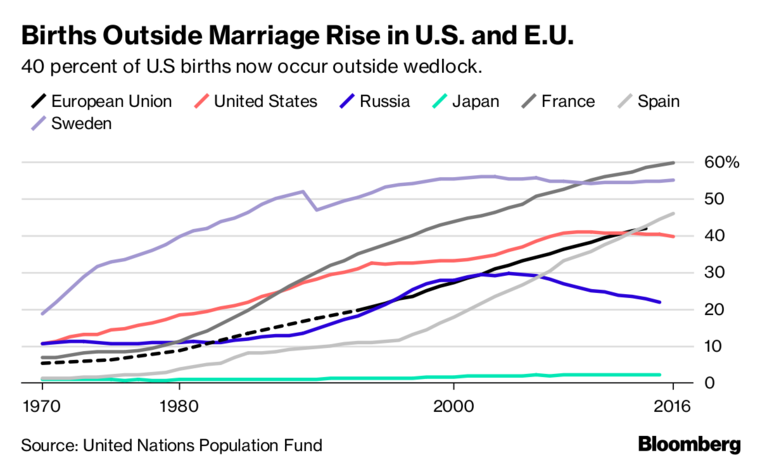
Unfortunately, young people are having children outside of a marriage commitment more and more.

Out-of-wedlocks births rising as cohabitation replaces marriage

Far-left Bloomberg News reports:

Forty percent of all births in the U.S. now occur outside of wedlock, up from 10 percent in 1970, according to an annual report released on Wednesday by the United Nations Population Fund (UNFPA), the largest international provider of sexual and reproductive health services. That number is even higher in the European Union.

The EU has a higher rate of fatherless births because they have high taxes and big government to allow women to have children without having to commit to a husband:

The EU likely sees more births out of wedlock because many member countries have welfare systems that support gender-balanced child care, said Michael Hermann, UNFPA’s senior adviser on economics and demography, in an interview. Public health care systems, paid paternal leave, early education programs and tax incentives give unwed parents support beyond what a partner can provide.

More welfare and more government services make it easier for women to pursue relationships with men who aren’t interested in marriage. Hot bad boys who give them all the tingles. Big government makes those boring, predictable marriage-ready men dispensable. Big government also makes it much harder for a man who does marry to afford a stay-at-home mother for his kids, because he has to pay higher taxes for big government.

More:

The data show such births in the U.S. and EU are predominantly to unmarried couples living together rather than to single mothers, the report says.

[…]Jones also noted that the rise in births outside of marriage is closely correlated to delays in childbearing. “Women are claiming their ground professionally,” she said. “Delaying motherhood is a rational decision when you consider the impact it can have on your career, and that’s contributing to this trend.”

[….]The traditional progression of Western life “has been reversed,” said John Santelli, a professor in population, family health and pediatrics at Columbia’s Mailman School of Public Health. “Cohabiting partners are having children before getting married. That’s a long-term trend across developing nations.”

Regardless of marital status, more couples are choosing not to have kids at all. The U.S. fertility rate hit a historic 30-year low last year, according to the Centers for Disease Control and Prevention. Hermann said the rise in births outside of wedlock has actually mitigated the decline in fertility, which “would be much steeper if women weren’t having children outside marriage.”

What’s interesting about this anti-marriage article is that they have nothing to say about the research showing that cohabitation – and also marriages that occur after a period of cohabitation – are inferior to no-cohabitation marriages. People who are serious about self-control, and who are serious about committing through thick and thin, tend to have longer lasting marriages. But we don’t prioritize chastity, fidelity and self-sacrificial commitment anymore, because that relationships that require self-denial make us unhappy.

The article concludes: “We can’t go back to the ’50s”. Right. Because if feelings-based “morality” is assumed, then any choice between adult happiness and children’s happiness will favor the adults. Today’s young people carefully AVOID any evidence that contradicts their new “happiness-morality”. They act surprised when their unstable relationships dissolve, leaving children separated from their fathers. Marriage requires that both partners have a system of morality that puts the commitment above happy feelings. People have to be accustomed to doing things that feel bad, just because they are good and moral things to do according to an objective standard of morality. The new atheist morality of happy feelings doesn’t develop the character needed for commitment.

If you ask an atheist millennial, they think they are doing a great job of being “moral”. They don’t see the messes they are making for children as something that they are causing themselves, with their own foolish feelings-based decision-making. They think they know everything about relationships through their feelings. They think that they are exempt from the patterns of cause and effect in the peer-reviewed research.

How to help fatherlessness women make better choices about men and marriage

Here's some helpful advice for women about choosing a man
Here’s some helpful advice for women about choosing a man

I found a YouTube video featuring a conversation about the fundamental problem that I see with young, unmarried women: their decision to have recreational premarital sex with hot guys throughout their teens and 20s. I realize that this is controversial, but I think by listening to a woman who did this, we can get some clues about how to talk them out of it.

Here is the conversation: (just listen to the first 7 minutes to start)

Note: this conversation contains vulgar language. Listener discretion is advised.

Molyneux gets her talking about the most important question that women who fail with men never want to answer: why did your mother choose this awful, awful man, to be your father out of all the other men in the world? At the end, she really has learned her lesson and gives a good warning to other young women at the crossroads.

Summary of key admissions:

  • Caller: I’m a 41-year-old single white female who was a bad girl in my 20s. I was raised fatherless by a loving Christian mom. Question: what caused me to fail at life and be living with my (divorced) mother?
  • I was gifted, very intellectual, top of the class
  • My mom is a very caring person
  • My mom approached my Dad when he was already in another relationship (i.e. – her mom was the woman her father cheated with on another woman, then her mom married this cheating man and he dumped the previous woman)
  • My mom was very attractive, and could have chosen different men, but she was really attracted to this terrible man
  • My mom had a desire to get away from her strict parents, who she resented
  • when I was 15 I chose a man, I had recreational sex with him before marriage, and he stalked me and humiliated me
  • I felt like an adult at age 15, and I had sex with this man then so that I could put childhood behind me and become an adult
  • My mother counter-acted the absence of my Dad by raising me as a Christian – she was a radical, intense Christian and that hyper-religiosity made me not want to talk about sex with her
  • My mom divorced my father because he was a jerk
  • My mom did not mind that he had other children from past relationships, was underemployed, and was lazy
  • I used to sneak out of my room and sit on the back porch and drink alcohol with the neighbor kids
  • My mom was a worrier and a control freak, so I rebelled against her warnings and attempts to set boundaries on my wildness
  • I and my 15-year-old recreational sex partner used a condom from my devout Christian mother’s drawer
  • I had sex with 5 different boyfriends from age 15-18 and caught mono
  • My mom had temporary boyfriends after the divorce
  • In my 20s, “there wasn’t much to do except go out and drink”. “two to three times a week, me and my girlfriends would get dressed up, go to the clubs, and try to attract hot guys”.
  • From 21-30, I stopped looking for relationships, I just hooked up with hot guys for one-night stands and FWBs
  • I felt better about myself, more confident and in control when I would drink and have one-night stands with these hot guys
  • “I don’t know why I was so focused on looks” in these guys
  • The hooking up stopped at 30, then dating (with sex) resumed
  • I realized that the hot guys I wanted were not going to settle down, especially with new younger women available
  • From 15 to now, I’ve slept with 60 different men, sometimes repeatedly, and on and off
  • I never admitted the true number of men I slept with to any of these men
  • last relationship was 5 years ago (at age 36)
  • I have lost interest in sex, and lost interest in men
  • I don’t have the mental toughness to be in a relationship
  • I have “been broken” by too many failed relationships
  • nobody told me that my decisions with men were not going to go well

In the final 8 minutes where Stefan explains the larger consequences of women’s choices for civilization is very important, I think. I was surprised that he spoke directly to the “hot” alpha males that women want and told them that they are breaking women, and share the blame for destroying our civilization. The thing is, I don’t think those hot alpha males care about civilization, or anything except for themselves. So I don’t think it’s going to work to speak to these degenerate men. We have to speak to the women. They are the ones who aspire to marriage and security, and they make the choices that do not lead to the future they want.

I think we need to teach young women, especially fatherless women, to connect their choices with men to the tasks that men actually perform in a married home. I am talking about non-Christian women AND Christian women. What do men do in a marriage on a day-to-day basis? They protect. They provide. They lead on moral issues. They lead on spiritual issues. So, we need to sit down with women and tell them what is important in a man. I have heard Christian women tell me how they married non-Christian men who they were attracted to for superficial reasons, then spent the rest of their lives watching their children grow up without a spiritual leader in the home. I want this to stop happening.

I think the problem is that we need stronger men who are willing to confront women and speak about moral boundaries so that young women who don’t have guidance can at least have the opportunity to make better choices. What we need less is men who agree with women who are making bad decisions. And we need less men who blame that bad men that women freely choose for being bad. Bad men are going to be bad. The only way forward is to tell women not to choose them. This is hard to do, but it is the loving thing to do. It’s not loving to tell women that they can expect the man they choose to give them the traditional male roles when they chose him for superficial qualities that have nothing to do with the traditional male roles.