Tag Archives: Science

Are solar eclipses common? What has to be in place to observe a solar eclipse?

Christianity and the progress of science

If there were a Designer of the universe, what would He have to do to allow creatures living on a planet to observe a solar eclipse?

Consider this article from Discovery Institute.

Excerpt:

A rare convergence of events allows Earthlings to witness not just solar eclipses, but perfect solar eclipses, where the Moon just barely covers the Sun’s bright photosphere. Such eclipses depend on the precise sizes, shapes, and relative distances of the Sun, Moon, and Earth. There’s no law of physics or celestial mechanics that requires the right configuration. In fact, of the more than 65 major moons in our Solar System, ours best matches the Sun as viewed from its planet’s surface, and this is only possible during a fairly narrow window of Earth’s history encompassing the present. The Moon is about 400 times smaller than the Sun. But right now, the Moon is about 400 times closer to the Earth than is the Sun. So, the Moon’s apparent size on the sky matches the Sun’s. Astronomers have noted this odd coincidence for centuries. And, since the Sun appears larger from the Earth than from any other planet with a moon, an Earth-bound observer can discern finer details in the Sun’s chromosphere and corona than from any other planet. This makes our solar eclipses more valuable scientifically.

The recent pictures of solar eclipses sent back from the Opportunity rover on Mars nicely illustrate how much better our solar eclipses are. The two small potato-shaped Martian moons, Deimos and Phobos, appear much too small to cover the Sun’s disk, and they zip across it in less than a minute.

Not only do you need things to be finely-tuned to see the eclipse, but you also need observers to be there.

More:

It’s intriguing that the best place to view total solar eclipses in our Solar System is the one time and place where there are observers to see them. It turns out that the precise configuration of Earth, Moon and Sun are also vital to sustaining life on Earth. A moon large enough to cover the Sun stabilizes the tilt of the rotation axis of its host planet, yielding a more stable climate, which is necessary for complex life. The Moon also contributes to Earth’s ocean tides, which increase the vital mixing of nutrients from the land to the oceans. The two moons around Mars are much too small to stabilize its rotation axis.

In addition, it’s only in the so-called Circumstellar Habitable Zone of our Sun–that cozy life friendly ring where water can stay liquid on a planet’s surface–that the Sun appears to be about the same size as the Moon from Earth’s surface. As a result, we enjoy perfect solar eclipses.

Why would the Designer of the Universe want his observers to exist in exactly the right place to observe the solar eclipse? What is the point of seeing a solar eclipse?

Here is the point:

Our ability to observe perfect solar eclipses has figured prominently in several important scientific discoveries, discoveries that would have been difficult if not impossible on the much more common planets that don’t enjoy such eclipses.

First, these observations helped disclose the nature of stars. Scientists since Isaac Newton (1666) had known that sunlight splits into all the colors of the rainbow when passed through a prism. But only in the 19th century did astronomers observe solar eclipses with spectroscopes, which use prisms. The combination of the man-made spectroscope with the natural experiment provided by eclipses gave astronomers the tools they needed not only to discover how the Sun’s spectrum is produced, but the nature of the Sun itself. This knowledge enabled astronomers to interpret the spectra of the distant stars. So, in a sense, perfect eclipses were a key that unlocked the field of astrophysics.

Second, in 1919, perfect solar eclipses allowed two teams of astronomers, one led by Sir Arthur Eddington, to confirm a prediction of Einstein’s General Theory of Relativity–that gravity bends light. They succeeded in measuring the changes in the positions of starlight passing near the Sun’s edge compared to their positions months later. Such a test was most feasible during a perfect solar eclipse. The tests led to the general acceptance of Einstein’s theory, which is the foundation of modern cosmology.

So, you’ve got fine-tuning for the eclipse, fine-tuning for the observers, and with that in place, the observers can collect scientific evidence… including evidence that confirms cosmic fine-tuning as well as general relativity. General relativity is important because if gives us the expanding universe – one of the evidences for the Big Bang cosmology. The Big Bang cosmology states that the entire physical universe came into being out of nothing, about 14 billion years ago. Who could have caused that? If we don’t have eclipses, we are losing out on evidence of cosmic fine-tuning and cosmic creation.

There’s a new Discovery Institute podcast featuring Jay Richards, co-author of the amazing book “The Privileged Planet”.

Details:

On this episode of ID: The Future, CSC Senior Fellow Jay Richards explains how perfect solar eclipses are the tip of an iceberg-size design argument found in a book he co-wrote, The Privileged Planet. The conditions for a habitable planet (right distance from the right size star, a big but not too big moon that is the right distance away to stabilize Earth’s tilt and circulate its oceans) are also conditions that make perfect solar eclipses from the Earth’s surface much more likely. And perfect eclipses aren’t just eerie and beautiful. They’ve helped scientists test and discover things, and are part of a larger pattern: The conditions needed for a habitable place in the cosmos correlate with the conditions well suited for scientific discovery. As Richards notes, this correlation is inexplicable if the cosmos is the product of chance. But if it’s intelligently designed with creatures like us in mind, it’s just what we might expect.

The MP3 file is here.

If you have not seen The Privileged Planet, you can get the same argument as in the book in just over an hour. You can either buy The Privileged Planet DVD, or click here to watch it on YouTube. And it’s narrated by John-Rhys Davies.
Is Google right to say that sex differences don’t exist?

Radical feminists complain a lot about sexism, but damage is self-inflicted

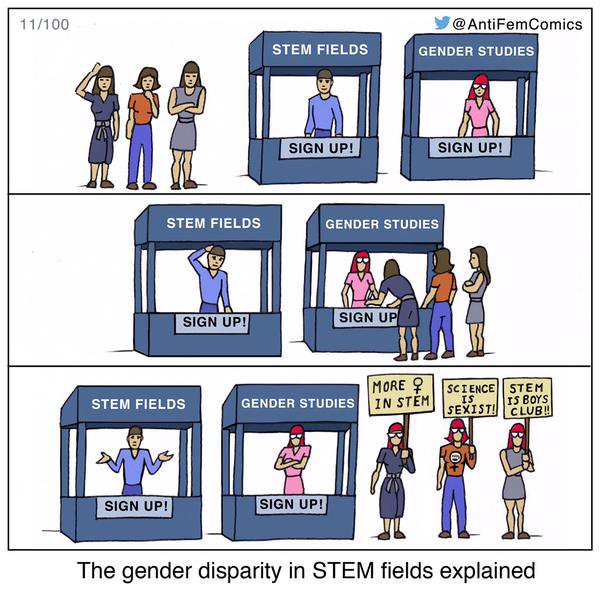
Google recently fired a software engineer who asked them to do a better job of promoting diversity by actually appealing to women’s different needs and desires. He suggested more collaborative coding (“pair programming”) and more part-time work options. Google responded to his suggestions by ejecting him forcibly from their left-wing politically correct echo chamber. Google executives claim that their company is rooted in science. Well, is there a science of sex differences? Who is right?

This article from The Globe and Mail, which is the more leftist of Canada’s two national newspapers, is written by a PhD in the field of sexual neuroscience from York University.

She says:

Despite how it’s been portrayed, the memo was fair and factually accurate. Scientific studies have confirmed sex differences in the brain that lead to differences in our interests and behaviour.

As mentioned in the memo, gendered interests are predicted by exposure to prenatal testosterone – higher levels are associated with a preference for mechanically interesting things and occupations in adulthood. Lower levels are associated with a preference for people-oriented activities and occupations. This is why STEM (science, technology, engineering and mathematics) fields tend to be dominated by men.

We see evidence for this in girls with a genetic condition called congenital adrenal hyperplasia, who are exposed to unusually high levels of testosterone in the womb. When they are born, these girls prefer male-typical, wheeled toys, such as trucks, even if their parents offer more positive feedback when they play with female-typical toys, such as dolls. Similarly, men who are interested in female-typical activities were likely exposed to lower levels of testosterone.

As well, new research from the field of genetics shows that testosterone alters the programming of neural stem cells, leading to sex differences in the brain even before it’s finished developing in utero. This further suggests that our interests are influenced strongly by biology, as opposed to being learned or socially constructed.

Her article is filled with linked to peer-reviewed papers, although I removed the links when quoting her article.

She even links to peer-reviewed papers to refute the Google science-deniers:

Many people, including a former Google employee, have attempted to refute the memo’s points, alleging that they contradict the latest research.

I’d love to know what “research done […] for decades” he’s referring to, because thousands of studies would suggest otherwise. A single study, published in 2015, did claim that male and female brains existed along a “mosaic” and that it isn’t possible to differentiate them by sex, but this has been refuted by four – yes, four – academicstudies since.

This includes a study that analyzed the exact same brain data from the original study and found that the sex of a given brain could be correctly identified with 69-per-cent to 77-per-cent accuracy.

[…]Contrary to what detractors would have you believe, women are, on average, higher in neuroticism and agreeableness, and lower in stress tolerance.

I think the key point in this debate is one that the author makes herself: women ought to be able to find ways to study and work on things that are interesting to them. Of course some jobs pay more than others because they are more productive, and of course we should make women aware of the consequences of studying nonsense subjects that don’t pay. We don’t want women running up student loans they’ll never pay back, then defaulting on them and passing the costs off to taxpayers. But we shouldn’t try to push women into STEM jobs by watering down the requirements of those jobs – that just treats the people who can do the jobs very unfairly.

In my own case, I prefer women who do have STEM degrees and STEM work experience, but that’s because I think that STEM education and work experience grinds out some of the characteristics of women that make them bad partners for goal-directed men like myself. I have every reason for wanting more women in STEM, but I want them to do it honestly. I want them to be treated fairly, and not get a whole bunch of advantages in education and the workplace just because they are women.

MIT physicist Alan Lightman on fine-tuning and the multiverse

Christianity and the progress of science

Here’s the article from Harper’s magazine.

The MIT physicist says that the fine-tuning is real, and is best explained by positing the existence of an infinite number of universes that are not fine-tuned – the so-called multiverse.

Excerpt:

While challenging the Platonic dream of theoretical physicists, the multiverse idea does explain one aspect of our universe that has unsettled some scientists for years: according to various calculations, if the values of some of the fundamental parameters of our universe were a little larger or a little smaller, life could not have arisen. For example, if the nuclear force were a few percentage points stronger than it actually is, then all the hydrogen atoms in the infant universe would have fused with other hydrogen atoms to make helium, and there would be no hydrogen left. No hydrogen means no water. Although we are far from certain about what conditions are necessary for life, most biologists believe that water is necessary. On the other hand, if the nuclear force were substantially weaker than what it actually is, then the complex atoms needed for biology could not hold together. As another example, if the relationship between the strengths of the gravitational force and the electromagnetic force were not close to what it is, then the cosmos would not harbor any stars that explode and spew out life-supporting chemical elements into space or any other stars that form planets. Both kinds of stars are required for the emergence of life. The strengths of the basic forces and certain other fundamental parameters in our universe appear to be “fine-tuned” to allow the existence of life. The recognition of this fine-­tuning led British physicist Brandon Carter to articulate what he called the anthropic principle, which states that the universe must have the parameters it does because we are here to observe it. Actually, the word anthropic, from the Greek for “man,” is a misnomer: if these fundamental parameters were much different from what they are, it is not only human beings who would not exist. No life of any kind would exist.

If such conclusions are correct, the great question, of course, is why these fundamental parameters happen to lie within the range needed for life. Does the universe care about life? Intelligent design is one answer. Indeed, a fair number of theologians, philosophers, and even some scientists have used fine-tuning and the anthropic principle as evidence of the existence of God. For example, at the 2011 Christian Scholars’ Conference at Pepperdine University, Francis Collins, a leading geneticist and director of the National Institutes of Health, said, “To get our universe, with all of its potential for complexities or any kind of potential for any kind of life-form, everything has to be precisely defined on this knife edge of improbability…. [Y]ou have to see the hands of a creator who set the parameters to be just so because the creator was interested in something a little more complicated than random particles.”

Intelligent design, however, is an answer to fine-tuning that does not appeal to most scientists. The multiverse offers another explanation. If there are countless different universes with different properties—for example, some with nuclear forces much stronger than in our universe and some with nuclear forces much weaker—then some of those universes will allow the emergence of life and some will not. Some of those universes will be dead, lifeless hulks of matter and energy, and others will permit the emergence of cells, plants and animals, minds. From the huge range of possible universes predicted by the theories, the fraction of universes with life is undoubtedly small. But that doesn’t matter. We live in one of the universes that permits life because otherwise we wouldn’t be here to ask the question.

I thought I was going to have to go outside this article to refute the multiverse, but Lightman is honest enough to refute it himself:

The… conjecture that there are many other worlds… [T]here is no way they can prove this conjecture. That same uncertainty disturbs many physicists who are adjusting to the idea of the multiverse. Not only must we accept that basic properties of our universe are accidental and uncalculable. In addition, we must believe in the existence of many other universes. But we have no conceivable way of observing these other universes and cannot prove their existence. Thus, to explain what we see in the world and in our mental deductions, we must believe in what we cannot prove.

Sound familiar? Theologians are accustomed to taking some beliefs on faith. Scientists are not. All we can do is hope that the same theories that predict the multiverse also produce many other predictions that we can test here in our own universe. But the other universes themselves will almost certainly remain a conjecture.

The multiverse is not pure nonsense, it is theoretically possible. The problem is that the multiverse generator itself would require fine-tuning, so the multiverse doesn’t get rid of the problem. And, as Lightman indicates, we have no independent experimental evidence for the existence of the multiverse in any case. Atheists just have to take it on faith, and hope that their speculations will be proved right. Meanwhile, the fine-tuning is just as easily explained by postulating God, and we have independent evidence for God’s existence, like the the origin of biological information, the sudden appearance of animal body plans, the argument from consciousness, and so on. Even if the naturalists could explain the fine-tuning, they would still have a lot of explaining to do. Theism (intelligent causation) is the simplest explanation for all of the things we learn from the progress of science.

We need to be frank about atheists and their objections to the progress of science. Within the last 100 years, we have discovered that the physical universe came into being out of nothing 15 billion years ago, and we have discovered that this one universe is fine-tuned for intelligent life. I don’t think it’s like that the last 100 years of scientific progress on the origins question are going to be overturned so that science once again affirms what atheists believe about the universe. Things are going the wrong way for atheists – at least with respect to science.

See it in action

To see these arguments examined in a debate with a famous atheist, simply watch the debate between William Lane Craig and Christopher Hitchens, and judge which debater is willing to form his beliefs on scientific progress, and which debater is forming his beliefs against the science we have today, and hoping that the good science we have today based on experiments will be overturned by speculative theories at some point in the future. When you watch that debate, it becomes very clear that Christian theists are interested in conforming their beliefs to science, and atheists are very interested in speculating against what science has shown in order to maintain their current pre-scientific view. That’s not what rational people ought to do when confronted with evidence.

Positive arguments for Christian theism