Tag Archives: Science

New study: there is no gay gene that causes homosexuality

I heard one of the authors of this new study commenting on how he was a gay man, and the purpose of his research was to show a genetic basis for homosexuality, in order to make it equal to race. His goal was to make it impossible to disagree with homosexual behavior, because homosexual behavior would be seen as natural and normal. Let’s see if his new study helps him out.

The blog of the peer-reviewed journal PLOS One reported on the new study, which was published in the prestigious journal Science.

Excerpt:

The once-prevailing concept of a “gay gene” dictating sexual orientation has been put to rest in a powerhouse study published today in Science. The work brilliantly illustrates the very nature of science: evolving with the input of new data, especially the large-scale contributions of bioinformatics and crowd-sourcing.

“We formed a large international consortium and collected data for more than 500,000 people, comparing DNA and self-reported sexual behavior. This is approximately 100 times bigger than any previous study on this topic,” said lead author Andrea Ganna, of the Institute of Molecular Medicine in Finland and an instructor at Massachusetts General Hospital and Harvard Medical School, opening a news conference earlier this week.

[…]The investigation estimates a genetic contribution to same-sex sexual behavior as under 1 percent, thanks to analysis of a trove of data from the UK Biobank and the consumer genetic testing company 23andme.

So, there you have it, there is no gay gene. But this is of course something we’ve known for decades, as all the previous studies had found the same thing.

The normal way that people do these studies is to analyze identical twins, and see how often both identical twins are gay.

Eight major studies of identical twins in Australia, the U.S., and Scandinavia during the last two decades all arrive at the same conclusion: gays were not born that way.

“At best genetics is a minor factor,” says Dr. Neil Whitehead, PhD. Whitehead worked for the New Zealand government as a scientific researcher for 24 years, then spent four years working for the United Nations and International Atomic Energy Agency. Most recently, he serves as a consultant to Japanese universities about the effects of radiation exposure. His PhD is in biochemistry and statistics.

Identical twins have the same genes or DNA. They are nurtured in equal prenatal conditions. If homosexuality is caused by genetics or prenatal conditions and one twin is gay, the co-twin should also be gay.

“Because they have identical DNA, it ought to be 100%,” Dr. Whitehead notes. But the studies reveal something else. “If an identical twin has same-sex attraction the chances the co-twin has it are only about 11% for men and 14% for women.”

Because identical twins are always genetically identical, homosexuality cannot be genetically dictated. “No-one is born gay,” he notes. “The predominant things that create homosexuality in one identical twin and not in the other have to be post-birth factors.”

Dr. Whitehead believes same-sex attraction (SSA) is caused by “non-shared factors,” things happening to one twin but not the other, or a personal response to an event by one of the twins and not the other.

By the way, a previous study also found that transgender behavior was not genetic, but was clearly linked to environmental factors such as peer approval and social media.

Here is the report from Science Daily:

This month, a Brown University researcher published the first study to empirically describe teens and young adults who did not have symptoms of gender dysphoria during childhood but who were observed by their parents to rapidly develop gender dysphoria symptoms over days, weeks or months during or after puberty.

[…]The study was published on Aug. 16 in PLOS ONE.

Littman surveyed more than 250 parents of children who suddenly developed gender dysphoria symptoms during or after puberty.

[…]“Of the parents who provided information about their child’s friendship group, about a third responded that more than half of the kids in the friendship group became transgender-identified,” Littman said. “A group with 50 percent of its members becoming transgender-identified represents a rate that is more 70 times the expected prevalence for young adults.”

A previous study also found that children are more likely to be gay if they are raised by gay adults. It was reported in AOL News.

Excerpt:

Walter Schumm knows what he’s about to do is unpopular: publish a study arguing that gay parents are more likely to raise gay children than straight parents. But the Kansas State University family studies professor has a detailed analysis that past almost aggressively ideological researchers never had.

[…]His study on sexual orientation, out next month, says that gay and lesbian parents are far more likely to have children who become gay. “I’m trying to prove that it’s not 100 percent genetic,” Schumm tells AOL News.

His study is a meta-analysis of existing work. First, Schumm extrapolated data from 10 books on gay parenting… [and] skewed his data so that only self-identified gay and lesbian children would be labeled as such.

[…]Schumm concluded that children of lesbian parents identified themselves as gay 31 percent of the time; children of gay men had gay children 19 percent of the time, and children of a lesbian mother and gay father had at least one gay child 25 percent of the time.

[…]Finally, Schumm looked at the existing academic studies… In all there are 26 such studies. Schumm ran the numbers from them and concluded that, surprisingly, 20 percent of the kids of gay parents were gay themselves. When children only 17 or older were included in the analysis, 28 percent were gay.

It’s very important for people to understand that there is a trend in society to make every behavior traditionally seen as sinful into something caused by genetics. The twin goals of this effort are to insulate the behaviors from criticism, and to minimize evaluation of the effects of these behaviors on society as a whole. The genetic argument was used extensively to normalize same-sex marriage and transgenderism. I have seen the genetic argument used to defend other behaviors like pedophilia and incest. But the scientific research does nothing to support any of these arguments. What’s amazing is how a majority of people in the United States have such false beliefs about the scientific research. They vastly overestimate the number of gay people, and also the influence of genetics.
What’s the best explanation for the origin of life for atheists?

I just ordered the newest edition of “The Mystery of Life’s Origin“, which is a classic book on the origin of life by pro-design authors. The new edition has several new chapters. It reminded me of my interest in the origin of life when I was a younger man, just starting full-time work with a hot Internet start-up in the big city.

Back then, I liked to listen to debates about the origin of life (e.g. – Walter Bradley versus Robert Shapiro, etc.), as well as lectures and interviews. I ordered tons of academic lectures and debates, especially from Access Research Network. Two of my favorite interviews from ARN featured Dr. Charles Thaxton and Dr. Dean Kenyon.

Let’s start with Charles Thaxton’s interview.

And here are the questions:

1. How did you first get interested in the origin of life?
2. How did you come to write The Mystery of Life’s Origin with Walter Bradley and Roger Olsen?
3. Was there an advantage to having the three of you collaborate on the project?
4. What is the primary argument of your book, The Mystery of Life’s Origin?
5. Have scientists come close to developing a plausible naturalistic explanation to the origin of life or do you still consider the origin of life to be a mystery?
6. Do you see a particular irony in the timing of Stanley Miller’s experiments and the discovery of DNA by Watson and Crick?
7. How does the emergence of modern genetics tie in with the Darwinian scenario of life going from simple to complex?
8. What are the major problems with origin of life simulation experiments?
9. Isn’t it rather impressive that amino acids were produced in the Miller experiments?
10. How close is the development of amino acids to the threshold of life?
11. What are the steps involved in producing proteins from amino acids?
12. Why are amino acids isolated during this process?
13. How can the investigator affect the outcome of a simulation experiment?
14. How did you evaluate the different chemical evolution experiments?
15. Are the initial conditions in the simulation experiments plausible?
16. What did the earth’s early atmosphere contain?
17. Will the simulation experiments work with this atmosphere?
18. There seems to be an underlying assumption that the origin of life resulted without any intelligent input whatsoever yet the simulation experiments appear to rely upon intelligent guidance. Could you comment on this irony?
19. Are there any natural processes that would have filtered out destructive ultraviolet light?
20. What additional steps beyond creating amino acids would be required to develop life?
21. What is so difficult about making proteins or nucleic acids?
22. In addition to the energy problem in protein synthesis isn’t there a sequencing problem?
23. Are DNA sequences analogous to a written language?
24. Has Hubert Yockey made similar claims?
25. In The Mystery of Life’s Origin you refer to order, randomness, and specified complexity. Could you give us an overview of these concepts?
26. What do you think the presence of specified complexity in a living system indicates about its origin?
27. In inferring the necessity of intelligence to produce life haven’t you ventured from the realm of science to religion?
28. Could you summarize the reasons why you believe intelligence was involved in the origin of life?
29. What are the major objections to your current point of view?
30. How was The Mystery of Life’s Origin received by the scientific community?
31. What was Dean Kenyon’s response to your critiques of his book, Biochemical Predestination?
32. What was Dean Kenyon’s response to The Mystery of Life’s Origin?
33. Were you a bit apprehensive about meeting Kenyon after writing a book which was quite critical of his views in Biochemical Predestination?
34. Are self-organizational theories plausible?
35. Would you comment on the work done by Prigogine and Eigen?
36. What is your assessment of RNA scenarios?
37. What other problems do you see with an RNA world?

You can learn more about Charles Thaxton here.

And here’s the interview with Dean Kenyon:

And here are the questions:

1. What first interested you in biology and the origin of life? What is your academic background in this area?
2. What was your viewpoint on the origin of life when you wrote Biochemical Predestination?
3. How have your views on the origin of life changed since you wrote Biochemical Predestination?
4. Do many of your colleagues support your new position? If not, why not?
5. What are the general presuppositions that scientists make who study the origin of life?
6. What is the Oparin-Haldane hypothesis, and what role does it play in current research and teaching on the origin of life?
7. What are the major underlying assumptions of the Oparin (chemical evolution) hypothesis?
8. Are there any other important assumptions in origin of life theories?
9. How well are these assumptions supported by currently available scientific data?
10. What is your evaluation of the Miller type of simulation experiment? What do these experiments tell us about possible chemical events on the prebiotic Earth?
11. Is it possible that interfering cross-reactions might prevent life from arising naturalistically?
12. Stanley Miller’s pioneering work in the origin of life assumed a reducing atmosphere of methane, ammonia, water vapor, and carbon dioxide? Is there sufficient empirical support for this assumption?
15. How large a gap is there between the most complex “protocell” model and the simplest living cell?
16. What is the biologically relevant information content of the simplest living organism known to exist? What are estimates for a theoretical minimum information content of the first living cell?
17. How probable is it that such complexity could arise by undirected chemical processes?
19. What are the major unsolved problems in research on the origin of life?
20. What is the relevance of the Second Law of Thermodynamics to the origin of life?
21. Is it plausible that an “RNA world” was the precursor of the first living cells?
25. If life did not originate by chemical evolution on the primitive Earth, what other possible scientific explanations exist?
26. What do you mean by your statement that “perhaps scientism is more widespread than we like to think”?
27. Is it possible that natural processes are insufficient to account for the origin of all biological information?
28. Can science rule out the possibility that most biological information had an intelligent cause?
29. What alternatives are there to pursuing purely naturalistic explanations for the origin of life?
30. What do you mean by “intelligent design” as it relates to the origin of life?
31. Why is an intelligent design or creationist interpretation of scientific data bearing on origins not acceptable to many scientists?
32. What criteria could be used to determine if the information content of living organisms had an intelligent or natural cause?
34. Does academic freedom allow you to discuss the difficulties of scientific naturalism and origin of life theories? If not, why are they protected from criticism?
35. How should the origin of life be taught in light of the California Science Framework policy which states that “nothing in science or in any other field of knowledge shall be taught dogmatically”?
36. How is scientific progress impacted when critiques of current theories are suppressed?

You can learn more about Dean Kenyon here.

The challenge for naturalists posed by the origin of life makes it well worth your time to learn and understand. I used to explain this argument to my entire IT department on white boards when I was a young man. It’s fascinating, and more convincing than personal testimonies or abstract philosophical arguments. Although I read books on the origin of life, I learned how to present the information as an argument by watching the interviews above over and over.

People sometimes ask me how I was able to survive 22 years in IT with my theism intact. It turns out that there are no shortcuts to a theistic worldview. You have to support it with evidence. You have to be able to show your work about how you reached your conclusions. I’m a theist today because I never found a single atheist in any software development job who could even begin to challenge the evidence that I collected from listening to all those lectures and debates that I started from in my early 20s. It was as easy to defeat them as taking candy from a baby.

If only Christian parents and Christian leaders understood the importance of scientific facts when they talk to young people about Christianity. We need to be less worried about hurting the feelings of young people by making them “feel dumb”. Christianity isn’t supposed to be easy. It’s not a bad thing to ask people to work hard at learning how to rationally ground it with evidence. If we want to stop our young people from being lazy, ignorant and cowardly, then the right way to do it is to make them work. Make them learn. Make them fight.

Study: non-STEM college programs make students less religious

Lets take a closer look at a puzzle

Why do students turn away from Christianity in college? It might have something to do with what they choose to study.

Rice University reports on a new study conducted by sociologist Elaine Howard Ecklund.

Excerpt:

The public’s view that science and religion can’t work in collaboration is a misconception that stunts progress, according to a new survey of more than 10,000 Americans, scientists and evangelical Protestants. The study by Rice University also found that scientists and the general public are surprisingly similar in their religious practices.

The study, “Religious Understandings of Science (RUS),” was conducted by sociologist Elaine Howard Ecklund and presented today in Chicago during the annual American Association for the Advancement of Science (AAAS) conference. Ecklund is the Autrey Professor of Sociology and director of Rice’s Religion and Public Life Program.

“We found that nearly 50 percent of evangelicals believe that science and religion can work together and support one another,” Ecklund said. “That’s in contrast to the fact that only 38 percent of Americans feel that science and religion can work in collaboration.”

The study also found that 18 percent of scientists attended weekly religious services, compared with 20 percent of the general U.S. population; 15 percent consider themselves very religious (versus 19 percent of the general U.S. population); 13.5 percent read religious texts weekly (compared with 17 percent of the U.S. population); and 19 percent pray several times a day (versus 26 percent of the U.S. population).

[…]RUS is the largest study of American views on religion and science.

Meanwhile, Reasonable Faith has a podcast about the study, and what they discuss is how students who go into non-STEM university programs lose their interest in religion at a much higher rate than people who study STEM.

Here is the MP3 file.

And the relevant portion of the transcript:

DR. CRAIG: Right. If you look at their chart they give, where it shows the changes in religiosity by college major, it shows that in biology, engineering, and physical science and math they were mixed. The overall effect was neither negative nor positive. For some it was positive, some negative. But those majors did not seem to have a very significant effect upon the person’s religious behavior. The majors that had a very positive impact on religiosity were education, vocational or clerical education, business, and what is classified as “other.” All of those majors – whatever those are – have an overall positive impact upon students’ religiosity.

KEVIN HARRIS: And attendance as well – attendance to church services.

DR. CRAIG: Yes.

KEVIN HARRIS: The big fly in the ointment here is that “both the Humanities and the Social Sciences see dramatic declines in attendance and even more in religious beliefs.” It lowers church attendance, synagogue attendance, and even more in religious beliefs. What do we mean by the humanities and the social sciences?

DR. CRAIG: Humanities would include your non-scientific areas; for example, literature (hence the title of the article), politics.[3] I don’t know if they would include economics in this or not. Religious studies. In the social sciences are things like anthropology and sociology would be included there.

KEVIN HARRIS: The study of art?

DR. CRAIG: Yes, I suppose the arts would be in the humanities – that would be music and graphic arts. It is a big, big catch-all category.

And why does Dr. Craig think this is happening?

DR. CRAIG: […]It could well be that it is because it is in the humanities that the radicals of the 1960s were able to find a place in the university and become ensconced as professors with the relativism that they were championing. In areas like anthropology and sociology you find tremendous relativism where you simply study these cultures and societies without making any sort of judgment as to truth with regard to what they believe. This leads to the belief that it is all relative; there isn’t anything that is objectively true. John Searle is a very prominent philosopher at the University of California, Berkeley. Searle says that he believes that because of the commitment to the objectivity of truth and logic and the scientific method the hard sciences were barred to these radicals of the 1960s – getting into them and influencing them. But where they found an opening was in things like the Women’s Studies Department, Religious Studies, Anthropology, Sociology. These soft sciences. He says the professors in these disciplines are the children of the 1960s that have carried into it their relativistic views of truth. I noticed here the conclusion by the researchers of the University of Michigan (apparently who did this study), “Our results suggest that it is Postmodernism, not Science, that is the bête noir [the black beast or the hated thing] of religiosity.” The enemy of religiosity is postmodernism, not science.

KEVIN HARRIS: Postmodernism, as you’ve pointed out, was mainly a thing confined to literature and the soft sciences.

DR. CRAIG: Right. Women’s Studies, Religious Studies is rampant with Postmodernist perspectives. That has a real ring of truth to it, and could be the reason behind these statistics.

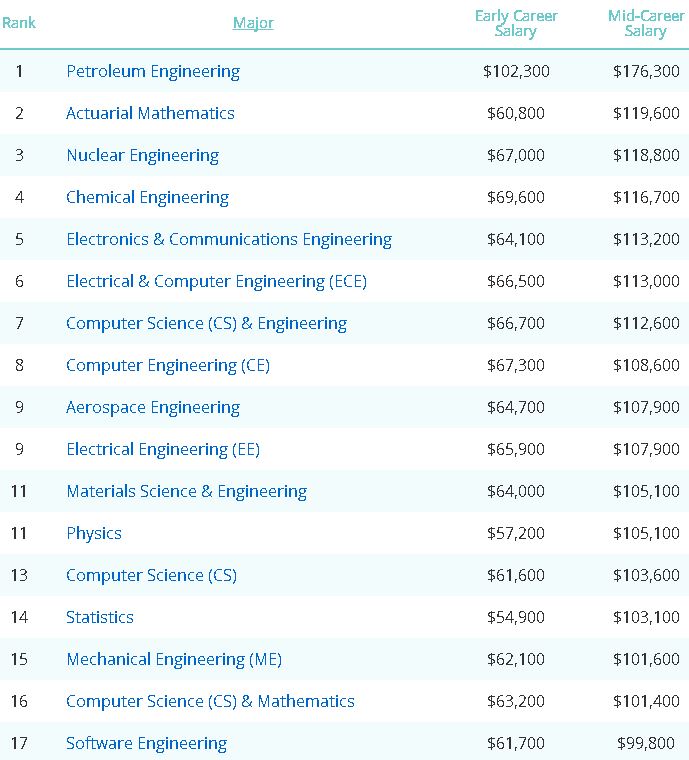
And this is why I recommend that people not drop math in high school, and pick a STEM field to study in college (or a trade in trade school). You are wasting your money when you let people in non-STEM areas indoctrinate you in fact-free irrationality. By the way, I love business administration as a major, for those who do not want to do the lab work. It attracts a lot of conservatives and entrepreneurs.

If you’re not worried about your faith, then you should at least be worried about your wallet:

Should you study philosophy?
STEM degrees are good for your finances as well

It’s much easier to have an influence as a Christian if you get your financial house in order. Having a degree that leads to a good paying job is certainly a good way to fund your life plan. Money also helps you to not worry too much about what the secular left can do to you. It’s good for offense and defense, in short.