Tag Archives: Recreational Sex

New study: virgins have happiest marriages, more sex partners means more unhappiness

Although we live in a culture that is dominated by the thoughts and opinions of secular leftists, science provides useful information for those who want defend Biblical morality. Consider the issue of sexuality and marriage. Secular leftists claim that sex outside of marriage is natural, and produces happiness. Bible believing Christians and Jews say chastity is best. Who is right?

Here is the latest study authored by Dr. Nicholas Wolfinger, a sociologist at the University of Utah. His previous book on relationships was published by Oxford University Press. In his analysis of the data, Wolfinger controlled for divorce rates, religiosity, and socioeconomic status.

Here’s the most important graph:

Study: virgins have the happiest marriages, more partners means less happiness

Other factors that increased marital happiness: having a 4-year college degree (5%), having a salary > 78K (5%), regular church attendance (6%). Notice that women are more dissatisfied with marriage (in general) than men are, and they tend to blame the spouse they freely chose for that unhappiness.

The Federalist also reported on previous research relevant to this study:

Psychologists Galena K. Rhoades and Scott M. Stanley found that women who have had sex with someone other than their husband report statistically significant drops in marital quality over those who don’t. A 2004 study by sociologist Jay Teachman showed that intimate premarital activities such as cohabitation and intercourse increased the rate of marital dissolution by anywhere between 28 and 109 percent, depending on the activity.

Wolfinger also noted in a previous study that only 5% of women were virgins when they married.

Wolfinger noted that a possible explanation for the link between promiscuity and unhappiness is that people look back on their past partners and compare their spouse unfavorably to them. This is especially the case with women. My concern about this is that feminism has taught women to try to increase their social standing by having hook-up sex with attractive bad boys. If those women ever marry, they do it when they are older, less fertile, and less attractive. The husband they eventually “settle” for will (in their minds) always compare unfavorably to the hot bad boys they had sex with when they were younger and prettier. This, I believe, is what leads to their unhappiness with the man they chose to marry.

More partners also means more marital instability

In a previous post, I blogged about several studies linking virginity to marital stability. Couples who don’t have sex before marriage, or even who delayed it, reported better communication, higher satisfaction, better quality sex, and a lower chance of divorce.

Men ought to be aware of this research when they are choosing a spouse. Obviously, you want a virgin, for the increased happiness and increased stability. For marriage-friendly character, you want to avoid women who are promiscuous thrill-seekers. You want to avoid women who run up debt doing easy non-STEM degrees and traveling. You want to avoid women who hook up with hot bad boys aren’t serious about commitment. Women who choose fun and thrills in their teens and 20s are setting a pattern of using sex as a way to get happiness in the moment. Later on, they’ll continue that pattern of seeing relationships as commodities that are designed to make them feel good, moment by moment. They’ll look at marriage as a way to fulfill their needs. They’ll have internalized the view that relationships are not commitments to invest in self-sacrificially. The pattern will be: “if it doesn’t make me feel happy right now, then it should be ended”. Men who aren’t serious about evaluating the character of the women for the marriage enterprise are running the risk of divorce, it’s that simple.

The best way to make sure that you have a clear head when evaluating a woman is to stay sober, and keep her hands off of you. When a man refuses to let a woman cloud his judgment with sex, then she is forced to learn how to love him, help him, and submit to his leadership. Male chastity encourages women who have been influenced by feminism to abandon selfishness, fun-seeking, and thrill-seeking, so that they learn to care for others. Male chastity also helps a man to resist older women who chose bad boys in their teens and 20s and want to get married to a good provider in their 30s. The studies discussed above clearly show that such women are more likely to be unhappy, and their future marriages are more likely to be unstable. Avoid them.

My conversation about morality with an atheist millennial man

This is one of the memes from the Wintery Knight facebook page
A meme that was posted on the WK Facebook page, by the new meme admin

I spent some time talking to an atheist millennial recently. He considers himself a moral person, and he is very helpful to others. I asked him to define morality, and he said that morality was feeling good, and helping other people to feel good. I was trying to think of a way to punch a hole in his feelings-based utilitarianism. How could I show him that happy feelings are not a good basis for morality?

Now, you’re probably thinking that abortion is the most obvious example of something that is morally wrong – it’s just killing a baby because adults don’t want to take responsibility for their foolish pursuit of pleasure. But atheists typically don’t think of unborn children as people. They usually believe in naturalistic evolution, and they are committed to a view of reality where the universe is an accident, human beings are accidents, there are no objective human rights, and biological evolution progresses because the strong survive while the weak die. So you aren’t going to be able to generate a moral standard that includes compassion for weak unborn children on that scenario. If the rule is “let’s do what makes us happy”, and the unborn child can’t voice her opinion, then the selfish grown-ups win.

Instead, I decided to focus on fatherlessness. I asked him whether he thought that fatherlessness harmed children. Surprisingly, he said that it didn’t, and that he had a relative who was doing a great job raising fatherless kids. I asked him if he had ever looked at the research on what father absence does to children. He hadn’t. Then I asked him if a system of sexual rules based on “me feeling good, and other people around me feeling good”, was likely to protect children. He went silent.

Well, that was the end of that conversation. And I think it was a nice window into how millennials – who are absolutely clueless about what research says about sex, dating, marriage and parenting – think about relationships. They’re making decisions based on their feelings, then acting surprised when their “common sense” decisions based on happiness “in the moment” blow up in their faces, and destroy the lives of their children, including their unborn children.

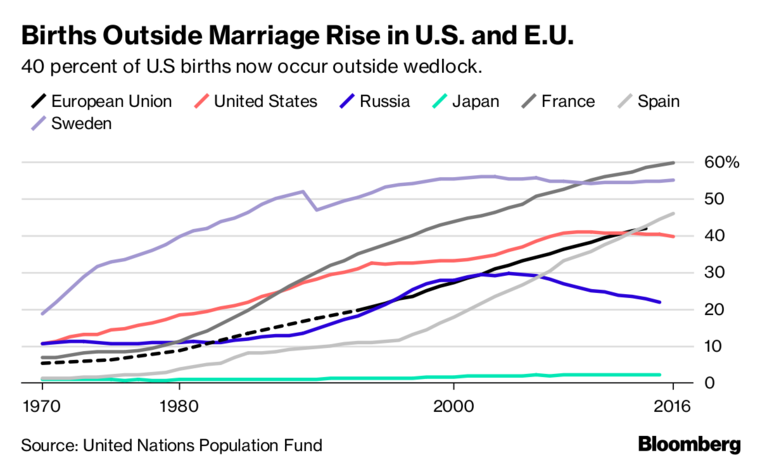
Unfortunately, young people are having children outside of a marriage commitment more and more.

Out-of-wedlocks births rising as cohabitation replaces marriage

Far-left Bloomberg News reports:

Forty percent of all births in the U.S. now occur outside of wedlock, up from 10 percent in 1970, according to an annual report released on Wednesday by the United Nations Population Fund (UNFPA), the largest international provider of sexual and reproductive health services. That number is even higher in the European Union.

The EU has a higher rate of fatherless births because they have high taxes and big government to allow women to have children without having to commit to a husband:

The EU likely sees more births out of wedlock because many member countries have welfare systems that support gender-balanced child care, said Michael Hermann, UNFPA’s senior adviser on economics and demography, in an interview. Public health care systems, paid paternal leave, early education programs and tax incentives give unwed parents support beyond what a partner can provide.

More welfare and more government services make it easier for women to pursue relationships with men who aren’t interested in marriage. Hot bad boys who give them all the tingles. Big government makes those boring, predictable marriage-ready men dispensable. Big government also makes it much harder for a man who does marry to afford a stay-at-home mother for his kids, because he has to pay higher taxes for big government.

More:

The data show such births in the U.S. and EU are predominantly to unmarried couples living together rather than to single mothers, the report says.

[…]Jones also noted that the rise in births outside of marriage is closely correlated to delays in childbearing. “Women are claiming their ground professionally,” she said. “Delaying motherhood is a rational decision when you consider the impact it can have on your career, and that’s contributing to this trend.”

[….]The traditional progression of Western life “has been reversed,” said John Santelli, a professor in population, family health and pediatrics at Columbia’s Mailman School of Public Health. “Cohabiting partners are having children before getting married. That’s a long-term trend across developing nations.”

Regardless of marital status, more couples are choosing not to have kids at all. The U.S. fertility rate hit a historic 30-year low last year, according to the Centers for Disease Control and Prevention. Hermann said the rise in births outside of wedlock has actually mitigated the decline in fertility, which “would be much steeper if women weren’t having children outside marriage.”

What’s interesting about this anti-marriage article is that they have nothing to say about the research showing that cohabitation – and also marriages that occur after a period of cohabitation – are inferior to no-cohabitation marriages. People who are serious about self-control, and who are serious about committing through thick and thin, tend to have longer lasting marriages. But we don’t prioritize chastity, fidelity and self-sacrificial commitment anymore, because that relationships that require self-denial make us unhappy.

The article concludes: “We can’t go back to the ’50s”. Right. Because if feelings-based “morality” is assumed, then any choice between adult happiness and children’s happiness will favor the adults. Today’s young people carefully AVOID any evidence that contradicts their new “happiness-morality”. They act surprised when their unstable relationships dissolve, leaving children separated from their fathers. Marriage requires that both partners have a system of morality that puts the commitment above happy feelings. People have to be accustomed to doing things that feel bad, just because they are good and moral things to do according to an objective standard of morality. The new atheist morality of happy feelings doesn’t develop the character needed for commitment.

If you ask an atheist millennial, they think they are doing a great job of being “moral”. They don’t see the messes they are making for children as something that they are causing themselves, with their own foolish feelings-based decision-making. They think they know everything about relationships through their feelings. They think that they are exempt from the patterns of cause and effect in the peer-reviewed research.

Jennifer Roback Morse lectures on sex and sexuality at Harvard University

Dr. Jennifer Roback Morse

Dr. Morse delivers a talk based on her book “Smart Sex” at Harvard University.

The MP3 file is here. (21 Mb) (Link in case that doesn’t work)

Topics:

  • the hook-up culture and its effects on men and women
  • cohabitation and its effect on marriage stability
  • balancing marriage, family and career
  • single motherhood by choice and IVF
  • donor-conceived children
  • modern sex: a sterile, recreation activity
  • the real purposes of sex: procreation and spousal unity
  • the hormone oxytocin: when it is secreted and what it does
  • the hormone vassopressin: when it is secreted and what it does
  • the sexual revolution and the commoditization of sex
  • the consumer view of sex vs the organic view of sex
  • fatherlessness and multi-partner fertility
  • how the “sex-without-relationship” view harms children

52 minutes of lecture, 33 minutes of Q&A from the Harvard students. The Q&A is worth listening to – the first question is from a gay student, and Dr. Morse pulls a William Lane Craig to defeat her objection. It was awesome! I never get tired of listening to her talk, and especially on the topics of marriage and family.