

Tag Archives: Rebellion

Are atheists unbiased about the question of God’s existence?

I have a key that will unlock a puzzling mystery

Brian Auten has a book review posted up at Apologetics 315.

The book is “If There’s A God, Why Are There Atheists?”, by theologian R.C. Sproul. R.C. Sproul is one of my favorite theologians. The book in question has a very, very special place in my heart, because I think that it is one of the major reasons why I was able to resist pernicious ideas like religious pluralism and postmodernism for so long. Once you put on the glasses of Romans 1 and see for the first time what man is really doing with respect to God, you can never see things the same again. I’ll say more about this at the end, but let’s see what Brian wrote first.

The review

So often, you hear atheists complaining about religion is nothing but wish-fulfillment or some sort of crutch for people who are frightened by a variety of things. They think that God is invented to solve several problems. 1) how does the world work?, 2) is there meaning to suffering and evil?, 3) why should I be moral?, and 4) what will happen to me and my loved ones when I die?. On the atheistic view, God is just a crutch that people cling to out of weakness and ignorance. But is this really the case?

Sproul starts the book by investigating three atheists who sought to explain religious belief as a result of psychological factors.

Brian writes:

Before tackling the psychology of atheism, Sproul spends a chapter on the psychology of theism, from the perspective of Freud’s question “If there is no God, why is there religion?”11 What follows is an overview of various psychological explanations of theistic belief: Feuerbach’s “religion is a dream of the human mind.”12 Marx’s belief that religion is “due to the devious imagination of particular segment of mankind.”13 And Nietzche’s idea that “religion endures because weak men need it.”14 The author properly reiterates: “We must be careful to note that the above arguments can never be used as proof for the nonexistence of God. They can be useful for atheists who hear theists state that the only possible explanation for religion is the existence of God.”15 That being said, Sproul also reveals what these arguments presume:

Their arguments already presupposed the nonexistence of God. They were not dealing with the question, Is there a God? They were dealing with the question, Since there is no God, why is there religion?16

Sproul points out the weaknesses of each of these approaches and says “there are just as many arguments showing that unbelief has its roots in the psychological needs of man.”

Wow, could that really be true? What are the real reasons why people reject God? Does the Bible have anything to say about what those reasons are?

Brian cites Sproul’s contention:

The New Testament maintains that unbelief is generated not so much by intellectual causes as by moral and psychological ones. The problem is not that there is insufficient evidence to convince rational beings that there is a God, but that rational beings have a natural hostility to the being of God.

[…]Man’s desire is not that the omnipotent, personal Judeo-Christian God exist, but that He not exist.

In Romans 1:18-23, the apostle Paul explains what is really going on:

18The wrath of God is being revealed from heaven against all the godlessness and wickedness of men who suppress the truth by their wickedness,

19since what may be known about God is plain to them, because God has made it plain to them.

20For since the creation of the world God’s invisible qualities—his eternal power and divine nature—have been clearly seen, being understood from what has been made, so that men are without excuse.

21For although they knew God, they neither glorified him as God nor gave thanks to him, but their thinking became futile and their foolish hearts were darkened.

22Although they claimed to be wise, they became fools

23and exchanged the glory of the immortal God for images made to look like mortal man and birds and animals and reptiles.

Do you believe that? I believe that. I have never in my life met an atheist who varied from what Paul is saying here.

On this blog, I have presented many, many arguments for theism in general, and Christian theism in particular:

Sproul explains why atheists cannot allow themselves to live according to the evidence that is presented to them:

The cumulative effect of this knowledge that is clearly seen is to leave men ‘without excuse.’ Herein lies the basis of the universal guilt of man. No one can claim ignorance of the knowledge of God. No one can cite insufficient evidence for not believing in God. Though people are not persuaded by the evidence, this does not indicate an insufficiency in the evidence, but rather an insufficiency in man.

[…]The basic stages of man’s reaction to God can be formulated by means of the categories of trauma, repression, and substitution.

[…]If God exists, man cannot be a law unto himself. If God exists, man’s will-to-power is destined to run head-on into the will of God.

So, it’s pretty clear that there are huge implications to the question of God’s existence, and that the atheist will be affected by these implications when weighing evidence.

Here’s something Thomas Nagel, an excellent atheist philosopher, and not one of these idiots like Dawkins or Hitchens, said:

“In speaking of the fear of religion, I don’t mean to refer to the entirely reasonable hostility toward certain established religions and religious institutions, in virtue of their objectionable moral doctrines, social policies, and political influence. Nor am I referring to the association of many religious beliefs with superstition and the acceptance of evident empirical falsehoods. I am talking about something much deeper–namely, the fear of religion itself. I speak from experience, being strongly subject to this fear myself: I want atheism to be true and am made uneasy by the fact that some of the most intelligent and well-informed people I know are religious believers.

I want atheism to be true and am made uneasy by the fact that some of the most intelligent and well-informed people I know are religious believers. It isn’t just that I don’t believe in God and, naturally, hope that I’m right in my belief. It’s that I hope there is no God! I don’t want there to be a God; I don’t want the universe to be like that.”

(”The Last Word” by Thomas Nagel, Oxford University Press: 1997)”

The rest of the book review, and the book, deals with explaining in detail how atheists respond to an all-good, all-powerful, all-knowing Creator/Designer. I encourage you to click through and read the whole book review. You can read the review, and the book, and then investigate for yourself whether the atheists are effected by this bias against moral accountability.

How to help fatherlessness women make better choices about men and marriage

Here's some helpful advice for women about choosing a man
Here’s some helpful advice for women about choosing a man

I found a YouTube video featuring a conversation about the fundamental problem that I see with young, unmarried women: their decision to have recreational premarital sex with hot guys throughout their teens and 20s. I realize that this is controversial, but I think by listening to a woman who did this, we can get some clues about how to talk them out of it.

Here is the conversation: (just listen to the first 7 minutes to start)

Note: this conversation contains vulgar language. Listener discretion is advised.

Molyneux gets her talking about the most important question that women who fail with men never want to answer: why did your mother choose this awful, awful man, to be your father out of all the other men in the world? At the end, she really has learned her lesson and gives a good warning to other young women at the crossroads.

Summary of key admissions:

  • Caller: I’m a 41-year-old single white female who was a bad girl in my 20s. I was raised fatherless by a loving Christian mom. Question: what caused me to fail at life and be living with my (divorced) mother?
  • I was gifted, very intellectual, top of the class
  • My mom is a very caring person
  • My mom approached my Dad when he was already in another relationship (i.e. – her mom was the woman her father cheated with on another woman, then her mom married this cheating man and he dumped the previous woman)
  • My mom was very attractive, and could have chosen different men, but she was really attracted to this terrible man
  • My mom had a desire to get away from her strict parents, who she resented
  • when I was 15 I chose a man, I had recreational sex with him before marriage, and he stalked me and humiliated me
  • I felt like an adult at age 15, and I had sex with this man then so that I could put childhood behind me and become an adult
  • My mother counter-acted the absence of my Dad by raising me as a Christian – she was a radical, intense Christian and that hyper-religiosity made me not want to talk about sex with her
  • My mom divorced my father because he was a jerk
  • My mom did not mind that he had other children from past relationships, was underemployed, and was lazy
  • I used to sneak out of my room and sit on the back porch and drink alcohol with the neighbor kids
  • My mom was a worrier and a control freak, so I rebelled against her warnings and attempts to set boundaries on my wildness
  • I and my 15-year-old recreational sex partner used a condom from my devout Christian mother’s drawer
  • I had sex with 5 different boyfriends from age 15-18 and caught mono
  • My mom had temporary boyfriends after the divorce
  • In my 20s, “there wasn’t much to do except go out and drink”. “two to three times a week, me and my girlfriends would get dressed up, go to the clubs, and try to attract hot guys”.
  • From 21-30, I stopped looking for relationships, I just hooked up with hot guys for one-night stands and FWBs
  • I felt better about myself, more confident and in control when I would drink and have one-night stands with these hot guys
  • “I don’t know why I was so focused on looks” in these guys
  • The hooking up stopped at 30, then dating (with sex) resumed
  • I realized that the hot guys I wanted were not going to settle down, especially with new younger women available
  • From 15 to now, I’ve slept with 60 different men, sometimes repeatedly, and on and off
  • I never admitted the true number of men I slept with to any of these men
  • last relationship was 5 years ago (at age 36)
  • I have lost interest in sex, and lost interest in men
  • I don’t have the mental toughness to be in a relationship
  • I have “been broken” by too many failed relationships
  • nobody told me that my decisions with men were not going to go well

In the final 8 minutes where Stefan explains the larger consequences of women’s choices for civilization is very important, I think. I was surprised that he spoke directly to the “hot” alpha males that women want and told them that they are breaking women, and share the blame for destroying our civilization. The thing is, I don’t think those hot alpha males care about civilization, or anything except for themselves. So I don’t think it’s going to work to speak to these degenerate men. We have to speak to the women. They are the ones who aspire to marriage and security, and they make the choices that do not lead to the future they want.

I think we need to teach young women, especially fatherless women, to connect their choices with men to the tasks that men actually perform in a married home. I am talking about non-Christian women AND Christian women. What do men do in a marriage on a day-to-day basis? They protect. They provide. They lead on moral issues. They lead on spiritual issues. So, we need to sit down with women and tell them what is important in a man. I have heard Christian women tell me how they married non-Christian men who they were attracted to for superficial reasons, then spent the rest of their lives watching their children grow up without a spiritual leader in the home. I want this to stop happening.

I think the problem is that we need stronger men who are willing to confront women and speak about moral boundaries so that young women who don’t have guidance can at least have the opportunity to make better choices. What we need less is men who agree with women who are making bad decisions. And we need less men who blame that bad men that women freely choose for being bad. Bad men are going to be bad. The only way forward is to tell women not to choose them. This is hard to do, but it is the loving thing to do. It’s not loving to tell women that they can expect the man they choose to give them the traditional male roles when they chose him for superficial qualities that have nothing to do with the traditional male roles.

A lesson about men for marriage-minded women from the movie “High Noon”

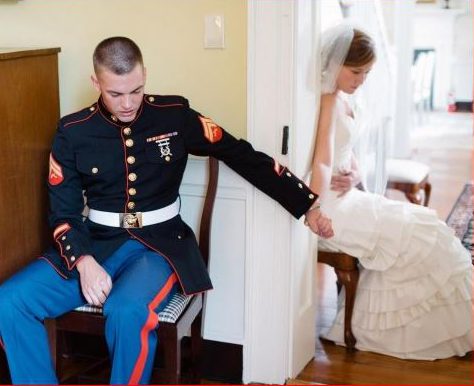
Marine prays with his wife on their wedding day

One of my favorite movies for explaining the differences between men and women is “High Noon” (1952).

Here’s the summary from IMDB:

Former marshal Will Kane (Gary Cooper) is preparing to leave the small town of Hadleyville, New Mexico, with his new bride, Amy (Grace Kelly), when he learns that local criminal Frank Miller has been set free and is coming to seek revenge on the marshal who turned him in. When he starts recruiting deputies to fight Miller, Kane is discouraged to find that the people of Hadleyville turn cowardly when the time comes for a showdown, and he must face Miller and his cronies alone.

The main theme of the film concerns Amy’s decision to break her wedding vows the very day that she makes them. She tells her new husband that he must bow to her will, and give up his male role as protector. When he explains his reasons for standing his ground to her practically (Miller will hunt them down) and morally (he has a duty protect the town), she dismisses both. She tells him that if he doesn’t run away from Miller and his gang with her, that she will get on the train and leave town by herself.

The intro of film shows the member’s of Miller’s gang assembling, and the words of the song explain the central conflict between husband and wife:

Here’s the part of the lyrics we care about:

The noonday train will bring Frank Miller.
If I’m a man I must be brave
And I must face that deadly killer
Or lie a coward, a craven coward,
Or lie a coward in my grave.

O to be torn ‘twixt love and duty!
S’posin’ I lose my fair-haired beauty!
Look at that big hand move along
Nearin’ high noon.

He made a vow while in State’s Prison,
Vow’d it would be my life or his’n
I’m not afraid of death, but O,
What will I do if you leave me?

Do not forsake me O my darlin’
You made that promise when we wed.
Do not forsake me O my darlin’
Although you’re grievin’, I can’t be leavin’
Until I shoot Frank Miller dead.

What’s interesting is that his new wife Amy apparently does not understand the meaning of wedding vows or the natural roles of good men as protectors of the weak, and fighters against evil. Although she vowed to stick by him and help him, the minute anything threatening appears that makes her feel unhappy, she abandons her vows and abandons her man. Let’s break down her mistakes now, using actual conversations from the movie.

First, she doesn’t understand or respect the man she married as a man:

Kane: [while riding out of town] It’s no good. I’ve got to go back, Amy.

Amy: Why?

Kane: This is crazy. I haven’t even got any guns.

Amy: Then let’s go on. Hurry.

Kane: No, that’s what I’ve been thinkin’. They’re making me run. I’ve never run from anybody before.

Amy: I don’t understand any of this.

Kane: [after looking at his vest watch] Well, I haven’t got time to tell ya.

Amy: Then don’t go back, Will.

Kane: I’ve got to. That’s the whole thing. [He turns the buggy around and rides back into town]

Her feelings and her desires for the world to be a happy place for her are so strong that they cloud her judgment.

Second, she doesn’t understand the threat posed by evil men:

More:

Kane: I sent a man up five years ago for murder. He was supposed to hang. But up North, they commuted it to life and now he’s free. I don’t know how. Anyway, it looks like he’s coming back.

Amy: I still don’t understand.

Kane: He was always wild and kind of crazy. He’ll probably make trouble.

Amy: But that’s no concern of yours, not anymore.

Kane: I’m the one who sent him up.

Amy: Well, that was part of your job. That’s finished now. They’ve got a new marshal.

Kane: He won’t be here until tomorrow. Seems to me I’ve got to stay. Anyway, I’m the same man with or without this. [He pins his badge on his vest]

Amy: Oh, that isn’t so.

Kane: I expect he’ll come lookin’ for me. Three of his old bunch are waiting at the depot.

Amy: That’s exactly why we ought to go.

Kane: They’ll just come after us, four of ’em, and we’d be all alone on the prairie.

Amy: We’ve got an hour.

Kane: What’s an hour?…What’s a hundred miles? We’d never be able to keep that store, Amy. They’d come after us and we’d have to run again, as long as we live.

Amy: No we wouldn’t, not if they didn’t know where to find us. Oh Will! Will, I’m begging you, please let’s go.

Kane: I can’t.

Amy: Don’t try to be a hero. You don’t have to be a hero, not for me.

Kane: I’m not trying to be a hero. If you think I like this, you’re crazy.

Instead of recognizing how her feelings are deceiving her about the threat and trusting her husband, she tries to force him to accept her mistaken view of reality by threatening to abandon him.

One of Kane’s ex-girlfriends has a talk with Amy, which helps her to understand who Kane is, and what is expected of her:

Amy: That man downstairs, the clerk, he said things about you and Will. I’ve been trying to understand why he wouldn’t go with me, and now all I can think of is that it’s got to be because of you…Let him go, he still has a chance. Let him go.

Helen: He isn’t staying for me. I haven’t spoken to him for a year – until today. I am leaving on the same train you are…What kind of woman are you? How can you leave him like this? Does the sound of guns frighten you that much?

Amy: I’ve heard guns. My father and my brother were killed by guns. They were on the right side but that didn’t help them any when the shooting started. My brother was nineteen. I watched him die. That’s when I became a Quaker. I don’t care who’s right or who’s wrong. There’s got to be some better way for people to live. Will knows how I feel about it.

Helen: I hate this town. I always hated it – to be a Mexican woman in a town like this.

Amy: I understand.

Helen: You do? That’s good. I don’t understand you. No matter what you say. If Kane was my man, I’d never leave him like this. I’d get a gun. I’d fight.

Amy: Why don’t you?

Helen: He is not my man. He’s yours.

Helen understands the need for a wife to stand by her man. But Amy’s response to evil is to shut her eyes and focus on feeling good and being happy. Notice that her “better way” is unspecified – it’s just a feeling she has that pacificism and no-violence will somehow “work” to stop evil. But in reality, pacifism is not a “better way” of dealing with evil – it does not work. Her pacifist response not only does not make evil go away, it actually encourages more evil. Weakness emboldens evildoers, and laying down your arms provokes them to do more evil. Will Kane knows this, but she won’t listen to him.

You can watch the final gunfight here, as well as Amy’s final decision:

So, this is why I really recommend this movie as a discussion-starter when you like a girl and are thinking of marrying her. It clarifies the essential problem with many young women today not being ready for marriage. To be fair, most women come around to respect their husbands and his different roles after they get married. However, the risk of divorce is so dangerous that it makes sense to bring it up for discussion before the marriage happens. Marriage is supposed to be an engine to serve God, and the success of that enterprise cannot be left to chance. You can’t just rely on the fact that she says the words of the vow, you have to check to see if she has a habit of keeping her promises when it goes against her own self-interest.

Ask yourself: Who are you, as a man? And does your woman accept that you have obligations to stand up to evil and do good ? Will she support you in your battle against evil, or will the marriage just be about her feelings and desires? I would especially beware of women who think that God is speaking to them through their feelings and desires. Look at her friends: are they practical and successful? Or are they irresponsible, unaccountable and reckless? Look at her father: does he have a plan for her, and does he lead her to be practical, frugal and hard-working? If you are not going to get an ally and a supporter in a wife, then you will not be able to serve God well, as a married man. Think about it.