Tag Archives: Radical Feminism

New study: decline in mainline church attendance linked to progressive theology

Church attendance for progressive denominations in free fall

This study was reported in the Weekly Standard, of all places.

Excerpt:

A literal reading of scripture and faith in an interventionist God strengthen church attendance. According to a new academic study of what drives a mainline Protestant church to die out or succeed, preaching these two theological precepts makes all the difference.

The forthcoming article, entitled “Theology Matters,” confirms a truth universally acknowledged, or reasonably intuited anyway. The Christ-optional, Gospel-as-metaphor, liberal-progressive mainline Protestantism borne of our secular age keeps so loose a lock on wandering souls that they wander away—choosing boozy brunch, perhaps, over pew-sitting.

The authors, Drs. David Haskell, Kevin Flatt and Stephanie Burgoyne, used five years’ data gathered from 2,255 attendees of Anglican, Lutheran, Presbyterian and United Church of Canada parishes across the province of Ontario. (The United Church of Canada boasts an ongoing, unsurprising self-parody in an atheist minister no one seems to have ginned up the nerve to defrock.)

Approximately half of the authors’ subjects belong to growing parishes within these three mainline denominations, the other half to shrinking ones. Their most striking survey result finds churchgoers at shrinking parishes more doctrinally committed than their ministers.

That’s true about the atheist woman who is leading one of the denominations into decline:

An ordained minister with the United Church of Canada is resisting efforts to oust her from the pulpit because she is an atheist.

“I don’t believe in … the god called God,” Gretta Vosper told the Globe and Mail. “Using the word gets in the way of sharing what I want to share.”

She said that she believes the Bible is “mythology,” and denies that Jesus is the Son of God.

The United Church of Canada has majored in progressive politics . Progressive politics is more important to them than apologetics and theology. From what I’ve read, their ministers are more likely to affirm the writings of progressive atheists like John Dominic Crossan and Marcus Borg as “infallible” than the Christian Scriptures. We have similar problems in the USA with ELCA, PCUSA, ECUSA, and other far left denominations.

Church attendance by denomination, ages 23-35

Mainline Roman Catholicism, which focuses less on the Bible and more on political goals like Obamacare, climate change alarmism and amnesty is also in decline. They are declining faster than any other denomination.

Here’s a quote from the study that breaks down the theology by change in church attendance:

When asked to agree or disagree with the statement “Jesus rose from the dead with a real, flesh-and-blood body leaving behind an empty tomb” 93% of growing church pastors agreed, 83% of growing church attendees agreed, 67% of declining church attendees agreed, and just 56% of declining church pastors agreed.

When asked if “God performs miracles in answer to prayer” 100% of the growing church pastors agreed, 90% of the growing church attendees agreed, 80% of the declining church attendees agreed, and just 44% of the declining church pastors agreed.

I think the problem is that when a minister quotes the Bible and espouses traditional theology, people can sense that this teaching is from God, because it is at odds with their selfish desires. They understand the authenticity of it, because it calls them higher. Progressives like Greta Vosper tell people that their current sinfulness is just fine, since the goal of spirituality is to look inside yourself for guidance so that you feel good. But does sinfulness really deliver results over the long term? We were designed by God for righteousness, not selfishness. I am pretty sure that Jesus knows a little more about human nature than Greta Vosper does.

Consider the words of Daniel 2:

1 In the second year of his reign, Nebuchadnezzar had dreams; his mind was troubled and he could not sleep.

2 So the king summoned the magicians, enchanters, sorcerers and astrologers to tell him what he had dreamed. When they came in and stood before the king,

3 he said to them, “I have had a dream that troubles me and I want to know what it means.”

4 Then the astrologers answered the king, “May the king live forever! Tell your servants the dream, and we will interpret it.”

5 The king replied to the astrologers, “This is what I have firmly decided: If you do not tell me what my dream was and interpret it, I will have you cut into pieces and your houses turned into piles of rubble.

6 But if you tell me the dream and explain it, you will receive from me gifts and rewards and great honor. So tell me the dream and interpret it for me.”

7 Once more they replied, “Let the king tell his servants the dream, and we will interpret it.”

8 Then the king answered, “I am certain that you are trying to gain time, because you realize that this is what I have firmly decided:

9 If you do not tell me the dream, there is only one penalty for you. You have conspired to tell me misleading and wicked things, hoping the situation will change. So then, tell me the dream, and I will know that you can interpret it for me.”

10 The astrologers answered the king, “There is no one on earth who can do what the king asks! No king, however great and mighty, has ever asked such a thing of any magician or enchanter or astrologer.

11 What the king asks is too difficult. No one can reveal it to the king except the gods, and they do not live among humans.”

12 This made the king so angry and furious that he ordered the execution of all the wise men of Babylon.

13 So the decree was issued to put the wise men to death, and men were sent to look for Daniel and his friends to put them to death.

14 When Arioch, the commander of the king’s guard, had gone out to put to death the wise men of Babylon, Daniel spoke to him with wisdom and tact.

15 He asked the king’s officer, “Why did the king issue such a harsh decree?” Arioch then explained the matter to Daniel.

16 At this, Daniel went in to the king and asked for time, so that he might interpret the dream for him.

17 Then Daniel returned to his house and explained the matter to his friends Hananiah, Mishael and Azariah.

18 He urged them to plead for mercy from the God of heaven concerning this mystery, so that he and his friends might not be executed with the rest of the wise men of Babylon.

19 During the night the mystery was revealed to Daniel in a vision. Then Daniel praised the God of heaven

20 and said:

“Praise be to the name of God for ever and ever;
wisdom and power are his.

21 He changes times and seasons;
he deposes kings and raises up others.
He gives wisdom to the wise
and knowledge to the discerning.

22 He reveals deep and hidden things;
he knows what lies in darkness,
and light dwells with him.

23 I thank and praise you, God of my ancestors:
You have given me wisdom and power,
you have made known to me what we asked of you,
you have made known to us the dream of the king.”

24Then Daniel went to Arioch, whom the king had appointed to execute the wise men of Babylon, and said to him, “Do not execute the wise men of Babylon. Take me to the king, and I will interpret his dream for him.”

25 Arioch took Daniel to the king at once and said, “I have found a man among the exiles from Judah who can tell the king what his dream means.”

26 The king asked Daniel (also called Belteshazzar), “Are you able to tell me what I saw in my dream and interpret it?”

27 Daniel replied, “No wise man, enchanter, magician or diviner can explain to the king the mystery he has asked about,

28 but there is a God in heaven who reveals mysteries. He has shown King Nebuchadnezzar what will happen in days to come. Your dream and the visions that passed through your mind as you were lying in bed are these:

29 “As Your Majesty was lying there, your mind turned to things to come, and the revealer of mysteries showed you what is going to happen.

30 As for me, this mystery has been revealed to me, not because I have greater wisdom than anyone else alive, but so that Your Majesty may know the interpretation and that you may understand what went through your mind.

People can see right through progressive “spirituality”. They see that this is man-made humanism designed to make people feel better. They know that this is just one person’s opinion, and not from God. The blind leading the blind, as the Bible says. Greta Vosper isn’t deriving her worldview from a truth-centered investigation of science, history or logic. It’s feelings all the way down, and that’s not useful to people who are looking for objective truth and purpose.

Debating forgiveness: must a person admit wrongdoing before being forgiven?

Two horses fight it out, may the best horse win!

I’ve listened to this debate three times because I liked it so much. I even ordered Chris’ book for my best friend Dina. She has listened to the debate, and is currently split between the two debaters. I am in firm agreement with the pastor Chris, although Remy has some useful things to say that I agree with.

Here’s a link to the debate page on Moody Bible Institute’s “Up For Debate” program with Julie Roys.

Details:

Should Christians Forgive No Matter What?

Should Christians forgive someone even if he’s not sorry?  Or does true forgiveness require repentance and a desire to reconcile?  This Saturday, on Up For Debate, Julie Roys will explore this issue with Chris Brauns, a pastor who believes forgiveness requires repentance, and Remy Diederich who believes it does not.

Although I disagree with Remy, I only disagree with him about whether the guilty person must admit guilt and feel remorse and make restitution (depending on the severity of the offense). I agree with him on other things like no revenge, attitude of love, expressing willingness to forgive and be reconciled, etc. I also disagree with Remy on “forgiving God”, which I think is just crazy, because when God is engineering a person’s salvation, he never fails. I think that God is the Great General, and his strategies never fail to achieve the outcomes he desires (while still respecting free will). Whatever suffering or inadequacy or longing that you experience as a Christian is not some sort of mistake, horrible as it may be for you at the time. God is not your cosmic butler, although a lot of people these days seem to think that he is, and then they get disappointed.

Anyway, please listen to that debate and comment on it about who you think is right. I think my view (and Chris’ view) is in the minority in the church, because the church is so utterly dominated by feelings and radical feminism. I think my view (and Chris’ view) is the masculine view – the view that upholds moral standards, sets moral boundaries and defends the rightness of making moral judgments.

Below, I have pasted in some of my other thoughts on forgiveness from a previous post.

I think this is the key passage – Luke 17:3-4:

Be on your guard! If your brother sins, rebuke him; and if he repents, forgive him.

And if he sins against you seven times a day, and returns to you seven times, saying, ‘I repent,’ forgive him.”

That’s Jesus speaking, there.

Also, I was having a debate with someone who disagrees with all this, and while debating with her, I thought of another example.

Luke 18:9-14:

And He also told this parable to some people who trusted in themselves that they were righteous, and viewed others with contempt:

10 “Two men went up into the temple to pray, one a Pharisee and the other a tax collector.

11 The Pharisee stood and was praying this to himself: ‘God, I thank You that I am not like other people: swindlers, unjust, adulterers, or even like this tax collector.

12 I fast twice a week; I pay tithes of all that I get.’

13 But the tax collector,standing some distance away, was even unwilling to lift up his eyes to heaven, but was beating his breast, saying, ‘God, be merciful to me, the sinner!’

14 I tell you, this man went to his house justified rather than the other; for everyone who exalts himself will be humbled, but he who humbles himself will be exalted.”

So again, no forgiveness without repentance.

Forgiveness is what happens when someone who is sinned against treats the sinner as if he had never sinned. It is not on the balance sheet. It is not brought to mind. It is not held against them in the future. The forgiver trusts the sinner again as if the previous sin had never happened.

In divine (vertical) forgiveness, there is no forgiveness without repentance. There are Bible verses above to show that.

My argument is twofold. First, there is a clear teaching of Jesus explaining the sequence of sin and forgiveness. Repentance precedes forgiveness, between humans (Luke 17:3). The verses cited by the forgive without repentance crowd don’t show the mechanics of how to forgive, they are making the point that if you want God to forgive you, you should forgive others. The parable in Luke 18:9-14 affirms this again – repentance always precedes forgiveness.

Second, we have an obligation to imitate God, and that means imitating the way he forgives those who sin against him. When I raise that with the unconditional forgiveness crowd, they want to insist that there is a difference, that the word “forgive” means different things. I’m not convinced.

Finally, I do think that forgiving someone is obligatory if they sincerely repent, and even if they screw up again and again. So long as the repentance is sincere, (like if there is restitution and a genuine effort to show an understanding how the sin affected the wronged party in writing), then forgiveness should be automatic. Depending on how bad the sin is, there maybe be more to do than just say “I’m sorry”. If the repentance is genuine, then I think the person who is sinned against must forgive, if they expect to be forgiven by God for the things they repent of.

Alan E. Kurschner adds one final point about the unconditional forgiveness view. He argues that there is serious textual doubt about the originality of Luke 23:34a, a text used by the pro-unconditional-forgiveness crowd. He has a journal article coming out on it, but a synopsis of his argument is here.

He also wrote this in a comment on this blog:

Second, on Matt 6:15, this is what I have to say. Notice the then-clause: “neither will your Father forgive your sins.” This would require universalism on the Father’s part according to the unconditional interpretation given the first half: “But if you do not forgive others their sins.” Since everyone has wronged the Father is the Father required to forgive everyone even if they are not seeking forgiveness?

So I think the case for the forgiveness being conditional on repentance is pretty strong, especially when serious harm has been caused.

Survey of scientific literature finds that children need their mom for first 3 years

Child grabs for his mom, who is leaving for work

Recently, an article published in the Wall Street Journal reported on research survey done why a far-left Democrat psychotherapist based in far-left New York City. Surprisingly, her book caused an uproar among the author’s left-wing allies. How come?

Excerpt:

Motherhood used to be as American as apple pie. Nowadays it can be as antagonistic as American politics. Ask Erica Komisar.

Ms. Komisar, 53, is a Jewish psychoanalyst who lives and practices on the Upper West Side of Manhattan. If that biographical thumbnail leads you to stereotype her as a political liberal, you’re right. But she tells me she has become “a bit of a pariah” on the left because of the book she published this year, “Being There: Why Prioritizing Motherhood in the First Three Years Matters.”

[…]The premise of Ms. Komisar’s book—backed by research in psychology, neuroscience and epigenetics—is that “mothers are biologically necessary for babies,” and not only for the obvious reasons of pregnancy and birth. “Babies are much more neurologically fragile than we’ve ever understood,” Ms. Komisar says. She cites the view of one neuroscientist, Nim Tottenham of Columbia University, “that babies are born without a central nervous system” and “mothers are the central nervous system to babies,” especially for the first nine months after birth.

What does that mean? “Every time a mother comforts a baby in distress, she’s actually regulating that baby’s emotions from the outside in. After three years, the baby internalizes that ability to regulate their emotions, but not until then.” For that reason, mothers “need to be there as much as possible, both physically and emotionally, for children in the first 1,000 days.”

What’s interesting about this is how the left responds to the science. You might have heard that the left is very fond of science, but veterans of debates about God’s existence know that people on the left tend to be hostile to science that goes against their view: the Big Bang cosmology, cosmic fine-tuning, biological information, irreducible complexity, molecular machines, habitability, etc. And early childhood education is no exception.

More:

Christian radio stations “interviewed me and loved me,” she says. She went on “Fox & Friends,” and “the host was like, your book is the best thing since the invention of the refrigerator.” But “I couldn’t get on NPR,” and “I was rejected wholesale—particularly in New York—by the liberal press.” She did appear on ABC’s “Good Morning America,” but seconds before the camera went live, she says, the interviewer told her: “I don’t believe in the premise of your book at all. I don’t like your book.”

[…]Ms. Komisar tells of hosting a charity gathering for millennials at her apartment. One young woman “asked me what my book was about. I told her, and she got so angry. She almost had fire coming out of her eyes, she was so angry at my message. She said, ‘You are going to set women back 50 years.’ I said, ‘Gosh, I wouldn’t want to do that.’ ”

[…]The needs of children get lost in all this—and Ms. Komisar hears repeatedly that the hostility to her message is born of guilt. When she was shopping for a literary agent, she tells me, “a number of the agents said, ‘No, we couldn’t touch that. That would make women feel guilty.’ ” Another time she was rejected for a speaking gig at a health conference. She quotes the head of the host institution as telling her: “You are going to make women feel badly. How dare you?”

[…]“The thing I dislike the most is day care,” she says. “It’s really not appropriate for children under the age of 3,” because it is “overstimulating” given their neurological undevelopment. She cites the “Strange Situation experiments,” devised in 1969 by developmental psychologist Mary Ainsworth, a pioneer of attachment theory: “A mother and the baby are on the floor playing. The mother gets up and leaves the baby in the room alone. The baby has a separation-anxiety response. A stranger walks in; the baby has a stressed reaction to the stranger.”

[…]Researchers sample the infant’s saliva and test it for cortisol, a hormone associated with stress (and inversely correlated with oxytocin). In a series of such experiments in which Ms. Komisar herself participated, “the levels were so high in the babies that the anticipation was that it would . . . in the end, cause disorders and problems.” In a more recent variant of the experiment, scientists use functional magnetic resonance imaging to look directly at the brain of an infant reacting to photos of the mother and of a stranger.

I spoke to a millennial co-worker in my office who is very proud of his strong feminist views. His wife just had a baby, and they stuck the baby in daycare after 3 months so that she could go back to work. I did speak to him about what the research says (daycare and public school studies are a hobby of mine!), but I try to only disagree with him on one thing at a time, and right now, we’re disagreeing about cohabitation and marital stability. It’s amazing how confident millennials are about taking positions on things like daycare, cohabitation, public schools, etc. without ever having consulted the relevant peer-reviewed science.

Let’s look at one of the studies, to see some evidence.

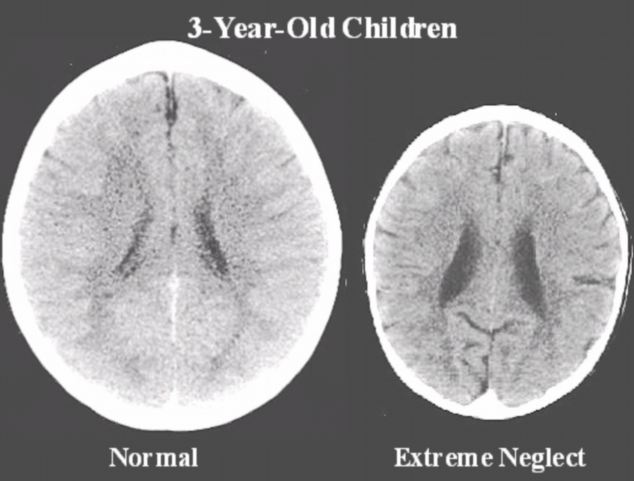
Brain scans of 3-year old children: normal vs neglected

The UK Telegraph reported on a recent study that measured the brain development of 3-year-old children.

Excerpt:

Take a careful look at the image of two brains on this page. The picture is of the brains of two three-year-old children. It’s obvious that the brain on the left is much bigger than the one on the right. The image on the left also has fewer spots, and far fewer dark “fuzzy” areas.

To neurologists who study the brain, and who have worked out how to interpret the images, the difference between these two brains is both remarkable and shocking. The brain on the right lacks some of the most fundamental areas present in the image on the left. Those deficits make it impossible for that child to develop capacities that the child on the left will have: the child on the right will grow into an adult who is less intelligent, less able to empathise with others, more likely to become addicted to drugs and involved in violent crime than the child on the left. The child on the right is much more likely to be unemployed and to be dependent on welfare, and to develop mental and other serious health problems.

[…]The primary cause of the extraordinary difference between the brains of these two three-year-old children is the way they were treated by their mothers. The child with the much more fully developed brain was cherished by its mother, who was constantly and fully responsive to her baby.

The child with the shrivelled brain was neglected and abused. That difference in treatment explains why one child’s brain develops fully, and the other’s does not.

[…]Professor Allan Schore, of UCLA, who has surveyed the scientific literature and has made significant contributions to it, stresses that the growth of brain cells is a “consequence of an infant’s interaction with the main caregiver [usually the mother]”.

The growth of the baby’s brain “literally requires positive interaction between mother and infant. The development of cerebral circuits depends on it.”

Prof Schore points out that if a baby is not treated properly in the first two years of life, the genes for various aspects of brain function, including intelligence, cannot operate, and may not even come into existence. Nature and nurture cannot be disentangled: the genes a baby has will be profoundly affected by the way it is treated.

I always like to consult the findings of science to find out the right way to achieve a goal. This puts off some prospective mates, who want to avoid planning and preparation so they can ride a roller-coaster of emotions and just do whatever they want to be happy in the moment. But in every other area of life, I’ve found that doing things the right way always involves studying and planning, then careful execution of a plan. Nobody passes an exam by going clubbing when they should be studying. Going clubbing is more fun “in the moment”, but studying always gets better results.

In this case, it’s very clear that keeping a mother at home for the first three years of each child would require some earning and saving by me, since men are the principal providers. And I expect that women who are looking for husbands to raise their children with will look for men who have made preparations to give the young children what they need. Not everything a man does is about looks and fun – there are real requirements here. It’s very important for young people to prepare for marriage and raising children by working backward from what the science says about children’s needs.

The more you read about the science, the less wiggle-room there is for feelings. Doing the right thing (saving money for a stay-at-home mom) is hard because it feels bad. But when you inform yourself with science, it makes it easier to override your bad feelings, because you know you’re doing the right thing to achieve a result. If you can’t bring yourself to prepare now to do things right later, then you should read more science, and that might make it easier to do the right thing.