Tag Archives: Radical Feminism

Most Americans think cohabitation leads to a stable marriage, but what does the data say?

Men who cohabitate are not certain that the relationship is permanent

If there’s one thing that ought to lead people to Christianity, it’s the proven ability of the Christian moral rules to guide believers away from the sins that destroy them. A lot of modern “Christians” have reduced Christianity to being about their feelings and their community, while allowing the culture to determine their goals and moral boundaries. But that won’t protect them from danger.

Cohabitation describes the situation of a couple moving into the same home and being sexually active, but without any legally-recognized commitment. It’s extremely popular among young people today, and even Christians.

Consider this article from The Federalist about cohabitation:

A new Pew Research Center study shows Americans both cohabitate (“live with an unmarried partner”) and find cohabitation acceptable more than before.

[…]More young adults have cohabited than have married. Pew’s analysis in the summer of 2019 of the National Survey of Family Growth found that, for the first time ever, the percentage of American adults aged 18-44 who have ever cohabited with a partner (59 percent) exceeded the percentage of those who have ever married (50 percent).

I thought this was very interesting, especially for the Christian parents and pastors who imagine that their lovely pious daughters all have a Christian worldview just because they sing in the church choir:

Just 14 percent hold a view consistent with a biblical sexual ethic, that cohabitation with an unmarried romantic partner outside of marriage is “never acceptable.”

Just to be clear, in my life I’ve met about 6 non-Christian men who cohabitated with women, and every single one of them cohabitated with a Christian-raised woman. That should tell you what young women are being told about relationships in their homes and churches about sex and marriage. “Do whatever you want”.

So what purpose does cohabitation serve?

A majority of Americans (69 percent) say that “it is acceptable for an unmarried couple to live together even if they don’t plan to get married.” They may assume that they can decrease their chances of a bad marriage and increase their chances of a good one by giving the relationship a cohabitation “test run.”

[…]A plurality of Americans believe cohabitating before marriage yields more successful unions. Nearly half of Americans (48 percent) believe that couples who live together before marriage “have a better chance of having a successful marriage.” This view is even more prevalent among young adults aged 18-29 (63 percent).

Another 38 percent of all Americans say cohabitation “doesn’t make much difference” on marital success. Only 13 percent of Americans believe cohabiting couples have “a worse chance” of having a successful marriage.

[…]Most Americans believe cohabitating couples raise children just as well as married couples. Pew also surveyed people’s opinions about cohabiting couples raising children, and 59 percent of Americans declared that cohabiting couples “can raise children just as well as married couples.” Again, the younger respondents were most likely to have a favorable view of cohabitation: among adults aged 18 to 49, 67 percent agreed cohabiting couples do just as well, while 32 percent said: “Married couples do a better job raising children.”

Yes, cohabitation seen as a test run, and it’s supposed to make stable marriage more likely and not be harmful to children at all.

But why think that a test run should be part of getting married? After all, when I buy a parrot from the pet store, I don’t expect to later return that parrot. Why not? Because I am not buying the parrot to enhance MY life. I am buying the parrot to make a commitment to care for the parrot. Whether the parrot fulfills any of my needs is irrelevant to me. I want the bird in my house so that I can decide what it eats, what it drinks, and invest myself into making it happy, according to its birdish nature. This is because I think that parrots have value in and of themselves, and they deserve a certain quality of life. When I buy the parrot, I am guaranteeing a permanent commitment to the bird to provide for its needs, physical and emotional. And that commitment carries forward to the time (now) when the bird is elderly, and can’t even fly up to his cage or down to the floor. He calls for me, and I go over and pick him up and move him. That’s commitment.

Cohabitation, on the other hand, is the practice of saying to another human being: “I am going to try you out as an entertaining commodity in my home, but if you don’t fulfill my needs then I’m going to send you right back.” That’s not a commitment. That’s self indulgence. It’s defining a relationship as entertainment that is designed to meet my needs and make me happy. And that’s because the concept of commitment in relationships is not presented to young people at any time in their lives. Not from parents. Not in churches. Not in the secular left culture as a whole. Everything is a consumer good designed for the purpose of entertainment – including people. It was only the Christian worldview that had a view of people as creatures made by God for eternal life, so that marriage was about guarding the other person’s faith, and building them up to achieve all the things that God wanted them to achieve for his purposes.

But does cohabitation really work to create stable relationships? After all, anyone can find a partner when they’re young and pretty. The real question is whether that partner will stick around when you’re old and ugly and can’t be as “fun” as you used to be.

Here’s a recent (2018) study on cohabitation and stability:

A new study published in the Journal of Marriage and Family finds that the “premarital cohabitation effect” lives on, despite what you’ve likely heard. The premarital cohabitation effect is the finding that those who live together prior to marriage are more likely, not less, to struggle in marriage.

[…]Michael Rosenfeld and Katharina Roesler’s new findings suggest that there remains an increased risk for divorce for those living together prior to marriage, and that prior studies suggesting the effect has gone away had a bias toward short versus longer-term effects. They find that living together before marriage is associated with lower odds of divorce in the first year of marriage, but increases the odds of divorce in all other years tested, and this finding holds across decades of data.

Strategy advice to those who debate this issue: just be aware that Team Secular Leftist is using papers that have short-range samples, which don’t show the instability problem, because they deliberately cherry-pick recently married couples.

And what about children raised in cohabitating relationships?

While Americans are optimistic about the ability of cohabiting couples to raise children, a study published by the American College of Pediatricians in 2014 reported that children whose parents cohabit face a higher risk of: “premature birth, school failure, lower education, more poverty during childhood and lower incomes as adults, more incarceration and behavior problems, single parenthood, medical neglect and chronic health problems both medical and psychiatric, more substance, alcohol and tobacco abuse, and child abuse,” and that “a child conceived by a cohabiting woman is at 10 times higher risk of abortion compared to one conceived in marriage.”

I’m just going to be blunt here. The majority of young people are progressives, and they vote for candidates who believe in abortion through all nine months of pregnancy, and even after birth. Why? Because they don’t want to have their right to seek happiness impacted by the needs of other people. Progressives believe that children, if they exist at all, should enhance the lives of their adult owners. No one should be surprised that people who think that killing inconvenient children is moral are willing to inflict other bad outcomes on them by raising them in an unstable cohabitation environment.

New study: virgins have happiest marriages, more sex partners means more unhappiness

Although we live in a culture that is dominated by the thoughts and opinions of secular leftists, science provides useful information for those who want defend Biblical morality. Consider the issue of sexuality and marriage. Secular leftists claim that sex outside of marriage is natural, and produces happiness. Bible believing Christians and Jews say chastity is best. Who is right?

Here is the latest study authored by Dr. Nicholas Wolfinger, a sociologist at the University of Utah. His previous book on relationships was published by Oxford University Press. In his analysis of the data, Wolfinger controlled for divorce rates, religiosity, and socioeconomic status.

Here’s the most important graph:

Study: virgins have the happiest marriages, more partners means less happiness

Other factors that increased marital happiness: having a 4-year college degree (5%), having a salary > 78K (5%), regular church attendance (6%). Notice that women are more dissatisfied with marriage (in general) than men are, and they tend to blame the spouse they freely chose for that unhappiness.

The Federalist also reported on previous research relevant to this study:

Psychologists Galena K. Rhoades and Scott M. Stanley found that women who have had sex with someone other than their husband report statistically significant drops in marital quality over those who don’t. A 2004 study by sociologist Jay Teachman showed that intimate premarital activities such as cohabitation and intercourse increased the rate of marital dissolution by anywhere between 28 and 109 percent, depending on the activity.

Wolfinger also noted in a previous study that only 5% of women were virgins when they married.

Wolfinger noted that a possible explanation for the link between promiscuity and unhappiness is that people look back on their past partners and compare their spouse unfavorably to them. This is especially the case with women. My concern about this is that feminism has taught women to try to increase their social standing by having hook-up sex with attractive bad boys. If those women ever marry, they do it when they are older, less fertile, and less attractive. The husband they eventually “settle” for will (in their minds) always compare unfavorably to the hot bad boys they had sex with when they were younger and prettier. This, I believe, is what leads to their unhappiness with the man they chose to marry.

More partners also means more marital instability

In a previous post, I blogged about several studies linking virginity to marital stability. Couples who don’t have sex before marriage, or even who delayed it, reported better communication, higher satisfaction, better quality sex, and a lower chance of divorce.

Men ought to be aware of this research when they are choosing a spouse. Obviously, you want a virgin, for the increased happiness and increased stability. For marriage-friendly character, you want to avoid women who are promiscuous thrill-seekers. You want to avoid women who run up debt doing easy non-STEM degrees and traveling. You want to avoid women who hook up with hot bad boys aren’t serious about commitment. Women who choose fun and thrills in their teens and 20s are setting a pattern of using sex as a way to get happiness in the moment. Later on, they’ll continue that pattern of seeing relationships as commodities that are designed to make them feel good, moment by moment. They’ll look at marriage as a way to fulfill their needs. They’ll have internalized the view that relationships are not commitments to invest in self-sacrificially. The pattern will be: “if it doesn’t make me feel happy right now, then it should be ended”. Men who aren’t serious about evaluating the character of the women for the marriage enterprise are running the risk of divorce, it’s that simple.

The best way to make sure that you have a clear head when evaluating a woman is to stay sober, and keep her hands off of you. When a man refuses to let a woman cloud his judgment with sex, then she is forced to learn how to love him, help him, and submit to his leadership. Male chastity encourages women who have been influenced by feminism to abandon selfishness, fun-seeking, and thrill-seeking, so that they learn to care for others. Male chastity also helps a man to resist older women who chose bad boys in their teens and 20s and want to get married to a good provider in their 30s. The studies discussed above clearly show that such women are more likely to be unhappy, and their future marriages are more likely to be unstable. Avoid them.

Survey of scientific literature finds that children need their mom for first 3 years

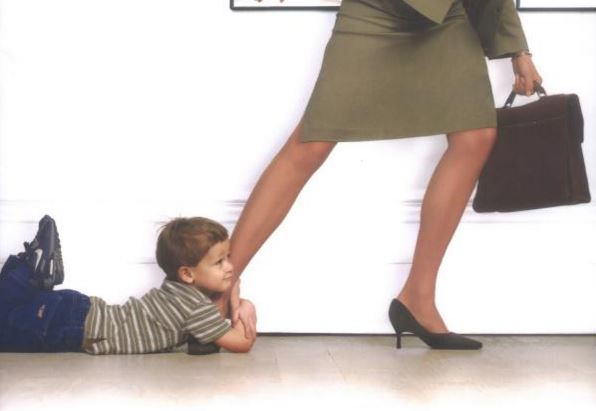
Child grabs for his mom, who is leaving for work

Recently, an article published in the Wall Street Journal reported on a research survey done by a far-left Democrat psychotherapist based in far-left New York City. Surprisingly, her book caused an uproar among the author’s left-wing allies. How come?

Excerpt:

Motherhood used to be as American as apple pie. Nowadays it can be as antagonistic as American politics. Ask Erica Komisar.

Ms. Komisar, 53, is a Jewish psychoanalyst who lives and practices on the Upper West Side of Manhattan. If that biographical thumbnail leads you to stereotype her as a political liberal, you’re right. But she tells me she has become “a bit of a pariah” on the left because of the book she published this year, “Being There: Why Prioritizing Motherhood in the First Three Years Matters.”

[…]The premise of Ms. Komisar’s book—backed by research in psychology, neuroscience and epigenetics—is that “mothers are biologically necessary for babies,” and not only for the obvious reasons of pregnancy and birth. “Babies are much more neurologically fragile than we’ve ever understood,” Ms. Komisar says. She cites the view of one neuroscientist, Nim Tottenham of Columbia University, “that babies are born without a central nervous system” and “mothers are the central nervous system to babies,” especially for the first nine months after birth.

What does that mean? “Every time a mother comforts a baby in distress, she’s actually regulating that baby’s emotions from the outside in. After three years, the baby internalizes that ability to regulate their emotions, but not until then.” For that reason, mothers “need to be there as much as possible, both physically and emotionally, for children in the first 1,000 days.”

What’s interesting about this is how the left responds to the science. They don’t want to see anything that challenges their desires to focus on fun in the short-term, but have marriage and successful children in the long-term.

More:

Christian radio stations “interviewed me and loved me,” she says. She went on “Fox & Friends,” and “the host was like, your book is the best thing since the invention of the refrigerator.” But “I couldn’t get on NPR,” and “I was rejected wholesale—particularly in New York—by the liberal press.” She did appear on ABC’s “Good Morning America,” but seconds before the camera went live, she says, the interviewer told her: “I don’t believe in the premise of your book at all. I don’t like your book.”

[…]Ms. Komisar tells of hosting a charity gathering for millennials at her apartment. One young woman “asked me what my book was about. I told her, and she got so angry. She almost had fire coming out of her eyes, she was so angry at my message. She said, ‘You are going to set women back 50 years.’ I said, ‘Gosh, I wouldn’t want to do that.’ ”

[…]The needs of children get lost in all this—and Ms. Komisar hears repeatedly that the hostility to her message is born of guilt. When she was shopping for a literary agent, she tells me, “a number of the agents said, ‘No, we couldn’t touch that. That would make women feel guilty.’ ” Another time she was rejected for a speaking gig at a health conference. She quotes the head of the host institution as telling her: “You are going to make women feel badly. How dare you?”

[…]“The thing I dislike the most is day care,” she says. “It’s really not appropriate for children under the age of 3,” because it is “overstimulating” given their neurological undevelopment. She cites the “Strange Situation experiments,” devised in 1969 by developmental psychologist Mary Ainsworth, a pioneer of attachment theory: “A mother and the baby are on the floor playing. The mother gets up and leaves the baby in the room alone. The baby has a separation-anxiety response. A stranger walks in; the baby has a stressed reaction to the stranger.”

[…]Researchers sample the infant’s saliva and test it for cortisol, a hormone associated with stress (and inversely correlated with oxytocin). In a series of such experiments in which Ms. Komisar herself participated, “the levels were so high in the babies that the anticipation was that it would . . . in the end, cause disorders and problems.” In a more recent variant of the experiment, scientists use functional magnetic resonance imaging to look directly at the brain of an infant reacting to photos of the mother and of a stranger.

You’d think that people would be happy to find out how the world works, and adjust their decisions to match. But they’re not. The only good evidence is evidence that confirms their desires and ideology.

Let’s look at one of the studies, to see some evidence.

Brain scans of 3-year old children: normal vs neglected

The UK Telegraph reported on a recent study that measured the brain development of 3-year-old children.

Excerpt:

Take a careful look at the image of two brains on this page. The picture is of the brains of two three-year-old children. It’s obvious that the brain on the left is much bigger than the one on the right. The image on the left also has fewer spots, and far fewer dark “fuzzy” areas.

To neurologists who study the brain, and who have worked out how to interpret the images, the difference between these two brains is both remarkable and shocking. The brain on the right lacks some of the most fundamental areas present in the image on the left. Those deficits make it impossible for that child to develop capacities that the child on the left will have: the child on the right will grow into an adult who is less intelligent, less able to empathise with others, more likely to become addicted to drugs and involved in violent crime than the child on the left. The child on the right is much more likely to be unemployed and to be dependent on welfare, and to develop mental and other serious health problems.

[…]The primary cause of the extraordinary difference between the brains of these two three-year-old children is the way they were treated by their mothers. The child with the much more fully developed brain was cherished by its mother, who was constantly and fully responsive to her baby.

The child with the shrivelled brain was neglected and abused. That difference in treatment explains why one child’s brain develops fully, and the other’s does not.

[…]Professor Allan Schore, of UCLA, who has surveyed the scientific literature and has made significant contributions to it, stresses that the growth of brain cells is a “consequence of an infant’s interaction with the main caregiver [usually the mother]”.

The growth of the baby’s brain “literally requires positive interaction between mother and infant. The development of cerebral circuits depends on it.”

I like bringing science to bear on moral issues. The more you read about the science, the less wiggle-room there is for feelings. Doing the right thing (e.g. – saving money for a stay-at-home mom) is hard because it feels bad. But when you inform yourself with science, it makes it easier to override your bad feelings, because you know you’re doing the right thing to achieve a result.