
Tag Archives: Radical Feminism

Should Christians be motivated by the fear of missing out (FOMO)?

Bible study that hits the spot

My best friend Dina and I recently spent some time talking over some articles that we found on the culture. We specifically talked about what is motivating young people, so I wanted to write something about that.

FOMO: Fear Of Missing Out

Here’s a leftist New York Times article explaining where FOMO comes from:

It’s known as FOMO, or “fear of missing out,” and refers to the blend of anxiety, inadequacy and irritation that can flare up while skimming social media like Facebook, Twitter, Foursquare and Instagram. Billions of Twitter messages, status updates and photographs provide thrilling glimpses of the daily lives and activities of friends, “frenemies,” co-workers and peers.

[…]When we scroll through pictures and status updates, the worry that tugs at the corners of our minds is set off by the fear of regret, according to Dan Ariely, author of “Predictably Irrational” and a professor of psychology and behavioral economics at Duke University. He says we become afraid that we’ve made the wrong decision about how to spend our time.

[…]A friend who works in advertising told me that she felt fine about her life — until she opened Facebook. “Then I’m thinking, ‘I am 28, with three roommates, and oh, it looks like you have a precious baby and a mortgage,’ ” she said. “And then I wanna die.”

It’s like they want to run a race to do fun and exotic things with their peers, and not finish last.

Anyway, I want to begin this post with examples of FOMO behavior I have personally encountered.

FOMO Travel

Dina and I read and discussed this article by Alain de Botton in The European – notice the emphasis on travel and having fun, sophisticated experiences:

We’re continually being bombarded with suggestions about what we might do (go jet skiing, study in Colorado, visit the Maldives or see the Pyramids). We’re always hearing of the amazing things friends have done or are going to do: ‘there was this great bar we all went to …’; ‘she’s getting married in a little country church, then we’re having a picnic…’; ‘the sun was glinting on Sydney Harbour…’ There are endless hints of the allure of life in other places: an article about family-friendly restaurants in Brooklyn, a crime novel set in Trieste, the departure board at the airport with its list of places only a plane trip away: Moscow, Bangkok, Addis Ababa… The modern world makes sure we know at all times just how much we’re missing. It is a culture in which intense and painful doses of FOMO (Fear Of Missing Out) are almost inevitable.

What’s interesting is this – how does FOMO travel affect young, unmarried Christians?

Travel through missions work seems to be the FOMO activity of choice for at least a few young, unmarried Christians. One of my best friends who is married to another of my best friends told me about her missions trip to a European country. I asked her why she did it, since it meant lost savings, lost earnings, lost work experience, etc. (She gave up a year of earnings, and she had a great job in engineering). Her answer was that she did it for the adventure. I have a hard time hearing Jesus say that he was going to do something because he was bored and wanted an adventure. Especially when it’s $30,000 in costs, $60,000 of lost income, and lost work experience – per year. This was before the time of the Internet, though, when missionary work actually made sense. I just don’t think it’s worth spending that kind of money for the impact you make. The people I know who went on missionary trips just wanted to feel spiritual, look spiritual, and have a fun “life experience” vacation. One missionary told me that she was desperate to get away from her boring mid-Western roots.

If you really want to share Christ effectively with people in other countries, then you can start a blog and pay the tiny costs for it out of your earnings from your day job – that’s what I do. I get more people from Europe reading my blog than I could contact in a year of missionary work. I Skype with the people who are interested in Christianity from these countries (Scotland, Northern Ireland, England, Canada, etc.), as well. Meanwhile, I keep working my not-exciting job, so my savings increase, and my resume remains gap-less. This is good stewardship of finances, and self-denial prepares your character for the hard work of marriage and parenting. The Bible says that those who do not work should not eat. And Paul says that he built tents so that no one could accuse him of taking on missionary work for financial gain.

You can tell whether a person is sincere in their missionary intentions by looking at how responsible they’ve been in their decision-making. If a person has gone into debt paying for fun, thrilling activities like skydiving, ziplining, surfing, etc., then it’s FOMO travel. We must look past the spiritual smokescreen, and tell young people to grow up.

After all, if defending God’s honor was the missionary’s main goal, then the real battlefield would be the university.

Bill Craig puts it best:
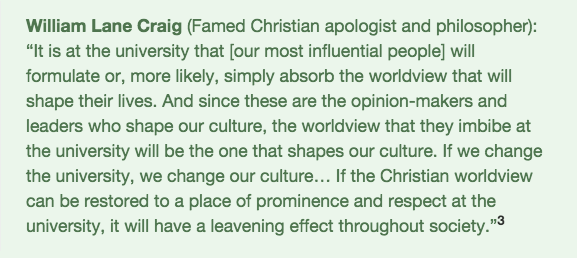
If serving God is your goal, look to the university

There is already a perfectly fine university right next door – no need to fly to Europe to find one! Remember, the university that took your faith away, or maybe the faith of someone you cared about? Yeah, it’s still sitting there in your home town! And it’s still ruining the lives of thousands of young people, by peer-pressuring them into secular, liberal views – and behaviors. It seems to me that it’s better stewardship to stay here and work, then give money to groups like Reasonable Faith. And you can start a blog, teach in church and invite scholars to the local university, too. That costs almost nothing, and it produces better results.

What about Jesus?

Sometimes, it’s a good idea to look beyond the words of the Bible and reflect on the overall message of it at a higher level. When I look in the Bible, I see that Jesus went through a lot of suffering in obedience to God in order to secure the salvation of people who did not even like him. And it’s from this sacrifice on our behalf that his claim on our obedience comes. There are things that I don’t like to do that I do anyway because they work to serve God. Jesus life’s ambition was not to do things that were easy, or that made him happy. Experienced Christians do things that are not fun, because these things are right and because they solve the real problem.

New study: college students drink more before casual sex than relationship sex

Sex events measured against intimacy level (for women only)

It turns out that college students use MORE alcohol and drugs when they have sex with strangers, and LESS alcohol and drugs when they have sex with people they are in a relationship with.

This study was reported by the far-left Psychology Today.

Excerpt:

A recent study published in the Journal of Sex Research sheds some light on these questions. A research team headed by Jennifer Walsh analyzed alcohol use in almost 500 casual and 1400 romantic sexual intercourse events that happened to 300 college women on a monthly basis over a period of 12 months. Alcohol use was not very common during romantic sex: 20% of romantic encounters involved some drinking and only 5% involved heavy drinking (defined as four or more drinks). Hookups, on the other hand, were a different story: Women drank during 53% of their hookups, and drank heavily during 38% of all hookups.

But not all hookups are created equal. There was an almost perfect linear relationship between drinking and partner closeness: The less known the partner, the more likely women drank before sex, and the more likely they drank a lot. Look at the graph I created based on their data. When the casual partner was an ex-boyfriend, for example, only 30% of hookups involved drinking and 17% heavy drinking. When the partner was a random stranger, however, 89% of hookups involved drinking and 63% involved four or more drinks!

The writer explains why this happens:

Alcohol also provides an excuse to those who need one. In a world that encourages hooking up but also judges those (especially women) who engage in it too much, many seem to need it. You’re a slut if you hook up with people just because you want to: Good girls don’t actively want to hook up, and being sober means taking full responsibility for your actions. But if you can blame it on the alcohol, you’re absolved of guilt. You can still be a good girl who just happened to make a mistake.

This study agrees with a study I blogged about before from the University of Virginia, which explained that college students drink before hook-ups in order to be able to explain to their friends why it wasn’t their fault:

A Rutgers University student commented, “If you’re drinking a lot it’s easier to hook up with someone… [and] drugs, it’s kind of like a bonding thing… and then if you hook up with them and you don’t want to speak to them again, you can always blame it on the drinking or the drugs.”

Other women observed that being drunk gives a woman license to act sexually interested in public in ways that would not be tolerated if she were sober. For instance, a University of Michigan student said, “Girls are actually allowed to be a lot more sexual when they are drunk…”

A University of Chicago junior observed, “One of my best friends… sometimes that’s her goal when we go out. Like she wants to get drunk so I guess she doesn’t have to feel guilty about [hooking up].”

Now, the first thing I thought of when I saw this article in Psychology Today was: “I wonder what criteria these college students are using in order to decide which strangers they have sex with”. And then I realized. For perfect strangers, it would have to be something obvious, like physical appearance. A study found that it takes a woman 3 minutes to decide if she likes a man or not. Whatever assessment is being made in that 3 minutes surely isn’t adequate for long-term plans for marriage, children and church attendance.

Don’t judge me, it wasn’t my fault

It reminds me of something I read a while back in a Theodore Dalrymple book. Theodore Dalrymple is the famous psychiatrist who writes books about culture in the UK. One of his books about the complete lack of personal responsibility among criminals is actually posted online.

In the chapter “Tough Love“, he talks about the nurses he works with:

All the more surprising is it to me, therefore, that the nurses perceive things differently. They do not see a man’s violence in his face, his gestures, his deportment, and his bodily adornments, even though they have the same experience of the patients as I. They hear the same stories, they see the same signs, but they do not make the same judgments. What’s more, they seem never to learn; for experience—like chance, in the famous dictum of Louis Pasteur—favors only the mind prepared. And when I guess at a glance that a man is an inveterate wife beater (I use the term “wife” loosely), they are appalled at the harshness of my judgment, even when it proves right once more.

This is not a matter of merely theoretical interest to the nurses, for many of them in their private lives have themselves been the compliant victims of violent men. For example, the lover of one of the senior nurses, an attractive and lively young woman, recently held her at gunpoint and threatened her with death, after having repeatedly blacked her eye during the previous months. I met him once when he came looking for her in the hospital: he was just the kind of ferocious young egotist to whom I would give a wide berth in the broadest daylight.

Why are the nurses so reluctant to come to the most inescapable of conclusions? Their training tells them, quite rightly, that it is their duty to care for everyone without regard for personal merit or deserts; but for them, there is no difference between suspending judgment for certain restricted purposes and making no judgment at all in any circumstances whatsoever. It is as if they were more afraid of passing an adverse verdict on someone than of getting a punch in the face—a likely enough consequence, incidentally, of their failure of discernment. Since it is scarcely possible to recognize a wife beater without inwardly condemning him, it is safer not to recognize him as one in the first place.

This failure of recognition is almost universal among my violently abused women patients, but its function for them is somewhat different from what it is for the nurses. The nurses need to retain a certain positive regard for their patients in order to do their job. But for the abused women, the failure to perceive in advance the violence of their chosen men serves to absolve them of all responsibility for whatever happens thereafter, allowing them to think of themselves as victims alone rather than the victims and accomplices they are. Moreover, it licenses them to obey their impulses and whims, allowing them to suppose that sexual attractiveness is the measure of all things and that prudence in the selection of a male companion is neither possible nor desirable.

Often, their imprudence would be laughable, were it not tragic: many times in my ward I’ve watched liaisons form between an abused female patient and an abusing male patient within half an hour of their striking up an acquaintance. By now, I can often predict the formation of such a liaison—and predict that it will as certainly end in violence as that the sun will rise tomorrow.

At first, of course, my female patients deny that the violence of their men was foreseeable. But when I ask them whether they think I would have recognized it in advance, the great majority—nine out of ten—reply, yes, of course. And when asked how they think I would have done so, they enumerate precisely the factors that would have led me to that conclusion. So their blindness is willful.

If Dalrymple’s observations about female patients and nurses can be applied more broadly, then it explains why women initiate 70% of divorces. Women who don’t want to be “forced” to be self-controlled and responsible with their choices will want an easy way to get out of it. According to Dalrymple’s experience, it’s not that women don’t know that bad boys are lousy at marriage and fatherhood. They know it, but they choose to blind themselves to it, because it’s just too much self-denial to have to be serious about making responsible choices with men and sex and marriage.

Right now, we are $20 trillion in debt, half of that thanks to Barack Obama’s administration. I believe that the majority of this debt was accrued because people wanted to do what felt good to them in the moment, and then pass off the costs of their “unpredictable” mistakes onto their neighbors. The truth is that these costs will be paid by generations of young people not yet born. People shouldn’t talk about how much they care about children, if their voting will force all the children of tomorrow into slavery.

One last piece of advice to men. My best friend Dina told me to always evaluate women based on their past choices, not based on the picture of themselves that they paint with words. Wise advice.

Male professor forced to say fake pronouns by female judges and female dean

Female judge compels speech and prohibits speech
Female judge (Clinton appointee) rules that man violate his conscience

U.S. District Judge Susan Dlott ruled that professor Nicholas Meriwether had use the preferred pronouns of students instead of the ones that match biological reality.

Here’s an article from College Fix:

In a three-page order last week that mostly recited the background of the professor’s First Amendment lawsuit against the taxpayer-funded institution’s compelled-speech policy, the jurist conclusorily alleged that “the manner by which he addressed” a transgender student was not protected speech.

He is being forced to used preferred pronouns, and he is banned from telling anyone that he is being forced:

The Ohio university didn’t just order Meriwether to address transgender student Alena Bruening (left), a biological male, as a woman, but banned the professor from even telling students that he was being compelled to use the student’s preferred pronouns.

The female judge Susan Dlott took the advice of another female judge Karen Litkovitz, who put her own female feelings and intuitions above the law:

Judge Dlott accepted a lengthy “report and recommendation” issued last fall by Magistrate Judge Karen Litkovitz, who determined his practice of addressing students was “pursuant to his official duties as a public employee,” not as a citizen.

Litkovitz had to explain away contrary rulings by her own federal appeals court, the 6th Circuit, to find that gender identity is not a “public concern” whose discussion is covered by the First Amendment in the classroom context.

The student allegedly threatened the professor, but the female dean Roberta Milliken did not think that this was anything to be concerned about, and in fact blamed the male professor for agitating the transgender student:

Bruening allegedly threatened Meriwether, prompting him to ask for security personnel to be near his next class and to report the incident to the dean of students. Roberta Milliken, dean of the College of Arts & Sciences, blamed Meriwether for the incident, he said.

People sometimes ask me what I would do if I met a very good woman. Wouldn’t I marry her? And the answer to that is NO, not because of her, but because of the kind of world that’s been created by brainwashing millions of leftist women to hate men and despise good men who lead.

In my experience, most women don’t form their worldviews by reading non-fiction on their own, and then standing up for their beliefs in discussions. The women I meet mostly read fiction and romance novels. And they form their beliefs just by finding out what will make them feel good and be liked. Most women adapt to the people around them. And in college, that means a lot of atheism, drinking, promiscuity, left-wing activism, etc. And then these damaged leftist women are pushed by affirmative action into positions of power, where they are allowed to rule over men of conscience. These are the women who become teachers, professors, judges, administrators, politicians, etc.

All you have to do is take a look at what women do to men in the universities, the divorce courts, the human rights tribunals, etc. They love to disregard the law and impose their “compassion” on men who are trying to act according to their conscience. It gives them joy to seize the reins of a mans life and compel him to act against his conscience, and then to  ban him from expressing what has been done to him, so that others will be warned.

The only rational solution to this change in society is avoid women in general, and rule out marriage entirely. It’s fine to be friends with women who do have a conservative Christian worldview and who are respectful of men. But you can’t get married and start a family in a world where the bitter promiscuous man-hating progressive women are in power. You have to hold on to your ability to walk away from anything that violates your conscience. One day, women who want to get married may start to actively shame the drunken promiscuity, atheism, and socialism of their female peers. At that point, maybe I’ll reconsider.