
Tag Archives: Racism

Two black economists explain how to end poverty in America

These days, everyone seems to think that being good to the poor means looking around to see what people are saying is good to the poor, then loudly shouting your agreement with it. People want to look good to others more than they want to help others. Besides, looking good by loud virtue signaling is free. If we really wanted to help people, though, we should tell them to do what will work.

So let’s talk about poverty in America, with help from famous black economist Walter Williams.

First, he says real poverty is not common in America:

There is no material poverty in the U.S. Here are a few facts about people whom the Census Bureau labels as poor. Dr. Robert Rector and Rachel Sheffield, in their study “Understanding Poverty in the United States: Surprising Facts About America’s Poor”, report that 80 percent of poor households have air conditioning; nearly three-quarters have a car or truck, and 31 percent have two or more. Two-thirds have cable or satellite TV. Half have one or more computers. Forty-two percent own their homes. Poor Americans have more living space than the typical non-poor person in Sweden, France or the U.K. What we have in our nation are dependency and poverty of the spirit, with people making unwise choices and leading pathological lives aided and abetted by the welfare state.

Second, the “poverty” is not caused by racism, but by poor choices:

The Census Bureau pegs the poverty rate among blacks at 35 percent and among whites at 13 percent. The illegitimacy rate among blacks is 72 percent, and among whites it’s 30 percent. A statistic that one doesn’t hear much about is that the poverty rate among black married families has been in the single digits for more than two decades, currently at 8 percent. For married white families, it’s 5 percent. Now the politically incorrect questions: Whose fault is it to have children without the benefit of marriage and risk a life of dependency? Do people have free will, or are they governed by instincts?

There may be some pinhead sociologists who blame the weak black family structure on racial discrimination. But why was the black illegitimacy rate only 14 percent in 1940, and why, as Dr. Thomas Sowell reports, do we find that census data “going back a hundred years, when blacks were just one generation out of slavery … showed that a slightly higher percentage of black adults had married than white adults. This fact remained true in every census from 1890 to 1940”? Is anyone willing to advance the argument that the reason the illegitimacy rate among blacks was lower and marriage rates higher in earlier periods was there was less racial discrimination and greater opportunity?

Third, avoiding poverty is the result of good choices:

No one can blame a person if he starts out in life poor, because how one starts out is not his fault.

If he stays poor, he is to blame because it is his fault. Avoiding long-term poverty is not rocket science. First, graduate from high school. Second, get married before you have children, and stay married. Third, work at any kind of job, even one that starts out paying the minimum wage. And finally, avoid engaging in criminal behavior. It turns out that a married couple, each earning the minimum wage, would earn an annual combined income of $30,000. The Census Bureau poverty line for a family of two is $15,500, and for a family of four, it’s $23,000. By the way, no adult who starts out earning the minimum wage does so for very long.

Fourth, what stops people from making good choices is big government:

Since President Lyndon Johnson declared war on poverty, the nation has spent about $18 trillion at the federal, state and local levels of government on programs justified by the “need” to deal with some aspect of poverty. In a column of mine in 1995, I pointed out that at that time, the nation had spent $5.4 trillion on the War on Poverty, and with that princely sum, “you could purchase every U.S. factory, all manufacturing equipment, and every office building. With what’s left over, one could buy every airline, trucking company and our commercial maritime fleet. If you’re still in the shopping mood, you could also buy every television, radio and power company, plus every retail and wholesale store in the entire nation”. Today’s total of $18 trillion spent on poverty means you could purchase everything produced in our country each year and then some.

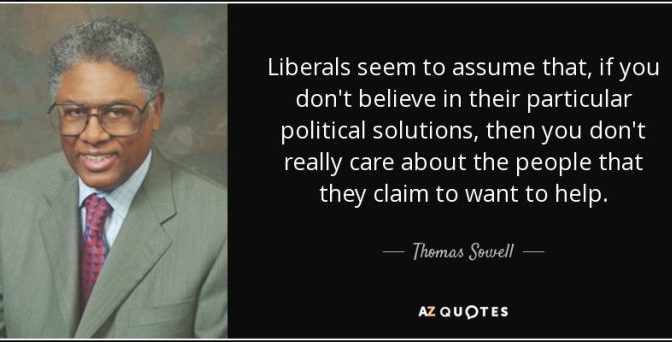
Regarding those last two points, here is another famous black economist, Thomas Sowell:
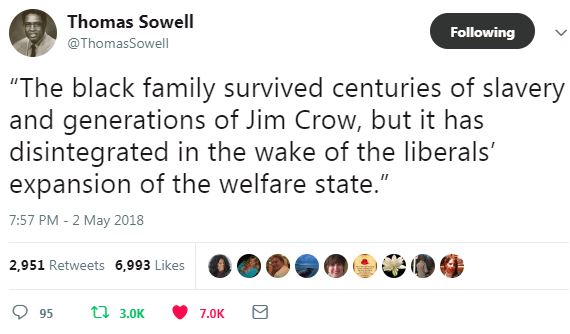
Economist Thomas Sowell blames welfare for killing the black family

To illustrate this point, here’s a graph with some helpful data taken from the U. S. Census.

In fact, there is a whole video featuring Thomas Sowell to go with this graph:

Black women were more likely to be married before welfare programs

And an article to go with it:

If we wanted to be serious about evidence, we might compare where blacks stood a hundred years after the end of slavery with where they stood after 30 years of the liberal welfare state. In other words, we could compare hard evidence on “the legacy of slavery” with hard evidence on the legacy of liberals.

Despite the grand myth that black economic progress began or accelerated with the passage of the civil rights laws and “war on poverty” programs of the 1960s, the cold fact is that the poverty rate among blacks fell from 87 percent in 1940 to 47 percent by 1960. This was before any of those programs began.

Over the next 20 years, the poverty rate among blacks fell another 18 percentage points, compared to the 40-point drop in the previous 20 years. This was the continuation of a previous economic trend, at a slower rate of progress, not the economic grand deliverance proclaimed by liberals and self-serving black “leaders.”

Ending the Jim Crow laws was a landmark achievement. But, despite the great proliferation of black political and other “leaders” that resulted from the laws and policies of the 1960s, nothing comparable happened economically. And there were serious retrogressions socially.

Nearly a hundred years of the supposed “legacy of slavery” found most black children being raised in two-parent families in 1960. But thirty years after the liberal welfare state found the great majority of black children being raised by a single parent.

The rest of the article points out how even crime rates among blacks were caused by the implementation of soft law enforcement policies by progressives. Just look at the big cities if you want to know what it is like for blacks to be ruled by Democrats. It sucks!

If everybody started to read more Thomas Sowell books, we would be much better off as a country! Only good things happen when people stop watching TV and listening to music and watching movies, and instead settle down in a chair with a Thomas Sowell book. I recommended a bunch of them in a previous post.
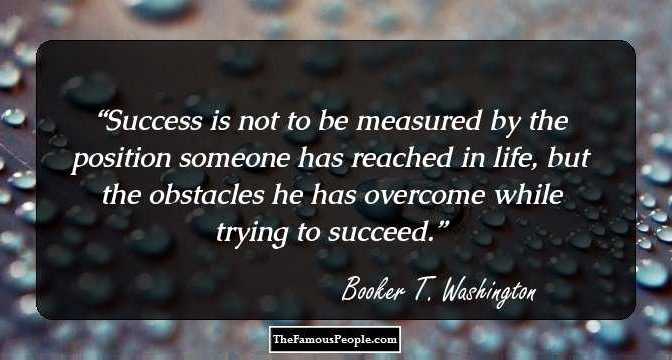
Why you should read “Up From Slavery” by Booker T. Washington

Lately, my friends have been very excited that I’m a non-white conservative. They want me to answer the grievances of BLM people, and explain from my own experiences what Christianity and conservative policies have to say about making the lives of non-whites better. My friend Wes recommended “Up From Slavery” by Booker T. Washington to help me focus my thoughts.

Here’s a summary of the book:

Dignity through Labor

Over the course of Up From Slavery, Washington develops the idea and ideal of dignity through labor. For Washington, the gravest aspect of the institution of slavery is the denigration of labor for both blacks and whites. Because the enslaved had no personal investment or return on their labor, they did not complete their work with an attitude toward improvement. Likewise, whites, largely deprived of meaningful labor, were robbed of the ability to achieve self-sufficiency. In both races, this produced personalities and characters that seek to escape labor. Washington emphasizes labor as the only way to make oneself useful in an interdependent, modern society. Throughout the whole of Up From Slavery, Washington searches for and obtains work. Further, once he obtains it, Washington completes all labor to best of his ability, no matter how lowly the task. At the Tuskegee Institute, Washington makes this idea and ideal a foundational ethos. All students who study at the Tuskegee Institute must learn a trade or industry alongside their more traditional academic pursuits. In addition, many of the buildings, most of the furniture, the wagons, and the materials used at the school are produced by students. This level of practical skill and diligence also acts as the foundation of Washington’s theory and program for racial uplift.

Selflessness, Desire to Be Useful to One’s Community

The people that Washington most admires and models himself after are those he labels selfless. Washington defines this as the willingness to work on the behalf of others. For Washington, this is not only about duty or labor, but also about the willingness to do one’s best for the benefit of the collective good. Washington believes that racial prejudice can be overcome if black people make themselves indispensable to their communities and their nation. The brick-making episode provides an example. Though the brick-making enterprise at Tuskegee felled three kilns before successfully producing bricks, the venture eventually proved successful and the school began to sell its bricks on the open market. Washington describes how whites who were unsympathetic or apathetic to the education of blacks and the overall project of the Tuskegee Institute were willing to purchase Tuskegee bricks due to their quality and convenience. Washington suggests that if black race can find their niche in society by fulfilling a need, then they can co-exist peacefully and productively with whites.

Impracticality of Political Agitation

Throughout Up From Slavery, Washington defends his ideas about racial advancement and uplift by subtly undermining the proposals of his critics. Though Washington does not explicitly state his objection to the strategies of specific thinkers like W.E.B. Dubois or even his predecessor, Frederick Douglass, he nevertheless highlights the wastefulness of political agitation for equal rights at every chance he gets. To do this, Washington shows that political agitation results in worse relations and outcomes than those that existed before. For example, when he goes home to Malden after his second year at the Hampton Institute, Washington finds that both the salt-furnace and the coal-mine are not in operation due to worker’s strikes. In Chapter IV, Washington describes how strikers usually spent all their savings during the strikes and returned to work in debt, but at the same wages. He raises the impracticality of political agitation again after his controversial Atlanta Exposition speech. After the success of his speech, he hypothetically asks if a black man would have been invited to give a speech had people agitated to put a black person on the program. He answers in the negative, saying that such opportunities can only arise through merit.

And here’s a summary of his most famous speech:

On September 18, 1895, Booker T. Washington was selected to give a speech that would open the Cotton States and International Exposition in Atlanta, Georgia. The speech, which is often referred to as the “Atlanta Compromise,” was the first speech given by an African American to a racially-mixed audience in the South. In it, Washington suggested that African Americans should not agitate for political and social equality, but should instead work hard, earn respect and acquire vocational training in order to participate in the economic development of the South. By doing so, eventually, he stated, African Americans would gain the respect of white society and be granted the rights of full citizenship.

There’s a free full audio version of the book, and the full text is online. I recommend this book to people of all races, because as the sexual anarchy brought on by feminism becomes widespread, the majority of the children of tomorrow will face the same kinds of challenges.

I see Washington’s ideas as consistent with a Christian worldview, where we don’t expect to be treated fairly. We expect sinful people to treat us badly. What Christianity says is to be patient, and focus on your relationship with God and loving your neighbor. And one way to love your neighbor is to sell them something valuable that you made through your labor. Another way is to work and save, and give to charity.

Government solutions to problems like racism and poverty aren’t a top priority for Christians. Most of all, we need the freedom to be good, and to do good. That’s priority one. You may not make your life better by being moral and diligent, but it’s rare that doing so causes you to harm yourself. It’s very important that you not harm yourself.

So, this dovetails nicely with my own story. My married non-white parents were not smart enough or willing enough to monitor my education, but they were clear that they wanted me to do well in order to find good-paying work. So I completed my BS and MS in a STEM field, and went to work right away, and I’ve been at it continuously for 22 years now. I save most of what I earn for charity and early retirement.

I’ve never experienced any of the racism or police brutality that American blacks complain about. And that’s because I follow what Washington is teaching. I dress in a clean way that doesn’t communicate danger to others. I’m careful to spend my time reading apologetics, economics and military history. I don’t listen to popular music or watch popular TV or movies. I don’t hang out with people who blame other people for their lack of success.

I got my first job by volunteering to do it for free on Saturdays for 7 months. My first full-time job salary after college was $50,000. Then I got a raise of $6,000 and then a raise of $9,000. I used to work 70 hour weeks in my 20s. I graduated college with $9,000 dollars in the black, because I went to a small local college and lived at home, and never spent any money on alcohol. My net worth is now about $1.35 million. By the way, the secret to becoming wealthy is to not spend money on showing off. You can be very generous to your friends and still get rich. Just never buy anything that is designed to communicate “status” to anyone. And never spend money on alcohol or chasing sex outside of marriage.

At no time did I accept that the problems defined by the secular left were my real problems. And at no time did I accept their “solutions” as real solutions to anything. As black economist Thomas Sowell writes, the “solutions” of the left are not effective at helping people like me. The “solutions” of the left are designed to make leftists feel better, and look more virtuous to others. You are much better off reading the Bible, Christian apologetics, free market economics, American military history, etc., and then respecting what you learn from that in your decision-making. I think that reading the right stuff is even more important than having good parents or attending church.

Study: white progressives are more racist against minorities than white conservatives

What’s the definition of racism? Well, it seems to me that a person is racist if they treat people of a different skin color differently than they treat people of their own skin color. So, if a white person treats a black person differently than they do a white person, then the white person is a racist. Because they’re discriminating on the basis of skin color. So, who are the real racists? Conservatives? Or Progressives?

The Yale School of Management reports on an academic study that provides the definitive answer to the question:

According to new research by Cydney Dupree, assistant professor of organizational behavior at Yale SOM, white liberals tend to downplay their own verbal competence in exchanges with racial minorities, compared to how other white Americans act in such exchanges. The study is scheduled for publication in the Journal of Personality and Social Psychology.

[…]Dupree and her co-author, Susan Fiske of Princeton University, began by analyzing the words used in campaign speeches delivered by Democratic and Republican presidential candidates to different audiences over the years. They scanned 74 speeches delivered by white candidates over a 25-year period. Approximately half were addressed to mostly-minority audiences—at a Hispanic small business roundtable discussion or a black church, for example. They then paired each speech delivered to a mostly-minority audience with a comparable speech delivered at a mostly-white audience—at a mostly-white church or university, for example. The researchers analyzed the text of these speeches for two measures: words related to competence (that is, words about ability or status, such as “assertive” or “competitive”) and words related to warmth (that is, words about friendliness, such as “supportive” and “compassionate”).

[…]The team found that Democratic candidates used fewer competence-related words in speeches delivered to mostly minority audiences than they did in speeches delivered to mostly white audiences. The difference wasn’t statistically significant in speeches by Republican candidates… There was no difference in Democrats’ or Republicans’ usage of words related to warmth.

More testing confirmed the patronizing white supremacist attitude of whites on the political left:

They designed a series of experiments in which white participants were asked to respond to a hypothetical or presumed-real interaction partner. For half of these participants, their partner was given a stereotypically white name (such as “Emily”); for the other half, their partner was given a stereotypically black name (such as “Lakisha”). Participants were asked to select from a list of words for an email to their partner.

[…]The researchers found that liberal individuals were less likely to use words that would make them appear highly competent when the person they were addressing was presumed to be black rather than white. No significant differences were seen in the word selection of conservatives based on the presumed race of their partner.

Conservatives aren’t racist at all – they’re color blind.

One of the reasons why I get along so well with white conservatives is that they don’t patronize me with low expectations, the way that white leftists patronize non-whites. The view of white progressives is similar to the view of white supremacist racists – they think that there is something defective about people like me because of our non-white skin color.

White supremacists and white progressives agree on this: that non-white people aren’t competent enough to make our own decisions. We need help from big government in order to do what whites can do without help. We need to be told what to think for our own good, and shamed if we step out of line. It’s amazing to me that white racist progressives are seen as “compassionate”, when they are the ones who actually believe in the racial inferiority of non-whites.