Victims say that officers in the borough of Tower Hamlets have ignored or downplayed outbreaks of hate crime, and suppressed evidence implicating Muslims in them, because they fear being accused of racism.
The claims come as four Tower Hamlets Muslims were jailed for at least 19 years for attacking a local white teacher who gave religious studies lessons to Muslim girls.
The Sunday Telegraph has uncovered more than a dozen other cases in Tower Hamlets where both Muslims and non-Muslims have been threatened or beaten for behaviour deemed to breach fundamentalist “Islamic norms.”
One victim, Mohammed Monzur Rahman, said he was left partially blind and with a dislocated shoulder after being attacked by a mob in Cannon Street Road, Shadwell, for smoking during the Muslim holy month of Ramadan last year.
“Two guys stopped me in the street and asked me why I was smoking,” he said. “I just carried on, and before I knew another dozen guys came and jumped me. The next thing I knew, I was waking up in hospital.”
“He reported it to the police and they just said they couldn’t track anyone down and there were no witnesses,” said Ansar Ahmed Ullah, a local anti-extremism campaigner who has advised Mr Rahman. “But there is CCTV in that street and it is lined with shops and people.”
Teachers in several local schools have told The Sunday Telegraph that they feel “under pressure” from local Muslim extremists, who have mounted campaigns through both parents and pupils – and, in one case, through another teacher – to enforce the compulsory wearing of the veil for Muslim girls. “It was totally orchestrated,” said one teacher. “The atmosphere became extremely unpleasant for a while, with constant verbal aggression from both the children and some parents against the head over this issue.”
One teacher at the Bigland Green primary school, Nicholas Kafouris, last year took the council to an employment tribunal, saying he was forced out of his job for complaining that Muslim pupils were engaging in racist and anti-Semitic bullying and saying they supported terrorism. Mr Kafouris lost his case, though the school did admit that insufficient action had been taken against the behaviour of some pupils. The number of assaults on teachers in Tower Hamlets resulting in exclusions has more than doubled from 190 in 2007/8 to 383 in 2008/9, the latest available year, though not all are necessarily race-related.
This is the kind of bullying that the secular left just doesn’t care about.
A Gallup poll released last week showed Mr. Cain with the highest voter intensity score of any Republican presidential contender — far higher than Ms. Palin, a former governor of Alaska, or Mr. Romney, a former governor of Massachusetts. While Mr. Cain’s name recognition was at 37 percent, it had risen 16 points since March.
Many pundits and voters declared him the winner of the first Republican debate last month. And he won the straw polls at the Tea Party Patriots convention in February and the Conservative Values Conference in Iowa in March.
If few people think Mr. Cain can win the nomination, he is satisfying voters’ desire to fall in love with a candidate. Their passion for him says as much about what the Republican field is lacking as it does about any specifics he is offering.
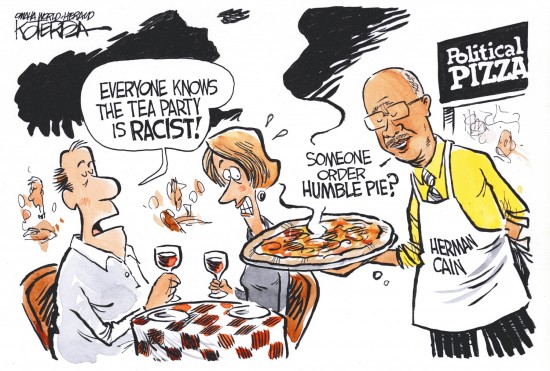
He captivates with his talk radio certainty, his pulpit cadences, and what he describes as his “common-sense business solutions” that make it sound as though solving the nation’s debt crisis is as simple as streamlining the number of pizza toppings on offer, as he did to improve performance at Godfather’s.
His rags-to-riches personal story and his talk of an “empowerment agenda” appeals to voters who believe that the federal budget has been corrupted by a culture of entitlement that no longer values sweat equity. As a black conservative, he appeals to Tea Party supporters who are angry at being tagged racists for their disagreements with the nation’s first black president. And in a country increasingly sour on Washington, his lack of political experience has become a calling card.
“Tea Party people love him,” said Jenny Beth Martin, the co-founder of Tea Party Patriots.
[…]Mr. Cain, 65, grew up poor in Georgia, his father working three jobs to finally buy a house for his family. Mr. Cain worked his way through Morehouse College and earned a master’s degree at Purdue University before becoming a vice president at Pillsbury.
Advised by the president of the company that he had to take a different route if he wanted to be a president of a company himself, Mr. Cain quit and entered the Burger King training program, where potential executives are trained from the grill up, working as “Whopper floppers” and cleaning bathrooms. Soon he was in charge of his region, and within a couple of years Pillsbury asked him to help turn around the Godfather’s chain, which he eventually joined in buying.
He became a folk hero among Republicans in 1994, when he challenged President Bill Clinton on his health care legislation during a televised town-hall-style meeting: “If I’m forced to do this, what will I tell all those people whose jobs I’m forced to eliminate?”
He ran for the Senate in Georgia in 2004, coming in second in the Republican primary ahead of a more seasoned politician, and parlayed his success into a career as a talk radio host.
[…]Liberals, he said, “are scared to death of me. They don’t want me to go up against their beloved Obama. I have done stuff, fixed stuff, can explain stuff and run stuff. He’s been a community organizer, he’s got failed policies. He reads from the teleprompter, I don’t. I’ve got common-sense solutions, he passes 2,700-page legislation. The contrast would be so obvious, and when you get past all of the quantitative stuff, they can’t use race to cover for him.”
Mr. Cain predicts he will finish in the top three or better in Iowa, New Hampshire and South Carolina. More and more voters seem to agree.
At a lunch in Concord, Kevin Attar, a small-business owner, listened to Mr. Cain’s pitch, then said: “I think this country is ready for someone with your platform. How do we get more people to know who you are?”
Mr. Cain urged him to spread the word.
He excused himself from the table, telling his guests he had someone to greet upstairs.
There, Ms. Bachmann, a congresswoman from Minnesota, was doing a radio interview. Mr. Cain put his arm around her and smiled for the assembled cameras. “She can run, that’s great,” he boomed. “The more the merrier. She’s a great friend. I have a lot of respect for her.”
Ms. Bachmann, finally allowed a word in, joked, “That’s why he supports me.”
“Did you all get what you need for pictures?” Mr. Cain asked. “Here, let me give you one more.”
He put his arm around Ms. Bachmann again, leaned far forward and smiled bigger than anyone in the room.
She’s Mrs. Bachmann, you stupid New York Times person. Oh well.
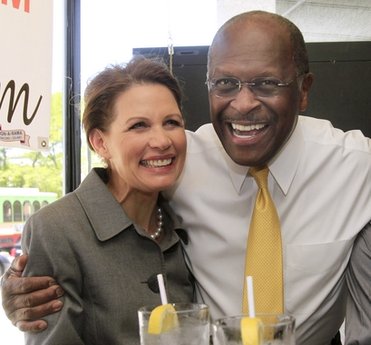
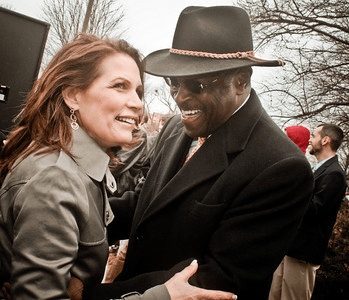
And I actually found the pictures:
Cain/Bachmann 2012?
And another from earlier:
Bachmann/Cain 2012?
If I get Bachmann/Cain, or even Cain/Bachmann, I am going to be a very happy Knight. I’ll be Summery Knight, then. Well… for a little while. Then back to being gloomy and judgmental.
Herman Cain and Michele Bachmann continue to earn the highest Positive Intensity Scores, at 25% and 21%, respectively. Below these two, several other candidates have Positive Intensity Scores in the 14 to 16 range, including two of the best-known candidates, Sarah Palin and Mitt Romney, and two who are less well-known — Tim Pawlenty and Rick Santorum.
That’s good news!
Fiscal assessments of the candidates
You can read Club For Growth’s assessment of Herman Cain’s fiscal conservatism. Club For Growth had mixed reviews of Newt Gingrich and Tim Pawlenty, but they are very positive about Herman Cain, based on his speeches. Cain does not have a record, so he is a bit more of a gamble. We don’t know if he would do what he says! But if he does what he says then he gets an A grade. By the way, these reports are excellent to print out and leave them out on your desk. (Read them first). We need to be getting into discussions with people in the office NOW. Be passionate about these policies! Memorize them, understand them, and explain them.
Once again, Michele Bachmann is my first choice, then Herman Cain, then Tim Pawlenty. This is strictly on policy. You can learn more about Michele Bachmann in this post, in which I beg her to run for President.
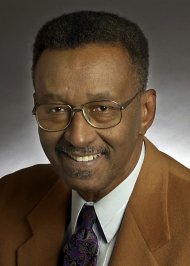
He’s my second favorite economist, right behind Thomas Sowell.
In his latest column, he explains the famous “Broken Window Fallacy”.
Excerpt:
Economic lunacy abounds, and often the most learned, including Nobel Laureates, are its primary victims. The most recent example of economic lunacy is found in a Huffington Post article titled “The Silver Lining of Japan’s Quake” written by Nathan Gardels, editor of New Perspectives Quarterly, who has also written articles for The Wall Street Journal, Los Angeles Times, New York Times and Washington Post.
Mr. Gardels says, “No one — least of all someone like myself who has experienced the existential terror of California’s regular tremors and knows the big one is coming here next — would minimize the grief, suffering and disruption caused by Japan’s massive earthquake and tsunami. But if one can look past the devastation, there is a silver lining. The need to rebuild a large swath of Japan will create huge opportunities for domestic economic growth, particularly in energy-efficient technologies, while also stimulating global demand and hastening the integration of East Asia. … By taking Japan’s mature economy down a notch, Mother Nature has accomplished what fiscal policy and the central bank could not.”
[…]Why might Japan’s and Florida’s devastation be seen as “pluses”? French economist Frederic Bastiat (1801-1850) explained it in his pamphlet “What is Seen and What is Not Seen,” saying, “There is only one difference between a bad economist and a good one: the bad economist confines himself to the visible effect; the good economist takes into account both the effect that can be seen and those effects that must be foreseen.”
Bastiat elaborated further in his “Broken Window Fallacy” parable where a vandal smashes a shopkeeper’s window.
A crowd forms, sympathizing with the shopkeeper. Soon, someone in the crowd suggests that instead of a tragedy, there might be a silver lining. Instead of the boy being a vandal, he was a public benefactor, creating economic benefits for everyone in town. Fixing the broken window creates employment for the glazier, who will then buy bread and benefit the baker, who will then buy shoes and benefit the cobbler and so forth.
Bastiat says that’s what’s seen. What is not seen is what the shopkeeper would have done with the money had his window not been smashed. He might have purchased a suit from the tailor. Therefore, an act that created a job for the glazier destroyed a job for the tailor. On top of that, had the property destruction not occurred, the shopkeeper would have had a suit and a window. Now he has just a window and as a result, he is poorer.

 WINTERY KNIGHT