Consider this article by the Cato Institute, a libertarian think tank, which discusses how the Reagan tax cuts affected the unemployment rate.
Excerpt:
In 1980, President Carter and his supporters in the Congress and news media asked, “how can we afford” presidential candidate Ronald Reagan’s proposed tax cuts?
Mr. Reagan’s critics claimed the tax cuts would lead to more inflation and higher interest rates, while Mr. Reagan said tax cuts would lead to more economic growth and higher living standards. What happened? Inflation fell from 12.5 percent in 1980 to 3.9 percent in 1984, interest rates fell, and economic growth went from minus 0.2 percent in 1980 to plus 7.3 percent in 1984, and Mr. Reagan was re-elected in a landslide.
[…]Despite the fact that federal revenues have varied little (as a percentage of GDP) over the last 40 years, there has been an enormous variation in top tax rates. When Ronald Reagan took office, the top individual tax rate was 70 percent and by 1986 it was down to only 28 percent. All Americans received at least a 30 percent tax rate cut; yet federal tax revenues as a percent of GDP were almost unchanged during the Reagan presidency (from 18.9 percent in 1980 to 18.1 percent in 1988).
What did change, however, was the rate of economic growth, which was more than 50 percent higher for the seven years after the Reagan tax cuts compared with the previous seven years. This increase in economic growth, plus some reductions in tax credits and deductions, almost entirely offset the effect of the rate reductions. Rapid economic growth, unlike government spending programs, proved to be the most effective way to reduce unemployment and poverty, and create opportunity for the disadvantaged.
President Bush signed the first wave of tax cuts in 2001, cutting rates and providing tax relief for families by, for example, doubling of the child tax credit to $1,000.
At Congress’ insistence, the tax relief was initially phased in over many years, so the economy continued to lose jobs. In 2003, realizing its error, Congress made the earlier tax relief effective immediately. Congress also lowered tax rates on capital gains and dividends to encourage business investment, which had been lagging.
It was the then that the economy turned around. Within months of enactment, job growth shot up, eventually creating 8.1 million jobs through 2007. Tax revenues also increased after the Bush tax cuts, due to economic growth.
In 2003, capital gains tax rates were reduced. Rather than expand by 36% as the Congressional Budget Office projected before the tax cut, capital gains revenues more than doubled to $103 billion.
The CBO incorrectly calculated that the post-March 2003 tax cuts would lower 2006 revenues by $75 billion. Revenues for 2006 came in $47 billion above the pre-tax cut baseline.
Here’s what else happened after the 2003 tax cuts lowered the rates on income, capital gains and dividend taxes:
GDP grew at an annual rate of just 1.7% in the six quarters before the 2003 tax cuts. In the six quarters following the tax cuts, the growth rate was 4.1%.
The S&P 500 dropped 18% in the six quarters before the 2003 tax cuts but increased by 32% over the next six quarters.
The economy lost 267,000 jobs in the six quarters before the 2003 tax cuts. In the next six quarters, it added 307,000 jobs, followed by 5 million jobs in the next seven quarters.
The timing of the lower tax rates coincides almost exactly with the stark acceleration in the economy. Nor was this experience unique. The famous Clinton economic boom began when Congress passed legislation cutting spending and cutting the capital gains tax rate.
Those are the facts. That’s not what you hear in the media, but they are the facts.
GOP presidential challenger Mitt Romney tonight charged that President Barack Obama’s jobs plan is a failure, with millions out of work and looking for help.
“My plan is to put people back to work in America,” Romney said tonight at the first of three presidential debates scheduled for the 2012 presidential election season.
“Look at the history of the past four years. We have 23 million people unemployed. Keeping with the status quo is not going to work for the American people.”
Obama returned to his oft-repeated theme of blaming George W. Bush, asserting the taxation approach Romney was proposing was nothing more than a return to the “trickle-down” economy of the Republican plan.
Obama began the debate by reciting familiar campaign themes, suggesting once again that his administration inherited from Bush one of the worst economies in the history of the United States.
But Romney struck a theme of energy independence and advancing small business as keys to getting the U.S. economy growing again. He accused Obama of proposing “trickle-down government,” represented by more government regulation and more taxation.
Romney disputed Obama’s assertion he was locked into a tax cut, charging that under the Obama administration the middle class has been pressed by reduced income, diminished job opportunities and increased food and energy costs.
From the first moments of the debate, Romney looked Obama directly in the eye, took exception to president’s assertions about Romney’s policies, and gave more precise answers.
Obama pressed that Romney’s economic plan called for $5 trillion in tax cuts and $2 trillion in military budget increases, a program Obama asserted would demand tax increases on middle-income earners.
“Look, I’ve got five boys and I’m used to somebody saying something that’s not true and hoping that by repeating it I’m going to believe it,” Romney countered, asserting that everything Obama said about his tax program was inaccurate.
Obama insisted Romney’s tax-reduction plan of necessity would either increase the deficit or demand tax increases for the middle class, charging that under Romney’s definition Donald Trump would be a small business.
Objecting to Jim Lehrer’s interruption that the first segment was exceeding the 15-minute limit, Romney charged that Obama would increase taxes on small businesses at the cost of 700,000 jobs.
As the discussion advanced to the nation’s deficit, Obama reiterated his statement that he inherited a massive deficit, and appeared on the defensive.
“You have been president for four years, you said you would cut the deficit in half and you have run $1 trillion in deficits each of the four years,” Romney attacked. “That does not get the job done.”
Romney pointed out that when the economy was growing as slowly as it is now, more slowly than when Obama took office, this is no time to increase taxes.
“You never balance the budget by increasing taxes,” Romney insisted. “I don’t want to go down the path of Spain.”
And:
Romney said “ignoring the 10th Amendment is not the way to have a vibrant economy.”
Romney said the key to education is great teachers, and he raised a reference to the U.S. Constitution regarding citizen rights.
“I interpret our founding documents as providing a responsibility for religious freedom – to pursue happiness by taking care of the less fortunate – but massive government involvement limits freedom – the path we are taking is not working with 23 million Americans unemployed and 50 million on food stamps.”
Obama said the responsibility of the federal government was important in improving the educational system in America.
“Budgets reflect choices. If we cut taxes to benefit people like Gov. Romney and me, it makes a difference,” Obama. He again demanded specifics of the GOP plans.
“When it comes to making college affordable, whether it be two years or four years, we cut out the middleman and eliminated banks from making a profit in student loans. Gov. Romney believes in education but he tells kids to borrow from their parents to go to college.”
Romney responded, “Mr. President, you are entitled to your own airplane and your own house – but not to your own facts.”
Romney said Obama put $90 billion into green jobs, but half of the recipients went bankrupt and others were owned by contributors to your campaign, and questioned the number of teachers that would have hired.
Romney proposed grading schools to know which were succeeding and which were failing.
“Massachusetts schools are ranked No. 1 in education because I care for education for all our children,” Romney said.
It was so bad that even gay activist and radical leftist Andrew Sullivan called it for Romney: (H/T Hot Air)
Look: you know how much I love the guy, and you know how much of a high information viewer I am, and I can see the logic of some of Obama’s meandering, weak, professorial arguments. But this was a disaster for the president for the key people he needs to reach, and his effete, wonkish lectures may have jolted a lot of independents into giving Romney a second look…
The person with authority on that stage was Romney – offered it by one of the lamest moderators ever, and seized with relish. This was Romney the salesman. And my gut tells me he sold a few voters on a change tonight. It’s beyond depressing. But it’s true.
Call it the curse of incumbency. Like many of his predecessors, President Obama fell victim Wednesday night to high expectations, a short fuse, and a hungry challenger.
If Republican presidential candidate Mitt Romney didn’t win the first of three presidential debates outright, he more than covered the spread. He was personable, funny, and relentlessly on the attack against a heavily favored Obama.
The president looked peeved and flat as he carried a conversation, for the first time in four years, with somebody telling him he’s wrong.
This debate was a blowout – and that’s just the reaction of the left.
Left-wing reactions on Twitter
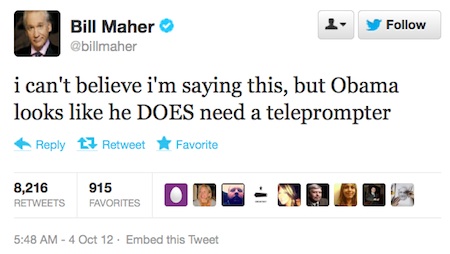
Bill Maher: (HBO)
Bill Maher says Romney defeated Obama
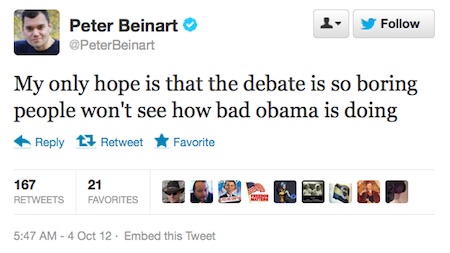
Peter Beinart (The New Republic)
Peter Beinart says Romney defeated Obama
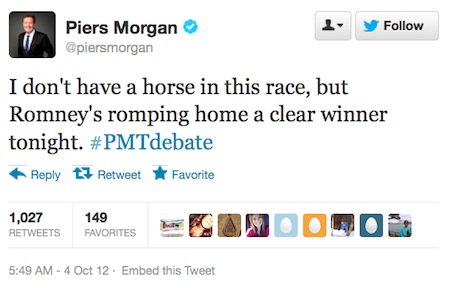
Piers Morgan: (CNN)
Piers Morgan says Romney defeated Obama
And CHRIS MATTHEWS too:
Something else ran down his leg tonight, and it wasn’t a tingle, it was a tinkle.
Romney leading by 4 points in swing states
The latest poll of swings states from the left-wing Politico shows Romney leading Obama by 4 points, even with a 2 point oversampling of Democrats.
This week, Politico released its latest Battleground pollof the presidential race. Despite coming from the left-wing news site, the poll is one of my favorites. Its put together by respected pollsters from both parties, makes available its full cross-tabs and uses a very modest and reasonable turnout model for its sample. Including leaners, the sample in the poll is D+2. Nationally, Obama leads by 2-3 points, but, in the critical swing states, Romney now has the edge.
Each candidate leads in states considered “safe” for their party. In safe GOP states, Romney leads by 8. In safe Democrat states, Obama leads by a massive 22 points. But, in the more numerous and more important “toss up” states, Romney leads by 4, hitting the critical 50% threshold.
In the slightly different category of “battleground” states identified by Politico, Romney leads by 2, 49-47. Romney’s lead over Obama is powered primarily by his edge with independents. Romney leads Obama by 4 among the important swing voters. By 11 points, these voters think Romney would do better on the economy than Obama, 51-40.
Romney also has a big edge with middle class families, who prefer him over Obama by 15 points, 56-41.
My prediction for this election remains Romney 52, Obama 47.
More than 600,000 jobs in manufacturing went unfilled in 2011 due to a skills shortage, according to a survey conducted by the consultancy Deloitte.
The problem seems soluble: Equip workers with the skills they need to match them with employers who are hiring. That explains the emphasis that policy makers of both parties place on science, technology, engineering and math degrees—it is such a mantra that they’re known by shorthand as STEM degrees.
American manufacturing has become more advanced, we’re told, and requires computer aptitude, intricate problem solving, and greater dexterity with complex tasks. Surely if Americans were getting STEM education, they would have the skills they need to get jobs in our modern, high-tech economy.
But considerable evidence suggests that many employers would be happy just to find job applicants who have the sort of “soft” skills that used to be almost taken for granted. In the Manpower Group’s 2012 Talent Shortage Survey, nearly 20% of employers cited a lack of soft skills as a key reason they couldn’t hire needed employees. “Interpersonal skills and enthusiasm/motivation” were among the most commonly identified soft skills that employers found lacking.
Employers also mention a lack of elementary command of the English language. A survey in April of human-resources professionals conducted by the Society for Human Resource Management and the AARP compared the skills gap between older workers who were nearing retirement and younger workers coming into the labor pool. More than half of the organizations surveyed reported that simple grammar and spelling were the top “basic” skills among older workers that are not readily present among younger workers.
The SHRM/AARP survey also found that “professionalism” or “work ethic” is the top “applied” skill that younger workers lack. This finding is bolstered by the Empire Manufacturing Survey for April, published by the Federal Reserve Bank of New York. It said that manufacturers were finding it harder to find punctual, reliable workers today than in 2007, “an interesting result given that New York State’s unemployment rate was more than 4 percentage points lower in early 2007 than in early 2012.”
Stuart Schneiderman blames the focus on equality and self-esteem over competition and achievement:
The American school system has failed America’s students. It has especially failed to teach the skills required to do the kinds of high tech jobs that are increasingly available.
American children are deficient in science, technology, engineering and math, in what are now known as the STEM subjects.
It should surprise no one. A pedagogical policy promoting self-esteem over achievement must diminish the best students in order to make the worst students feel good about themselves. The result: a large cohort of undereducated underachievers who are proud of their incompetence.
In STEM subjects there are right and wrong answers. When these subjects are taught correctly, you will find that some children are markedly better than others.
Children improve because they emulate their betters. They strive to get better because they want to be as good as someone else.
If the best students are rewarded other children will want to emulate them. If the best students are demeaned no one will want to emulate them.
If you refuse to call on them in class, if you refuse to hold them up as exemplary, if you turn math exercises into storytelling and feeling sharing you are going to drag everyone down.
If you say that no one is better than anyone else, you are saying that no child should strive for greater achievements.
Stuart didn’t say it, so I will. It’s important to be careful about handing your children off to any school, especially the feminized public school system. The public school system from administration to the classroom is not welcoming to values like competition and individual achievement – which are more often (but not exclusively) associated with men. Unfortunately, there just aren’t many men in public school classrooms. Public schools favor security and equality of outcomes. These goals are best achieved by growing government to minimize individual achievement and to maximize the “safety net”, so that individual striving doesn’t matter. Another goal of the public school system is to increase the amount of money they are paid. They want higher taxes and more government spending, so that they are paid more. Their job is not to get your children skills so they can be independent of government. They want more government. They want more security. They want less personal responsibility. They want less individual achievement.
I think that teachers should have to work in a field related to what they want to teach in for at least 5 years before being admitted to teacher’s college. That requirement alone would improve education drastically.

 WINTERY KNIGHT