Tag Archives: Progress of Science

How do atheists try to accommodate the Big Bang in their worldview?

J. Warner Wallace: God's Crime Scene
J. Warner Wallace: God’s Crime Scene

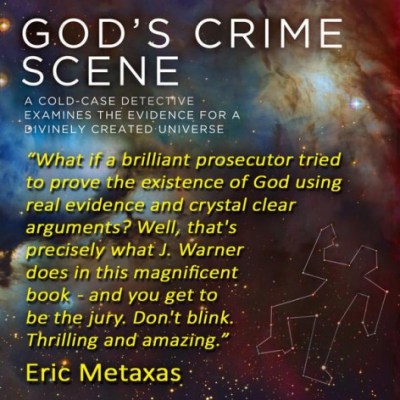
OK, so J. Warner Wallace has a new book out and it’s about science and God.

I wanted to link to something about Lawrence Krauss trying to accommodate the Big Bang within his worldview of atheism.

Wallace writes:

One of the key pieces of evidence in the universe is simply it’s origin. If our universe began to exist, what could have caused it’s beginning? How did everything (all space, time and matter) come into existence from nothing? One way atheist physicists have navigated this dilemma has simply been to redefine the terms they have been using. What do we mean when we say “everything” or “nothing”? At first these two terms might seem rather self-explanatory, but it’s important for us to take the time to define the words. As I’ve already stated, by “everything” we mean all space, time and matter. That’s right, space is “something”; empty space is part of “everything” not part of “nothing”. For some of us, that’s an interesting concept that might be hard to grasp, but it’s an important distinction that must be understood. When we say “nothing”, we mean the complete absence of everything; the thorough non-existence of anything at all (including all space time and matter). These two terms, when defined in this way, are consistent with the principles of the Standard Cosmological Model, but demonstrate the dilemma. If everything came from nothing, what caused this to occur? What is the non-spatial, atemporal, immaterial, uncaused, first cause of the universe? A cause of this sort sounds a lot like a supernatural Being, and that’s why I think many naturalists have begun to redefine the terms.

Lawrence Krauss, Arizona State University Professor (School of Earth and Space Exploration and Director of the Origins Initiative) wrote a book entitled, “A Universe from Nothing: Why There Is Something Rather than Nothing”. As part of the promotion for the book, Krauss appeared on the Colbert Report where he was interviewed by comedian Stephen Colbert. During the interview, Krauss tried to redefine “nothing” to avoid the need for a supernatural first cause:

“Physics has changed what we mean by nothing… Empty space is a boiling, bubbling brew of virtual particles popping in and out of existence… if you wait long enough, that kind of nothing will always produce particles.” (Colbert Nation, June 21st, 2012)

Now if you’re not careful, you might miss Krauss’ subtle redefinition. In describing the sudden appearance of matter (“particles”), Krauss assumes the prior existence of space (“empty space”) and time (“if you wait long enough”). If you’ve got some empty space and wait long enough, matter appears. For Krauss, the “nothing” from which the universe comes includes two common features of “everything” (space and time), and something more (virtual particles). This leaves us with the real question: “Where did the space, time and virtual particles come from (given all our evidence points to their origination at the beginning of our universe)?” Krauss avoids this inquiry by moving space and time from the category of “something” to the category of “nothing”.

If you’ve got a teenager in your house, you might recognize Krauss’ approach to language. I bet you’ve seen your teenager open the refrigerator door, gaze at all the nutritious fruits and vegetables on the shelves, then lament that there is “nothing to eat.”

I used to say that when I was a teenager, but I grew out of it. I didn’t go on the Comedy Channel and try to convince everyone that what I was saying about the refrigerator was scientifically accurate.

Anyway, here is a debate between William Lane Craig and Lawrence Krauss, if you want to see how Krauss defends his “refrigerator has nothing to eat” view of cosmology. I know everybody and even many Christians all think that we have something to hide when it comes to science, but if you would just watch these debates, you would see that there is nothing to fear from science at all. We own it.

Meanwhile, I want to show you that this is not at all rare among atheists.

Look, here is Peter Atkins explaining how he makes the Big Bang reconcile with his atheism – and notice that it’s a completely different view than Krauss:

So, just who is this Peter Atkins, and why is he a good spokesman for atheism?

From his Wikipedia bio.

Peter William Atkins (born August 10, 1940) is an English chemist and a fellow and professor of chemistry at Lincoln College of the University of Oxford. He is a prolific writer of popular chemistry textbooks, including Physical Chemistry, 8th ed. (with Julio de Paula of Haverford College), Inorganic Chemistry, and Molecular Quantum Mechanics, 4th ed. Atkins is also the author of a number of science books for the general public, including Atkins’ Molecules and Galileo’s Finger: The Ten Great Ideas of Science.

[…]Atkins is a well-known atheist and supporter of many of Richard Dawkins’ ideas. He has written and spoken on issues of humanism, atheism, and what he sees as the incompatibility between science and religion. According to Atkins, whereas religion scorns the power of human comprehension, science respects it.

[…]He was the first Senior Member for the Oxford Secular Society and an Honorary Associate of the National Secular Society. He is also a member of the Advisory Board of The Reason Project, a US-based charitable foundation devoted to spreading scientific knowledge and secular values in society. The organisation is led by fellow atheist and author Sam Harris.

Now watch that 6-minute video above. Peter Atkins thinks that nothing exists. He thinks he doesn’t exist. He thinks that you don’t exist. This is how atheism adapts to a world where the Big Bang creation event is fact.

I think Peter Atkins should join Lawrence Krauss on the Comedy Channel and present that view. I would laugh. Wouldn’t you?
Information Enigma: 21-minute video explains intelligent design

Can random mutation and natural selection create new functional information?

The video is here:

I have read and listened and watched a lot of material on intelligent design, but I have never seen so much value packed into such a short lecture. I really hope you’ll watch this and that it’s helpful to you.

Summary:

  • the big question when discussing the origin of life: where did the information in living systems come from?
  • Until 530 million years ago, the oceans were largely devoid of life
  • In a 10 million year period, many new forms of animal life emerged
  • New biological forms of life require new information
  • the discovery of DNA shows that living systems work because cells have information that allows them to build the components of molecular machines: cell types, proteins, etc.
  • can random mutation and natural selection create new functional information?
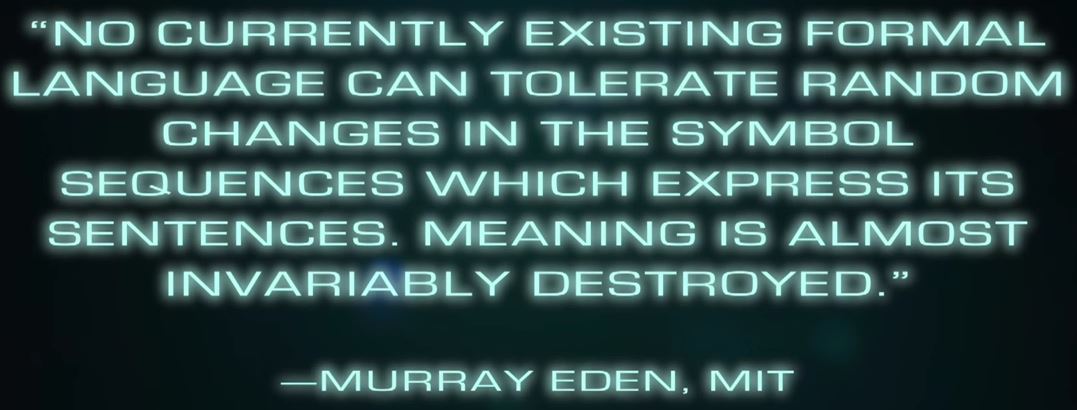
  • normally, random mutations tend to degrade the functionality of information, e.g. – randomly changing symbols in an applications code does not usually introduce useful new functions, it usually renders what is there non-functional
  • the majority of possible sequences will NOT have functions, so random mutations will more likely give you non-functional code, rather than functional code
  • example: a bicycle lock  with 4 numbers has many possible sequences for the 4 numbers, and only one of them has unlock functionality, the rest have no functionality
  • if you have lots of time, then you might be able to guess the combination, but if the lock as has 10 billion numbers, and only one combination that unlocks, you can spend your whole life trying to unlock it and won’t succeed
  • how likely is it to arrive at a functional protein or gene by chance? Is it more like the 4-dial lock (can be done with lots of time) or the 10 billion dial lock (amount of time required exceeds the time available)?
  • the probability is LOW because there is only one sequence of numbers that has unlock function
  • consider a short protein of 150 amino acids has 10 to the 195th power possible sequences
  • if many of these sequences of amino acides had biological function, then it might be easier to get to one by random mutation and selection than it is with a lock that only unlocks for ONE sequence
  • how many of the possible sequences have biological function?
  • Thanks to research done by Douglas Axe, we now know that the number of functional amino acid sequences for even a short protein is incredibly small…
  • Axe found that the odds of getting a functional sequence of amino acids that will fold and have biological function is 1 in 10 to the 77th power
  • Is that number too improbable to reach by chance? well, there are 10 to 65th atoms in the entire Milky Way galaxy… so yes, this is a very improbable outcome
  • can random genetic mutations search through all the sequences in order to find the one in 10 to the 77th power one that has biological function? It depends on how much guessers we have and how many guesses we get in the time available
  • even with the entire 3.5 billion year history of life on Earth, only about 10 to the 40th organisms have ever lived, which far smaller fraction of the 10 to the 77th total sequences
  • even with a very fast mutation rate, you would not be able to reach a functional protein even with all that time, and even with all those organisms

I was once having a discussion with a woman about the research that Axe did at the Cambridge University lab. He published four articles in the Journal of Molecular Biology. I held out one of the papers to her and showed her the numbers. She said over and over “I hate the Discovery Institute! I hate the Discovery Institute!” Well, yeah, but you can’t make the Journal of Molecular Biology go away with hating the Discovery Institute. JMB is peer-reviewed, and this was experimental evidence – not a theory, not a hypothesis.

We have been blessed by the Creator and Designer of the universe in this time and place with overwhelming evidence – an abundance of riches. For those who have an open mind, this is what you’ve been waiting for to make your decision. For the naturalists who struggle so mightily to block out the progress of experimental science, they’ll need to shout louder and shut their eyes tighter and push harder to block their ears. Maybe if they keep screaming “Star Trek” and “Star Wars” over and over to themselves, they will be able to ignore the real science a little longer.

William Lane Craig debates Austin Dacey: Does God Exist?

Two tough rams butt heads, and may the best ram win!

Here is the video and summary of a debate between Christian theist William Lane Craig and Austin Dacey at Purdue University in 2004 about the existence of God.

The debaters:

The video: (2 hours)

The video shows the speakers and powerpoint slides of their arguments. Austin Dacey is one of the top atheist debaters, and I would put him second to Peter Millican alone, with Walter Sinnott-Armstrong in third place. This is the debate to show people who are new to apologetics. The debate with Peter Millican is better for advanced students, and that’s no surprise since he teaches at Oxford University and is familiar with all of Dr. Craig’s work. The Craig-Dacey debate is the one that I give to my co-workers.

By the way, you can get the DVDs and CDs for the first Craig-Dacey debate and the second Craig-Dacey debate and the second Craig-Sinnott-Armstrong debate. The Peter Millican debate is not available on DVD, but the link above (Peter Millican) has the video and my summary.

Dr. Dacey’s 5 arguments below are all good arguments that you find in the academic literature. He is also an effective and engaging speaker, This is a great debate to watch!

SUMMARY of the opening speeches:

Dr. Craig’s opening statement:

Dr. Craig will present six reasons why God exists:

  1. (Contingency argument) God is the best explanation of why something exists rather than nothing
  2. (Cosmological argument)  God’s existence is implied by the origin of the universe
  3. (Fine-tuning argument) The fine-tuning of the universe for intelligent life points to a designer of the cosmos
  4. (Moral argument) God is the best explanation for the existence of objective moral values and objective moral duties
  5. (Miracles argument) The historical facts surrounding the life, death and resurrection of Jesus
  6. (Religious experience) God’s existence is directly knowable even apart from arguments

Dr. Dacey’s opening argument:

There are two ways to disprove God’s existence, by showing that the concept of God is self-contradictory, or by showing that certain facts about ourselves and the world are incompatible with what we would expect to be true if God did exist. Dr. Dacey will focus on the second kind of argument.

  1. The hiddenness of God
  2. The success of science in explaining nature without needing a supernatural agency
  3. The dependence of mind on physical processes in the brain
  4. Naturalistic evolution
  5. The existence of gratuitous / pointless evil and suffering

One final point:

One thing that I have to point out is that Dr. Dacey quotes Brian Greene during the debate to counter Dr. Craig’s cosmological argument. Dr. Craig could not respond because he can’t see the context of the quote. However, Dr. Craig had a rematch with Dr. Dacey where was able to read the context of the quote and defuse Dr. Dacey’s objection. This is what he wrote in his August 2005 newsletter after the re-match:

The following week, I was off an another three-day trip, this time to California State University at Fresno. As part of a week of campus outreach the Veritas Forum scheduled a debate on the existence of God between me and Austin Dacey, whom I had debated last spring at Purdue University. In preparation for the rematch I adopted two strategies: (1) Since Dacey had come to the Purdue debate with prepared speeches, I decided to throw him for a loop by offering a different set of arguments for God, so that his canned objections wouldn’t apply. I chose to focus on the cosmological argument, giving four separate arguments for the beginning of the universe, and on the evidence for Jesus’ resurrection. (2) I reviewed our previous debate carefully, preparing critiques of his five atheistic arguments. In the process I found that he had seriously misunderstood or misrepresented a statement by a scientist on the Big Bang; so I brought along the book itself in case Dacey quoted this source again. I figured he might change his arguments just as I was doing; but I wanted to be ready in case he used his old arguments again.

[…]The auditorium was packed that night for the debate, and I later learned that there were overflow rooms, too. To my surprise Dr. Dacey gave the very same case he had presented at Purdue; so he really got clobbered on those arguments. Because he wasn’t prepared for my new arguments, he didn’t even respond to two of my arguments for the beginning of the universe, though he did a credible job responding to the others. I was pleased when he attacked the Big Bang by quoting the same scientist as before, because I then held up the book, specified the page number, and proceeded to quote the context to show what the scientist really meant.

Dr. Craig is always prepared!