Tag Archives: Money

Guttmacher Institute: states enact record number of abortion restrictions

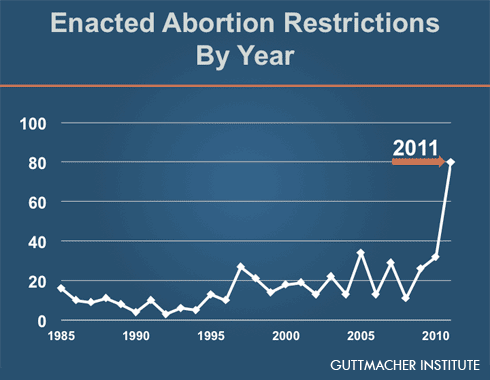
Enacted Abortion Restrictions By Year

Great news from the Guttmacher Institute, a pro-abortion think tank. (H/T John from Truth in Religion & Politics)

Excerpt:

In the first six months of 2011, states enacted 162 new provisions related to reproductive health and rights. Fully 49% of these new laws seek to restrict access to abortion services, a sharp increase from 2010, when 26% of new laws restricted abortion. The 80 abortion restrictions enacted this year are more than double the previous record of 34 abortion restrictions enacted in 2005—and more than triple the 23 enacted in 2010. All of these new provisions were enacted in just 19 states.

The post breaks down the pro-life measures by category:

  • Counseling and waiting periods
  • Gestational bans
  • “Heartbeat” bill
  • Banning abortion coverage in new insurance exchanges
  • Medication abortion
  • Cuts to abortion subsidies

All of these bills were supported by Republicans, and opposed by Democrats.

Elections have consequences. We elected a massive number of Republicans in 2010, and now we are seeing the results of that effort. I could not be more proud of the Republicans who voted in these measures to protect the unborn.

Related posts

Live Action’s Lila Rose debates pro-abortion activist

I found this video of Lila Rose debating on the Live Action web site.

Are you wondering about that pro-abortion woman? Me too. So I found this interesting post on Captain’s Quarters (Ed Morrissey) about the pro-abortion woman. She wrote on the Daily Kos that she has a crush on Iran’s theocratic dictator Mahmoud Achmandinejad – even though she’s a Jewish lesbian! Very weird.

Planned Parenthood attemps to censor Live Action videos

In this related Life News story, I learned that Planned Parenthood attempted to censor the Live Action undercover videos on Youtube.

Excerpt:

A key part of Planned Parenthood’s counterattack against Lila Rose’s youth-led group, Live Action, and its staggered release early this year of damning videos depicting Planned Parenthood managers, “health professionals,” and other employees willing to welcome, advise and aid & abet purported “sex traffickers” and “pimps” was to get YouTube to suppress the videos on the basis that they violated YouTube’s published “privacy guidelines.”  This post recalls our long and ultimately successful effort to help Live Action defeat Planned Parenthood’s counterattack.

On their release last January, the Live Action videos “went viral,” winning hundreds of thousands of viewers online, and both sparking and helping to sustain a nationwide firestorm of outrage against Planned Parenthood’s willingness to use federal funds to support criminal exploitation of young people and sex slavery.  The epidemic of outrage prompted Congressional efforts to de-fund Planned Parenthood, the nation’s largest abortion provider, by ending its federal subsidies.  Those efforts nearly culminated in a shutdown of the federal government, as House Republicans pushed the issue as far as they could in last minute White House negotiations over the federal budget.

The rest of the post documents the back and forth exchanges between Planned Parenthood and the Thomas More Society lawyers, as Planned Parenthood tries to censor the undercover videos that exposed them as being willing “…to do business with, and thereby aid and abet, sex traffickers and pimps of underage girls, many of whom … recently arrived in this country, imported here for lewd and immoral purposes in what could only be described as a form of sex slavery – an obscenely cruel bondage.” If you click through to read the whole thing, there is a happy ending, but only after some setbacks.

In other news, pro-lifers are asking New Jersey governor Chris Christie to veto Planned Parenthood funding again, after the Democrats in the Senate voted to restore subsidies to Planned Parenthood.

Related posts

FRC releases new study on marriage and economic well-being

Mary found this little blurb on the Christian Post.

Excerpt:

Marriage plays a big role in the well-being of the U.S. economy, such that sound and stable marriages keep the economy healthy while divorce helps the economy regress, a new report suggests.

The findings released by the Family Research Council’s Marriage and Religion Research Institute show how intact married-couple families outperform other family types, including remarried families, divorced families, single-parent families, and cohabiting families, in all of the following economic segments: employment, income, net value, net worth, poverty, receipt of welfare and child economic well-being.

Basically the stats show that the more intact the family remains, the less the difficulties and the inefficiencies the family encounters.

Married-couple families generate the most income with “the median household income twice that of divorced households and four times that of separated households,” reads the report.

Divorced families on the other hand experience a sharp decrease in income after the separation. Divorced women are affected the most as they are 2.83 times more prone to live in poverty than women who remain married.

MARRI Director Pat Fagan, Ph.D, said couples that remain stably married can provide a sound environment where children can be securely fostered while divorce triggers society’s reliance on government welfare programs – programs that currently cost tax payers around $112 billion per year.

Then I went looking for the research paper and found this press release.

Excerpt:

The economic well-being of the United States is strongly related to marriage, which is a choice about how we channel our sexuality. The implications of sexual choices are apparent when comparing family structures across basic economic measures such as employment, income, net worth, poverty, receipt of welfare, and child economic well-being. In all of these the stable, intact married family outperforms other sexual partnering structures; hence the economy rises with the former and encounters more difficulties and inefficiencies as it diverges from it.

Family Structures and Economic Outcomes:

  • Employment and Income. Married-couple families generate the most income, on average. Young married men are more likely to be in the labor force, employed, and working a full-time job than their nonmarried counterparts. Cohabiting men have less stable employment histories than single and married men. Married families generally earn higher incomes than stepfamilies, cohabiting families, divorced families, separated families, and single-parent families. According to one study, married couples had a median household income twice that of divorced households and four times the household income of separated households.
  • Net Worth. Intact, married families have the greatest net worth. A family’s net worth is the value of all its assets minus any liabilities it holds. Married households’ net worth is attributable to more than simply having two adults in the household: a longer-term economic outlook, thrift, and greater head-of-household earning ability (the marriage premium) all contribute to greater household net worth.
  • Poverty and Welfare. Poverty rates are significantly higher among cohabiting families and single-parent families than among married families. Over one third of single mothers live in poverty. Nearly 60 percent of non-teenage single mothers rely on food stamps or cash welfare payments.
  • Child Economic Mobility and Well-Being. Children in married, two-parent families enjoy more economic well-being than children in any other family structure. Children in cohabiting families enjoy less economic well-being than children in married families, but more than children in single-parent families. The children of married parents also enjoy relatively strong upward mobility. By contrast, divorce is correlated with downward mobility. A non-intact family background increases by over 50 percent a boy’s odds of ending up in the lowest socioeconomic level.

Having a high net worth is necessary if you want to have an impact. With money, you can buy people apologetics books, sponsor debates, get more degrees, and contribute to Michele Bachmann, and send your children to the best universities so they can have an influence. Therefore, we need to be extra careful who we marry, extra diligent about preparing for our roles in marriage, and extra persistent in staying married. We need the money for important things.

The FRC is my second favorite think tank, right behind the Heritage Foundation.