Tag Archives: Minimum Wage

Youth unemployment rate would rise if minimum wage is increased

From CNBC.

Excerpt:

A quarter of teenagers were jobless in March, representing a surprising increase from February, even as the unemployment rate for the rest of the population decreased.

This figure may only get worse if budget-strapped states raise the minimum wage, and it could also be a sign of greater structural damage underlying our economy, analysts said.

The unemployment rate for 16- to 19-year olds jumped back up to 24.5 percent in March, up from 23.9 percent the prior month, according to the latest jobs data from the Labor Department.

[…]“Even when comprehending that teen employment is volatile in nature, the data that exists serves up some shock and awe,” said Brian Sozzi, a retail research analyst with Wall Street Strategies, in a note Wednesday. “If these (wage) increases do go through, the prospect for teen employment will remain grim as employers search for workers with advanced skills to fill positions.”

Twelve states, including Illinois and Pennsylvania, are considering a hike in the minimum wage. While this has been the subject of a long-running debate, many economists and analysts say raising this pay bar may cause more teen layoffs, even as it helps teens who manage to stay employed make more.

“Minimum wage increases over the past few years has definitely made it worse,” said Peter Boockvar, chief equities strategist at Miller Tabak. “In fact, there should be zero minimum wage for teenagers, or at most, something much less than the current rate.”

Teens typically are the first to be fired and the last to be hired back in a normal economic cycle, so this rate can be considered a kind of leading indicator of employment.

The majority of young people foolishly favor Democrats – the same Democrats whose policies create a 25% unemployment rate for youth. Irony!

You can find out more about how raising the minimum wage increases unemployment from this comprehensive, 50-year, government study.

Excerpt:

Summary of Research on the Minimum Wage

* The minimum wage reduces employment.

Currie and Fallick (1993), Gallasch (1975), Gardner (1981), Peterson (1957), Peterson and Stewart (1969).

* The minimum wage reduces employment more among teenagers than adults.

Adie (1973); Brown, Gilroy and Kohen (1981a, 1981b); Fleisher (1981); Hammermesh (1982); Meyer and Wise (1981, 1983a); Minimum Wage Study Commission (1981); Neumark and Wascher (1992); Ragan (1977); Vandenbrink (1987); Welch (1974, 1978); Welch and Cunningham (1978).

* The minimum wage reduces employment most among black teenage males.

Al-Salam, Quester, and Welch (1981), Iden (1980), Mincer (1976), Moore (1971), Ragan (1977), Williams (1977a, 1977b).

* The minimum wage helped South African whites at the expense of blacks.

Bauer (1959).

* The minimum wage hurts blacks generally.

Behrman, Sickles and Taubman (1983); Linneman (1982).

* The minimum wage hurts the unskilled.

Krumm (1981).

* The minimum wage hurts low wage workers.

Brozen (1962), Cox and Oaxaca (1986), Gordon (1981).

* The minimum wage hurts low wage workers particularly during cyclical downturns.

Kosters and Welch (1972), Welch (1974).

* The minimum wage reduces average earnings of young workers.Meyer and Wise (1983b).

* The minimum wage reduces employment in low-wage industries, such as retailing.Cotterman (1981), Douty (1960), Fleisher (1981), Hammermesh (1981), Peterson (1981).

* The minimum wage causes employers to cut back on training.Hashimoto (1981, 1982), Leighton and Mincer (1981), Ragan (1981).

* The minimum wage encourages employers to install labor-saving devices.Trapani and Moroney (1981).

* The minimum wage increases the number of people on welfare.Brandon (1995), Leffler (1978).

* The minimum wage hurts the poor generally.

Stigler (1946).

* The minimum wage does little to reduce poverty.

Bonilla (1992), Brown (1988), Johnson and Browning (1983), Kohen and Gilroy (1981), Parsons (1980), Smith and Vavrichek (1987).

* The minimum wage helps unions.Linneman (1982), Cox and Oaxaca (1982).

* The minimum wage increases teenage crime rates.Hashimoto (1987), Phillips (1981).

* The minimum wage encourages employers to hire illegal aliens.

Beranek (1982).

* Few workers are permanently stuck at the minimum wage.

Brozen (1969), Smith and Vavrichek (1992).

* The minimum wage has reduced employment in foreign countries.Canada: Forrest (1982); Chile: Corbo (1981); Costa Rica: Gregory (1981); France: Rosa (1981).

This is why it is important for voters to understand economics. When you raise the price of labor, fewer employers will purchase labor. Supply and demand.
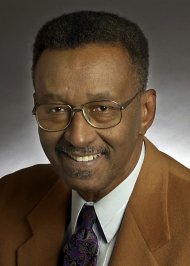
Walter Williams interviewed by libertarian Reason magazine

Walter Williams
Walter Williams

Here’s the video. (H/T The Blog Prof)

He’s my second favorite economist, right behind Thomas Sowell.

In his latest column, he explains the famous “Broken Window Fallacy”.

Excerpt:

Economic lunacy abounds, and often the most learned, including Nobel Laureates, are its primary victims. The most recent example of economic lunacy is found in a Huffington Post article titled “The Silver Lining of Japan’s Quake” written by Nathan Gardels, editor of New Perspectives Quarterly, who has also written articles for The Wall Street Journal, Los Angeles Times, New York Times and Washington Post.

Mr. Gardels says, “No one — least of all someone like myself who has experienced the existential terror of California’s regular tremors and knows the big one is coming here next — would minimize the grief, suffering and disruption caused by Japan’s massive earthquake and tsunami. But if one can look past the devastation, there is a silver lining. The need to rebuild a large swath of Japan will create huge opportunities for domestic economic growth, particularly in energy-efficient technologies, while also stimulating global demand and hastening the integration of East Asia. … By taking Japan’s mature economy down a notch, Mother Nature has accomplished what fiscal policy and the central bank could not.”

[…]Why might Japan’s and Florida’s devastation be seen as “pluses”? French economist Frederic Bastiat (1801-1850) explained it in his pamphlet “What is Seen and What is Not Seen,” saying, “There is only one difference between a bad economist and a good one: the bad economist confines himself to the visible effect; the good economist takes into account both the effect that can be seen and those effects that must be foreseen.”

Bastiat elaborated further in his “Broken Window Fallacy” parable where a vandal smashes a shopkeeper’s window.

A crowd forms, sympathizing with the shopkeeper. Soon, someone in the crowd suggests that instead of a tragedy, there might be a silver lining. Instead of the boy being a vandal, he was a public benefactor, creating economic benefits for everyone in town. Fixing the broken window creates employment for the glazier, who will then buy bread and benefit the baker, who will then buy shoes and benefit the cobbler and so forth.

Bastiat says that’s what’s seen. What is not seen is what the shopkeeper would have done with the money had his window not been smashed. He might have purchased a suit from the tailor. Therefore, an act that created a job for the glazier destroyed a job for the tailor. On top of that, had the property destruction not occurred, the shopkeeper would have had a suit and a window. Now he has just a window and as a result, he is poorer.

I learned a lot about economics from his columns.

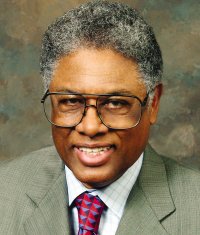
Thomas Sowell urges us to reflect on economic trade-offs and incentives

Thomas Sowell

Article here on Creators.

Excerpt:

With all the laments in the media about skyrocketing unemployment among young people, and especially minority young people, few media pundits even try to connect the dots to explain why unemployment hits some groups much harder than others.

Yet unusually high unemployment rates among young people is not something new or even something peculiar to the United States. Even before the current worldwide recession, unemployment rates were 20 percent or more among workers under 25 years of age in a number of Western European countries.

The young have less experience to offer and are therefore less in demand. Before politicians stepped in, that just meant that younger workers were paid less. But this is not a permanent situation because youth itself is not permanent, and pay rises with experience.

Enter politicians. By mandating a minimum wage that sounds reasonable for most workers, they put a price on inexperienced and unskilled labor that often exceeds what it is worth.

Mandated pay rates, like mandated insurance coverage, impose on buyers and sellers alike things that they would not choose to do otherwise.

Workers of course prefer higher wage rates. But the very fact that the government has to impose those wage rates means that workers were unwilling to risk not having a job by refusing to work for less than the wage rate that has been mandated. Now that choice has been taken out of their hands, with the hidden cost in this case being higher unemployment rates.

The law of unintended consequences – hurting the very people they intended to help, because of their economic ignorance. They priced the youngest and most vulnerable workers out of a job, by mandating a minimum wage that no employer will pay to an inexperienced worker. During a recession, you LOWER minimum wage in order to make sure that those most in need can find a job rather than depend on the government.

When people have jobs, they have confidence to spend more money. Making sure that no policy harms job creation is a primary responsibility of government. Jobs, jobs, jobs. No one (especially Christians) should be dependent on the government for money – because the one who pays the piper calls the tune. And no Christian should dance to the tune of a secular leftist government.

If you are a Christian, but not yet a solid small-government fiscal conservative, then read the WHOLE thing. Christians need to understand that the free market is the best guarantor of our freedom of conscience.

Thomas Sowell is my favorite living economist. Walter Williams is number 2. If you click this link, you can read something from Walter Williams about the economic problems that are created by forcing insurance companies to cover people with pre-existing conditions.

Related posts