
Tag Archives: Matter

Angus Menuge on methodological materialism and the search for truth

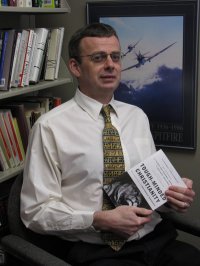
Dr. Angus Menuge
Dr. Angus Menuge

Methodological materialism is the view that requires scientists to explain everything they observe in nature using material causes and never intelligent causes.

And now, from the Evangelical Philosophical Society blog, an article entitled “Is methodological materialism good for science?”. The article is written by Dr. Angus Menuge, whom I wrote about before.

Intro:

Should science by governed by methodological materialism? That is, should scientists assume that only undirected causes can figure in their theories and explanations? If the answer to these questions is yes, then there can be no such thing as teleological science or intelligent design. But is methodological materialism a defensible approach to science, or might it prevent scientists from discovering important truths about the natural world? In my contribution to The Waning of Materialism (OUP, 2010), edited by Robert Koons and George Bealer, I consider twelve of the most common arguments in favor of methodological materialism and show that none of them is convincing.

Of these arguments, perhaps the most prevalent is the “God of the gaps” charge, according to which invoking something other than a material cause is an argument from ignorance which, like a bad script writer, cites a deus ex machina to save our account from difficulty. Not only materialists, but also many Christian thinkers, like Francis Collins, worry that appeal to intelligent design commits the God of the gaps fallacy.

As I argue, however, not only is an inference to an intelligent cause not the same as an inference to the supernatural, it is a mistake to assume that all gap arguments are bad, or that only theists make them. If a gap argument is based solely on ignorance of what might explain some phenomenon, then indeed it is a bad argument. But there are many good gap arguments which are made both by scientific materialists and proponents of intelligent design.

So how do you make an argument like that?

As Stephen Meyer has argued in his Signature in the Cell, intelligent design argues in just the same way, claiming not merely that the material categories of chance and necessity (singly or in combination) are unable to explain the complex specified information in DNA, but also that in our experience, intelligent agents are the only known causes of such information. The argument is based on what we know about causal powers, not on what we do not know about them.

Since the inference is based on known causal powers, we learn that the cause is intelligent, but only further assumptions or data can tell us whether that intelligence is immanent in nature or supernatural. It is a serious mistake to confuse intelligent design with theistic science, and the argument that since some proponents of design believe that the designer is God, that is what they are claiming can be inferred from the data, is a sophomoric intensional fallacy.

Basically, you identify what material processes have been OBSERVED to be capable of, and then you show that the effect you are trying to explain is beyond the reach of those powers. For example, think of a Scrabble board left alone in a locked room with an open window from morning till evening. It’s summer, so the air conditioner is working hard all day. If you come home and enter the room and find a sentence on the Scrabble game board that says “IF YOU LEAVE YOUR WINDOWS OPEN THEN YOU PAY HIGHER ELECTRICITY BILLS” then does it make more sense to attribute that effect to the wind, or to an intelligent intruder?

If you are a materialist, then you can only appeal to matter, chance and time (and not much time, too). By ruling out intelligence, you are really confining yourself to an obviously wrong answer. But suppose you came home and found that that the tiles were scattered all over the board and on the floor and the only sequences spelled out “AN” and “ZYKDSFGOJD”. I think a better inference there is that the wind blew the bag open made a couple of nonsense sequences. Of course the idea that wind could blow open a bag of Scrabble letters at all is very unlikely, but if you rule out intelligence, that’s all you have left, no matter how strained the inference. You have to believe nonsense.

But what about the design theorist who can rule nonsense out as impossible? Well he hits on the correct explanation of the effect – intelligence.

As the fictional detective Sherlock Holmes says:

“When you have eliminated the impossible, whatever remains, however improbable, must be the truth.”

But if an intelligent design theorist comes along and rules out material causes as an explanation of the effect by showing that the effect is beyond the reach of matter, time and chance, then the explanation of intelligence must be, however improbably, true. The important thing is to rule out materialism by evaluating what material causes can do. We don’t want to rule it out by pre-supposition, because that’s what the naturalists do when they rule out intelligence as an explanation. Ruling things out by pre-supposition is how you get wrong answers to questions. Everything has to be on the table that we have experienced. And every human knows what it is to sequence Scrabble letters into meaningful words and phrases

By the way, the publisher of the book, OUP, is Oxford University Press. Angus Menuge doesn’t mess around.

Is there such a thing as genuine libertarian free will if naturalism is true?

PNAS article shows what naturalists think of free will. (H/T Secondhand Smoke)

Excerpt:

Although, like any biosynthetic process, the product may be quite distinct from the input material, it is still a direct consequence of these materials. I suggest that consciousness acts on behavior in a similar manner, such as to commonly reinforce the negative effects that are associated with antisocial behavior. Similarly, for some of us, consciousness heightens our desire to listen to music, for example, or to watch or participate in sporting activities. Whereas the impressions are that we are making “free” conscious decisions, the reality is that consciousness is simply a state of awareness that reflects the input signals, and these are an unavoidable consequence of GES. The mechanistic details of these conscious processes are unknown, and remain the major unsolved problem in biology.

And:

A belief in free will is akin to religious beliefs. Indeed, I would argue that free will makes “logical sense,” as long as one has the luxury of the “causal magic” of religion. Neither religious beliefs, nor a belief in free will, comply with the laws of the physical world. However, despite thi similarity, although in scientific circles a skeptical viewpoint is very common regarding religious forces and their day-to-day impact on biological systems, it is my observation that similar skepticism is not widely held regarding a belief in free will.

And finally:

We are conscious automata.” That is, Huxley believed (as I and many others do) that we are mechanical forces of nature and that, by some mechanism we have evolved the phenomenon of consciousness, which, I would argue, has conferred upon us the illusion of responsibility.

The illusion of free will. The illusion of moral choices. The illusion of responsibility. It should be noted that if determinism is true, as he states, then everything he says is non-rational. The chemicals in his brain simply fizzed up those particular words. Note that conscious is undeniable, but no materialist can explain how inanimate matter can create consciousness. No matter how many parts you add to a computer, it will never gain self-awareness. It’s behavior will always be determined by programming and inputs.

What do atheists think of morality?

Let me cite the views of atheist scholars from a previous post. These are the people who are the most committed, authentic atheists, and who have thought through what it means to be an atheist at the highest level.

The idea of political or legal obligation is clear enough… Similarly, the idea of an obligation higher than this, referred to as moral obligation, is clear enough, provided reference to some lawgiver higher…than those of the state is understood. In other words, our moral obligations can…be understood as those that are imposed by God…. But what if this higher-than-human lawgiver is no longer taken into account? Does the concept of moral obligation…still make sense? …The concept of moral obligation [is] unintelligible apart from the idea of God. The words remain but their meaning is gone. (Richard Taylor, Ethics, Faith, and Reason (Englewood Cliffs, N. J.: Prentice-Hall, 1985), p. 83-84)

In a universe of blind physical forces and genetic replication, some people are going to get hurt, other people are going to get lucky, and you won’t find any rhyme or reason in it, or any justice. The universe that we observe has precisely the properties we should expect if there is, at bottom, no design, no purpose, no evil and no good, nothing but blind, pitiless indifference… DNA neither knows nor cares. DNA just is. And we dance to its music. (Source: Richard Dawkins)

The position of the modern evolutionist is that humans have an awareness of morality because such an awareness of biological worth. Morality is a biological adaptation no less than are hands and feet and teeth. Considered as a rationally justifiable set of claims about an objective something, ethics is illusory. I appreciate when someone says, ‘Love thy neighbor as thyself,’ they think they are referring above and beyond themselves. Nevertheless, such reference is truly without foundation. Morality is just an aid to survival and reproduction, . . . and any deeper meaning is illusory. (Michael Ruse, “Evolutionary Theory and Christian Ethics,” in The Darwinian Paradigm (London: Routledge, 1989), pp. 262-269).

There is no such thing as morality on atheism.

Debating the Kalam argument in a YouTube thread

A new reader to the blog read my article on the Kalam cosmological argument, and he decided to try it out on youtube here. He presented the argument PERFECTLY, and then he got some responses. He asked me to comment, so I will below. But I want you guys to comment, too! (UPDATE: Comment in this post – I don’t recommend commenting in YouTube discussions)

Anyway, here’s the page. (I didn’t watch the video)

And here’s his initial presentation of the argument:

1 Whatever begins to exist requires a cause
2 The universe began to exist
3 Therefore, the universe requires a cause

The cause for the universe (time, space, matter, etc) must be something entirely different (outside the realm of time, space, and matter) since a thing cannot be the cause of itself.

Now I’ll reply to his opponents, but you can reply too in the comments, because he’s reading this post, and we should all try to offer him our thoughts. At the end, I recommend some additional resources, all free online, to help everyone understand the details of this fine argument.

Responses to the Kalam argument

Here’s the first reply:

Just because we don’t know the cause yet doesn’t mean it’s not something scientific. I’m not saying it is, I’m just saying it’s possible.

By “scientific”, I am thinking that this challenger is hoping for a material cause, but the problem is that the origin of the universe is the origin of all space and matter – so no “scientific” cause is possible. So it is not possible that the origin of the universe was caused by something “scientific”, because it’s an absolute origin of all matter, and the physical laws that govern matter, as well. Tell him that there is only one kind of non-material entity capable of causing effects and that is a mind.

Here’s another reply:

What if the universe always existed? We don’t know that it has started to exist, we just know that it exists and that it has existed for very long. So it is possible that it has always existed. So that doesn’t prove anything.

I would ask this person why they hate science so much to deny the good data about the measurements of red-shift in light from distant galaxies, the helium-hydrogen abundance measurements, the cosmic microwave background radiation, the second law of thermodynamics, the star formation cycle, etc. As them what is wrong with science, and why must they push their religion (naturalism) on science?

Here’s another reply:

The same principle can apply to god as well, so this argument doesn’t prove or disprove either it is just pointless.

My response is that the cause of the universe causes the beginning of time as well, and so therefore the cause exists necessarily, outside of time. Things that exist outside of time are eternal, they don’t not exist at time t1 and then begin to exist at time t2. The cause of time’s beginning cannot come into being itself, because there is no t1 and t2 before time is created.

Here’s another reply:

uhm .. no, there is no definition of god like that and even if it is it’s invalid, why ? well mostly because apart from a book “The Bible” there is no real proof he existed, no one has seen him and I’ll wager that no one ever will, henceforth you cannot define something that you really know nothing about, something that might not even exist, it’s like saying that bigfoot is a mammal. you can’t prove that either since you haven’t seen it and don’t even know if it exists

Notice that onlinesid produced an argument for the existence of God, and now this guy is bringing in the Bible (red herring), no proof (red herring), why can’t I see God (red herring), no one knows anything about God (red herring and self-refuting), and bigfoot (red herring). This person is clearly brain-damaged and not one of the things he write is worth a response. Note: I am being mean, but you can’t be mean when you reply to him, you have to tell them to stay focused on your argument and deny premise 1 or premise 2.

And here’s another:

You assume that the universe began to exist.

We currently don’t know if it did or not; the present hypothesis is expansion from a single point that is infinitely small.

You also assume that the cause of the universe doesn’t have a cause. You need to account for the cause of the cause, and the cause of that cause, ad infinitum.

And on “God being outside of” reality, then he shouldn’t be able to affect reality in any observable way. God is untestable.

Again, tell him he is a science-hating flat-earther and ask which of the empirical evidences for the Big Bang he denies. We need to get off of his speculations and evasions and ask him to deny a premise or to deny some scientific data. As soon as he does, ask him for peer-reviewed data that refutes the scientific observations. The cause of the universe doesn’t have a cause because it is outside of time and doesn’t begin to exist. The premise is that only things that begin to exist require a cause. Regarding God not being able to cause effects, you should say that God is a mind and causes effects in time subsequent to creation the same way that humans cause effects using their wills on their bodies.

Here’s another:

It’s called the “Big Bang” hypothesis. Even simple Wikipedia will besufficient for an understanding of it. Or videos on Youtube, if you are that lazy and/or ignorant.

The “evidence” for it is background electromagnetic radiation and the appearance that the universe is expanding. Among other things

The “mind” we perceive is the function of electrochemical impulses between our brain cells. We classify it as a “mind”. And as a physical system of reality, it is affected by physical reality..

Again ask him what is his scientific evidence that the universe is eternal, and ask him what is wrong with your scientific evidence showing that it isn’t eternal. You must make him make a claim and supply evidence for his claim. You need to buy a book called “God and the Astronomers” by agnostic Robert Jastrow and read it. It explains all the discoveries that led to the Big Bang, but get the second edition. Also, if he thinks that mind is biologically determined, then you need to explain that biological determinism makes rationality impossible, since all of our outputs are determined by inputs and DNA programming that has the goal of reproducing, not finding truth.

More challenges:

…The beginning of the universe need not be “God”. Could have been made by a pencil. Or could have always been, like a trigonomic function, repeating and diverging into two dimensions.

I think our boy is beginning to wear him down. He now thinks a pencil caused the entire physical universe to appear out of nothing. But the problem is that a pencil is made of matter and cannot have caused the beginning of all matter. But do go on and make him identify what he thinks the cause is. It can’t be in time, it can’t be matter.

More:

And the theist-point-of-view actually can in no way prove God because there are many OTHER ways it could have happened. A pencil could have been the original cause of the big-bang, or it could repeat like a trig function, eternally epanding, collapsing, expanding in another
dimension, etc.

He’s raising the oscillating model, which is falsified theoretically and observationally. In 1998, the discovery of the year was that the universe would expand forever. The oscillating model also faces theoretical problems with the “bounce” mechanism. Sid, if you still can, try your best in physics class, and take astronomy and physics in university, along with philosophy and logic. It will help you to have more fun in these debates and you’ll know more details.

More:

I did not say that the physical realm is all there is. (Thought there could be two realms, or more.) BUT asuming that an entity exists outside the physical realm and created this universe from that dimension IS illogical.

Ask him for a logical argument that proves that God cannot create matter out of nothing. These assertions need to be backed up with deductive arguments, with premises supported by scientific observations. You can’t just throw around that word “illogical”. It sounds like he is just saying “I don’t like it”. Make sure that you ask him for peer-reviewed papers for anything he says about science, and formal arguments for anything he says is “illogical”.

This time he argues quatum mechanics:

Small particles of matter, at least as I understand it, CAN be “created” from energy. The only real “trouble” is the creation of energy, which “god made it” faces the problem of “what made god?”…

If he wants to argue quantum mechanics, you need to remind him that virtual particles can only appear in a quantum vaccuum, which exists in space. It is not nothing. Also, virtual particles are not as massive as a universe, and those virtual particles only stay in existence for a fraction of a second. So this is not a good analogy for the origin of the entire physical universe.

Further study

You did well, you just need to be meaner in demanding that he bear his share of the burdern of proof. Ask him why you should accept his speculations and assertions, where are his arguments, where is his scientific evidence.

I think that this book would be a good one along with God and the Astronomers, second edition. But read this paper, too, and every William Lane Craig debate you can get your hands on, especially the one with physicist Victor Stenger (video, audio), the follow-up lecture at UC Boulder where Stenger is in the audience, and the second Craig-Dacey debate. When you’re done with that, listen to this lecture and this lecture (I know it’s similar to the first one, but tough!) and this lecture and this lecture. And study more physics if you’re still in school!

God meant for us to enjoy ourselves arguing in his universe. Jesus cured the paralytic to provide evidence for his claims. Similarly, we can use the evidence of nature miracles that science is just now discovering to get the same effect as though we could perform miracles. But we need to understand philosophy and physics down to the details.