
Here’s the speech from July 3, 2008:
Ha! That looks like Obama giving that speech. Oh, it is Obama. Ha ha.
In that clip, Obama says:
The problem is, is that the way Bush has done it over the last eight years is to take out a credit card from the Bank of China in the name of our children, driving up our national debt from $5 trillion for the first 42 presidents – #43 added $4 trillion by his lonesome, so that we now have over $9 trillion of debt that we are going to have to pay back — $30,000 for every man, woman and child. That’s irresponsible. It’s unpatriotic.
Obama liked to talk about the credit card from the bank of China during the campaign. And many people who watch Jon Stewart and Stephen Colbert and Rachel Maddow believed him. They believed him because the comedians told them to believe him. They did not want to stop laughing long enough to look at Obama’s voting record to see that he was consistently getting F ratings on spending and government waste and pork in all of his years as a legislator.
So Obama said that spending 4 trillion is “unpatriotic”. But then Obama did a funny thing. CBS News reports.
The latest posting by the Treasury Department shows the national debt has now increased $4 trillion on President Obama’s watch.
The debt was $10.626 trillion on the day Mr. Obama took office. The latest calculation from Treasury shows the debt has now hit $14.639 trillion.
It’s the most rapid increase in the debt under any U.S. president.
The national debt increased $4.9 trillion during the eight-year presidency of George W. Bush. The debt now is rising at a pace to surpass that amount during Mr. Obama’s four-year term.
Mr. Obama blames policies inherited from his predecessor’s administration for the soaring debt. He singles out:
“two wars we didn’t pay for”
“a prescription drug program for seniors…we didn’t pay for.”
“tax cuts in 2001 and 2003 that were not paid for.”He goes on to blame the recession, and its resulting decrease in tax revenue on businesses, for making fewer sales, and more employees being laid off. He says the recession also resulted in more government spending due to increased unemployment insurance payments, subsidies to farms and funding of infrastructure programs that were part of his stimulus program.
Obama’s explanation for the deficits doesn’t wash, since the deficit was only $162 billion in 2007, the last year the Republicans had control of the House and Senate.
The Washington Times explains.
Excerpt:
A favorite liberal narrative is that President George W. Bush squan- dered the Clinton-era budget surpluses and piled up deficits with expensive wars and tax cuts for the rich. Candidate Barack Obama used this tale to great effect, and President Obama tells it still. Take his State of the Union address last week, when Mr. Obama attributed the Bush-era deficits to “paying for two wars, two tax cuts, and an expensive prescription drug program.”
The truth is that Mr. Bush’s deficits were the product of spending, not tax cuts. In fact, Mr. Obama could learn an important lesson for his own economic plan by studying Mr. Bush’s two very different attempts at tax-cutting.
As the Wall Street Journal’s Stephen Moore illuminates in his 2008 book “The End of Prosperity” (Threshold Editions), Mr. Bush’s 2001 tax cuts failed to revive an economy still staggering from the bursting of the dot-com bubble. Mr. Bush’s strategy had been to adopt a demand-side, Keynesian stimulus, hoping that putting a few extra dollars in Americans’ pockets would jump-start the economy through increased consumption. This approach faltered, not just because Americans opted to save their rebates, but because it neglected the importance of business investment to overall growth. Predictably, the economy lagged and government revenues stagnated. What the United States needed then (and needs now) was to stimulate investment, not consumption.
By 2003, Mr. Bush grasped this lesson. In that year, he cut the dividend and capital gains rates to 15 percent each, and the economy responded. In two years, stocks rose 20 percent. In three years, $15 trillion of new wealth was created. The U.S. economy added 8 million new jobs from mid-2003 to early 2007, and the median household increased its wealth by $20,000 in real terms.
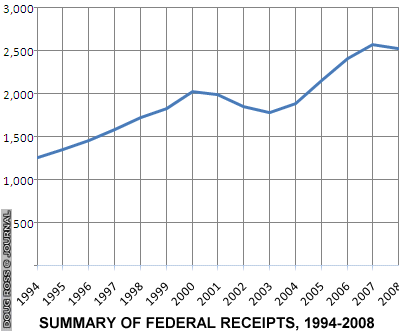
But the real jolt for tax-cutting opponents was that the 03 Bush tax cuts also generated a massive increase in federal tax receipts. From 2004 to 2007, federal tax revenues increased by $785 billion, the largest four-year increase in American history. According to the Treasury Department, individual and corporate income tax receipts were up 40 percent in the three years following the Bush tax cuts. And (bonus) the rich paid an even higher percentage of the total tax burden than they had at any time in at least the previous 40 years. This was news to theNew York Times, whose astonished editorial board could only describe the gains as a “surprise windfall.”
Unfortunately, Mr. Bush allowed Congress to spend away those additional tax revenues. The fact is that the increase in tax revenues that flowed from the ‘03 tax cuts could have paid for the wars in Afghanistan and Iraq and then some but for rampant discretionary domestic spending.
So, Bush passed his tax cuts in 2001 and 2003, but revenue went up:
And the deficits went down from 2004 to 2007:

Bush was on track to balance the budget, then Nancy Pelosi came along and added 5.34 trillion to the debt in her 4 years as Speaker.
 WINTERY KNIGHT