
Tag Archives: Jobs

Liberal feminist Hanna Rosin debunks the 77 percent pay for women myth

In the far-left Slate, of all places.

Excerpt:

The official Bureau of Labor Department statistics show that the median earnings of full-time female workers is 77 percent of the median earnings of full-time male workers. But that is very different than “77 cents on the dollar for doing the same work as men.” The latter gives the impression that a man and a woman standing next to each other doing the same job for the same number of hours get paid different salaries. That’s not at all the case. “Full time” officially means 35 hours, but men work more hours than women. That’s the first problem: We could be comparing men working 40 hours to women working 35.

How to get a more accurate measure? First, instead of comparing annual wages, start by comparing average weekly wages. This is considered a slightly more accurate measure because it eliminates variables like time off during the year or annual bonuses (and yes, men get higher bonuses, but let’s shelve that for a moment in our quest for a pure wage gap number). By this measure, women earn 81 percent of what men earn, although it varies widely by race. African-American women, for example, earn 94 percent of what African-American men earn in a typical week. Then, when you restrict the comparison to men and women working 40 hours a week, the gap narrows to 87 percent.

But we’re still not close to measuring women “doing the same work as men.” For that, we’d have to adjust for many other factors that go into determining salary. Economists Francine Blau and Lawrence Kahn did that in a recent paper, “The Gender Pay Gap.”.”They first accounted for education and experience. That didn’t shift the gap very much, because women generally have at least as much and usually more education than men, and since the 1980s they have been gaining the experience. The fact that men are more likely to be in unions and have their salaries protected accounts for about 4 percent of the gap. The big differences are in occupation and industry. Women congregate in different professions than men do, and the largely male professions tend to be higher-paying. If you account for those differences, and then compare a woman and a man doing the same job, the pay gap narrows to 91 percent. So, you could accurately say in that Obama ad that, “women get paid 91 cents on the dollar for doing the same work as men.”

I believe that the remainder of the gap can be accounted for by looking at other voluntary factors that differentiate men and women.

The Heritage Foundation says that a recent study puts the number at 95 cents per dollar.

Excerpt:

Women are more likely than men to work in industries with more flexible schedules. Women are also more likely to spend time outside the labor force to care for children. These choices have benefits, but they also reduce pay—for both men and women. When economists control for such factors, they find the gender gap largely disappears.

A 2009 study commissioned by the Department of Labor found that after controlling for occupation, experience, and other choices, women earn 95 percent as much as men do. In 2005, June O’Neil, the former director of the Congressional Budget Office, found that “There is no gender gap in wages among men and women with similar family roles.” Different choices—not discrimination—account for different employment and wage outcomes.

A popular article by Carrie Lukas in the Wall Street Journal agrees.

Excerpt:

The Department of Labor’s Time Use survey shows that full-time working women spend an average of 8.01 hours per day on the job, compared to 8.75 hours for full-time working men. One would expect that someone who works 9% more would also earn more. This one fact alone accounts for more than a third of the wage gap.

[…]Recent studies have shown that the wage gap shrinks—or even reverses—when relevant factors are taken into account and comparisons are made between men and women in similar circumstances. In a 2010 study of single, childless urban workers between the ages of 22 and 30, the research firm Reach Advisors found that women earned an average of 8% more than their male counterparts. Given that women are outpacing men in educational attainment, and that our economy is increasingly geared toward knowledge-based jobs, it makes sense that women’s earnings are going up compared to men’s.

When women make different choices about education and labor that are more like what men choose, they earn just as much or more than men. What does it mean that people on the left keep pushing pseudo-science on us to try to punish men and reward women? Why are men so awful that they need to be denigrated like this? And how will men respond to social expectations when they have to face being told that they are “bad”? It seems to me that putting men down is going to lower their level of engagement.
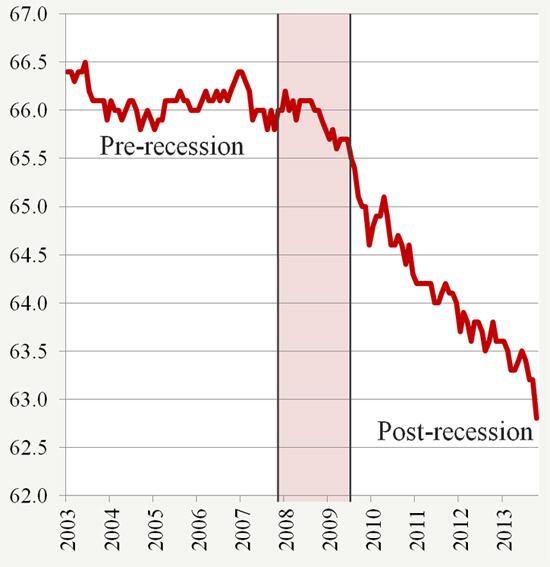
New study: Obama’s proposed minimum wage hike could destroy 1 million jobs

Labor Force Participation down to 62.8%

From the Daily Caller. (H/T Conway)

Excerpt:

The Obama administration’s proposal to raise the minimum wage to $10.10 an hour could result in as many 1,084,000 jobs eliminated from the work force, according to a new study conducted by the Employment Policies Institute (EPI)

“No amount of denial by the president and his political allies — and no number of ‘studies’ published by biased researchers — can change the fact that minimum wage hikes eliminate jobs for low-skill and entry-level employees. Non-partisan economists have agreed on this consensus for decades, and the laws of economics haven’t changed,” Michael Saltsman, research director at EPI, said in a statement.

He offered an alternative to the president’s plan: “Instead of raising small businesses’ labor costs and creating more barriers to entry-level employment, the president and the Senate should focus on policies that help reduce poverty and create jobs.”

The  study was released in the wake of an expected vote on a Senate bill that aims to raise the federal minimum wage from the current $7.25 an hour to $10.10 an hour — a nearly 40 percent increase.

Many Democrats argue that increasing the federal minimum will reduce poverty without having an adverse effect on unemployment.

EPI’s report, which used analysis from economists at Miami and Trinity University, reached a different conclusion.

Researchers used recently updated Census Bureau data from 2012 and 2013 to calculate how each individual state would be impacted by the proposed wage hikes. As a lump sum, Americans would see a loss of at least 360,000 jobs, and perhaps even over one million if hourly wages are increased to $10.10.

The number of job losses would be the most dramatic in large states, such as California and Texas. Economists found that California could lose as many as 100,016 jobs and Texas could see up to 128,617 jobs disappear from its economy.

This article from Investors Business Daily, written by the famous economist Thomas Sowell has more on the effects of raising the minimum wage.

Excerpt:

Switzerland is one of the few modern nations without a minimum-wage law. In 2003, the Economist magazine reported: “Switzerland’s unemployment neared a five-year high of 3.9% in February.”

In February of this year, Switzerland’s unemployment rate was 3.1%. A recent issue of the Economist showed Switzerland’s unemployment rate as 2.1%.

Most Americans today have never seen unemployment rates that low. However, there was a time when there was no federal minimum-wage law in the United States.

The last time was during the Coolidge administration, when the annual unemployment rate went as low as 1.8%. When Hong Kong was a British colony, it had no minimum-wage law. In 1991 its unemployment rate was under 2%.

[…]Most people in the lower income brackets are not an enduring class. Most working people in the bottom 20% in income at a given time do not stay there over time. More of them end up in the top 20% than remain behind in the bottom 20%.

There is nothing mysterious about the fact that most people start off in entry-level jobs that pay much less than they will earn after they get some work experience.

But when minimum-wage levels are set without regard to their initial productivity, young people are disproportionately unemployed — priced out of jobs.

In European welfare states where minimum wages, and mandated job benefits to be paid for by employers, are more generous than in the United States, unemployment rates for younger workers are often 20% or higher, even when there is no recession.

Unemployed young people lose not only the pay they could have earned but, at least equally important, the work experience that would enable them to earn higher rates of pay later on.

Minorities, like young people, can also be priced out of jobs. In the United States, the last year in which the black unemployment rate was lower than the white unemployment rate — 1930 — was also the last year when there was no federal minimum-wage law.

Inflation in the 1940s raised the pay of even unskilled workers above the minimum wage set in 1938. Economically, it was the same as if there were no minimum-wage law by the late 1940s.

In 1948 the unemployment rate of black 16-year-old and 17-year-old males was 9.4%. This was a fraction of what it would become in even the most prosperous years from 1958 on, as the minimum wage was raised repeatedly to keep up with inflation.

A survey of American economists found that 90% of them regarded minimum-wage laws as increasing the rate of unemployment among low-skilled workers.

Harvard University economist Greg Mankiw puts the level of opposition to minimum wage hikes at 79% among professional economists across the ideological spectrum.

Only 74,000 jobs added in December, lowest in 3 years

Labor Force Participation down to 62.8%

CNS News reports on the disappointing job numbers.

Excerpt:

The economy added only 74,000 non-farm jobs in December, the fewest in three years. Yet the unemployment rate dropped 0.3 points to 6.7 percent — the first time in 60 months it has dropped below 7 percent, the Labor Department announced on Friday.

With so few jobs added, the jobless rate still went down because people stopped looking for work.

The Bureau of Labor Statistics says the number of unemployed persons declined by 490,000 to 10.4 million in December, indicating that many of them dropped out of the labor force.

The government counts people as unemployed only if they are actively searching for work.

[…]In 2013, job growth averaged 182,000 per month, about the same as in 2012, when it averaged 183,000 a month.

I am thinking about whether the Obama administration has done anything in the last 5 years to create any jobs. I know they could have suspended the employer portion of payroll taxes. They didn’t do that. They could have allowed the Keystone XL pipeline. They didn’t do that. They could have repealed Obamacare so that employers didn’t have to reduce worker hours to avoid having to pay penalties. They didn’t do that. They could have stopped borrowing over a trillion dollars a year. They didn’t do that.

So I am just wondering what exactly this government has done to create jobs. I know the economy is resilient, and some jobs get created every month, no matter what. But I would like someone to tell me how this government has encouraged the private sector to hire more workers. I think if they had done anything to specifically address jobs, then I would know about it.