Tag Archives: Indoctrination

Left uses stories and peer-pressure to indoctrinate children to support same-sex marriage

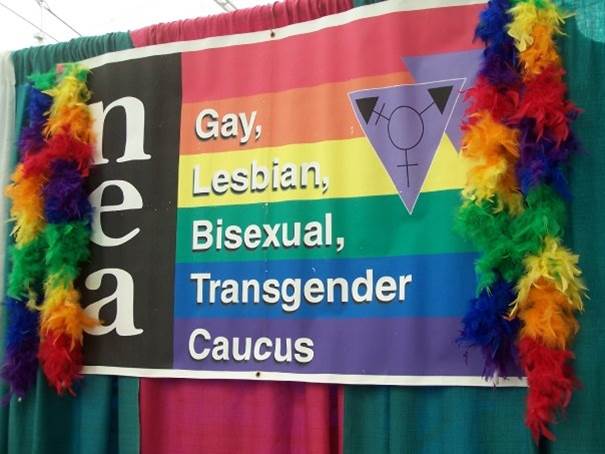
National Education Association

This is a striking story from Life Site News. It talks about how the school system gets pro-same-sex-marriage speakers to teach the children to support same-sex-marriage.

It says:

A primary grade lesbian teacher from an Ontario public school revealed in a workshop at a homosexual activist conference for teachers earlier this month how she uses her classroom to convince children as young as four to accept homosexual relationships.

“And I started in Kindergarten. What a great place to start. It was where I was teaching. So, I was the most comfortable there,” Pam Strong said at the conference, attended by LifeSiteNews.

The conference, hosted by the homosexual activist organization Jer’s Vision, now called the Canadian Centre for Gender and Sexual Diversity, focused on the implementation of Bill 13 in Ontario classrooms. Bill 13, called by critics the ‘homosexual bill of rights,’ passed in June 2012 and gave students the right to form pro-gay clubs in their school, including Catholic ones, using the name Gay-Straight Alliance (GSA).

Strong, who is in an open relationship with another woman and who has been a teacher for about five years, focused her workshop on what she called the “power of conversation” for promoting LGBTQ issues in an elementary classroom. She began her talk by relating how she reacted the first time one of her students called another student ‘gay’ as a putdown.

“With [the principal’s] encouragement, we decided that I would go from class to class and talk about what ‘gay’ means, what does ‘LGBTQ’ mean, what do ‘I’ mean,” she told about 40 attendees, all educators, at her workshop.

There are some examples of how she manipulates the children, but I want to focus on one in particular:

Strong related an incident that happened last fall involving a new boy who had recently entered her grade 5 classroom. The new boy had not yet been made aware of Strong’s sexual preference for other women.

“All my class is very used to who I am. My family picture is very proudly in my room now. On Mondays they quite often will say, ‘What did you do with your wife?’ It’s normal in my classroom.”

Strong said that a conversation between herself and the students came up one day where it was mentioned that she was a lesbian. The new boy put his hands over his mouth and said, according to Strong: “Oh, my God, I think I’m going to puke.”

“As I took the abuse — personally, as an individual – of those words, I also saw half of my class look at me with incredible concern. One student who was right in front of me already had tears in her eyes. And I noticed several other students who were looking at him. They were just very, very upset with this kid,” she related.

Strong said the boy instantly became aware that “something he had said had just created this unbelievable tension in the room.” She related how she addressed the boy, telling him: “I think that what you might not be aware of is that I am gay, and I am married to a woman, and my family has two moms.’”

“His eyes just started darting around, and he was incredibly uncomfortable,” she related.

“I looked at the other kids and I said: ‘Ok guys, what I want to ask you is: Am I upset with him?’ And the one little girl in my class put up her hand — that doesn’t usually get into these conversations very much in my classroom — and she said, ‘Mrs Strong, I know you’re not upset with him, because he hasn’t had the benefit of our conversations.”

“And I looked at my little friend, my ‘new’ friend, and I said: ‘But, we’re going to have one now,’” she related.

Strong said that she then directed her class to the board and asked them to write everything she had told them related to LGBTQ.

“And my class all of a sudden popped up. ‘LGBTQ’ was on the board, ‘lesbian,’ and all the different words coming out there. And I sat back and said, ‘Let’s review.’ So, the last year and a half of ‘inclusive’ education came alive in my classroom.”

Strong told her workshop attendees that her “new little friend” is now a devoted champion of diversity. She boasted how he was the one in her class to count down the days to the pro-homosexual Day of Pink that took place earlier this month. When Strong took a photo of all the children wearing pink shirts in her classroom, she said the boy requested to be in the front.

She isn’t interested in presenting both sides of the argument, or persuading grown adults like Dr. Ryan T. Anderson. She wants to go after children with stories that make her side look a certain way, stories that cannot be challenged or refuted by children. And with no opt-out or notification for parents, because parents have to be kept in the dark. Parents just get to pay to feed and clothe and shelter the children – but what they think is decided by teachers with an agenda. This indoctrination against the values of parents is taxpayer-funded. With no opt-out.  This is the “big government” that so many young evangelicals support.

This is why I am concerned about finding a wife who understands these things and takes them seriously enough to make a plan to deal with it. I have had Christian women who responded to this challenge from the schools by telling me that they intended to entrust the children to daycare and secular schools so they could focus on careers, travel, buying bling, etc. I try to show them studies showing how children are affected by daycare, homeschooling, etc. Usually, it’s like banging your head against a brick wall. It’s almost as if they have to  get their way on these things even though they have not studied these things themselves. They have to find a way to escape from any responsibilities to others so they can be free to do what feels good to them. But I need a partner who will take these concerns seriously and think of our children, not of her own happiness.

Keep in mind that even if you homeschool or private-school your kids, that they have live next door to the brainwashed kids. The brainwashed kids are taught to hold to their views at a brittle, non-rational, emotional level. This is why children who are indoctrinated by the secular left are so offended by “triggering” behaviors that they have to take refuge in “safe spaces” free of opposing views. Our kids (raised by us) might agree with us, but they are not free of the influence from a much larger group of brainwashed kids. Our kids have to work for them. Our kids have to go to school with them. Our kids have to live under the laws that these other kids will pass, as they are shuffled through the best schools because they have the “right” views. The brainwashed kids vote and we will have to live under the laws they pass. Do you have a plan to deal with this? It seems to me that if women want to get married and have kids “some day”, then they should have thought about this some and be willing to talk about what to do about it, and be open to the fact that they may have to make some adjustments to prepare for it.

UPDATE: Life Site News is now threatened with a lawsuit after breaking this story.

Why is college so expensive? Why does university tuition cost so much?

The correct answer appeared in the radically leftist New York Times, of all places.

This is by Paul F. Campos, law professor at the radically leftist UC Boulder.

He writes:

[P]ublic investment in higher education in America is vastly larger today, in inflation-adjusted dollars, than it was during the supposed golden age of public funding in the 1960s. Such spending has increased at a much faster rate than government spending in general. For example, the military’s budget is about 1.8 times higher today than it was in 1960, while legislative appropriations to higher education are more than 10 times higher.

In other words, far from being caused by funding cuts, the astonishing rise in college tuition correlates closely with a huge increase in public subsidies for higher education. If over the past three decades car prices had gone up as fast as tuition, the average new car would cost more than $80,000.

Some of this increased spending in education has been driven by a sharp rise in the percentage of Americans who go to college. While the college-age population has not increased since the tail end of the baby boom, the percentage of the population enrolled in college has risen significantly, especially in the last 20 years. Enrollment in undergraduate, graduate and professional programs has increased by almost 50 percent since 1995. As a consequence, while state legislative appropriations for higher education have risen much faster than inflation, total state appropriations per student are somewhat lower than they were at their peak in 1990. (Appropriations per student are much higher now than they were in the 1960s and 1970s, when tuition was a small fraction of what it is today.)

As the baby boomers reached college age, state appropriations to higher education skyrocketed, increasing more than fourfold in today’s dollars, from $11.1 billion in 1960 to $48.2 billion in 1975. By 1980, state funding for higher education had increased a mind-boggling 390 percent in real terms over the previous 20 years. This tsunami of public money did not reduce tuition: quite the contrary.

[…]State appropriations reached a record inflation-adjusted high of $86.6 billion in 2009. They declined as a consequence of the Great Recession, but have since risen to $81 billion. And these totals do not include the enormous expansion of the federal Pell Grant program, which has grown, in today’s dollars, to $34.3 billion per year from $10.3 billion in 2000.

The more money that is attached to students, the more money universities charge – simple.

But where is the money going? Is it mostly going to research? To the classroom? To hire more and better professors?

No:

Interestingly, increased spending has not been going into the pockets of the typical professor. Salaries of full-time faculty members are, on average, barely higher than they were in 1970. Moreover, while 45 years ago 78 percent of college and university professors were full time, today half of postsecondary faculty members are lower-paid part-time employees, meaning that the average salaries of the people who do the teaching in American higher education are actually quite a bit lower than they were in 1970.

By contrast, a major factor driving increasing costs is the constant expansion of university administration. According to the Department of Education data, administrative positions at colleges and universities grew by 60 percent between 1993 and 2009, which Bloomberg reported was 10 times the rate of growth of tenured faculty positions.

Even more strikingly, an analysis by a professor at California Polytechnic University, Pomona, found that, while the total number of full-time faculty members in the C.S.U. system grew from 11,614 to 12,019 between 1975 and 2008, the total number of administrators grew from 3,800 to 12,183 — a 221 percent increase.

If you’re going to college or trade school, go to a low-cost school. Do a STEM degree or do a trade that pays well. Try to get tuition assistance even if it means going to a less prestigious school. And work at every opportunity you get in the most serious job you can find. Don’t spend your money – save it. Especially don’t spend your money on fun, vacations and alcohol. As soon as you grow up, you’re going to wish you could have it all back.

Why is it so hard to reason with college-educated millenials about spiritual things?

Why is it hard to reason with students?

The first article today is from lesbian feminist Camille Paglia. She is a university professor, but liberal (in the classical sense) in her outlook.

An hour-long interview is posted at Reason, and there’s a transcript.

Camille says:

reason: Clarify what’s the difference between a legitimate gripe and whining?

Paglia: Well, in my point of view, no college administration should be taking any interest whatever in the social lives of the students. None! If a crime’s committed on campus, it should always be reported to the police. I absolutely do not agree with any committees investigating any charge of sexual assault. Either it’s a real crime, or it’s not a real crime. Get the hell out. So you get this expansion of the campus bureaucracy with this Stalinist oversight. But the students have been raised with helicopter parents. They want it. The students of today—they’re utterly uninformed, not necessarily at my school, the art school, I’m talking about the elite schools.

reason: So it’s those kids over at that other school.

Paglia: It’s the grade grubbers, the bright overachievers. I’m not at that kind of school [here at University of the Arts in Philadelphia] . I’m at a school of arts and communication where people already have a vocational trend. To be admitted here, you have to already have demonstrated a vocational aptitude. I’m talking about the Ivy League. Now, I’ve encountered these graduates of Harvard, Yale, the University of Pennsylvania, and Princeton, I’ve encountered them in the media, and people in their 30s now, some of them, their minds are like Jell-O. They know nothing! They’ve not been trained in history. They have absolutely no structure to their minds. Their emotions are unfixed. The banality of contemporary cultural criticism, of academe, the absolute collapse of any kind of intellectual discourse in the U.S. is the result of these colleges, which should have been the best, have produced the finest minds, instead having retracted into caretaking. The whole thing is about approved social positions in a kind of misty, love of humanity without any direct knowledge of history or economics or anthropology.

reason: Maybe the university is not the place where that sort of stuff is happening anymore. So, for instance, you have think tanks that do a lot of economic or policy work. You have popular historians who are not academic. Fiction and poetry, even as there’s been a rise in for decades now of creative writing programs and what not. Nobody looks to the university to be cutting edge on almost anything really, so maybe it’s just that you picked the wrong hors. Maybe you should have followed the campus radicals’ suggestion and not gone into academia?

Paglia: [As a] writer of cultural criticism, I find that I’m happiest when I’m writing for the British press, and I write quite a bit for The Sunday Times magazine in London. I find that the general sense of cultural awareness means that I can have an authentic discourse about ideas with international journalists from Brazil or Germany or Italy or Norway or Canada even—somewhat, but they have a P.C. problem themselves. I can feel the vacuum and the nothingness of American cultural criticism at the present time. It is impossible—any journalist today, an American journalist, you cannot have any kind of deep discussion of ideas.

The students at the Ivy league universities are so insulated from “vocation” (working for money) and so indoctrinated in political correctness, that they cannot have a civil conversation about ideas. All they can do is state their own views, and if you disagree with them, then they call you names then retreat to “safe spaces”, where all unpleasant communication is blocked . They can’t even explain why they hold their own views except they have been taught to believe that all smart people believe them. They are traumatized by dissent, and they are not able to critically assess arguments and evidence.

Here’s a second article by Eleanor Taylor writing in the ultra-leftist New York Times.

She writes:

KATHERINE BYRON, a senior at Brown University and a member of its Sexual Assault Task Force, considers it her duty to make Brown a safe place for rape victims, free from anything that might prompt memories of trauma.

So when she heard last fall that a student group had organized a debate about campus sexual assault between Jessica Valenti, the founder of feministing.com, and Wendy McElroy, a libertarian, and that Ms. McElroy was likely to criticize the term “rape culture,” Ms. Byron was alarmed. “Bringing in a speaker like that could serve to invalidate people’s experiences,” she told me. It could be “damaging.”

Ms. Byron and some fellow task force members secured a meeting with administrators. Not long after, Brown’s president, Christina H. Paxson, announced that the university would hold a simultaneous, competing talk to provide “research and facts” about “the role of culture in sexual assault.” Meanwhile, student volunteers put up posters advertising that a “safe space” would be available for anyone who found the debate too upsetting.

The safe space, Ms. Byron explained, was intended to give people who might find comments “troubling” or “triggering,” a place to recuperate. The room was equipped with cookies, coloring books, bubbles, Play-Doh, calming music, pillows, blankets and a video of frolicking puppies, as well as students and staff members trained to deal with trauma. Emma Hall, a junior, rape survivor and “sexual assault peer educator” who helped set up the room and worked in it during the debate, estimates that a couple of dozen people used it. At one point she went to the lecture hall — it was packed — but after a while, she had to return to the safe space. “I was feeling bombarded by a lot of viewpoints that really go against my dearly and closely held beliefs,” Ms. Hall said.

Safe spaces are an expression of the conviction, increasingly prevalent among college students, that their schools should keep them from being “bombarded” by discomfiting or distressing viewpoints. Think of the safe space as the live-action version of the better-known trigger warning, a notice put on top of a syllabus or an assigned reading to alert students to the presence of potentially disturbing material.

I have had the opportunity to interact with people who went through the college system in non-STEM programs. The combination of binge-drinking, hooking-up, co-habitating, and indoctrination in secular leftist ideologies like feminism, postmodernism, moral relativism really seems to break down their ability to reason calmly with someone who disagrees with them. They become very brittle and defensive when their indoctrinated views are confronted with critical thinking. I think the indoctrinated views were accepted largely because of emotions, intuitions and peer-pressure, so any kind of questioning using reason, evidence, wisdom and experience are met with this fight-or-flight response. People who are wiser and more experienced aren’t allowed to speak in the “safe space”.

There are two ways I see this playing out. On the one hand, any attempt to lead the thinking of an indoctrinated person is going to be met with insults. For example, trying to teach basic economics is going to be called “manipulation”. Or, trying to tell them to that they have an obligation to behave a certain way towards others is going to be dismissed because others have to take “personal responsibility”. These are just smokescreens that cover the fact that indoctrinated millenials cannot be reasoned with, cannot be led, cannot be told to do the right thing. When challenged, they block all communication and retreat to a “safe space” where their similarly indoctrinated friends are there to reassure them. Unfortunately for them, reality has a way of breaking through the illusions in the long run.