Tag Archives: Income

9 reasons why the economy is not moving “forward” under Barack Obama

From the American Enterprise Institute.

Here’s the summary of the list of 9 items:

  1. Unemployment rate
  2. Declining U.S. labor force (structural unemployment/government dependency)
  3. Labor force participation rate
  4. Unemployment/population ratio
  5. Average hourly earnings of workers
  6. GDP growth
  7. Economic competitiveness
  8. Federal debt crisis
  9. Risk of renewed recession

And here’s the detail of one that I haven’t mentioned much before on this blog:

5. Average hourly earnings were unchanged in the August jobs report, and are up just 1.7% over the past year. Not only does that match the slowest pace on record, but one you account for inflation, wages are flat to down.

The graph:
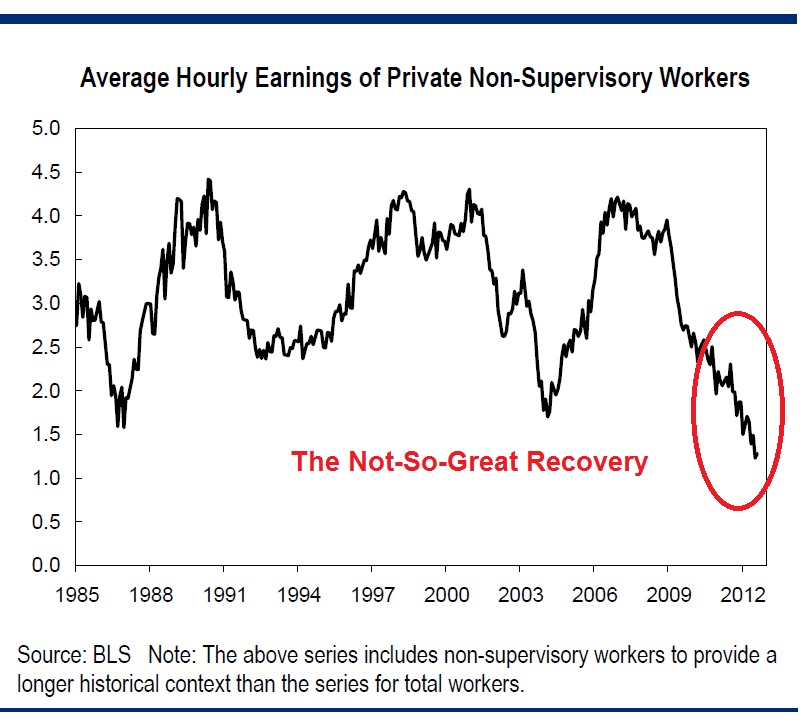
Average hourly earnings for American workers down under Obama
Average hourly earnings for workers way down under Obama

According to Forbes magazine: (H/T Gateway Pundit)

New income data from the Census Bureau reveal what a great job Barack Obama has done for the middle class as President. During his entire tenure in the oval office, median household income has declined by 7.3%.

In January, 2009, the month he entered office, median household income was $54,983. By June, 2012, it had spiraled down to $50,964. That’s a loss of $4,019 per family, the equivalent of losing a little less than one month’s income a year, every year. And on our current course that is only going to get worse not better…

[…]Three years into the Obama recovery, median family income had declined nearly 5% by June, 2012 as compared to June, 2009. That is nearly twice the decline of 2.6% that occurred during the recession from December, 2007 until June, 2009. As the Wall Street Journal summarized in its August 25-26 weekend edition, “For household income, in other words, the Obama recovery has been worse than the Bush recession.”

[…]Obama has failed the poor as well as the middle class. Last year, the Census Bureau reported more Americans in poverty than ever before in the more than 50 years that Census has been tracking poverty. Now The Huffington Post reports that the poverty rate is on track to rise to the highest level since 1965, before the War on Poverty began. A July 22 story by Hope Yen reports that when the new poverty rates are released in September, “even a 0.1 percentage point increase would put poverty at the highest level since 1965.”

Gateway Pundit adds:

Barack Obama is not just the food stamp president.
A record one in seven Americans is on food stamps today thanks to Barack Obama.

Barack Obama is also the poverty and pain president.
Under Obama, 6.4 million Americans are living below the poverty line and there is a record number of Americans living in deep poverty.

Meanwhile, Moody’s is threatening a credit downgrade:

Moody’s Investors Service said Tuesday that it would probably cut its triple-A rating on U.S. government debt by a notch unless congressional leaders can strike a budget deal in the coming months to bring down the deficit.

“If those negotiations lead to specific policies that produce a stabilization and then downward trend in the ratio of federal debt to GDP over the medium term, the rating will likely be affirmed,” Moody’s said in a press release Tuesday. “If those negotiations fail to produce such policies, however, Moody’s would expect to lower the rating, probably to Aa1.”

The threat comes after one of the other big three ratings firms, Standard & Poor’s, downgraded the U.S. last year following the brawl in Washington over the debt ceiling.

This would be the second credit downgrade – both occurred because of Obama’s Marxist policies of “spreading the wealth around” to punish job creators and their employees.

Are you better off now than you were four years ago?

It’s worse to be raised by a single mother than a married couple, even if you’re not poor

Here’s one of my favorite sociologists W. Bradford Wilcox writing about single motherhood in the left-leaning Slate.

Excerpt:

Take two contemporary social problems: teenage pregnancy and the incarceration of young males. Research by Sara McLanahan at Princeton University suggests that boys are significantly more likely to end up in jail or prison by the time they turn 30 if they are raised by a single mother. Specifically, McLanahan and a colleague found that boys raised in a single-parent household were more than twice as likely to be incarcerated, compared with boys raised in an intact, married home, even after controlling for differences in parental income, education, race, and ethnicity. Research on young men suggests they are less likely to engage in delinquent or illegal behavior when they have the affection, attention, and monitoring of their own mother and father.

But daughters depend on dads as well. One study by Bruce Ellis of the University of Arizona found that about one-third of girls whose fathers left the home before they turned 6 ended up pregnant as teenagers, compared with just 5 percent of girls whose fathers were there throughout their childhood. This dramatic divide was narrowed a bit when Ellis controlled for parents’ socioeconomic background—but only by a few percentage points. The research on this topic suggests that girls raised by single mothers are less likely to be supervised, more likely to engage in early sex, and to end up pregnant compared with girls raised by their own married parents.

It’s true that poorer families are more likely to be headed by single mothers. But even factoring out class shows a clear difference. Research by the Economic Mobility Project at Pew suggests that children from intact families are also more likely to rise up the income ladder if they were raised in a low-income family, and less likely to fall into poverty if they were raised in a wealthy family. For instance, according to Pew’s analysis, 54 percent of today’s young adults who grew up in an intact two-parent home in the top-third of household income have remained in the top-third as adults, compared with just 37 percent of today’s young adults who grew up in a wealthy (top-third) but divorced family.

Why is this? Single mothers, even from wealthier families, have less time. They are less likely to be able to monitor their kids. They do not have a partner who can relieve them when they are tired or frustrated or angry with their kids. This isn’t just a question of taking kids to the array of pampered extracurricular activities that many affluent, two-parent families turn to; it’s about the ways in which two sets of hands, ears, and eyes generally make parenting easier.

I think that people who think that it is hatred and bigotry to say that there should be rules around marriage and sex understand the reasons for these moral boundaries. We are trying to protect the children, and so we have boundaries about who can have sex and who can get married. Children need a mother and a father, and we need to promote and celebrate that as marriage, and not anything else. We should be rewarding people for getting married and staying married.

Related posts

1 in 2 new graduates are jobless or underemployed

From CNS News.

Excerpt:

 The college class of 2012 is in for a rude welcome to the world of work.

A weak labor market already has left half of young college graduates either jobless or underemployed in positions that don’t fully use their skills and knowledge.

Young adults with bachelor’s degrees are increasingly scraping by in lower-wage jobs — waiter or waitress, bartender, retail clerk or receptionist, for example — and that’s confounding their hopes a degree would pay off despite higher tuition and mounting student loans.

An analysis of government data conducted for The Associated Press lays bare the highly uneven prospects for holders of bachelor’s degrees.

Opportunities for college graduates vary widely.

While there’s strong demand in science, education and health fields, arts and humanities flounder. Median wages for those with bachelor’s degrees are down from 2000, hit by technological changes that are eliminating midlevel jobs such as bank tellers. Most future job openings are projected to be in lower-skilled positions such as home health aides, who can provide personalized attention as the U.S. population ages.

Taking underemployment into consideration, the job prospects for bachelor’s degree holders fell last year to the lowest level in more than a decade.

[…]You can make more money on average if you go to college, but it’s not true for everybody,” says Harvard economist Richard Freeman, noting the growing risk of a debt bubble with total U.S. student loan debt surpassing $1 trillion. “If you’re not sure what you’re going to be doing, it probably bodes well to take some job, if you can get one, and get a sense first of what you want from college.”

Andrew Sum, director of the Center for Labor Market Studies at Northeastern University who analyzed the numbers, said many people with a bachelor’s degree face a double whammy of rising tuition and poor job outcomes. “Simply put, we’re failing kids coming out of college,” he said, emphasizing that when it comes to jobs, a college major can make all the difference. “We’re going to need a lot better job growth and connections to the labor market, otherwise college debt will grow.”

That bit about getting a job so you know what you need to study. It’s important to get a job – any job – so that you understand what you are supposed to be learning in high school and college – what employers want! The next most important thing is to have a career mentor – someone to steer you away from subjects like English and ballet and into engineering and science. A trade school is another good choice: nursing or electrical wiring or something like that. Something valuable that employers need – that should be the deciding factor – what employers want you to do for them. Here’s a page listing degrees and expected incomes. Engineering, medicine and computer science are the three best fields.

I am still trying to puzzle out why young people vote for Democrats so much. I think that they have been brainwashed to think that making moral judgments is wrong, so they keep voting against Republicans who pro-life, pro-marriage, pro-family and pro-personal responsibility. That’s what teachers tell them in school – don’t have any moral standards, don’t make any moral judgments, let the government spend your money for you to be more “fair”, etc. So young people vote for Democrats. But voting for Democrats doesn’t just weaken the social fabric, it also wrecks the economy. Who do young people expect to work for when they keep voting to bash corporations all the time? Corporations hire young people. It seems stupid to vote against the people who want to pay you to do work.

Now that I think about it, it might be a good idea for social conservatives to be ready to make a case for free market capitalism and limited government, using evidence like this that shows how socialism fails to create economic growth and jobs. Even if people vote for conservatism based on fiscal concerns or foreign policy concerns, it’s still going to be helpful to social conservatives. We need to be like Paul and be able to speak intelligently to any audience on a wider variety of topics. Also, I think it helps social conservatives to be seen as competent in areas outside of social conservatism – it’s important to have a well-rounded worldview in order to not be perceived as being narrow-minded and ideologically motivated.