Tag Archives: Household

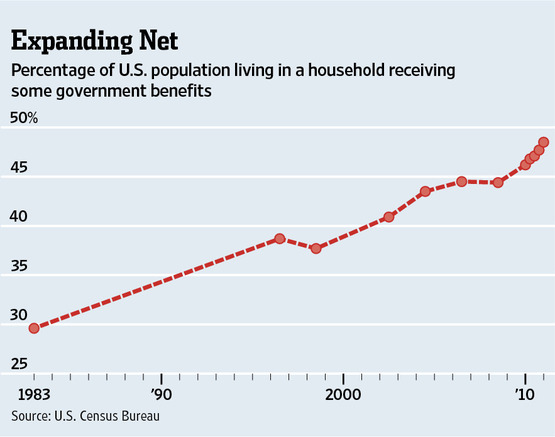
Nearly half of U.S. households are receiving some government benefits

Percentage of households receiving some government benefits

(Click for larger image)

This is the top story on the Wall Street Journal at the time I am writing this (Thursday at midnight).

Excerpt:

Families were more dependent on government programs than ever last year.

Nearly half, 48.5%, of the population lived in a household that received some type of government benefit in the first quarter of 2010, according to Census data. Those numbers have risen since the middle of the recession when 44.4% lived households receiving benefits in the third quarter of 2008.

The share of people relying on government benefits has reached a historic high, in large part from the deep recession and meager recovery, but also because of the expansion of government programs over the years. (See a timeline on the history of government benefits programs here.)

Means-tested programs, designed to help the needy, accounted for the largest share of recipients last year. Some 34.2% of Americans lived in a household that received benefits such as food stamps, subsidized housing, cash welfare or Medicaid (the federal-state health care program for the poor).

Another 14.5% lived in homes where someone was on Medicare (the health care program for the elderly). Nearly 16% lived in households receiving Social Security.

High unemployment and increased reliance on government programs has also shrunk the nation’s share of taxpayers. Some 46.4% of households will pay no federal income tax this year, according to the nonpartisan Tax Policy Center. That’s up from 39.9% in 2007, the year the recession began.

A plan like Herman Cain’s 9-9-9 plan would make sure that everybody is paying their fair share of taxes, and maybe then people who collect these benefits without paying their fair share would have a reason to want to cut government spending.

FRC releases new study on marriage and economic well-being

Mary found this little blurb on the Christian Post.

Excerpt:

Marriage plays a big role in the well-being of the U.S. economy, such that sound and stable marriages keep the economy healthy while divorce helps the economy regress, a new report suggests.

The findings released by the Family Research Council’s Marriage and Religion Research Institute show how intact married-couple families outperform other family types, including remarried families, divorced families, single-parent families, and cohabiting families, in all of the following economic segments: employment, income, net value, net worth, poverty, receipt of welfare and child economic well-being.

Basically the stats show that the more intact the family remains, the less the difficulties and the inefficiencies the family encounters.

Married-couple families generate the most income with “the median household income twice that of divorced households and four times that of separated households,” reads the report.

Divorced families on the other hand experience a sharp decrease in income after the separation. Divorced women are affected the most as they are 2.83 times more prone to live in poverty than women who remain married.

MARRI Director Pat Fagan, Ph.D, said couples that remain stably married can provide a sound environment where children can be securely fostered while divorce triggers society’s reliance on government welfare programs – programs that currently cost tax payers around $112 billion per year.

Then I went looking for the research paper and found this press release.

Excerpt:

The economic well-being of the United States is strongly related to marriage, which is a choice about how we channel our sexuality. The implications of sexual choices are apparent when comparing family structures across basic economic measures such as employment, income, net worth, poverty, receipt of welfare, and child economic well-being. In all of these the stable, intact married family outperforms other sexual partnering structures; hence the economy rises with the former and encounters more difficulties and inefficiencies as it diverges from it.

Family Structures and Economic Outcomes:

  • Employment and Income. Married-couple families generate the most income, on average. Young married men are more likely to be in the labor force, employed, and working a full-time job than their nonmarried counterparts. Cohabiting men have less stable employment histories than single and married men. Married families generally earn higher incomes than stepfamilies, cohabiting families, divorced families, separated families, and single-parent families. According to one study, married couples had a median household income twice that of divorced households and four times the household income of separated households.
  • Net Worth. Intact, married families have the greatest net worth. A family’s net worth is the value of all its assets minus any liabilities it holds. Married households’ net worth is attributable to more than simply having two adults in the household: a longer-term economic outlook, thrift, and greater head-of-household earning ability (the marriage premium) all contribute to greater household net worth.
  • Poverty and Welfare. Poverty rates are significantly higher among cohabiting families and single-parent families than among married families. Over one third of single mothers live in poverty. Nearly 60 percent of non-teenage single mothers rely on food stamps or cash welfare payments.
  • Child Economic Mobility and Well-Being. Children in married, two-parent families enjoy more economic well-being than children in any other family structure. Children in cohabiting families enjoy less economic well-being than children in married families, but more than children in single-parent families. The children of married parents also enjoy relatively strong upward mobility. By contrast, divorce is correlated with downward mobility. A non-intact family background increases by over 50 percent a boy’s odds of ending up in the lowest socioeconomic level.

Having a high net worth is necessary if you want to have an impact. With money, you can buy people apologetics books, sponsor debates, get more degrees, and contribute to Michele Bachmann, and send your children to the best universities so they can have an influence. Therefore, we need to be extra careful who we marry, extra diligent about preparing for our roles in marriage, and extra persistent in staying married. We need the money for important things.

The FRC is my second favorite think tank, right behind the Heritage Foundation.

The conflict between the state and the family

A book review by Raymond J. Keating. I just ordered the book.

Excerpt:

Sympathy and compassion help make humans caring, moral beings. Adam Smith, the father of modern economics, understood that, as illustrated by his emphasis on sympathy in The Theory of Moral Sentiments.

Often, however, sympathy and compassion are transformed from tools of moral judgment and action into weapons of blind ideology, irrational emotionalism, and cynical politics. They particularly serve as the bat with which opponents of the welfare state get pummeled. After all, the argument goes, if you oppose an extensive network of government income, housing, healthcare, employment, and child-care assistance programs, you must be severely lacking in sympathy and compassion. To truly care, you must support big government.

That assumption, unfortunately, has long clouded the debate over welfare policies, especially when it comes to government programs affecting family life. The big-government crowd has pushed blindly for government to play an ever-larger role as financial provider for households, thereby contributing critically to the undermining of traditional families. Meanwhile, it should be noted that some who argue against such programs have tried to make their case without fully acknowledging the important economic and societal roles played by the family.

[…]Part of the problem is the failure to apply economic analysis to the family’s role in the economy and to the impact of government policies on the family. That has been remedied to a degree in The War Between the State and the Family: How Government Divides and Impoverishes by Patricia Morgan. Published initially by the London-based Institute of Economic Affairs, it mainly deals with the programs and realities of Great Britain, but the discussion and analysis obviously apply elsewhere, including the United States.

Morgan pulls together overwhelming evidence and data showing the benefits to adults, children, and society in general of marriage and intact families, and the problems of non-marriage, single parenthood, and divorce. And she illustrates how the welfare state subsidizes and encourages family breakdown.

For example, Morgan shows that marriage boosts personal responsibility and employment among males, while single males are far more likely to be jobless and receiving government assistance. She also makes clear that government benefits have a strong impact on marriage and childbearing decisions and responsibilities among both men and women.

She notes the varying ways in which government policies affect such critical decisions: “By rewarding some behaviours and penalising others, tax and welfare systems affect the preference and behaviour of individuals not just through hard cash calculations but by (unavoidably) embodying and promoting certain values and assumptions. . . . The generous subsidisation of the lone-parent household cannot but reinforce the belief that it is quite acceptable for men to expect the state to provide for their offspring.”

Morgan sums up the implications of all this on the size and intrusiveness of government: “Growing family and household fragmentation” drives government spending and taxes ever higher; increases the “number of clients of the state”; “displaces existing institutional and private arrangements”; places the government in the role of parent and provider to children; allows for increased government intrusions into family life; and generates “an increasing mass of legislation and regulation of provisions for custody, access and financial support.” For good measure, child development is inevitably hampered due to the loss of “private investment in children,” which can never be matched in substance or quality by government programs.

She’s like a British Jennifer Roback Morse, and I mean to read her book.

What I find puzzling is that I keep running into young people who aspire to be married and to have children, but who are going about their plan in ways that seem to be counterproductive – at least to me. I see a lot of young people voting Democrat, for example. I find this confusing, because voting Democrat means that there will be fewer jobs, higher taxes, more debt and more crime. That’s just a start. So why are people voting for Democrats when Democrat policies undermine the feasibility of marriage? Probably because they saw Republicans being mocked on Comedy Central and cannot tell the difference between comedy and news.