Tag Archives: Government

Red families v. blue families: which states have the strongest families?

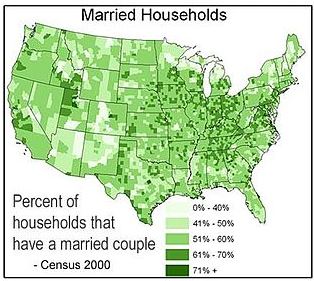
Map of marriage rate by state

This article from The Daily Signal talks about a recent study.

It says:

According to a study from the Institute for Family Studies, red counties tend to have more married adults, more children born within marriage and higher levels of children living with both biological parents than blue counties.

“The reddest counties have higher rates of family stability, which is surprising because red counties, especially in the South, tend to have higher divorce rates,” said W. Bradford Wilcox, senior fellow with the Institute for Family Studies and author of the study. “But what seems to be happening here is that non-marital childbearing has emerged as a bigger engine of family instability than divorce in America. And this brief indicates that non-marital childbearing is lower in redder counties.”

[…]Wilcox acknowledged in his report some of the most stable families do come from blue states, such as Massachusetts and Minnesota, and that, indeed, the most stable families exist in the most extreme red and blue states.

But Wilcox said the state-level data addresses only part of the equation because it does not explain the “connection between family stability and political culture” at the local level.

“At the local level, red counties typically enjoy somewhat stronger families than do blue counties on at least three measures worth considering: marriage, non-marital childbearing and family stability,” Wilcox wrote in the report.

“The bottom line: The marriage advantage in red America helps explain why children in red counties are somewhat more likely to enjoy stable families than are children in blue counties,” he added.

I’m going to guess that the reason why people in blue states have lower rates of marriage and higher out-of-wedlock birth rates is because of higher tax rates, marriage penalties at the state level, and big government welfare programs that reward single mothers. Smaller government helps economic growth and leaves money in the pockets of responsible people. It’s much easier to take the marriage track when you have more of your own money in your pocket.

I also think that Judeo-Christian values are a huge factor. People who are religious have the habit of unselfishness that is necessary to get married in the first place. Marriage is about self-sacrificially loving another sinner, and that is attractive to religious people. Marriage is not so attractive to people who think that there is no afterlife, that the purpose of life is fun, and selfishness is awesome. If you believe that this life is all there is and there is no objective morality, then there is no rational basis there for serving others when it goes against your self-interest.

Regarding that last point, about how religious people are more suited to unselfishness and cooperation, there is a new study out.

Consider this recent study from the University of Toronto, in Canada.

The abstract says:

A large literature is currently contesting the impact of religion on prosocial behavior. As a window into this discussion, I examine the close social networks of American adults and consider whether religious traditionalists are more likely than other network members to supply several basic forms of social support. Analysis of the Portraits of American Life Survey reveals three main findings. First, a majority of Americans—religious or not—count at least one perceived religious traditionalist among their close network ties. Second, American adults are more likely to receive advice, practical help, and money from ties identified as religious traditionalists than from other types of ties, a pattern that held among both kin and nonkin network ties. Finally, although perceived traditionalist network members appear especially inclined to assist highly religious people, they nevertheless offer social support to Americans across a broad spectrum of religiosity. Beyond its relevance for debates on religion and community life, this study also proposes a novel strategy to assess prosocial behavior. Asking people to recount the deeds of their network members can reduce certain self-reporting biases common to survey research and helps locate prosocial activity in concrete and meaningful social relationships.

So, people who are more religious and traditional already have the character traits to be unselfish. And what is marriage, but the promise to be unselfish, for the sake of your spouse, and eventually, for the sake of your kids?

Should government get out of the marriage business?

Dr. Jennifer Roback Morse

Here are three articles by Jennifer Roback Morse posted at The Public Discourse. The articles answer the charge from social liberals and libertarians that government should “get the government out of marriage”.

Here’s the first article which talks about how government will still be involved in marriage, even if we get rid of the traditional definition of marriage, because of the need for dispute resolution in private marriage contracts. She uses no-fault divorce as an example showing how it was sold as a way to get government out of the divorce business. But by making divorce easier by making it require no reason, it increased the number of disputes and the need for more government intervention to resolve these disputes.

Here’s the second article which talks about how the government will have to expand to resolve conflicts over decisions about who counts as a parent and who gets parental rights. With traditional marriage, identifying who the parents are is easy. But with private marriage contracts where the parties are not the biological parents, there is a need for the state to step in and assign parental rights. Again, this will require an expansion of government to resolve the disputes.

Here’s the third article which talks about how marriage is necessary in order to defend the needs and rights of the child at a time when they cannot enter into contracts and be parties to legal disputes.

The third article was my favorite, so here is an excerpt from it:

The fact of childhood dependence raises a whole series of questions. How do we get from a position of helpless dependence and complete self-centeredness, to a position of independence and respect for others? Are our views of the child somehow related to the foundations of a free society? And, to ask a question that may sound like heresy to libertarian ears: Do the needs of children place legitimate demands and limitations on the behavior of adults?

I came to the conclusion that a free society needs adults who can control themselves, and who have consciences. A free society needs people who can use their freedom, without bothering other people too much. We need to respect the rights of others, keep our promises, and restrain ourselves from taking advantage of others.

We learn to do these things inside the family, by being in a relationship with our parents. We can see this by looking at attachment- disordered children and failure-to-thrive children from orphanages and foster care. These children have their material needs met, for food, clothing, and medical care. But they are not held, or loved, or looked at. They simply do not develop properly, without mothers and fathers taking personal care of them. Some of them never develop consciences. But a child without a conscience becomes a real problem: this is exactly the type of child who does whatever he can get away with. A free society can’t handle very many people like that, and still function.

In other words I asked, “Do the needs of society place constraints on how we treat children?” But even this analysis still views the child from society’s perspective. It is about time we look at it from the child’s point of view, and ask a different kind of question. What is owed to the child?

Children are entitled to a relationship with both of their parents. They are entitled to know who they are and where they came from. Therefore children have a legitimate interest in the stability of their parents’ union, since that is ordinarily how kids have relationships with both parents. If Mom and Dad are quarreling, or if they live on opposite sides of the country, the child’s connection with one or both of them is seriously impaired.

But children cannot defend their rights themselves. Nor is it adequate to intervene after the fact, after harm already has been done. Children’s relational and identity rights must be protected proactively.

Marriage is society’s institutional structure for protecting these legitimate rights and interests of children.

I recommend taking a look at all three articles and becoming familiar with the arguments in case you have to explain why marriage matters and why we should not change it. I think it is important to read these articles and to be clear that to be a libertarian doctrine does not protect the right of a child to have a relationship with both his or her parents.  Nor does libertarianism promote the idea that parents ought to stick together for their children. Libertarianism means that adults get to do what they want, and no one speaks for the kids.

The purpose of marriage is to make adults make careful commitments, and restrain their desires and feelings, so that children will have a stable environment with their biological parents nearby. We do make exceptions, but we should not celebrate exceptions and we should not subsidize exceptions. It’s not fair to children to have to grow up without a mother or father just so that adults can pursue fun and thrills.

Is the root cause of crime poverty or fatherlessness?

Marriage and family
Marriage and family

If we were really serious about stopping crime, then we should go after the root cause of crime. So what is that root cause? The answer might surprise you.

Here is Dr. Robert Rector of the Heritage Foundation to explain:

Census data and the Fragile Families survey show that marriage can be extremely effective in reducing child poverty. But the positive effects of married fathers are not limited to income alone. Children raised by married parents have substantially better life outcomes compared to similar children raised in single-parent homes.

When compared to children in intact married homes, children raised by single parents are more likely to have emotional and behavioral problems; be physically abused; smoke, drink, and use drugs; be aggressive; engage in violent, delinquent, and criminal behavior; have poor school performance; be expelled from school; and drop out of high school.[19] Many of these negative outcomes are associated with the higher poverty rates of single mothers. In many cases, however, the improvements in child well-being that are associated with marriage persist even after adjusting for differences in family income. This indicates that the father brings more to his home than just a paycheck.

The effect of married fathers on child outcomes can be quite pronounced. For example, examination of families with the same race and same parental education shows that, when compared to intact married families, children from single-parent homes are:

  • More than twice as likely to be arrested for a juvenile crime;[20]
  • Twice as likely to be treated for emotional and behavioral problems;[21]
  • Roughly twice as likely to be suspended or expelled from school;[22] and
  • A third more likely to drop out before completing high school.[23]

The effects of being raised in a single-parent home continue into adulthood. Comparing families of the same race and similar incomes, children from broken and single-parent homes are three times more likely to end up in jail by the time they reach age 30 than are children raised in intact married families. [24] Compared to girls raised in similar married families, girls from single-parent homes are more than twice as likely to have a child without being married, thereby repeating the negative cycle for another generation.[25]

Finally, the decline of marriage generates poverty in future generations. Children living in single-parent homes are 50 percent more likely to experience poverty as adults when compared to children from intact married homes. This intergenerational poverty effect persists even after adjusting for the original differences in family income and poverty during childhood.[26]

People on the left claim that poverty causes crime, but they don’t look for the root cause of poverty. The root cause of poverty is the decline of marriage, which produces fatherless children. Unfortunately, some people promote the decline of marriage because they do not like the “unequal gender roles” inherent in marriage. So what is the main tool that the anti-marriage people use to increase the number of fatherless children?

Dr. Michael Tanner of the libertarian Cato Institute explains one of the causes of fatherlessness in his testimony to Congress:

Welfare contributes to crime in several ways. First, children from single-parent families are more likely to become involved in criminal activity. According to one study, children raised in single-parent families are one-third more likely to exhibit anti-social behavior.(3) Moreover, O’Neill found that, holding other variables constant, black children from single- parent households are twice as likely to commit crimes as black children from a family where the father is present. Nearly 70 percent of juveniles in state reform institutions come from fatherless homes, as do 43 percent of prison inmates.(4) Research indicates a direct correlation between crime rates and the number of single-parent families in a neighborhood.(5)

As Barbara Dafoe Whitehead noted in her seminal article for The Atlantic Monthly:

The relationship [between single-parent families and crime] is so strong that controlling for family configuration erases the relationship between race and crime and between low income and crime. This conclusion shows up time and again in the literature. The nation’s mayors, as well as police officers, social workers, probation officers, and court officials, consistently point to family break up as the most important source of rising rates of crime.(6)

At the same time, the evidence of a link between the availability of welfare and out-of-wedlock births is overwhelming. There have been 13 major studies of the relationship between the availability of welfare benefits and out-of-wedlock birth. Of these, 11 found a statistically significant correlation. Among the best of these studies is the work done by June O’Neill for the U.S. Department of Health and Human Services. Holding constant a wide range of variables, including income, education, and urban vs. suburban setting, the study found that a 50 percent increase in the value of AFDC and foodstamp payments led to a 43 percent increase in the number of out-of-wedlock births.(7) Likewise, research by Shelley Lundberg and Robert Plotnick of the University of Washington showed that an increase in welfare benefits of $200 per month per family increased the rate of out-of-wedlock births among teenagers by 150 percent.(8)

The same results can be seen from welfare systems in other countries. For example, a recent study of the impact of Canada’s social-welfare system on family structure concluded that “providing additional benefits to single parents encourages births of children to unwed women.”(9)

The poverty that everyone complains about is not the root cause of crime. The poverty is caused by fatherlessness. The fatherlessness is caused by welfare. Fatherlessness is also caused by laws and policies that make it easier for people to divorce, e.g. – no-fault divorce laws. Again, it’s people on the left who push for no-fault divorce laws. So the left is pushing two policies, welfare and no-fault divorce, which cause crime.