A mysterious Dr. J (not that Dr. J, this one is Jewish) posted this article on Facebook.
Full text:
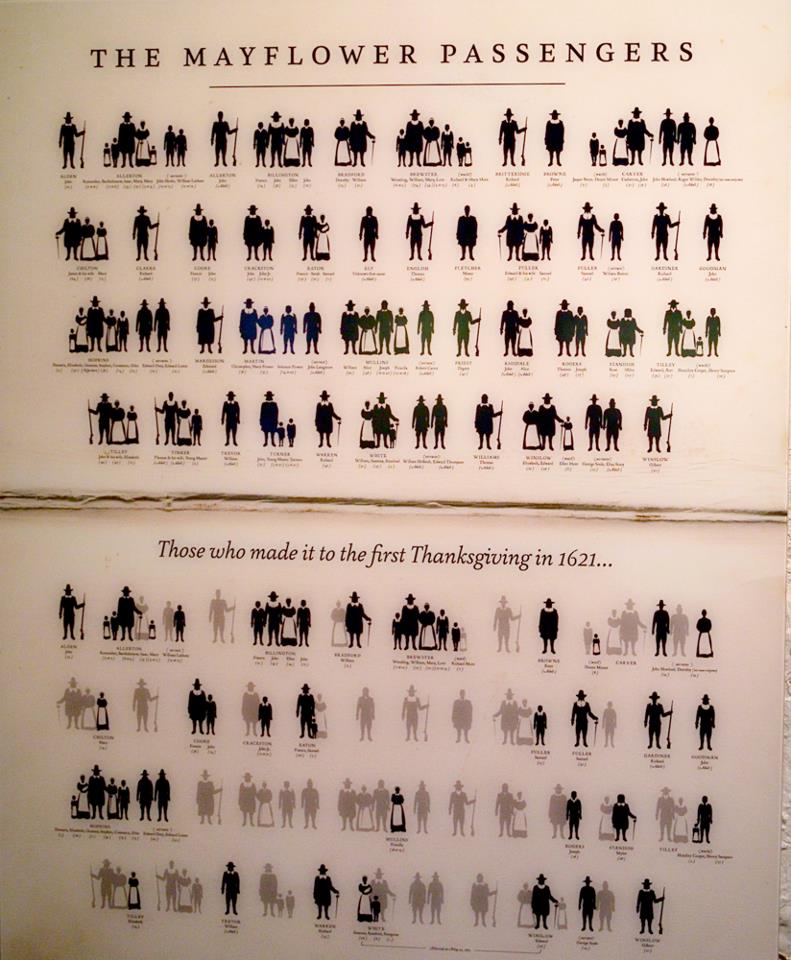
The major similarity between the first Jamestown settlers and the first Plymouth settlers was great human suffering.
November was too late to plant crops. Many settlers died of scurvy and malnutrition during that horrible first winter. Of the 102 original Mayflower passengers, only 44 survived. Again like in Jamestown, the kindness of the local Native Americans saved them from a frosty death.
The Pilgrims’ remarkable courage was displayed the following spring. When the Mayflower returned to Europe, not a single Pilgrim deserted Plymouth.
Massasoit, chief of the Wampanoag tribe, signed a treaty with the Pilgrams in 1621, that was never broken. As a result, the two groups enjoyed a peaceful coexistence.
By early 1621, the Pilgrims had built crude huts and a common house on the shores of Plymouth Bay. Soon neighboring Indians began to build relations with the Pilgrims. SQUANTO, a local Indian who had been kidnapped and taken to England nearly a decade before, served as an interpreter with the local tribes. Squanto taught the Pilgrims to fertilize the soil with dried fish remains to produce a stellar corn crop.
MASSASOIT, the chief of the nearby Wampanoags, signed a treaty of alliance with the Pilgrims in the summer. In exchange for assistance with defense against the feared Narragansett tribe, Massasoit supplemented the food supply of the Pilgrims for the first few years.
The modern conception of a Pilgrim might include a man in a black hat with a buckle, but not all of the original settlers of Plymouth County fit this description.
Successful colonies require successful leadership. The man to step forward in Plymouth colony wasWILLIAM BRADFORD. After the first governor elected under the Mayflower Compact perished from the harsh winter, Bradford was elected governor for the next thirty years. In May of 1621, he performed the colony’s first marriage ceremony.
Under Bradford’s guidance, Plymouth suffered less hardship than their English compatriots in Virginia. Relations with the local natives remained relatively smooth in Plymouth and the food supply grew with each passing year.
By autumn of 1621, the Pilgrims had much for which to be thankful. After the harvest, Massasoit and about ninety other Indians joined the Pilgrims for the great English tradition of HARVEST FESTIVAL. The participants celebrated for several days, dining on venison, goose, duck, turkey, fish, and of course, cornbread, the result of a bountiful corn harvest. This tradition was repeated at harvest time in the following years.
It was President Lincoln who declared Thanksgiving a national celebration in 1863. The Plymouth Pilgrims simply celebrated survival, as well as the hopes of good fortune in the years that lay ahead.
This might be a good thing to read out at the Thanksgiving table if you are looking for something meaningful to read.
Here’s a lecture by New York University professor Paul Vitz to explain a connection between atheism and fatherlessness:
Here’s an article by Paul Copan (related to the lecture) which points out how father presence/absence and father quality affects belief and disbelief in God.
Excerpt:
Seventh, the attempt to psychologize believers applies more readily to the hardened atheist.It is interesting that while atheists and skeptics often psychoanalyze the religious believer, they regularly fail to psychoanalyze their ownrejection of God. Why are believers subject to such scrutiny and not atheists? Remember another feature of Freud’s psychoanalysis — namely, an underlying resentment that desires to kill the father figure.
Why presume atheism is the rational, psychologically sound, and default position while theism is somehow psychologically deficient? New York University psychology professor Paul Vitz turns the tables on such thinking. He essentially says, “Let’s look into the lives of leading atheists and skeptics in the past. What do they have in common?” The result is interesting: virtually all of these leading figures lacked a positive fatherly role model — or had no father at all.11
Let’s look at some of them.
Voltaire(1694–1778): This biting critic of religion, though not an atheist, strongly rejected his father and rejected his birth name of Francois-Marie Arouet.
David Hume(1711–76): The father of this Scottish skeptic died when Hume was only 2 years old. Hume’s biographers mention no relatives or family friends who could have served as father figures.
Baron d’Holbach(1723–89): This French atheist became an orphan at age 13 and lived with his uncle.
Ludwig Feuerbach (1804–72): At age 13, his father left his family and took up living with another woman in a different town.
Karl Marx(1818–83): Marx’s father, a Jew, converted to being a Lutheran under pressure — not out of any religious conviction. Marx, therefore, did not respect his father.
Friedrich Nietzsche(1844–1900): He was 4 when he lost his father.
Sigmund Freud(1856–1939): His father, Jacob, was a great disappointment to him; his father was passive and weak. Freud also mentioned that his father was a sexual pervert and that his children suffered for it.
Bertrand Russell(1872–1970): His father died when he was 4.
Albert Camus(1913–60): His father died when he was 1 year old, and in his autobiographical novel The First Man, his father is the central figure preoccupation of his work.
Jean-Paul Sartre(1905–80): The famous existentialist’s father died before he was born.12
Madeleine Murray-O’Hair (1919–95): She hated her father and even tried to kill him with a butcher knife.
We could throw in a few more prominent contemporary atheists not mentioned by Vitz with similar childhood challenges:
Daniel Dennett (1942–): His father died when he was 5 years of age and had little influence on Dennett.13
Christopher Hitchens (1949–): His father (“the Commander”) was a good man, according to Hitchens, but he and Hitchens “didn’t hold much converse.” Once having “a respectful distance,” their relationship took on a “definite coolness” with an “occasional thaw.” Hitchens adds: “I am rather barren of paternal recollections.”14
Richard Dawkins (1941–): Though encouraged by his parents to study science, he mentions being molested as a child — no insignificant event, though Dawkins dismisses it as merely embarrassing.15
Moreover, Vitz’s study notes how many prominent theists in the past — such as Blaise Pascal, G.K. Chesterton, Karl Barth, and Dietrich Bonhoeffer — have had in common a loving, caring father in their lives.16
Not only is there that anecdotal evidence of a psychological explanation for atheism, but there is also statistical evidence.
Excerpt:
In 1994 the Swiss carried out an extra survey that the researchers for our masters in Europe (I write from England) were happy to record. The question was asked to determine whether a person’s religion carried through to the next generation, and if so, why, or if not, why not. The result is dynamite. There is one critical factor. It is overwhelming, and it is this: It is the religious practice of the father of the family that, above all, determines the future attendance at or absence from church of the children.
If both father and mother attend regularly, 33 percent of their children will end up as regular churchgoers, and 41 percent will end up attending irregularly. Only a quarter of their children will end up not practicing at all. If the father is irregular and mother regular, only 3 percent of the children will subsequently become regulars themselves, while a further 59 percent will become irregulars. Thirty-eight percent will be lost.
If the father is non-practicing and mother regular, only 2 percent of children will become regular worshippers, and 37 percent will attend irregularly. Over 60 percent of their children will be lost completely to the church.
Let us look at the figures the other way round. What happens if the father is regular but the mother irregular or non-practicing? Extraordinarily, the percentage of children becoming regular goesupfrom 33 percent to 38 percent with the irregular mother and to 44 percent with the non-practicing, as if loyalty to father’s commitment grows in proportion to mother’s laxity, indifference, or hostility.
[…]In short, if a father does not go to church, no matter how faithful his wife’s devotions, only one child in 50 will become a regular worshipper. If a father does go regularly, regardless of the practice of the mother, between two-thirds and three-quarters of their children will become churchgoers (regular and irregular). If a father goes but irregularly to church, regardless of his wife’s devotion, between a half and two-thirds of their offspring will find themselves coming to church regularly or occasionally.
A non-practicing mother with a regular father will see a minimum of two-thirds of her children ending up at church. In contrast, a non-practicing father with a regular mother will see two-thirds of his children never darken the church door. If his wife is similarly negligent that figure rises to 80 percent!
The results are shocking, but they should not be surprising. They are about as politically incorrect as it is possible to be; but they simply confirm what psychologists, criminologists, educationalists, and traditional Christians know. You cannot buck the biology of the created order. Father’s influence, from the determination of a child’s sex by the implantation of his seed to the funerary rites surrounding his passing, is out of all proportion to his allotted, and severely diminished role, in Western liberal society.
Basically, anyone who doesn’t have a benevolent, involved father is going to have an enormously difficult time believing that moral boundaries set by an authority are for the benefit of the person who is being bounded. The best way to make moral boundaries stick is to see that they apply to the person making the boundaries as well – and that these moral boundaries are rational, evidentially-grounded and not arbitrary.
By the way, isn’t it interesting to note that Barack Obama also grew up fatherless and has issues with God and morality.
UPDATE: Ed Babinski has some corrections for my list. He writes in a comment:
1) Voltaire was not an atheist but a deist who rejected claims of the Bible’s inspiration, like Paine. Voltaire’s aphorism, “If God did not exist, it would be necessary to invent him,” far from being the cynical remark it is often taken for, it was meant as a retort to the atheistic clique of d’Holbach, Grimm, and others.
2) David Hume’s religious views remain uncertain. He never said he was an atheist. A gentle skeptic suits him more.
Casey Luskin is an attorney with graduate degrees in both science and law. He earned his B.S. and M.S. in Earth Sciences from the University of California, San Diego. His Law Degree is from the University of San Diego. In his role at Discovery Institute, Mr. Luskin works as Research Coordinator for the Center for Science and Culture. He formerly conducted geological research at Scripps Institution for Oceanography (1997-2002).
Luskin is also co-founder of the Intelligent Design and Evolution Awareness (IDEA) Center, a non-profit helping students to investigate evolution by starting “IDEA Clubs” on college and high school campuses across the country. For his work with IDEA, the Intelligent Design and Undergraduate Research Center named an award honoring college graduates for excellence in student advocacy of intelligent design (ID) the “Casey Luskin Graduate Award.”
If you can’t see the video, then you can check out this article by Casey from Salvo magazine.
Excerpt:
Whenever someone avers belief in “God-guided evolution,” it’s important to clarify what is meant by “evolution.” It can mean something as benign as (1) “Life has changed over time,” or it can entail more controversial ideas, like (2) “All living things have a universal common ancestry,” or (3) “Natural selection acting upon random mutations produced the complexity of life.”
When the average theistic evolutionist says he believes that “God used evolution,” what he often actually means is that God supernaturally intervened at various points in Earth’s history to direct the course of life. He accepts evolution in sense 1 above, and maybe sense 2 as well, but has doubts about sense 3. This viewpoint differs dramatically from the standard neo-Darwinian paradigm that currently reigns in biology.
As defined by its proponents, neo-Darwinism is a blind process of natural selection acting upon random mutations without any guidance by an external agent. According to the architects of this theory, the evolutionary process has no goals or predetermined outcome, and is by definition unguided. Under this view of life, human beings are accidents of history—and not just their bodies, but their brains and behaviors as well, including their moral and religious impulses. Thus, true neo-Darwinian theistic evolutionists (and they are out there) claim that, somehow, God guided an unguided process.
But many of those who adopt the “theistic evolutionist” moniker actually reject neo-Darwinism and hold a view that’s much closer to intelligent design, that is, to the belief that an intelligent agent has actively intervened—in a meaningful and detectable manner—to guide the development of life. The Evolution Lobby, however, will never be satisfied until such people fully capitulate to the Darwinian view.
And a bit later in that same paper:
Evolutionary biologist Francisco Ayala makes this argument, stating, “Mutations are random or chance events because . . . [they] are unoriented with respect to adaptation.”
[…]Ayala continues:
The scientific account of these events does not necessitate recourse to a preordained plan, whether imprinted from the beginning or through successive interventions by an omniscient and almighty Designer. Biological evolution differs from a painting or an artifact in that it is not the outcome of preconceived design.
Ayala concludes that, “in evolution, there is no entity or person who is selecting adaptive combinations.”12 Again, that doesn’t sound like a religiously neutral model of biological origins.
Indeed, in surveying how mainstream biology textbooks define Darwinian evolution, we learn it is a “random,” “blind,” “uncaring,” “heartless,” “undirected,” “purposeless,” and “chance” process that acts “without plan” or “any goals”; that we are “not created for any special purpose or as part of any universal design,” and that “a god of design and purpose is not necessary.”13 If those don’t entail claims that cut against theism, what would?
Moreover, if Darwinian evolution is irrelevant to faith, why do so many atheists cite it as a reason for abandoning religion? A 2007 poll of 149 evolutionary biologists found that only two “described themselves as full theists.”14 Likewise, a survey of biologist members of the NAS found that over 94 percent were atheists or agnostics.15 It’s no coincidence that Eugenie Scott—the de facto head of the Evolution Lobby—signed the Third Humanist Manifesto, or that the world’s most famous evolutionary biologist, Richard Dawkins, is also the world’s most famous atheist. In Dawkins’s own words, “Darwin made it possible to be an intellectually fulfilled atheist.”16
He is one of my favorite people to listen to, because he is very very direct and definitely is not clouding the issues, the combatants and what each side is really trying to achieve. There is a lot of noise and obfuscation in this debate. But if you watch Casey’s video, you will get everything as it really is.