Tag Archives: Gay Marriage

Ryan T. Anderson lectures on marriage and why it matters

Marriage and family
Marriage and family

Here’s the lecture:

About the speaker:

Ryan T. Anderson researches and writes about marriage and religious liberty as the William E. Simon Fellow at The Heritage Foundation. He also focuses on justice and moral principles in economic thought, health care and education, and has expertise in bioethics and natural law theory.

Anderson, who joined the leading Washington think tank’s DeVos Center for Religion and Civil Society in 2012, also is the editor of Public Discourse, the online journal of the Witherspoon Institute of Princeton, N.J.

Anderson’s recent work at Heritage focuses on the constitutional questions surrounding same-sex “marriage.” He is the co-author with Princeton’s Robert P. George and Sherif Girgis of the acclaimed book “What Is Marriage? Man and Woman: A Defense” (Encounter Books, December 2012).

The lecture starts at 7:20 in. The lecture ends at 49:35. There are 32 minutes of Q&A.

Introduction:

  • When talking about marriage in public, we should talk about philosophy, sociology and public policy
  • Gay marriage proponents need to be pressed to define what marriage is, on their view
  • Every definition of marriage is going to include some relationships, and exclude others
  • It’s meaningless to portray one side as nice and the other mean
  • Typically, marriage redefiners view marriage as a more intense emotional relationship
  • Marriage redefiners should be challenged in three ways:
  • 1) Does the redefined version of marriage have a public policy reason to prefer only two people?
  • 2) Does the redefined version of marriage have a reason to prefer permanence?
  • 3) Does the redefined version of marriage have a reason to prefer sexual exclusivity?
  • Also, if marriage is just about romance, then why is the state getting involved in recognizing it?
  • The talk: 1) What marriage is, 2) Why marriage matters, 3) What are the consequences of redefining marriage?

What marriage is:

  • Marriage unites spouses – hearts, minds and bodies
  • Marriage unites spouses to perform a good: creating a human being and raising that human being
  • Marriage is a commitment: permanent and exclusive
  • Male and female natures are distinct and complementary

The public purpose of marriage:

  • to attach men and women to each other
  • to attach mothers and fathers to their children
  • there is no such thing as parenting, there is only mothering and fathering
  • the evidence shows that children benefit from mothering and fathering
  • boys who grow up without fathers are more likely to commit crimes
  • girls who grow up without fathers are more likely to have sex earlier
  • Children benefit from having a mother and a father
  • can’t say that fathers are essential for children if we support gay marriage, which makes fathers optional
  • without marriage: child poverty increases, crime increases, social mobility decreases, welfare spending increases
  • when government encourages marriage, then government has less do to – stays smaller, spends less
  • if we promote marriage as an idea, we are not excluding gay relationships or even partner benefits
  • finally, gay marriage has shown itself to be hostile to religious liberty

Consequences redefining marriage:

  • it undermines the norm in public like that kids deserve a mom and a dad – moms and dads are interchangeable
  • it changes the institution of marriage away from the needs of children, and towards the needs of adults
  • it undermines the norm of permanence
  • we learned what happens when marriage is redefined before: with no-fault divorce
  • no-fault divorce: after this became law, divorce rates doubled – the law changed society
  • gay marriage would teach society that mothers and fathers are optional when raising children
  • if marriage is what people with intense feelings do, then how can you rationally limit marriage to only two people?
  • if marriage is what people with intense feelings do, then if other people cause intense feelings, there’s no fidelity
  • if marriage is what people with intense feelings do, then if the feelings go away, there is no permanence
  • the public policy consequences to undermining the norms of exclusivity and permanence = fatherless children and fragmented families
  • a final consequences is the decline and elimination of religious liberty – e.g. – adoption agencies closing, businesses being sued

We’re doing very well on abortion, but we need to get better at knowing how to discuss marriage. If you’re looking for something short to read, click here. If you want to read a long paper that his book is based on.

Related posts

New study: children raised by same-sex parents have twice the risk of depression

Young people seem to like gay marriage more than they like individual liberties
Young people seem to like gay marriage more than they like to care for the needs of children

A new peer-reviewed study published in the journal Depression Research and Treatment confirms that children do better when raised by their mother and father.

Here’s the abstract:

The relationship of elevated depression risk recently discovered among adult persons raised by same-sex parents with possible precipitating conditions in childhood has not previously been acknowledged. This study tests whether such inattention is supportable. Logistic regression based risk ratios were estimated from longitudinal measures of mental health outcomes observed in three waves (at ages 15, 22, and 28) of the US National Survey of Adolescent to Adult Health (,701). At age 28, the adults raised by same-sex parents were at over twice the risk of depression (CES-D: risk ratio 2.6, 95% CI 1.4–4.6) as persons raised by man-woman parents. These findings should be interpreted with caution. Elevated risk was associated with imbalanced parental closeness and parental child abuse in family of origin; depression, suicidality, and anxiety at age 15; and stigma and obesity. More research and policy attention to potentially problematic conditions for children with same-sex parents appears warranted.

The Federalist commented on the new study:

Children of same-sex parents also reported more violence, having a parent slap, hit, or kick them, or saying “things that hurt your feelings or made you feel you were not wanted or loved,” or “touched you in a sexual way, forced you to touch him or her in a sexual way, or forced you to have sex relations.”

In conclusion:

 The emergence of higher depression risk in early adulthood, coupled with a more frequent history of abuse victimization, parental distance, and obesity, suggests that the inattention of research and policy to the problems of children with same-sex parents is unwarranted.

As initial results, the present findings should be interpreted with caution and balance, based on the limited evidence presented, and (it is hoped) neither exaggerated nor dismissed out of hand on preconceived ideological grounds. However, well-intentioned concern for revealing negative information about a stigmatized minority does not justify leaving children without support in an environment that may be problematic or dangerous for their dignity and security.

Sullins’ study is not alone in suggesting more research needs to be done in this area. The U.S. Department of Health and Human Services published an extensive study proving the importance of biological fathers in the “healthy development of children.” In addition, “the most careful, rigorous, and methodologically sound study ever conducted” on the issue of homosexual parenting found “numerous and significant differences” between children raised by biological parents and children of homosexuals, “with the outcomes for children of homosexuals rated ‘suboptimal’ in almost every category.”

Very important to understand that same-sex couples who bring children into their relationship are intentionally depriving the child of a relationship with one or more of her biological parents. Just imagine growing up in the world and not having access to the people who made you. It’s not fair, and adult selfishness should have to give way to the needs of vulnerable children. Motherlessness is bad for children, and fatherlessness is bad for children.

Let’s go back and look at a previous study from Canada.

The Public Discourse reported on it.

Excerpt:

A new academic study based on the Canadian census suggests that a married mom and dad matter for children. Children of same-sex coupled households do not fare as well.

There is a new and significant piece of evidence in the social science debate about gay parenting and the unique contributions that mothers and fathers make to their children’s flourishing. A study published last week in the journal Review of the Economics of the Household—analyzing data from a very large, population-based sample—reveals that the children of gay and lesbian couples are only about 65 percent as likely to have graduated from high school as the children of married, opposite-sex couples. And gender matters, too: girls are more apt to struggle than boys, with daughters of gay parents displaying dramatically low graduation rates.

Unlike US-based studies, this one evaluates a 20 percent sample of the Canadian census, where same-sex couples have had access to all taxation and government benefits since 1997 and to marriage since 2005.

[…]Three key findings stood out to Allen:

children of married opposite-sex families have a high graduation rate compared to the others; children of lesbian families have a very low graduation rate compared to the others; and the other four types [common law, gay, single mother, single father] are similar to each other and lie in between the married/lesbian extremes.

Employing regression models and series of control variables, Allen concludes that the substandard performance cannot be attributed to lower school attendance or the more modest education of gay or lesbian parents. Indeed, same-sex parents were characterized by higher levels of education, and their children were more likely to be enrolled in school than even those of married, opposite-sex couples. And yet their children are notably more likely to lag in finishing their own schooling.

[…]The truly unique aspect of Allen’s study, however, may be its ability to distinguish gender-specific effects of same-sex households on children. He writes:

the particular gender mix of a same-sex household has a dramatic difference in the association with child graduation. Consider the case of girls. . . . Regardless of the controls and whether or not girls are currently living in a gay or lesbian household, the odds of graduating from high school are considerably lower than any other household type. Indeed, girls living in gay households are only 15 percent as likely to graduate compared to girls from opposite sex married homes.

Thus although the children of same-sex couples fare worse overall, the disparity is unequally shared, but is instead based on the combination of the gender of child and gender of parents.

[…]Thus the study undermines not only claims about “no differences” but also assertions that moms and dads are interchangeable. They’re not.

Here’s the study.

The author of the study is a professor of economics at Simon Fraser University in British Columbia. His PhD in economics is from the University of Washington. A previous study had shown that gay relationships typically have far more instability (they last for more shorter times). Another study featured in the Atlantic talked about how gay relationships have much higher rates of domestic violence. Neither of these factors is good for children. So we have three reasons to think that normalizing gay relationships as “marriage” would not be good for children.

Related posts

ADF offers advice on SCOTUS marriage redefinition ruling

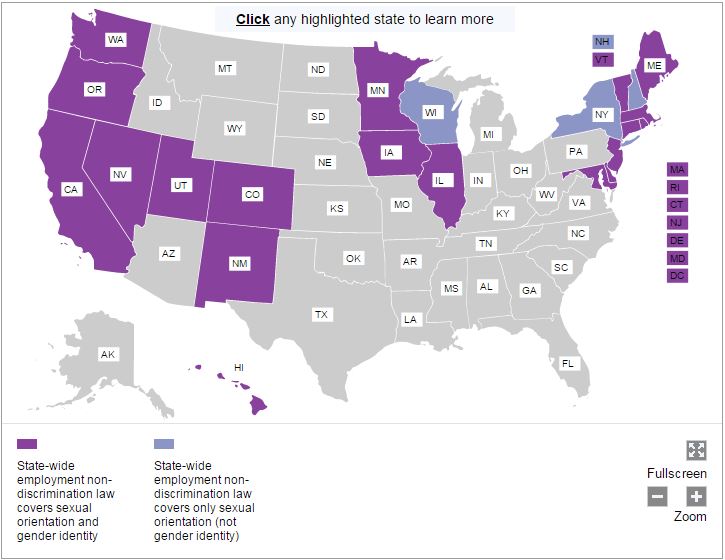
States with non-discrimination laws

(Source: ACLU)

Erik Stanley of the Alliance Defending Freedom offers advice to churches on how to respond to the Supreme Court’s decision to redefine marriage to remove the gender requirement.

He says:

[…][T]he greatest threat for churches lies in the application of the Court’s decision to believers who live in jurisdictions covered by so-called “non-discrimination” laws and ordinances. Everywhere that marriage has been redefined in the last several years has seen an awakening of non-discrimination laws that prohibit discrimination in employment, housing, or places of public accommodation on the basis of sexual orientation or gender identity. These laws are peppered throughout the states and local governments and are a linchpin of the sexual revolution’s broader legal and political strategy: to establish non-discrimination laws at all levels throughout the country and to to “ensure that religion is not used as an excuse to discriminate.”

In coming days, the threat from these non-discrimination laws will materialize in numerous ways as same-sex couples marry. But there are proactive steps your church can take to protect itself.

I put the map from the ACLU above. I think that’s what he is talking about when he says non-discrimination states. Keep in mind that the ACLU supported redefining marriage, and opposes religious liberty.

Erik’s article covers 3 areas:

  1. Church’s statement of faith
  2. Pastors officiating same-sex marriage ceremonies
  3. Church’s facility usage policy

Part 3) was the most interesting to me:

3. Churches should ensure their facilities usage policies are revised to allow only uses consistent with the church’s religious beliefs.

In the wake of the Supreme Court ruling, some churches may be approached by same-sex couples seeking to be married in the church facility. Churches should not feel as if they have to close their doors to the community just to prevent wedding ceremonies with which they disagree. Churches must continue to be a welcoming presence in the community and can do so through updating or revising their facility usage policy. The key point is to tie usage of the church’s facility to the statement of faith and religious beliefs of the church. And then to make clear that uses inconsistent with those religious beliefs will not be allowed. Alliance Defending Freedom has a sample facilities usage policy available in our Protecting Your Ministry manual.

So you update your statement of faith, and then tie usage of the the facility to that statement of faith. Simple.

I took a quick look at the booklet, and it also talked about tying employment within the church and church membership to the statement of faith.

Denny Burk summarizes those:

2. Religious Employment Criteria

Your church can best avail itself of the First Amendment’s protection in employee disputes if you create and faithfully enforce religious employment criteria for every employee. That requires churches to do at least two things: (1) require all employees and volunteers to sign a statement affirming the church’s statement of faith and standards of conduct, and (2) create written job descriptions for every employee and volunteer position.

4. Formal Membership Policy

If your church does not have a membership policy, you need to change that. Biblically, this should already be a priority for your church. You need to specify what the requirements for membership are, how one joins, how one resigns, and the procedures for church discipline. If all of this isn’t spelled out up front, your church could be exposed (see ADF guide pp. 17-18).

So what to make of this? Well, the ADF is an organization that I admire and trust. I cannot abide Christians who do not want to understand the details of what is happening with religious liberty in their country. The ADF has first class lawyers from the top law schools, and they defend religious liberty at every level of our justice system, up to and including the Supreme Court. If you want to help your church protect itself from prosecution, then you must point them to the ADF booklet linked above.

And this is especially true if you are in one of those states in the map above. In looking over the map, I noticed that much of the trouble we have been having with Christian businesses getting sued are in states that have these laws… Oregon, Washington, New Mexico, New York, and so on. Pay attention to that map and make decisions about where to live accordingly.