

Tag Archives: Fine Tuning

A must-read series of posts on cosmic fine-tuning by Allen Hainline

Apologetics and the progress of science

There are four posts in the series, so far. I think Allen might be done, so I’m going to link to all four and snip something I like from each one.

The first post is on whether the fine-tuning is real, and whether a multiverse explains the fine-tuning so that there is no need for a cosmic Designer.

I just have to choose this quote from the atheist Stephen Hawking on the fine-tuning:

The remarkable fact is that the values of these numbers [i.e. the constants of physics] seem to have been very finely adjusted to make possible the development of life. For example, if the electric charge of the electron had been only slightly different, stars would have been unable to burn hydrogen and helium, or else they would not have exploded. It seems clear that there are relatively few ranges of values for the numbers [i.e. the constants of nature] that would allow for development of any form of intelligent life.

And from Luke Barnes, who I’ve mentioned before on this blog:

In my years of researching this topic, I’m amazed at how few scientists who have studied the fine-tuning details disagree with this core claim that the subset of life-permitting physics is a tiny fraction among possibilities. Since Luke Barnes is a top researcher on this topic, consider his input on the level of acceptance of the fine-tuning claim: “I’ve published a review of the scientific literature, 200+ papers, and I can only think of a handful that oppose this conclusion, and piles and piles that support it.[3]

And on the multiverse as a way to escape the fine-tuning:

The key issue though is that for the multiverse to be an adequate explanation for the fine-tuning it requires the conjunction of several hypotheses for which we lack any empirical evidence:

  1. A universe-generating mechanism that generates a plethora of universes
  2. That this mechanism doesn’t itself require fine-tuning
  3. The many-worlds interpretation of quantum physics
  4. The ability to widely vary constants in those universes. If you think that it’s a foregone conclusion that String Theory/M-Theory[8] will come to the rescue in this area, you should watch this video clip by Oxford physicist Roger Penrose where he exclaims that “it’s not even a theory … it’s a collection of hopes”.

Occam’s razor therefore does seem to favor design over the multiverse. When one accounts for the extensive problems in affirming premise 2 and how these multiverse theories make predictions incompatible with our universe, the hypothesis that God designed the physics of the universe to bring about life is more plausible.

Here’s the second post, where he explains the fine-tuning argument philosophically, and gives an example of one of the constants that has to be fine-tuned in order to support complex, embodied intelligence of any kind.

The cosmological constant:

The inference to design will be more easily recognized if we shed some light as to the specialness of the required values. Consider the size of the bull’s eye and wall based on just 1 parameter – the cosmological constant. There is a natural range for possible values for this constant because there are known contributions that are 10120times larger than the overall net value. (There is a near perfect but inexact cancellation of contributions accurate to 120 decimal places). Let’s use the most conservative numbers in the physics literature that indicate a fine-tuning to 1 part in 1053. If the cosmological constant, which governs the expansion rate of the universe, had been larger than its current value by this tiny fraction, then the universe would have expanded so fast that no stars or planets would have formed and therefore no life. If the value were smaller by this amount then the universe would have rapidly collapsed before the universe cooled sufficiently to allow for stable information storage which is required by any self-replicating system such as life.

In the third post, he responds to objections to the fine-tuning argument. One objection you hear from atheists who don’t understand the science is that any selection of constants and quantities is as likely as any other, so our life-permitting set is just random. Now, first off, there are only 10 to the 80 atoms in the visible universe, so if the cosmological constant is fine-tuned to 1 in 10 to the 120, it’s not rational to say “it just happened randomly”.

But here is Allen’s response:

However, the assumption that any set of constants is just as likely as any other is the very thing that we want to know. Starting off with that as an assumption begs the question against design. As Luke Barnes articulates in this excellent podcast dealing with responses to the fine-tuning claim, suppose we’re playing poker and every time I deal I get a royal flush. If this continues to happen, you become increasingly convinced that I’m likely to be cheating. If I responded to an accusation of cheating by just saying “well any set of 5 cards is just as likely as any other so you can’t accuse me of cheating” you would be rational to reject this explanation. The question is not “how likely is any set of 5 cards?” but rather “how likely is it I’m cheating if I just dealt myself 10 straight royal flushes?” This question accounts for the possibility that I’m cheating which would almost certainly be true in this scenario. So the right fine-question is “given the fine-tuning evidence, how likely is it that the constants were set at random?” The values for physical constants conform to a very particular pattern – that which supports life. The fact that we have so many finely-tuned constants makes it unlikely that they were all set at random (at least in the single universe scenario and I’ve already shown some of the problems/challenges in multiverse explanations.)

Every 5-card hand that you draw is equally unlikely, but the royal flush is the highest hand in the game and always wins. Every hand you draw is unlikely, but whatever you draw is overwhelmingly likely to not be a royal flush.

Finally, the fourth post deals with the objection that the constants and quantities could not have been other than they are.

He quotes physicist John Barrow giving 5 reasons why the constants can vary, and then this:

Even if the constants and laws of physics couldn’t vary, there is even more reason to think that there were many physically possible sets of initial conditions. Paul Davies states this emphatically:

“Even if the laws of physics were unique, it doesn’t follow that the physical universe itself is unique…the laws of physics must be augmented by cosmic initial conditions…there is nothing in present ideas about ‘laws of initial conditions’ remotely to suggest that their consistency with the laws of physics would imply uniqueness. Far from it…it seems, then, that the physical universe does not have to be the way it is: it could have been otherwise.[4]”

John A. Wheeler agrees: “Never has physics come up with a way to tell with what initial conditions the universe was started off. On nothing is physics clearer than what is not physics.”

The constants and quantities are not determined by physics. They were selected by whoever created nature in the first place.

So that’s the series. I noticed that he kept linking to this Common Sense Atheism podcast featuring famous cosmologist Luke Barnes. I grabbed it to listen this weekend, and you might want to get it, too. It’s over an hour. It seems like it is one stop shopping to understand common objections to the fine-tuning argument, and how strong each one is.
 

Stephen C. Meyer and Keith Fox debate intelligent design and evolution

How did life begin?
How did life begin?

From Justin Brierley’s “Unbelievable” podcast.

Details:

Stephen Meyer is a leading proponent of Intelligent Design who directs the Centre for Science and Culture at the Discovery Institute in Seattle. His [first] book “Signature in the Cell” claims to show that the DNA code is the product of intelligent mind, not naturalistic processes. Keith Fox is Professor of Biochemistry at Southampton University. He chairs the UK Christians in Science network but disagrees strongly with ID. They debate how life could have originated and whether design is allowed as an explanation in science.

Summary: (stuff in italics is my snarky paraphrase)

Meyer:

  • background and how he got interested in intelligent design
  • his research focus is on the origin of life – the first replicator
  • summarizes the history of origin of life studies
  • authored the book “Signature in the Cell”
  • the DNA enigma: where did the information in DNA come from?
  • naturalistic explanations of the DNA information have failed
  • but intelligent agents are known to be able to produce information
  • the best explanation of the information in DNA is that an intelligent agent authored it
  • Meyer’s book was named by atheist philosopher of science Thomas Nagel as a Times Literary Supplement Book of the Year in 2010
  • why is design so controversial? Many people think that Darwin explained why nature appears design
  • the Darwinian view is that nature can create the appearance of design using mutation and selection
  • however, Darwinian mechanisms cannot explain the origin of the first living cell, it assumes replication, and the origin of life is about where the first replicator comes from

Fox:

  • Meyer’s argument is not about the evolution of life after the first cell
  • Meyer’s case for design is about the origin of life
  • naturalists do not know a naturalistic explanation for the origin of life
  • there are a number of naturalistic hypotheses for the origin of life, like the RNA-first hypothesis
  • maybe in a few years one of them will turn out to be correct
  • what intelligent design is arguing from a gap in our current naturalistic knowledge to infer that God intervened in nature

Meyer:

  • that’s not what intelligent design is at all
  • the approach ID theorists use is the inference to best explanation
  • you evaluate all explanations, non-intelligent causes and intelligent causes
  • you prefer the best possible explanation
  • we know that minds are capable of producing information just like the information we find in DNA

Fox:

  • living cells replicate, so they have the ability to introduce mutations as they replicate and then some of those mutations can be selected
  • so maybe the process of replicating that living cells do created the first living cell
  • maybe the first living cell created itself, X brought X into being, self-creation, what’s irrational about that?

Meyer:

  • the issue is the origin of life – where did the first living cell come from?
  • you cannot appeal to the operations that a living cell can perform to explain the origin of the first living cell
  • there was no first living cell operating before the first living cell
  • there was no replication, mutation or selection before the first living cell
  • in fact, in my book I show that there is no known naturalistic mechanism that is able to produce the information needed for the first living cell
  • nothing can create itself, that is self-contradictory
Fox:
  • Well, you are just saying that because something is complex that God did it
Meyer:
  • Sadly, no. What I actually said needed to be explained was the information, not complexity
  • And we know from software engineering that the process of adding information to code is performed by programmers
  • in the absence of any adequate naturalistic explanation for information, we are justified in taking the explanation that we are familiar with – namely, intelligent agency – based on our uniform, universal experience of what causes information
Fox:
  • well, maybe we can appeal to the mutation and selection in existing living cells to explain the origin of the first living cell
  • maybe there were living cells before the first living cell, and then these other living cells created the first living cell
Meyer:
  • we can’t keep invoking mutation and selection when those processes are not operating prior to the origin of the first living cell
Fox:
  • well maybe some bare-bones self-replication molecule was a precursor to the first living cell
Meyer:
  • even to generate very limited replicator would require a large amount of information
  • the argument I am making is – where does the evolution come from?
Fox:
  • well, maybe we will think of an explanation for information that is naturalistic in 20 years
  • we’ve thought of explanations to things that were NOT information before
  • so maybe we will be able to think of something to explain information based on our ability to explain NOT information before

Moderator: Change topics: the Dover decision

Meyer:

  • the Discovery Institute opposed the policy that causes the trial
  • the wording of the statute was poor
  • the judge was completely wrong in his decision
  • young earth creationists used the phrase “intelligent design” to cover their agenda
  • intelligent design is an inference using the normal methods of science
Fox:
  • intelligent design is a science stopper because it stops looking for a naturalistic explanation
  • everything in nature must have a naturalistic explanation
  • everything has to be explained using matter and time and chance
  • it just has to be that way!!!!
Meyer:
  • well, what luck would you have explaining an effect like Mt. Rushmore?
  • can you explain that using matter,time and chance?
  • Mt. Rushmore was the product of intelligence, not wind and erosion
  • similarly, there is information in the cell, and we know that intelligence causes information
Fox:
  • So you are saying that we don’t understand and therefore an intelligence is necessary?

Meyer:

  • no I am saying we DO understand and we are making an inference based on that understanding
  • you are the one who is insisting on a material explanation because you pre-suppose materialism
  • we know that minds have causal powers, and we can infer mind as an explanation from information
Fox:
  • well nature is a seamless chain of material causes and effects
Meyer:
  • agents can act without violating the laws of nature
  • even humans can act as intelligent agents to create information in books, and they don’t violate the laws of nature
  • intelligent causes are real, and they explain effects in nature
Fox:
  • you’re trying to impose on science something to do with meaning and purpose
Meyer:
  • no that’s not what we’re doing, we’re inferring from from the fact that we ourselves are known causes of information to the fact that an intelligence cause is the best explanation for information in the cell
Fox:
  • but I am a materialist, I need a materialist explanation
Meyer:
  • mind IS an answer to the how question
  • we infer to mind in many other scientific disciplines, like cryptography, archaeology, etc.
  • a materialist might accuse an archaeologist of engaging in a “scribe-of-the-gaps” argument, but the best explanation of an artifact with information is a scribe
  • we are inferring that mind is the cause from the nature of the effect: information
Moderator: is it appropriate to call DNA “information”

Fox:

  • well DNA is just a molecular polymer, any reference to information is just by analogy
Meyer:
  • DNA is a molecular polymer, but it also exhibits the property of specified complexity
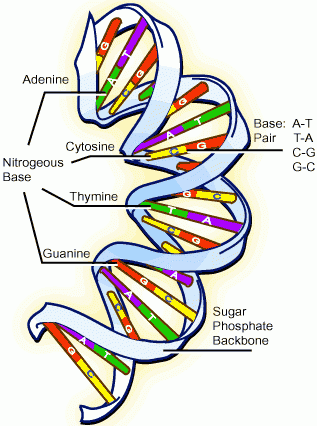
  • the arrangement of bases, which function as machine instructions in a software program, for performings task in the cell
  • we have observed that the property of specified complexity always comes from an intelligence
Fox:
  • well, maybe there are other sequences that would work, so maybe it’s really not uncommon to develop functioning sequences by chance alone, without an intelligence
Meyer:
  • you can measure how precise the functional specificity is in DNA and proteins

Moderator: is Shannon information the same as functional information

Meyer:

  • Shannon information refers to the sequences of digits or symbols that do not necessarily have any function, i.e. – a four character string QSZX has as much Shannon information as WORD. However, only the latter is functional against the pattern of the English language. There are arrangements of DNA bases and amino acids that have the same number of symbols/characters as a functional sequence would have, but they have no biological function – they do not exhibit specified complexity
Fox:
  • Well, maybe there are lots and lots of sequences of DNA and proteins so that it is fairly easy to get a functional one by chance

Meyer:

  • DNA sequences that are functional are extremely rare, protein sequences are even more rare
  • this is not my opinion, this is what the research shows – functional protein sequences are rare
Fox:
  • well maybe there are other functional sequences that are occur before the first functional sequence that are precursors to the first functional sequence
  • maybe there are billions of years of replication, mutation and selection before the first replication, mutation and selection

Meyer:

  • you can’t get to the first selectable functional sequence by appealing to precursor selectable functional sequences – there are no selectable functional sequences before the FIRST one
  • you have to get the first selectable functional sequence by chance alone, because there is nothing to mutate or select before the first replicator
  • the chance hypothesis has been rejected because the minimal amount of information for the simplest replicator is too high to get by chance alone, given the resources, including time, that are available

Moderator: Keith are you confident that naturalism will be able to substantiate these naturalism-of-the-gap speculations that you offer in response to Meyer’s actual science that we have today? 

Fox:

  • well, it is hard to know for sure because it was just a fluke event
  • but there’s nothing irrational or unscientific or miraculous about it – the fluke would have a material explanation
  • there is nothing that we can detect that would implicate God, my speculations about a fluke which I cannot observe or measure or test would all be compatible with an atheistic worldview that omits God as a causal entity

Meyer:

  • where are those material processes that could account for this fluke then?
  • the whole point of this argument is that the information in DNA transcends the material components in the sequence
  • it’s the arrangement of the material parts/letters/characters/symbols/instructions that needs to be explained
Fox:
  • Well, I just have a different philosophy of science that rules out intelligent causation a priori

Meyer:

  • Yes, that’s the difference between us – you pre-suppose that all explanations of natural phenomena must exclude intelligent causes

There is a bit more where Meyer talks about how parts of the cell are implementations of various design patterns (Gang of Four design patterns) that are used by software architects who design software.

Find more posts on Stephen C. Meyer here.

Four ways that the progress of experimental science conflicts with atheism

Apologetics and the progress of science

When people ask me whether the progress of science is more compatible with theism or atheism, I offer the following four basic pieces of scientific evidence that are more compatible with theism than atheism.

Here are the four pieces of evidence best explained by a Creator/Designer:

  1. the kalam argument from the origin of the universe
  2. the cosmic fine-tuning (habitability) argument
  3. the biological information in the first replicator (origin of life)
  4. the sudden origin of all of the different body plans in the fossil record (Cambrian explosion)

And I point to specific examples of recent discoveries that confirm those four arguments. Here are just a few of them:

  1. An explanation of 3 of the 6 experimental evidences for the Big Bang cosmology (From an article from Caltech)
  2. Examples of cosmic fine-tuning to allow the existence of conscious, embodied life (From the New Scientist)
  3. Evidence that functional protein sequences are beyond the reach of chance, (from Doug Axe’s JMB article)
  4. Evidence showing that Ediacaran fauna are not precursors to the Cambrian fossils, (from the journal Nature)

Atheists will typically reply to the recent scientific discoveries that overturned their speculations like this:

  1. Maybe the Big Bang cosmology will be overturned by the Big Crunch/Bounce so that the universe is eternal and has no cause
  2. Maybe there is a multiverse: an infinite number of unobservable, untestable universes which makes our finely-tuned one more probable
  3. Maybe the origin of life could be the result of chance and natural processes
  4. Maybe we will find a seamless chain of fossils that explain how the Cambrian explosion occurred slowly, over a long period time

Ever heard any of these responses?

Below I list some resources to help you to respond to the four responses of atheists to the experimental data.

1) The Big Crunch/Bounce has been disproved theoretically and experimentally.

Theoretically:

Nature 302, 505 – 506 (07 April 1983); doi:10.1038/302505a0

The impossibility of a bouncing universe

ALAN H. GUTH* & MARC SHER†

*Center for Theoretical Physics, Laboratory for Nuclear Science and Department of Physics, Massachusetts Institute of Technology, Cambridge, Massachusetts 02139, USA

†Department of Physics, University of California, Irvine, California 92717, USA

Petrosian1 has recently discussed the possibility that the restoration of symmetry at grand unification in a closed contracting Robertson–Walker universe could slow down and halt the contraction, causing the universe to bounce. He then went on to discuss the possibility that our universe has undergone a series of such bounces. We disagree with this analysis. One of us (M.S.) has already shown2 that if a contracting universe is dominated by radiation, then a bounce is impossible. We will show here two further results: (1) entropy considerations imply that the quantity S (defined in ref. 1 and below), which must decrease by ~1075 to allow the present Universe to bounce, can in fact decrease by no more than a factor of ~2; (2) if the true vacuum state has zero energy density, then a universe which is contracting in its low temperature phase can never complete a phase transition soon enough to cause a bounce.

Experimentally:

The universe is not only expanding, but that expansion appears to be speeding up. And as if that discovery alone weren’t strange enough, it implies that most of the energy in the cosmos is contained in empty space — a concept that Albert Einstein considered but discarded as his “biggest blunder.” The new findings have been recognized as 1998’s top scientific breakthrough by Science magazine.

[…]The flood of findings about the universe’s expansion rate is the result of about 10 years of study, said Saul Perlmutter, team leader of the Supernova Cosmology Project at Lawrence Berkeley National Laboratory.

Perlmutter and others found such a yardstick in a particular kind of exploding star known as a Type 1A supernova. Over the course of several years, the astronomers developed a model to predict how bright such a supernova would appear at any given distance. Astronomers recorded dozens of Type 1A supernovae and anxiously matched them up with redshifts to find out how much the universe’s expansion was slowing down.

To their surprise, the redshift readings indicated that the expansion rate for distant supernovae was lower than the expansion rate for closer supernovae, Perlmutter said. On the largest scale imaginable, the universe’s galaxies appear to be flying away from each other faster and faster as time goes on.

“What we have found is that there is a ‘dark force’ that permeates the universe and that has overcome the force of gravity,” said Nicholas Suntzeff of the Cerro Tololo Inter-American Observatory, who is the co-founder of another group called the High-z Supernova Search Team. “This result is so strange and unexpected that it perhaps is only believable because two independent international groups have found the same effect in their data.”

There has only been one creation of the universe, and the universe will never reverse its expansion, so that it could oscillate eternally. That view is popular, perhaps in part because many people watched videos of Carl Sagan speculating about it in public school classrooms, but all it was was idle naturalistic speculation, (Sagan was a naturalist, and held out hope that science would vindicate naturalism), and has been contradicted by good experimental science. You should be familiar with the 3 evidences for the Big Bang (redshift, light element abundances (helium/hydrogen) and the cosmic microwave background radiation. There are others, (radioactive element abundances, second law of thermodynamics, stellar lifecycle), but those are the big three. Point out how the experimental evidence for the Big Bang has piled up, making the problem even worse for the eternal-universe naturalists.

2) The multiverse has not been tested experimentally, it’s pure speculation.

Speculation:

Multiverse thinking or the belief in the existence of parallel universes is more philosophy or science fiction than science. ”Cosmology must seem odd to scientists in other fields”.

George Ellis, a well-known mathematician and cosmologist, who for instance has written a book with Stephen Hawking, is sceptical of the idea that our universe is just another universe among many others.

A few weeks ago, Ellis, professor emeritus of applied mathematics at the University of Cape Town, reviewed Brian Greene’s book The Hidden Reality: Parallel Universes and the Deep Laws of the Cosmos (Knopf/Allen Lane, 2011) in the journal Nature. He is not at all convinced that the multiverse hypothesis is credible: ”Greene is not presenting aspects of a known reality; he is telling of unproven theoretical possibilities.”

According to professor Ellis, there is no evidence of multiverses, they cannot be tested and they are not science.

Ellis is not the only multiverse sceptic in this universe. A few months ago, science writer John Horgan wrote a column in Scientific American, expressing his doubt in multiverses.

When you get into a debate, you must never ever let the other side get away with asserting something they have no evidence for. Call them on it – point out that they have no evidence, and then hammer them with evidence for your point. Pile up cases of fine-tuning on top of each other and continuously point out that they have no experimental evidence for their speculations. Point out that more evidence we get, the more cases of fine-tuning we find, and the tougher the problem gets for naturalists. There is no evidence for a multiverse, but there is evidence for fine-tuning. TONS OF IT.

3) Naturalistic theories for the origin of life have two problems: can’t make the amino acids in an oxydized atmosphere and can’t make protein and DNA sequences by chance in the time available.

Building blocks:

The oxidation state of Hadean magmas and implications for early Earth’s atmosphere

Dustin Trail, E. Bruce Watson & Nicholas D. Tailby

Nature 480, 79–82 (01 December 2011) doi:10.1038/nature10655

[…]These results suggest that outgassing of Earth’s interior later than ~200?Myr into the history of Solar System formation would not have resulted in a reducing atmosphere.

Functional protein sequences:

J Mol Biol. 2004 Aug 27;341(5):1295-315.

Estimating the prevalence of protein sequences adopting functional enzyme folds.

Axe DD.

The Babraham Institute, Structural Biology Unit, Babraham Research Campus, Cambridge CB2 4AT, UK. doug.axe@bbsrc.ac.uk

Proteins employ a wide variety of folds to perform their biological functions. How are these folds first acquired? An important step toward answering this is to obtain an estimate of the overall prevalence of sequences adopting functional folds.

[…]Starting with a weakly functional sequence carrying this signature, clusters of ten side-chains within the fold are replaced randomly, within the boundaries of the signature, and tested for function. The prevalence of low-level function in four such experiments indicates that roughly one in 10(64) signature-consistent sequences forms a working domain. Combined with the estimated prevalence of plausible hydropathic patterns (for any fold) and of relevant folds for particular functions, this implies the overall prevalence of sequences performing a specific function by any domain-sized fold may be as low as 1 in 10(77), adding to the body of evidence that functional folds require highly extraordinary sequences.

So atheists are in double jeopardy here. They don’t have a way to build the Scrabble letters needed for life, and they don’t have a way to form the Scrabble letters into meaningful words and sentences. Point out that the more research we do, the tougher the problem gets to solve for naturalists, and the more it looks like an effect of intelligence. Write out the calculations for them.

4) The best candidate to explain the sudden origin of the Cambrian era fossils was the Ediacaran fauna, but those are now recognized as not being precursors to the Cambrian fossils.

Science Daily reports on a paper from the peer-reviewed journal Science:

Evidence of the single-celled ancestors of animals, dating from the interval in Earth’s history just before multicellular animals appeared, has been discovered in 570 million-year-old rocks from South China by researchers from the University of Bristol, the Swedish Museum of Natural History, the Paul Scherrer Institut and the Chinese Academy of Geological Sciences.

[…]This X-ray microscopy revealed that the fossils had features that multicellular embryos do not, and this led the researchers to the conclusion that the fossils were neither animals nor embryos but rather the reproductive spore bodies of single-celled ancestors of animals.

Professor Philip Donoghue said: “We were very surprised by our results — we’ve been convinced for so long that these fossils represented the embryos of the earliest animals — much of what has been written about the fossils for the last ten years is flat wrong. Our colleagues are not going to like the result.”

Professor Stefan Bengtson said: “These fossils force us to rethink our ideas of how animals learned to make large bodies out of cells.”

The trend is that there is no evolutionary explanation for the body plans that emerged in the Cambrian era. If you want to make the claim that “evolution did it”, then you have to produce the data today. Not speculations about the future. The data we have today says no to naturalism. The only way to affirm naturalistic explanations for the evidence we have is by faith. But rational people know that we need to minimize our leaps of faith, and go with the simplest and most reasonable explanation – an intelligence is the best explanation responsible for rapid generation of biological information.

Conclusion

I do think it’s important for Christians to focus more on scientific apologetics and to focus their academic careers in scientific fields. So often I look at Christian blogs, and I see way too much G. K. Chesterton, Francis Chan and other untestable, ineffective jibber-jabber. We need to bring the hard science, and stop making excuses about not being able to understand it because it’s too hard. It’s not too hard. Everyone can understand Lee Strobel’s “The Case for a Creator“. That’s more than enough for the average Christian on science apologetics. We all have to do our best to learn what works. You don’t want to be anti-science and pro-speculation like atheists are. I recommend reading Uncommon Descent and Evolution News every day for a start.