
Tag Archives: Feminism

Woman who slept with 18 guys shocked that no one wants to marry her

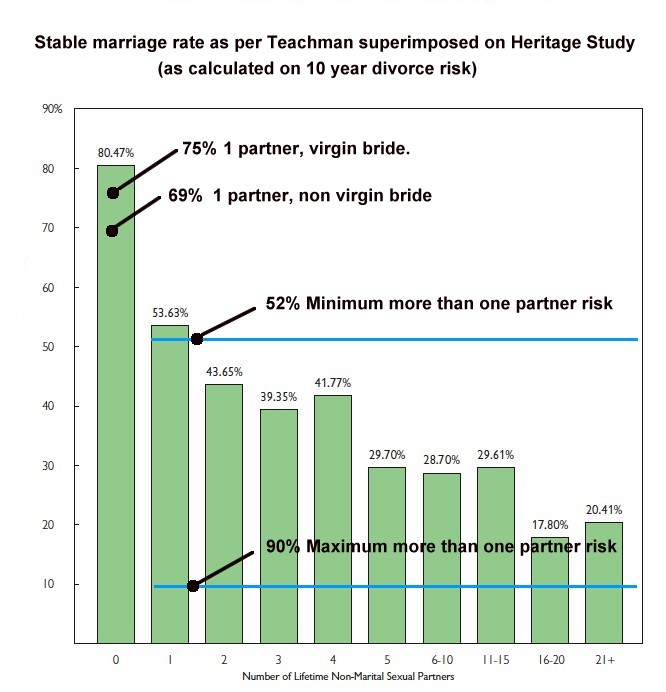
Does being a virgin before marriage affect marital stabilitity?
Does being a virgin before marriage affect marital stability?

Sunshine Mary linked to a post from Reddit by a 32-year old “progressive” woman who is surprised that 15 years of sleeping around with 18 different guys is not attractive to marriage-minded men.

Excerpt:

My parents are first generation immigrants. I have a younger brother and younger sister. In my family I was always the rebellious one; I would often challenge my parents. My family was very strict, when it came to dating and my siblings usually fell in line. However, I would challenge that norm.

My brother and sister were very repressed with their sexualities as a result, while I lost my virginity at 17 to my then boyfriend. While my brother and followed the traditional Indian path. My brother ended up not having any sexual contact with a girl until he got married at 25 (arranged marriage) and now they have a child together. My sister (too never kissed a boy) has recently gotten married too at 24 with an Indian boy she met at our Temple (both parents approved).

I live in LA, a city where both men and woman tend to marry a bit later in life, and yet I still spent the last years of my 20‘s feeling that somehow, I’d messed up. I had followed the wrong trail and thus, my “important-life-moments” timeline was off. Even with my more progressive friends it began slowly at first, when I was 27 … an engagement post on Facebook, an invite to a wedding—it was happening. People I knew were beginning the next stage of life and saying “I do.”

Throughout my whole life I never really dated any Indian guys; I exclusively dated white guys. However now I realize more than ever that the guys I dated never really took me seriously. They never really viewed me as someone they would eventually marry. I was always just some exotic fun. This part was definitely a realization that has hurt me to the core. I didn’t actually do it to spite Indian men or anything like that. I did what a lot of my white female friends did; I thought I was the same as them, but that could be farther from the truth. Most white guys I ran into wanted white wives.

I am now 32, and seems like everyone in my family has lapped me. I too want a family a marriage. However, now my chance of finding someone is gone. At my age getting an arranged marriage or finding another Indian man to marry me is out of the question. Majority of Indian guys usually get married pretty early. Often either to another Indian girl they meet here, or they go back to India for an arranged marriage. My parents have tried signing me up for a matrimony site, but of the guys I’d meet they would be turned off by my history (drink/eat meat/not a virgin).

[…]Most of my relationships have been long term I have only been with 18 guys and I have been sexually active since I was 17 years old.

She has only had steady sexual relationships with 18 guys in 15 years! That’s not a lot. Is it?

Let’s see what Sunshine Mary says first:

However, the more I think about it, the more it seems to me that articles like hers are a good thing simply because they expose the lie.  Feminists have sold young women a bill of goods, that they can live like men, work like men, have sex like men, and then turn back into women when they feel like it.  We laugh at a woman like this sometimes and make fun of her and say, “Didn’t she know that she’d end up like this?”

No, she didn’t know that.  That’s because when you are 17 years old, you don’t know much, especially in this culture of extended adolescence.  And when you have been told from a very young age that, as a girl, it is your destiny to Have It All exactly When You Want It, I’m sure it is very baffling to find yourself in your thirties with no husband and none in sight, with the dawning realization that your job and lonely apartment are not nearly as fulfilling as being a wife and mother would have been.

[…]Personally, I feel no joy in this woman’s pain.  I don’t think a White Knight should ride in to save her because I think she should suffer the natural consequences of her decisions so that other young women may see and learn from her errors, but I take no pleasure in the fact that she will have this lot in life.  However, what most of us don’t seem to understand is that young women make the terrible choices that they are making because they are told from an early age that these are actually good choices.  Some girls are able to resist that message, which saturates every aspect of the media and schools, but most girls aren’t, and they don’t develop the necessary wisdom until it is too late.

Emphasis hers. And now my turn.

Let me tell you what awaits a man who marries a woman like that, who spent her 20s hooking up with hot guys who had no interest in marriage and no  demonstrated ability to protect, provide and lead on moral/spiritual issues. She will have convinced herself that she is more attractive than she really is, and be constantly comparing a less-attractive husband to these other hot guys. I therefore do not recommend that any man marry this woman as she is now. What men need in marriage is respect, affection, affirmation and approval. A woman like her needs to work on building up her ability to trust and encourage men by choosing good men and supporting them chastely and unselfishly. That is the only way to fix this, if it even can be fixed.

I know that women will be surprised by this, but men can tell if you are a virgin or not based on how much you trust and encourage them in their plans. If you are constantly putting them down, calling them names, and making excuses for why you don’t have to care about their needs and feelings, then that’s just your past promiscuity showing itself. Virgins with good relationships with their fathers don’t put men down like that – they build men up. My recommendation for women who realize that they are making bad choices with men and being negative about the men they choose is to look in the mirror and acknowledge that they are the problem. The solution, then, is to find a good man and work hard at being submissive and supportive, but chastely.

In the church

My friend Ari, who is married with lots of kids, sent me a related article from Vox Day, about how church women are making choices about during their 20s and 30s.

Vox writes:

Women increasingly expect churches and church functions to be places of freedom from “unwanted” interactions. Translated, this means women expect unattractive men to know their place and not to ask women out or otherwise talk to them at church. They expect men either to avoid them completely, or to be eunuchs, existing to serve them. There have been reports in the manosphere of women actually complaining to pastors about “unattractive” men asking them out at church. It is as if women expect pastors and church staff to punish and rebuke men for “sexual harassment” at churches, merely because in a social situation they acted like men and pursued someone/something they wanted. Of course, none of this applies to attractive men, who are never the subject of complaint or sanction no matter what they do.

A friend of mine who has an engineering degree from MIT and a very high-paying job replied to that with this:

Heh. Sad, but good insight about the desexualized church. When I was single, I very friendly (not sexually — was very discerning and had very high standards) and some women found that very disconcerting. I was even had my behavior likened as “sexual harassment” at one point, so I asked if there were things like pelvic thrusts, hands in pockets pointing the wrong way, things that I said that were inappropriate. No, the answer came back. It was just that I was friendly. (Besides, I couldn’t see any of the women as date-material … one or two from what I could discern were nominally Christian, as in, one thought it would be cool to find a husband at a church but would take home guys.)

So I stated: I merely say hi and ask how the person is and if the person doesn’t want to talk, I don’t push the conversation. I am merely being pleasant especially to people I know. The answer came back that a certain group of women wanted me to just ignore them, not even wave, say hi, or acknowledge their existence. Really? Jesus died so we could just ignore each other? I mostly gaped … and wondered about John 13:34-35.

I was told “this was an unachievable ideal, don’t even try.” Now, who is still worshiping and still there? Not this group of women!

I think this problem of women wasting their lives on men who are attractive and entertaining, but not marriage-capable, is even more serious when it comes to the church, because I think there is a temptation that women have to be very secular in their standard for men, and yet the church affirms them by making it seem that their feelings are actually God speaking to them about which man to like. Every objection about the man’s unsuitability for marriage is met with “but he has a good heart for Jesus and he works hard”. Heart for Jesus = never read so much as a C.S. Lewis book in his life.

Where does the standard come from? Well it comes from TV, movies, music and pop culture. That’s where they learn what kind of man to like, and it’s reinforced by their peers. There is no effort to look at what a Christian man does in a marriage and then choose a man who is showing he can do that. A woman should always choose a man who gives her the tingles, because the tingles are the voice of God telling her that he is opening doors and providing signs for her to prefer the agnostic psychology student who lives in his parents’ basement and is 3 years younger than she is. But he is hawt, and the Holy Spirit told her to spend her 20s pining away for him. Her friends would be so envious, because he looks like that guy on “Mad Men”.

A primer for social conservatives who want to argue for their views with economics

Somehow I missed this editorial from Ross Douthat, which appeared in the radically leftist New York Times. He responds to the charge that conservatives don’t make economic arguments for their socially conservative views, even though the data is there to support such arguments. What he writes is a pretty good primer on evidential arguments for social conservatives. My regular readers will recognize some of the names he mentions from previous posts on this blog.

Excerpt:

Here are a few (of many) possible answers. The first is that social conservatives actually do make such arguments, even if the phrase “negative externalities” isn’t deployed with quite the frequency Caplan would like. Look at any prominent document on changing family structures, for instance, from The Moynihan Report down through Barbara Dafoe Whitehead’s famous “Dan Quayle Was Right” to the “marriage gap” arguments of today, and you’ll find an intense focus on the socioeconomic costs of the trends the writers are describing and/or deploring. Indeed, the entire corpus of socially-conservative intellectual efforts, from 1970s-era neoconservatives like Richard John Neuhaus and James Q. Wilson down to the present era, is shot through with arguments that are, if not purely economic, at least heavily informed by economic questions.

Right now, whether you’re reading Jonathan Last on demography or Kay Hymowitz on young manhood or Brad Wilcox on marriage and middle America or Mark Regnerus on the market for premarital sex, the case for social conservatism is reliably — perhaps even too reliably, I fear, in some of my own work — framed in the language of costs and benefits, mobility and opportunity, education and income and life outcomes. (And likewise on issues that fall within the socially-conservative penumbra, like immigration, crime, and drugs.)

But note that very few of the writers and intellectuals I’ve just mentioned are practicing economists: They’re political scientists, sociologists, journalists, and so forth. (Arguably the most influential socially-conservative champion of free market economics in the last generation, Michael Novak, earned degrees in theology and philosophy, not economics itself.)

In a previous NYT piece, he had also linked to a new 2014 study from the Journal of Sexual Research which showed how delaying sexual activity improves relationship quality and stability.

Abstract:

While recent studies have suggested that the timing of sexual initiation within a couple’s romantic relationship has important associations with later relationship success, few studies have examined how such timing is associated with relationship quality among unmarried couples. Using a sample of 10,932 individuals in unmarried, romantic relationships, we examined how four sexual-timing patterns (i.e., having sex prior to dating, initiating sex on the first date or shortly after, having sex after a few weeks of dating, and sexual abstinence) were associated with relationship satisfaction, stability, and communication in dating relationships. Results suggested that waiting to initiate sexual intimacy in unmarried relationships was generally associated with positive outcomes. This effect was strongly moderated by relationship length, with individuals who reported early sexual initiation reporting increasingly lower outcomes in relationships of longer than two years.

That’s nothing new, but it shows that research falsifies the standard leftist/feminist narrative about recreational sex being normal and healthy. The sexual revolution is very much an idealistic flight from reality. Reality is generally more conservative than the leftists present in their sterile classrooms and popular culture entertainment. You’re not going to see the conclusions of mainstream research reflected in a feminist university professor’s angry rhetoric, or in TV shows and movies written by privileged radicals who have made all the wrong choices in life.

Is the story of the woman being stoned for adultery in John 7-8 authentic?

Here’s the leading conservative New Testament scholar Daniel Wallace to explain.

Excerpt:

One hundred and forty years ago, conservative biblical scholar and Dean of Canterbury, Henry Alford, advocated a new translation to replace the King James Bible. One of his reasons was the inferior textual basis of the KJV. Alford argued that “a translator of Holy Scripture must be…ready to sacrifice the choicest text, and the plainest proof of doctrine, if the words are not those of what he is constrained in his conscience to receive as God’s testimony.” He was speaking about the Trinitarian formula found in the KJV rendering of 1 John 5:7–8. Twenty years later, two Cambridge scholars came to the firm conclusion that John 7:53–8:11 also was not part of the original text of scripture. But Westcott and Hort’s view has not had nearly the impact that Alford’s did.

For a long time, biblical scholars have recognized the poor textual credentials of the story of the woman caught in adultery (John 7:53–8:11). The evidence against its authenticity is overwhelming: The earliest manuscripts with substantial portions of John’s Gospel (P66 and P75) lack these verses. They skip from John 7:52to 8:12. The oldest large codices of the Bible also lack these verses: codex Sinaiticus and Vaticanus, both from the fourth century, are normally considered to be the most important biblical manuscripts of the NT extant today. Neither of them has these verses. Codex Alexandrinus, from the fifth century, lacks several leaves in the middle of John. But because of the consistency of the letter size, width of lines, and lines per page, the evidence is conclusive that this manuscript also lacked the pericope adulterae. Codex Ephraemi Rescriptusalso from the fifth century, apparently lacked these verses as well (it is similar to Alexandrinus in that some leaves are missing). The earliest extant manuscript to have these verses is codex Bezae, an eccentric text once in the possession of Theodore Beza. He gave this manuscript to the University of Cambridge in 1581 as a gift, telling the school that he was confident that the scholars there would be able to figure out its significance. He washed his hands of the document. Bezae is indeed the most eccentric NT manuscript extant today, yet it is the chief representative of the Western text-type (the text-form that became dominant in Rome and the Latin West).

When P66, P75, Sinaiticus, and Vaticanus agree, their combined testimony is overwhelmingly strong that a particular reading is not authentic. But it is not only the early Greek manuscripts that lack this text. The great majority of Greek manuscripts through the first eight centuries lack this pericope. And except for Bezae (or codex D), virtually all of the most important Greek witnesses through the first eight centuries do not have the verses. Of the three most important early versions of the New Testament (Coptic, Latin, Syriac), two of them lack the story in their earliest and best witnesses. The Latin alone has the story in its best early witnesses.

Even patristic writers seemed to overlook this text. Bruce Metzger, arguably the greatest textual critic of the twentieth century, argued that “No Greek Church Father prior to Euthymius Zigabenus (twelfth century) comments on the passage, and Euthymius declares that the accurate copies of the Gospel do not contain it” (Textual Commentary, 2nd ed., loc. cit.).

It is an important point to note that although the story of the woman caught in adultery is found in most of our printed Bibles today, the evidence suggests that the majority of Bibles during the first eight centuries of the Christian faith did not contain the story. Externally, most scholars would say that the evidence for it not being an authentic part of John’s Gospel is rock solid.

But textual criticism is not based on external evidence alone; there is also the internal evidence to consider. This is comprised of two parts: intrinsic evidence has to do with what an author is likely to have written;transcriptional evidence has to do with how and why a scribe would have changed the text.

Intrinsically, the vocabulary, syntax, and style look far more like Luke than they do John. There is almost nothing in these twelve verses that has a Johannine flavor. And transcriptionally, scribes were almost always prone to add material rather than omit it—especially a big block of text such as this, rich in its description of Jesus’ mercy. One of the remarkable things about this passage, in fact, is that it is found in multiple locations. Most manuscripts that have it place it in its now traditional location: between John 7:52 and 8:12. But an entire family of manuscripts has the passage at the end of Luke 21, while another family places it at the end of John’s Gospel. Other manuscripts place it at the end of Luke or in various places in John 7.

The pericope adulterae has all the earmarks of a pericope that was looking for a home. It took up permanent residence, in the ninth century, in the middle of the fourth gospel.

Wallace teaches at the ultra-conservative fundamentalist Dallas Theological Seminary, and is the foremost evangelical manuscript expert in the world.

Why is this important? I think it is important because this story is very prominent for a great many Christians, especially Christian women, who use this to justify a variety of positions that are inconsistent with the rest of the Bible. These Christians do not like the idea of anyone being judged and so they are naturally inclined to blow this disputed passage into an entire theology that repudiates making moral judgments on such things as capital punishment. In fact, in another post, I was accused of being the equivalent of one of the people who wanted to stone the woman taken for adultery because I oppose fornication and single motherhood. That’s how far this has gone, where some Christians, especially Christian feminists, have leveraged this passage to redefine the Bible so that women are no longer responsible to the Bible’s moral rules and can never be blamed for acting irresponsibly.

Is WK a big liberal?

As this debate between Peter Williams and Bart Ehrman shows, there are only TWO disputed passages in the entire NT that are theologically significant. The long ending of Mark and this adultery passage. A good case can be made for the long ending of Mark, but it’s best not to assume it in a debate. The adultery passage is difficult to defend as authentic. Dr. Wallace talks about both passages in this Parchment & Pen article (reclaimingthemind.org). Wallace has also debated Bart Ehrman in the Greer-Heard Forum. What that debate showed is that the New Testament text is actually quite reliable except for those two passages, but it’s important to be honest about the two places that are not well supported.

The other other NT passages that are a concern are the earthquake passage and the guard story in Matthew. I think that the earthquake is apocalyptic language and the guard is more likely historical than not.

For a closer look at what the Bible says about capital punishment, look here.