
Tag Archives: Evolution

Did your science textbook tell you that embryo drawings prove evolution?

When you learned about evolution in public school, what did they show you for evidence to support the theory? Some people say finch beaks changing size, some people say a feathered dinosaur, some people say similar features in different animals, and some people say embryo drawings. Let’s take a look at that last one and see if it’s good evidence for evolution.

Jonathan Wells, a biologist with Ph.Ds from Yale and UC Berkeley, writes about one example of fake evidence here:

Charles Darwin thought that “by far the strongest” evidence that humans and fish are descended from a common ancestor was the striking similarity of their early embryos. According to Darwin, the fact that “the embryos of the most distinct species belonging to the same class are closely similar, but become, when fully developed, widely dissimilar… reveals community of descent.” 2 To illustrate this, German Darwinist Ernst Haeckel made some drawings in the 1860s to show that the embryos of vertebrates (fish, amphibians, reptiles, birds and mammals) look almost identical in their earliest stages.

But Haeckel faked his drawings. Not only do they distort vertebrate embryos by making them appear more similar than they really are (in a way that Stephen Jay Gould wrote “can only be called fraudulent” 3), but they also omit classes and stages that do not fit Darwin’s theory. Most significantly, Haeckel omitted the earliest stages, in which vertebrate embryos are strikingly different from each other. The stage he portrayed as the first is actually midway through development. Yet according to Darwin’s logic, early dis-similarities do not provide evidence for common ancestry.

Haeckel used his faked drawings to support not only Darwinian evolution, but also his own “Biogenetic Law,” which stated that embryos pass through the adult stages of their ancestors in the process of development.

…Haeckel’s drawings were exposed as fakes by his own contemporaries, and his Biogenetic Law was thoroughly discredited by 20th century biologists. It is now generally acknowledged that early embryos never resemble the adults of their supposed ancestors. A modern version of recapitulation claims that early embryos resemble the embryos of their ancestors, but since fossil embryos are extremely rare, this claim is little more than speculation based on the assumption that Darwin’s theory is true.

Now the standard response from Darwinists: no textbooks are still using the fraudulent embryo images.

Haeckel's embryos and scientific fraud
Haeckel’s embryos and scientific fraud

You can see the actual faked pictures from the modern textbooks here. These textbooks were being produced as late as 2004, even though the fraud was detected in the 1800s! Is this the vaunted self-correction of science, or science being twisted to support social and political goals?

And this excerpt from that article is interesting:

Some Darwinists continue to deny that there has been any misuse of Haeckel in recent times. If that is the case, why did Stephen Jay Gould attack how textbooks use Haeckel in 2000? Gould wrote: “We should… not be surprised that Haeckel’s drawings entered nineteenth-century textbooks. But we do, I think, have the right to be both astonished and ashamed by the century of mindless recycling that has led to the persistence of these drawings in a large number, if not a majority, of modern textbooks!” (emphasis added) Similarly, in 1997, the leading embryologist Michael K. Richardson lamented in the journal Anatomy and Embyology that “Another point to emerge from this study is the considerable inaccuracy of Haeckel’s famous figures. These drawings are still widely reproduced in textbooks and review articles, and continue to exert a significant influence on the development of ideas in this field.” (emphases added)

Here is a link to the peer-reviewed journal Science, where there is an article talking about the fraudulent embryo drawings. Yes – the drawings really are fraudulent.

And finally, Casey Luskin has a post up at Evolution News that lists all the textbooks that contain the fraudulent drawings. One is dated 2013! The drawings just keep getting recycled over and over as a “proof” of evolution.

By the way, if you were told that finch beaks prove evolution, then read this post.
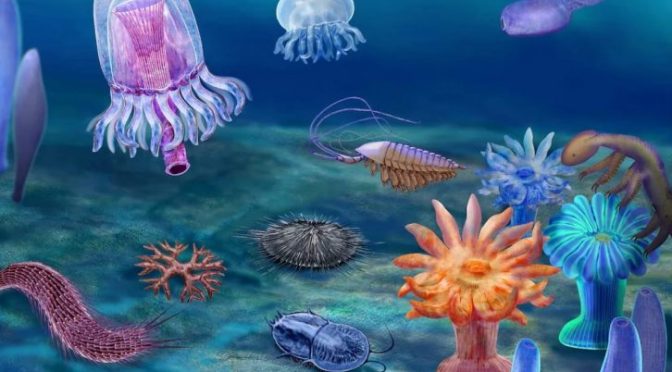
Stephen C. Meyer and Marcus Ross lecture on the Cambrian explosion

Cambrian Explosion
Cambrian Explosion

Access Research Network is a group that produces recordings  of lectures and debates related to intelligent design. I noticed that on their Youtube channel they are releasing some of their older lectures and debates for FREE. So I decided to write a summary of one that I really like on the Cambrian explosion. This lecture features Dr. Stephen C. Meyer and Dr. Marcus Ross.

The lecture is about two hours. There are really nice slides with lots of illustrations to help you understand what the speakers are saying, even if you are not a scientist.

Here is a summary of the lecture from ARN:

The Cambrian explosion is a term often heard in origins debates, but seldom completely understood by the non-specialist. This lecture by Meyer and Ross is one of the best overviews available on the topic and clearly presents in verbal and pictorial summary the latest fossil data (including the recent finds from Chengjiang China). This lecture is based on a paper recently published by Meyer, Ross, Nelson and Chien “The Cambrian Explosion: Biology’s Big Bang” in Darwinism, Design and Public Education(2003, Michigan State University Press). This 80-page article includes 127 references and the book includes two additional appendices with 63 references documenting the current state of knowledge on the Cambrian explosion data.

The term Cambrian explosion describes the geologically sudden appearance of animals in the fossil record during the Cambrian period of geologic time. During this event, at least nineteen, and perhaps as many as thirty-five (of forty total) phyla made their first appearance on earth. Phyla constitute the highest biological categories in the animal kingdom, with each phylum exhibiting a unique architecture, blueprint, or structural body plan. The word explosion is used to communicate that fact that these life forms appear in an exceedingly narrow window of geologic time (no more than 5 million years). If the standard earth’s history is represented as a 100 yard football field, the Cambrian explosion would represent a four inch section of that field.

For a majority of earth’s life forms to appear so abruptly is completely contrary to the predictions of Neo-Darwinian and Punctuated Equilibrium evolutionary theory, including:

  • the gradual emergence of biological complexity and the existence of numerous transitional forms leading to new phylum-level body plans;
  • small-scale morphological diversity preceding the emergence of large-scale morphological disparity; and
  • a steady increase in the morphological distance between organic forms over time and, consequently, an overall steady increase in the number of phyla over time (taking into account factors such as extinction).

After reviewing how the evidence is completely contrary to evolutionary predictions, Meyer and Ross address three common objections: 1) the artifact hypothesis: Is the Cambrian explosion real?; 2) The Vendian Radiation (a late pre-Cambrian multicellular organism); and 3) the deep divergence hypothesis.

Finally Meyer and Ross argue why design is a better scientific explanation for the Cambrian explosion. They argue that this is not an argument from ignorance, but rather the best explanation of the evidence from our knowledge base of the world. We find in the fossil record distinctive features or hallmarks of designed systems, including:

  • a quantum or discontinuous increase in specified complexity or information
  • a top-down pattern of scale diversity
  • the persistence of structural (or “morphological”) disparities between separate organizational systems; and
  • the discrete or novel organizational body plans

When we encounter objects that manifest any of these several features and we know how they arose, we invariably find that a purposeful agent or intelligent designer played a causal role in their origin.

Recorded April 24, 2004. Approximately 2 hours including audience Q&A.

I learned a lot by watching great lectures from Access Research Network. Their YouTube channel is here. I recommend their origin of life lectures – I have watched the ones with Dean Kenyon and Charles Thaxton probably a dozen times each. Speaking as an engineer, you never get tired of seeing engineering principles applied to questions like the origin of life.

If you’d like to see Dr. Meyer defend his views in a debate with someone who reviewed his book about the Cambrian explosion, you can find that in this previous post.

Further study

The Cambrian explosion lecture above is a great intermediate-level lecture and will prepare you to be able to understand Dr. Meyer’s new book “Darwin’s Doubt: The Explosive Origin of Animal Life and the Case for Intelligent Design“. The Michigan State University book that Dr. Meyer mentions is called “Darwin, Design and Public Education“. That book is one of the two good collections on intelligent design published by academic university presses, the other one being from Cambridge University Press, and titled “Debating Design: From Darwin to DNA“. If you think this lecture is above your level of understanding, then be sure and check out the shorter and more up-to-date DVD “Darwin’s Dilemma“.

William Lane Craig debates Austin Dacey: Does God Exist?

Here is the video and summary of a debate between Christian theist William Lane Craig and Austin Dacey at Purdue University in 2004 about the existence of God.

The debaters:

The video: (2 hours)

The video shows the speakers and powerpoint slides of their arguments. Austin Dacey is one of the top atheist debaters, and I would put him second to Peter Millican alone, with Walter Sinnott-Armstrong in third place. This is the debate to show people who are new to apologetics. The debate with Peter Millican is better for advanced students, and that’s no surprise since he teaches at Oxford University and is familiar with all of Dr. Craig’s work. The Craig-Dacey debate is the one that I give to my co-workers.

By the way, you can get the DVDs and CDs for the first Craig-Dacey debate and the second Craig-Dacey debate and the second Craig-Sinnott-Armstrong debate. The Peter Millican debate is not available on DVD, but the link above (Peter Millican) has the video and my summary.

Dr. Dacey’s 5 arguments below are all good arguments that you find in the academic literature. He is also an effective and engaging speaker, This is a great debate to watch!

SUMMARY of the opening speeches:

Dr. Craig’s opening statement:

Dr. Craig will present six reasons why God exists:

  1. (Contingency argument) God is the best explanation of why something exists rather than nothing
  2. (Cosmological argument)  God’s existence is implied by the origin of the universe
  3. (Fine-tuning argument) The fine-tuning of the universe for intelligent life points to a designer of the cosmos
  4. (Moral argument) God is the best explanation for the existence of objective moral values and objective moral duties
  5. (Miracles argument) The historical facts surrounding the life, death and resurrection of Jesus
  6. (Religious experience) God’s existence is directly knowable even apart from arguments

Dr. Dacey’s opening argument:

There are two ways to disprove God’s existence, by showing that the concept of God is self-contradictory, or by showing that certain facts about ourselves and the world are incompatible with what we would expect to be true if God did exist. Dr. Dacey will focus on the second kind of argument.

  1. The hiddenness of God
  2. The success of science in explaining nature without needing a supernatural agency
  3. The dependence of mind on physical processes in the brain
  4. Naturalistic evolution
  5. The existence of gratuitous / pointless evil and suffering

One final point:

One thing that I have to point out is that Dr. Dacey quotes Brian Greene during the debate to counter Dr. Craig’s cosmological argument. Dr. Craig could not respond because he can’t see the context of the quote. However, Dr. Craig had a rematch with Dr. Dacey where was able to read the context of the quote and defuse Dr. Dacey’s objection. This is what he wrote in his August 2005 newsletter after the re-match:

The following week, I was off an another three-day trip, this time to California State University at Fresno. As part of a week of campus outreach the Veritas Forum scheduled a debate on the existence of God between me and Austin Dacey, whom I had debated last spring at Purdue University. In preparation for the rematch I adopted two strategies: (1) Since Dacey had come to the Purdue debate with prepared speeches, I decided to throw him for a loop by offering a different set of arguments for God, so that his canned objections wouldn’t apply. I chose to focus on the cosmological argument, giving four separate arguments for the beginning of the universe, and on the evidence for Jesus’ resurrection. (2) I reviewed our previous debate carefully, preparing critiques of his five atheistic arguments. In the process I found that he had seriously misunderstood or misrepresented a statement by a scientist on the Big Bang; so I brought along the book itself in case Dacey quoted this source again. I figured he might change his arguments just as I was doing; but I wanted to be ready in case he used his old arguments again.

[…]The auditorium was packed that night for the debate, and I later learned that there were overflow rooms, too. To my surprise Dr. Dacey gave the very same case he had presented at Purdue; so he really got clobbered on those arguments. Because he wasn’t prepared for my new arguments, he didn’t even respond to two of my arguments for the beginning of the universe, though he did a credible job responding to the others. I was pleased when he attacked the Big Bang by quoting the same scientist as before, because I then held up the book, specified the page number, and proceeded to quote the context to show what the scientist really meant.

Dr. Craig is always prepared!