
Tag Archives: Evangelism

Should Christians be motivated by the fear of missing out (FOMO)?

Bible study that hits the spot

My best friend Dina and I recently spent some time talking over some articles that we found on the culture. We specifically talked about what is motivating young people, so I wanted to write something about that.

FOMO: Fear Of Missing Out

Here’s a leftist New York Times article explaining where FOMO comes from:

It’s known as FOMO, or “fear of missing out,” and refers to the blend of anxiety, inadequacy and irritation that can flare up while skimming social media like Facebook, Twitter, Foursquare and Instagram. Billions of Twitter messages, status updates and photographs provide thrilling glimpses of the daily lives and activities of friends, “frenemies,” co-workers and peers.

[…]When we scroll through pictures and status updates, the worry that tugs at the corners of our minds is set off by the fear of regret, according to Dan Ariely, author of “Predictably Irrational” and a professor of psychology and behavioral economics at Duke University. He says we become afraid that we’ve made the wrong decision about how to spend our time.

[…]A friend who works in advertising told me that she felt fine about her life — until she opened Facebook. “Then I’m thinking, ‘I am 28, with three roommates, and oh, it looks like you have a precious baby and a mortgage,’ ” she said. “And then I wanna die.”

It’s like they want to run a race to do fun and exotic things with their peers, and not finish last.

Anyway, I want to begin this post with examples of FOMO behavior I have personally encountered.

FOMO Travel

Dina and I read and discussed this article by Alain de Botton in The European – notice the emphasis on travel and having fun, sophisticated experiences:

We’re continually being bombarded with suggestions about what we might do (go jet skiing, study in Colorado, visit the Maldives or see the Pyramids). We’re always hearing of the amazing things friends have done or are going to do: ‘there was this great bar we all went to …’; ‘she’s getting married in a little country church, then we’re having a picnic…’; ‘the sun was glinting on Sydney Harbour…’ There are endless hints of the allure of life in other places: an article about family-friendly restaurants in Brooklyn, a crime novel set in Trieste, the departure board at the airport with its list of places only a plane trip away: Moscow, Bangkok, Addis Ababa… The modern world makes sure we know at all times just how much we’re missing. It is a culture in which intense and painful doses of FOMO (Fear Of Missing Out) are almost inevitable.

What’s interesting is this – how does FOMO travel affect young, unmarried Christians?

Travel through missions work seems to be the FOMO activity of choice for at least a few young, unmarried Christians. One of my best friends who is married to another of my best friends told me about her missions trip to a European country. I asked her why she did it, since it meant lost savings, lost earnings, lost work experience, etc. (She gave up a year of earnings, and she had a great job in engineering). Her answer was that she did it for the adventure. I have a hard time hearing Jesus say that he was going to do something because he was bored and wanted an adventure. Especially when it’s $30,000 in costs, $60,000 of lost income, and lost work experience – per year. This was before the time of the Internet, though, when missionary work actually made sense. I just don’t think it’s worth spending that kind of money for the impact you make. The people I know who went on missionary trips just wanted to feel spiritual, look spiritual, and have a fun “life experience” vacation. One missionary told me that she was desperate to get away from her boring mid-Western roots.

If you really want to share Christ effectively with people in other countries, then you can start a blog and pay the tiny costs for it out of your earnings from your day job – that’s what I do. I get more people from Europe reading my blog than I could contact in a year of missionary work. I Skype with the people who are interested in Christianity from these countries (Scotland, Northern Ireland, England, Canada, etc.), as well. Meanwhile, I keep working my not-exciting job, so my savings increase, and my resume remains gap-less. This is good stewardship of finances, and self-denial prepares your character for the hard work of marriage and parenting. The Bible says that those who do not work should not eat. And Paul says that he built tents so that no one could accuse him of taking on missionary work for financial gain.

You can tell whether a person is sincere in their missionary intentions by looking at how responsible they’ve been in their decision-making. If a person has gone into debt paying for fun, thrilling activities like skydiving, ziplining, surfing, etc., then it’s FOMO travel. We must look past the spiritual smokescreen, and tell young people to grow up.

After all, if defending God’s honor was the missionary’s main goal, then the real battlefield would be the university.

Bill Craig puts it best:
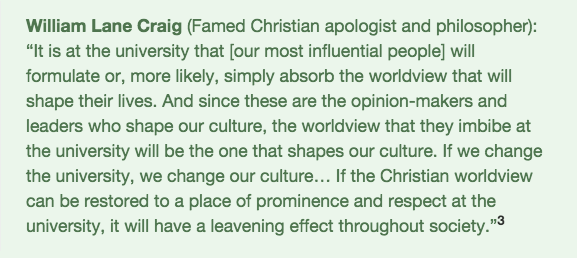
If serving God is your goal, look to the university

There is already a perfectly fine university right next door – no need to fly to Europe to find one! Remember, the university that took your faith away, or maybe the faith of someone you cared about? Yeah, it’s still sitting there in your home town! And it’s still ruining the lives of thousands of young people, by peer-pressuring them into secular, liberal views – and behaviors. It seems to me that it’s better stewardship to stay here and work, then give money to groups like Reasonable Faith. And you can start a blog, teach in church and invite scholars to the local university, too. That costs almost nothing, and it produces better results.

What about Jesus?

Sometimes, it’s a good idea to look beyond the words of the Bible and reflect on the overall message of it at a higher level. When I look in the Bible, I see that Jesus went through a lot of suffering in obedience to God in order to secure the salvation of people who did not even like him. And it’s from this sacrifice on our behalf that his claim on our obedience comes. There are things that I don’t like to do that I do anyway because they work to serve God. Jesus life’s ambition was not to do things that were easy, or that made him happy. Experienced Christians do things that are not fun, because these things are right and because they solve the real problem.

Stefan Molyneux: “why I was wrong about atheists”

A long journey through the night
A long, lonely journey through the night

This guy has one of the sharpest channels on YouTube, very un-PC. I don’t agree with him on everything, but he is outrageously popular.

Watch: (20 minutes) (H/T William)

This might be a very useful thing to show to pastors who favor socialist policies and big government redistribution. He actually says that the conservative policies that conservatives embrace attracted him to theism. I just think that is so hilarious… because all the pastors seem to want to embrace left-wing causes. Especially things like global warming, illegal immigration, redistribution of wealth, single payer health care, etc. Well, the kinds of atheists we like – the ones who believe in liberty, prosperity, security – don’t hold our small government politics against us.

No Christian presents their views through government – that’s why we are all crazy about apologetics. We love apologetics as much as secular leftists love big government. At least apologetics is non-coercive he says. But when atheists enforce their view through big government, backed by prisons and guns, that is coercive. His arguments about demographics, and being willing to marry, have kids for the good of society are terrific to illustrate the value of self-sacrifice within the Christian worldview. Far from being a liability, devotion to small government, low taxes and individual liberty is actually an asset when evangelizing. Just as pious pastors are all rushing to join the open borders, global warming, single-payer health care, radical feminism team, we find out that principled atheists are uncomfortable with many of those things. Maybe we should take note of that, instead of just blindly following the crowd.

Have a look at this video, and put THIS apologetic argument into your quiver. There is much, much more to evangelism and apologetics than what you read in books on apologetics. And this is why I work so hard to connect the Christian worldview to every other area of knowledge. You don’t always have to talk about old, boring William Lane Craig style apologetics with atheists. Sometimes, you can just talk to them about tax policy and free speech. Why not? Atheists are sometimes complicated people.

Simon Brace on the nature of spiritual warfare and a plea to churches

C.S. Lewis has some words to live by for you

This passionate, challenging lecture has been getting shared a lot on Facebook, so I thought that I would do a summary of it.

First, you can grab the MP3 file here.

Note that this talk is given by a very conservative evangelical Christian who is speaking to Christians. So this is not intended for a non-Christian audience. However, non-Christians are free to tune in if you want to hear a really passionate, fire-breathing conservative evangelical go non-linear over the superficial turn that the evangelical church has taken. If you are familiar with J.P. Moreland’s view that spiritual warfare is really about disputing speculations and falsehoods using logic and evidence, then you’ll know the meaning of the term “spiritual warfare” he has in mind. When he says spiritual warfare, he means apologetics: knowledge and preparation.

I would really caution you not to listen to this if you are not passionate about defending God’s honor. It will overwhelm and upset you. Having said that, this lecture reflects my convictions about the churches need to drop anti-intellectualism and take up apologetics. And not pre-suppositional apologetics, which I think is ineffective, but evidential apologetics. Evidential apologetics is effective, which is why everyone in the Bible used it.

About the speaker:

Simon Brace is the Director of Evangelism of Southern Evangelical Seminary. Simon was born in Zimbabwe and grew up in South Africa. Simon has a construction background and has lived in a number of countries and travelled extensively. He has a MA in Apologetics and BA in Religious Studies and is currently working on an MA in Philosophy at SES. Simon leads TEAM which is the missions program of SES on local, national, and international trips. In addition, Simon has worked with Ratio Christi at SES, and has an extensive knowledge of Ratio Christi’s history and operation. Simon currently resides in North Carolina with his wife Nel and children, Eva and Olivia.

I liked the second part of the lecture more than the first part, so there is less summarizing of the first part.

Topics:

  • What does the New Testament say about spiritual warfare in Ephesians?
  • Christian slogans about spiritual warfare sound pious, but they are mistaken
  • Today, Christianity is focused on piety and zeal, not on study and knowledge
  • The result is that Christianity in the West is in a state of erosion and decline
  • What we are doing about spiritual warfare is not working to stop the decline
  • Preaching, publishing, programs, retreats, etc. are not very useful for spiritual warfare
  • Enthusiasm and passion without knowledge  are not very useful for spiritual warfare
  • The Church has a theoretical understanding of spiritual warfare, but no real capability
  • Doesn’t work: trying to make Christianity seem popular and cool
  • Doesn’t work: making Christian music and art that non-Christians will like
  • Doesn’t work: pastors trying to be relevant by having cool clothes and cool haircuts
  • Doesn’t work: fundamentalists getting angry about peripheral issues
  • Doesn’t work: not read things apart from the Bible and sound foolish when speaking in the public square
  • Doesn’t work: church leaders think that careful exegesis and expository preaching is a good answer to skeptics
  • What works: we need to train people who are prepared and willing to defend the truth of the Christian faith
  • Evangelicalism has a deep suspicion of reading things outside the Bible, so they are unable to refute anything
  • Evangelicals are hyper-spiritualized and hysterical, focusing on demons, prophecy and end-times, etc.
  • Evangelicals have a pagan view of using their minds to alter reality, which is irrational and superstitious
  • Evangelicals like conservative celebrity preachers who do nothing to correct anti-intellectualism in the church
  • Evangelicals are focused on their personal relationships with Jesus instead of their whole worldview
  • Evangelicals focus too much on homeschooling and not enough on how to impact the secular universities
  • Church programs for youth are about “strumming guitars and eating pizza once a week”, not apologetics
  • Evangelicals have an over-inflated view of the effectiveness of their (non-intellectual) evangelism methods
  • The primary focus and primary responsibility in spiritual warfare is not dealing with supernatural evil
  • The real focus and responsibility in spiritual warfare is specified in 2 Cor 10:3-5
  • What we ought to be doing is defeating speculations (false ideas), using logical arguments and evidence
  • Defending the faith is not memorizing Bible verses and throwing them out randomly
  • Defending the faith is not just preaching the gospel
  • Demolishing an argument requires understanding arguments: premises, conclusions, the laws of logic
  • We should exchange our pious Bible memorizing skills and the like for a class in critical thinking
  • The New Testament requires that elders be capable of refuting those who oppose sound doctrine (Titus 1:9)
  • It is not enough to preach a good sermon, elders have to be able to defend the Christian faith as well
  • People who run conservative seminaries do not mandate that M.Div graduates study apologetics
  • Famous pastors like Driscoll, Begg, etc. need to teach other pastors to emphasize apologetics in church
  • People in church won’t engage the culture unless they have reasons and evidence to believe Christianity is true
  • We need a balance of both piety and intellectual engagement
  • We need to make our evangelism rooted in the intellect in order to have an influence at the university
  • Mission organizations also have a responsibility to defend the faith and not merely preach (1 Peter 3:15)

And here is his closing quote from C.S. Lewis:

To be ignorant and simple now not to be able to meet the enemies on their own ground would be to throw down our weapons and to betray our uneducated brethren who have, under God, no defense but us against the intellectual attacks of the heathen. Good philosophy must exist, if for no other reason, because bad philosophy needs to be answered.

I was really humbled by this, because I sort of knew that the church was anti-intellectual, but I didn’t really reflect on how everyone else in society thinks that we are anti-intellectual. It’s troubling. The quickest way to make Biblical Christianity respectable again is to hit the books and defeat all comers in intellectual disputations. Are we ready to make the sacrifices to do that?.