Tag Archives: Education

Should blacks vote for Democrats? Do liberal policies help young black men?

I want to quote from two black economists – my two favorite economists – to answer some questions.

First, Thomas Sowell.

Economist Thomas Sowell

Is minimum wage good for young blacks?

He writes:

Low-income minorities are often hardest-hit by the unemployment that follows in the wake of minimum wage laws. The last year when the black unemployment rate was lower than the white unemployment rate was 1930, the year before there was a federal minimum wage law.

The following year, the Davis-Bacon Act of 1931 was passed, requiring minimum wages in the construction industry. This was in response to complaints that construction companies with non-union black construction workers were able to underbid construction companies with unionized white workers (whose unions would not admit blacks).

Looking back over my own life, I realize now how lucky I was when I left home in 1948, at the age of 17, to become self-supporting. The unemployment rate for 16- and 17-year-old blacks at that time was under 10%. Inflation had made the minimum wage law, passed 10 years earlier, irrelevant.

But it was only a matter of time before liberal compassion led to repeated increases in the minimum wage to keep up with inflation. The annual unemployment rate for black teenagers has never been less than 20% in the past 50 years, and has ranged as high as over 50%.

You can check these numbers in a table of official government statistics on page 42 of professor Walter Williams’ book “Race and Economics.”

Incidentally, the black-white gap in unemployment rates for 16-year-olds and 17-year-olds was virtually nonexistent back in 1948. But the black teenage unemployment rate has been more than double that for white teenagers for every year since 1971.

Second, Walter Williams.

Economist Walter Williams

Is voting for black leaders good for blacks?

He writes:

Black leaders stress the importance of political power and getting out the vote, but we might ask how important political power is to the ordinary black person. As a start toward answering that question, we might examine black life in cities where blacks hold considerable political power.

Detroit is the nation’s most dangerous city. Rounding out Forbes magazine’s 2013 list of the 10 most dangerous cities are Oakland, Calif.; St. Louis; Memphis, Tenn.; Stockton, Calif.; Birmingham, Ala.; Baltimore; Cleveland; Atlanta; and Milwaukee.

According to a recent American Community Survey by the U.S. Census Bureau, the 10 poorest cities with populations of more than 250,000 are Detroit, with 33% of its residents below the poverty line; Buffalo, N.Y., 30%; Cincinnati, 28%; Cleveland, 27%; Miami, 27%; St. Louis, 27%; El Paso, Texas, 26%; Milwaukee, 26%; Philadelphia, 25%; and Newark, N.J., 24%.

In addition to poverty, there is grossly inferior education and high welfare dependency in these cities.

The most common feature of these cities is that for decades, all of them have had Democratic administrations. Some cities — such as Detroit, Buffalo, Newark and Philadelphia — haven’t elected a Republican mayor for more than a half-century.

What’s more is that in most of these cities, blacks have been mayors, chiefs of police, school superintendents and principals, and have dominated city councils.

[…]Let’s be clear about what I am saying and not saying. I am not suggesting that there’s a causal relationship between crime, poverty and squalor on the one hand and Democratic and black political power on the other. Nor am I suggesting that blacks ought to vote Republican.

What I am saying is that if one is strategizing on how to improve the lives of ordinary — and particularly the poorest — black people, he wants to leave off his high-priority to-do list the election of Democrats and black politicians. Also to be left off the to-do list is a civil rights agenda.

Perhaps the biggest roadblock to finding solutions is the widely held vision that the major problem confronting blacks is discrimination. I am not arguing that every vestige of discrimination has been eliminated. I am arguing that the devastating problems facing a large proportion of the black community are not civil rights problems. The solutions will not be found in the political or civil rights arena.

And third, more Walter Williams.

Is focusing on the few cases where a white police officer shoots a black man good for blacks?

He writes:

Excerpt:

Each year, roughly 7,000 blacks are murdered. Ninety-four percent of the time, the murderer is another black person.

According to the Bureau of Justice Statistics, between 1976 and 2011, there were 279,384 black murder victims. Using the 94-percent figure means that 262,621 were murdered by other blacks.

Though blacks are 13 percent of the nation’s population, they account for more than 50 percent of homicide victims. Nationally, the black homicide victimization rate is six times that of whites, and in some cities, it’s 22 times that of whites.

Coupled with being most of the nation’s homicide victims, blacks are most of the victims of violent personal crimes, such as assault and robbery.

The magnitude of this tragic mayhem can be viewed in another light. According to a Tuskegee Institute study, between 1882 and 1968, 3,446 blacks were lynched at the hands of whites. Black fatalities during the Korean War (3,075), Vietnam War (7,243) and all wars since 1980 (8,197) come to 18,515, a number that pales in comparison with black loss of life at home.

It’s a tragic commentary to be able to say that young black males have a greater chance of reaching maturity on the battlefields of Iraq and Afghanistan than on the streets of Philadelphia, Chicago, Detroit, Oakland, Newark and other cities.

Not everyone who runs around crying “racism, racism” is interested in helping blacks to do as well as other racial groups.

Blacks will do well, just as they used to do, when the political parties in power embrace free-market capitalist policies, such as lowering the minimum wage, or scrapping it entirely. Blacks will do well, just as they used to do, when we strengthen and subsidize natural marriage – by repealing no-fault divorce and reforming welfare for single mothers. Blacks will do well, just as they used to do, when we make public schools more responsive to parents, and less responsive to teacher unions. And so on.

Tad Hopp accumulates six figures of college debt, wants taxpayer bailout

From: theawkwardyeti.com

Here’s an interesting editorial from a “Christian” left blog. (H/T Acton Institute via Lindsay)

The author, Tad Hopp is graduating a PCUSA seminary – an extremely liberal, left-wing denomination.

He writes:

I graduated college in 2007.

[…] I majored in English, not exactly what most people consider a ‘marketable’ or ‘practical’ degree…

[…]I went to a somewhat expensive private school…

[…]I did what many students in their last year of high school do: I went to the school where I felt I was being called…

[…]I do not regret my four years at my undergraduate institution one bit.

[….]When I graduated college, I owed nearly $50,000 in student loan debt and was unemployed for almost six months before I finally found a low-paying office job.

[…]“Can’t find a job? Well, you should have majored in something more ‘practical’, like economics or business or medicine.” Yeah, that would be great…if those were the subjects where my skills and passions lie. They’re not.

[…]I felt called to go to seminary.

[…]I will graduate seminary with close to six figures worth of student loan debt.

Let’s take stock of what he’s said so far:

  • he studied English, a language that he already spoke, which has one of the lowest employment rates
  • he was warned by people who knew something about earning and saving money not to study English
  • he went to a school he couldn’t afford to go to, and he graduated with $50,000 in debt
  • he went to seminary, another subject that doesn’t pay, and added another $50,000 or so of debt
  • he says that he doesn’t have to study subjects that lead to a career because he isn’t “passionate” about them
  • he “followed his heart” by going to the school that he had mystical, emotional, intuitions about = “calling”

My advice to Tad at this point would be for him to take the Bible seriously when it says this:

2 Thessalonians 3:10:

10 For even when we were with you, we used to give you this order: if anyone is not willing to work, then he is not to eat, either.

And 1 Timothy 5:8:

8 But if anyone does not provide for his own, and especially for those of his household, he has denied the faith and is worse than an unbeliever.

Now, for a Bible-believing Christian, these are inerrant and cannot be denied. But we have to go outside the Bible and learn how the world really works in order to figure out how to achieve those stated goals. Why should anyone hire us? What is working really about?

But even before looking at economics, Tad needs to push away all his friends who tell him to “follow his heart” and stick close by his friends who understand economics, who have jobs already, who have savings already, and so on. Don’t look for advice from dreamers, you look to advice from doers – people who can read the times, run the numbers and who have demonstrated the ability to create plans that work to achieve results that please God. When it comes to planning about the future, look at the past accomplishments. Weaving a happy narrative sounds nice, but judge future predictions based on past performance.

I would recommend that Tad read an economist like Thomas Sowell, especially on work, prices, etc., and realize that work means providing value to others. It then follows that he is obligated by the Bible to NOT “follow his heart”, but to instead do something that offers value to his fellow man. Prices are a way of determining what is most valued by your fellow man. And we know what careers have the highest value:

Petroleum Engineering – Starting Salary: $103,000 / Mid-Career Salary: $160,000
Actuarial Mathematics – Starting Salary: $58,700 / Mid-Career Salary: $120,000
Nuclear Engineering – Starting Salary: $67,600 / Mid-Career Salary: $117,000
Chemical Engineering – Starting Salary: $68,200 / Mid-Career Salary: $115,000
Aerospace Engineering – Starting Salary: $62,800 / Mid-Career Salary: $109,000
Electrical Engineering – Starting Salary: $64,300 / Mid-Career Salary: $106,000
Computer Engineering – Starting Salary: $65,300 / Mid-Career Salary: $106,000
Computer Science – Starting Salary: $59,800 / Mid-Career Salary: $102,000
Physics – Starting Salary: $53,100 / Mid-Career Salary: $101,000
Mechanical Engineering – Starting Salary: $60,900 / Mid-Career Salary: $99,700

English and seminary are dead last on the list – he literally could not have chosen worse than he did. I don’t mind if a woman studies these things, but Tad is a man – he has the Biblical obligation to be the primary provider, as we saw in the verse above.

More Tad:

Is the PCUSA doing anything to address this crisis?

[…]What has our government done to address this issue?

[…]I, like so many in my generation, voted for Obama…

[…]It seems to me that we’ve bought into the lie that student loan debt is brought on by the individual person…

[…]You know what I think might stimulate the economy? Automatically cancelling every single outstanding student loan!

[…]If we can spend $640 billion dollars on defense spending, why can’t we find the money to better support public education?

It’s important to understand that an English degree and a seminary degree do not prepare a person to make statements on economics and government. Tad has never studied these things, has no experience in them. He cannot state what the impact of his suggestions would be to all groups, i.e. – he cannot answer “and then what happens?” for every impacted group. Thinking economically is a valuable skill, but as Tad’s personal life shows, it’s not an area he is really knowledgeable about. But he wants to shift money from defense spending (which he knows nothing about) so that he can have a personal bailout. I personally doubt that taxpayers would be better served by paying for his English degree and liberal seminary degree than they would be if a peace-loving democracy could project power abroad to deter aggression from countries like North Korea, Iran, Russia, China and Syria.

Here is the solution to Tad’s problems:

  • we need to put Tad to work in a minimum wage job and confiscate his entire salary, until his loans are paid off.
  • we need to put Tad on a watch list such that he is never allowed to borrow money from anyone ever again.
  • once Tad’s loans are paid off, he should be taxed on his future earnings at the top tax rate for the rest of his life. The money we tax from him can fund education – that’s what he said he wanted.
  • Tad and his household should all be barred from collecting any money for unemployment, welfare or other social programs.

That’s the only bailout Tad should get. It would actually be in his best interest that he encounter real life as quickly as possible, because the longer he waits, the harder it’s going to be for him to recover to independence. He needs to stop his crazy retreat from adult responsibilities, and start working and saving now. I would say that at this point, marriage and parenting is out of the question for him (in another post, he comes out as gay, so that also complicates things). And he can thank the politics of the secular left for marriage and family being less affordable now, thanks to laws like Obamacare, which raised the cost of health care by thousands of dollars. I found it interesting that he actually did work at some point but he mocked the job as a “dead-end job” – as if it was beneath him.

I know some of you will be thinking, “but God called him things and so of course God is going to bail him out with $100,000 for his student loans”. But the thing is, God doesn’t usually work like that. First, I don’t accept that he is a Christian at all. Second, just because you have feelings that your plan will work, that isn’t a calling. The truth is that you certainly can assess the feasibility of things that you feel “called” to do, and if the plan looks crazy, then don’t do it. If you find yourself at odds with wise, practical people when explaining your calling to them, then you’re probably doing it wrong.

U.S. millennials perform horribly on technology tests compared to other countries

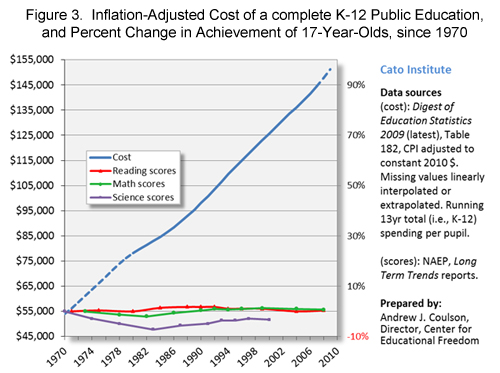
Education spending has tripled since 1970

This is from the leftist Washington Post.

Excerpt:

There was this test. And it was daunting. It was like the SAT or ACT — which many American millennials are no doubt familiar with, as they are on track to be the best educated generation in history — except this test was not about getting into college. This exam, given in 23 countries, assessed the thinking abilities and workplace skills of adults. It focused on literacy, math and technological problem-solving. The goal was to figure out how prepared people are to work in a complex, modern society.

And U.S. millennials performed horribly.

That might even be an understatement, given the extent of the American shortcomings. No matter how you sliced the data – by class, by race, by education – young Americans were laggards compared to their international peers. In every subject, U.S. millennials ranked at the bottom or very close to it, according to a new study by testing company ETS.

“We were taken aback,” said ETS researcher Anita Sands. “We tend to think millennials are really savvy in this area. But that’s not what we are seeing.”

The test is called the PIAAC test. It was developed by the Organization for Economic Co-operation and Development, better known as the OECD. The test was meant to assess adult skill levels. It was administered worldwide to people ages 16 to 65. The results came out two years ago and barely caused a ripple. But recently ETS went back and delved into the data to look at how  millennials did as a group. After all, they’re the future – and, in America, they’re poised to claim the title of largest generation from the baby boomers.

U.S. millennials, defined as people 16 to 34 years old, were supposed to be different. They’re digital natives. They get it. High achievement is part of their makeup. But the ETS study found signs of trouble, with its authors warning that the nation was at a crossroads: “We can decide to accept the current levels of mediocrity and inequality or we can decide to address the skills challenge head on.”

The challenge is that, in literacy, U.S. millennials scored higher than only three countries.

In math, Americans ranked last.

In technical problem-saving, they were second from the bottom.

“Abysmal,” noted ETS researcher Madeline Goodman. “There was just no place where we performed well.”

Nope. U.S. millennials with master’s degrees and doctorates did better than their peers in only three countries, Ireland, Poland and Spain. Those in Finland, Sweden and Japan seemed to be on a different planet.

Top-scoring U.S. millennials – the 90th percentile on the PIAAC test – were at the bottom internationally, ranking higher only than their peers in Spain. The bottom percentile (10th percentile) also lagged behind their peers.

Now the problem can’t be to spend more money on education – we already spend more money than all the other countries.

Excerpt:

The United States spent more than $11,000 per elementary student in 2010 and more than $12,000 per high school student. When researchers factored in the cost for programs after high school education such as college or vocational training, the United States spent $15,171 on each young person in the system — more than any other nation covered in the report.

That sum inched past some developed countries and far surpassed others. Switzerland’s total spending per student was $14,922 while Mexico averaged $2,993 in 2010. The average OECD nation spent $9,313 per young person.

So the solution has to be something else. What could it be? Previously, I linked to some ideas from Bobby Jindal. I think that’s the direction that we need to go in if we are to solve the problem. It’s pretty clear that raising taxes and throwing more money at teachers who can never be fired no matter how badly they perform is not the answer. It’s probably a good idea for kids to focus less on indoctrinating kids in leftist ideology, e.g. – sex education, postmodern skepticism and moral relativism. It’s probably a better idea for parents to take more responsibility for raising their kids and making sure that they do their homework and develop a love of learning. But that would require that we teach children as projects and have goals for them that we push them towards.