
Tag Archives: Domestic Violence

New study: children who grow up with single parents more likely to see domestic violence

Domestic violence least likely in married homes

This is from Family Studies. (H/T Brad Wilcox)

Excerpt:

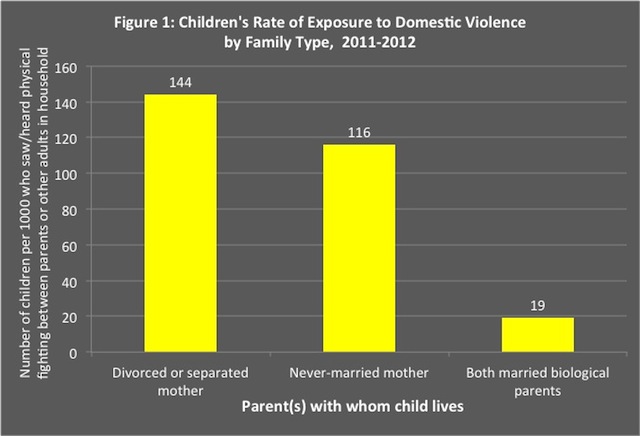
In the 2011-2012 National Survey of Children’s Health, conducted by the U.S. National Center for Health Statistics, parents of 95,677 children aged 17 and under were asked whether their child had ever seen or heard “any parents, guardians, or any other adults in the home slap, hit, kick, punch, or beat each other up.” Among children living with both married biological parents, the rate of exposure to family violence was relatively low: for every 1,000 children in intact families, 19 had witnessed one or more violent struggles between parents or other household members. By comparison, among children living with a divorced or separated mother, the rate of witnessing domestic violence was seven times higher: 144 children per 1,000 had had one or more such experiences. (See Figure 1.) These comparisons are adjusted for differences across groups in the age, sex, and race/ethnicity of the child, family income and poverty status, and the parent’s education level.

One might suppose that women who had never married would be less likely to get into violent arguments with the fathers of their children than separated or divorced mothers. Yet the rate of witnessing domestic violence among children living with never-married mothers was also elevated. It was 116 per 1,000, six times higher than the rate for children in intact families. (Some of these fights involved subsequent partners or boyfriends of the mother, rather than the father of the child.) Even children living with both biological parents who were cohabiting—rather than married—had more than double the risk of domestic violence exposure as those with married birth parents: 45 out of 1,000 of these children had witnessed family fights that became physical. Note also that a child’s family structure was a better predictor of witnessing family violence than was her parents’ education, family income, poverty status, or race.

Experiencing family violence is stressful for children, undercuts their respect and admiration for parents who engage in abusive behavior, and is associated with increased rates of emotional and behavioral problems at home and in school. For example, among children of never-married mothers who had witnessed family violence, 58 percent had conduct or academic problems at school requiring parental contact. The rate of school behavior problems for those who had not been exposed to family fights was significantly lower, though still fairly high (36 percent). Likewise, among children of divorced or separated mothers, nearly half of those exposed to family violence—48 percent—had had conduct or academic problems at school. Even among the small number of children in intact families who had witnessed family violence, just over half—51 percent—presented problems at school. This was twice the rate of school problems among students from intact families who had not witnessed domestic violence. (See Figure 2.) These figures are also adjusted for differences across groups in age, sex, and race/ethnicity of children, family income and poverty, and parent education levels. Children experiencing domestic violence were also more likely to have repeated a grade in school and to have received psychological counseling for emotional or behavioral problems. This was true in intact as well as disrupted families.

A good book to read on this topic is Theodore Dalrymple’s “Life at the Bottom“, which offered this memorable anecdote about about how and why women choose men who abuse them.

Introduction:

The disastrous pattern of human relationships that exists in the underclass is also becoming common higher up the social scale. With increasing frequency I am consulted by nurses, who for the most part come from and were themselves traditionally members of (at least after Florence Nightingale) the respectable lower middle class, who have illegitimate children by men who first abuse and then abandon them. This abuse and later abandonment is usually all too predictable from the man’s previous history and character; but the nurses who have been treated in this way say they refrained from making a judgment about him because it is wrong to make judgments. But if they do not make a judgment about the man with whom they are going to live and by whom they are going to have a child, about what are they ever going to make a judgment?

“It just didn’t work out,” they say, the “it” in question being the relationship that they conceive of having an existence independent of the two people who form it, and that exerts an influence on their on their lives rather like an astral projection. Life is fate.

Chapter one:

All the more surprising is it to me, therefore, that the nurses perceive things differently. They do not see a man’s violence in his face, his gestures, his deportment, and his bodily adornments, even though they have the same experience of the patients as I. They hear the same stories, they see the same signs, but they do not make the same judgments. What’s more, they seem never to learn; for experience—like chance, in the famous dictum of Louis Pasteur—favors only the mind prepared. And when I guess at a glance that a man is an inveterate wife beater (I use the term “wife” loosely), they are appalled at the harshness of my judgment, even when it proves right once more.

This is not a matter of merely theoretical interest to the nurses, for many of them in their private lives have themselves been the compliant victims of violent men. For example, the lover of one of the senior nurses, an attractive and lively young woman, recently held her at gunpoint and threatened her with death, after having repeatedly blacked her eye during the previous months. I met him once when he came looking for her in the hospital: he was just the kind of ferocious young egotist to whom I would give a wide berth in the broadest daylight.

Why are the nurses so reluctant to come to the most inescapable of conclusions? Their training tells them, quite rightly, that it is their duty to care for everyone without regard for personal merit or deserts; but for them, there is no difference between suspending judgment for certain restricted purposes and making no judgment at all in any circumstances whatsoever. It is as if they were more afraid of passing an adverse verdict on someone than of getting a punch in the face—a likely enough consequence, incidentally, of their failure of discernment. Since it is scarcely possible to recognize a wife beater without inwardly condemning him, it is safer not to recognize him as one in the first place.

This failure of recognition is almost universal among my violently abused women patients, but its function for them is somewhat different from what it is for the nurses. The nurses need to retain a certain positive regard for their patients in order to do their job. But for the abused women, the failure to perceive in advance the violence of their chosen men serves to absolve them of all responsibility for whatever happens thereafter, allowing them to think of themselves as victims alone rather than the victims and accomplices they are. Moreover, it licenses them to obey their impulses and whims, allowing them to suppose that sexual attractiveness is the measure of all things and that prudence in the selection of a male companion is neither possible nor desirable.

Often, their imprudence would be laughable, were it not tragic: many times in my ward I’ve watched liaisons form between an abused female patient and an abusing male patient within half an hour of their striking up an acquaintance. By now, I can often predict the formation of such a liaison—and predict that it will as certainly end in violence as that the sun will rise tomorrow.

At first, of course, my female patients deny that the violence of their men was foreseeable. But when I ask them whether they think I would have recognized it in advance, the great majority—nine out of ten—reply, yes, of course. And when asked how they think I would have done so, they enumerate precisely the factors that would have led me to that conclusion. So their blindness is willful.

The blindness is wilful, because the emotions cannot be corrected by evidence. And everything in the culture affirms women in this craziness, even after they fail over and over again with men – cohabitating with the bad ones for years, and then turning away from the good ones. They freely choose the wrong men, and freely pass by the good ones. And almost no one tells them that it’s entirely their fault. Everyone just tells them “follow your heart”. This emotional craziness causes harm to innocent children, and it needs to stop. We have to stop the man-blaming and hold women accountable for making decisions with their emotions and then expecting craziness to “work out”.

You can read the Dalrymple book online for free in this post.

Read Theodore Dalrymple’s “Life at the Bottom” online for free

I want to recommend that you read a book that is available online for free.

The author  is a psychiatrist in a British hospital that deals with a lot of criminals and victims of crime. So he gets to see the worldview of the “underclass” up close, and to understand how the policies of the compassionate secular left are really working at the street level. The theme of the book is that the left advances policies in order to feel good about themselves, even though the policies actually hurt the poor and vulnerable far more than they help them. And the solution of the elites is more of the same.

The whole book is available ONLINE for free! From City Journal!

Table of Contents

The Knife Went In 5
Goodbye, Cruel World 15
Reader, She Married Him–Alas 26
Tough Love 36
It Hurts, Therefore I Am 48
Festivity, and Menace 58
We Don’t Want No Education 68
Uncouth Chic 78
The Heart of a Heartless World 89
There’s No Damned Merit in It 102
Choosing to Fail 114
Free to Choose 124
What Is Poverty? 134
Do Sties Make Pigs? 144
Lost in the Ghetto 155
And Dying Thus Around Us Every Day 167
The Rush from Judgment 181
What Causes Crime? 195
How Criminologists Foster Crime 208
Policemen in Wonderland 221
Zero Intolerance 233
Seeing Is Not Believing 244

Lots more essays are here, all from City Journal.

My favorite passage

The only bad thing about reading it online is that you miss one of the best quotes from the introduction. But I’ll type it out for you.

The disastrous pattern of human relationships that exists in the underclass is also becoming common higher up the social scale. With increasing frequency I am consulted by nurses, who for the most part come from and were themselves traditionally members of (at least after Florence Nightingale) the respectable lower middle class, who have illegitimate children by men who first abuse and then abandon them. This abuse and later abandonment is usually all too predictable from the man’s previous history and character; but the nurses who have been treated in this way say they refrained from making a judgment about him because it is wrong to make judgments. But if they do not make a judgment about the man with whom they are going to live and by whom they are going to have a child, about what are they ever going to make a judgment?

“It just didn’t work out,” they say, the “it” in question being the relationship that they conceive of having an existence independent of the two people who form it, and that exerts an influence on their on their lives rather like an astral projection. Life is fate.

This is something I run into myself. I think that young people today prefer moral relativists as mates, because they are afraid of being judged and rejected by people who are too serious about religion and morality. The problem is that if you choose someone who doesn’t take religion and morality seriously, then you can’t rely on them to behave morally and exercise spiritual leadership when raising children. And being sexually involved with someone who doesn’t take morality seriously causes a lot of damage.

An excerpt

Here’s one of my favorite passages from “Tough Love”, in which he describes how easily he can detect whether a particular man has violent tendencies on sight, whereas female victims of domestic violence – and even the hospital nurses – will not recognize the same signs.

All the more surprising is it to me, therefore, that the nurses perceive things differently. They do not see a man’s violence in his face, his gestures, his deportment, and his bodily adornments, even though they have the same experience of the patients as I. They hear the same stories, they see the same signs, but they do not make the same judgments. What’s more, they seem never to learn; for experience—like chance, in the famous dictum of Louis Pasteur—favors only the mind prepared. And when I guess at a glance that a man is an inveterate wife beater (I use the term “wife” loosely), they are appalled at the harshness of my judgment, even when it proves right once more.

This is not a matter of merely theoretical interest to the nurses, for many of them in their private lives have themselves been the compliant victims of violent men. For example, the lover of one of the senior nurses, an attractive and lively young woman, recently held her at gunpoint and threatened her with death, after having repeatedly blacked her eye during the previous months. I met him once when he came looking for her in the hospital: he was just the kind of ferocious young egotist to whom I would give a wide berth in the broadest daylight.

Why are the nurses so reluctant to come to the most inescapable of conclusions? Their training tells them, quite rightly, that it is their duty to care for everyone without regard for personal merit or deserts; but for them, there is no difference between suspending judgment for certain restricted purposes and making no judgment at all in any circumstances whatsoever. It is as if they were more afraid of passing an adverse verdict on someone than of getting a punch in the face—a likely enough consequence, incidentally, of their failure of discernment. Since it is scarcely possible to recognize a wife beater without inwardly condemning him, it is safer not to recognize him as one in the first place.

This failure of recognition is almost universal among my violently abused women patients, but its function for them is somewhat different from what it is for the nurses. The nurses need to retain a certain positive regard for their patients in order to do their job. But for the abused women, the failure to perceive in advance the violence of their chosen men serves to absolve them of all responsibility for whatever happens thereafter, allowing them to think of themselves as victims alone rather than the victims and accomplices they are. Moreover, it licenses them to obey their impulses and whims, allowing them to suppose that sexual attractiveness is the measure of all things and that prudence in the selection of a male companion is neither possible nor desirable.

Often, their imprudence would be laughable, were it not tragic: many times in my ward I’ve watched liaisons form between an abused female patient and an abusing male patient within half an hour of their striking up an acquaintance. By now, I can often predict the formation of such a liaison—and predict that it will as certainly end in violence as that the sun will rise tomorrow.

At first, of course, my female patients deny that the violence of their men was foreseeable. But when I ask them whether they think I would have recognized it in advance, the great majority—nine out of ten—reply, yes, of course. And when asked how they think I would have done so, they enumerate precisely the factors that would have led me to that conclusion. So their blindness is willful.

Go read the rest!

Top 5 myths that old feminists pass on to young women

Christina Hoff Sommers writing in the ultra-leftist Time magazine of all places.

The list:

  1. MYTH 1: Women are half the world’s population, working two-thirds of the world’s working hours, receiving 10% of the world’s income, owning less than 1% of the world’s property.
  2. MYTH 2: Between 100,000 and 300,000 girls are pressed into sexual slavery each year in the United States.
  3. MYTH 3: In the United States, 22%–35% of women who visit hospital emergency rooms do so because of domestic violence.
  4. MYTH 4: One in five in college women will be sexually assaulted.
  5. MYTH 5: Women earn 77 cents for every dollar a man earns—for doing the same work.

I’m posting 4 and 5 below, since they were mentioned in the video above (that’s not Christina Hoff Sommers):

MYTH 4: One in five in college women will be sexually assaulted.

FACTS: This incendiary figure is everywhere in the media today. Journalists, senators and even President Obama cite it routinely. Can it be true that the American college campus is one of the most dangerous places on earth for women?

The one-in-five figure is based on the Campus Sexual Assault Study, commissioned by the National Institute of Justice and conducted from 2005 to 2007. Two prominent criminologists, Northeastern University’s James Alan Fox and Mount Holyoke College’s Richard Moran, have noted its weaknesses:

“The estimated 19% sexual assault rate among college women is based on a survey at two large four-year universities, which might not accurately reflect our nation’s colleges overall. In addition, the survey had a large non-response rate, with the clear possibility that those who had been victimized were more apt to have completed the questionnaire, resulting in an inflated prevalence figure.”

Fox and Moran also point out that the study used an overly broad definition of sexual assault. Respondents were counted as sexual assault victims if they had been subject to “attempted forced kissing” or engaged in intimate encounters while intoxicated.

Defenders of the one-in-five figure will reply that the finding has been replicated by other studies. But these studies suffer from some or all of the same flaws. Campus sexual assault is a serious problem and will not be solved by statistical hijinks.

MYTH 5: Women earn 77 cents for every dollar a man earns—for doing the same work.

FACTS: No matter how many times this wage gap claim is decisively refuted by economists, it always comes back. The bottom line: the 23-cent gender pay gap is simply the difference between the average earnings of all men and women working full-time. It does not account for differences in occupations, positions, education, job tenure or hours worked per week. When such relevant factors are considered, the wage gap narrows to the point of vanishing.

Wage gap activists say women with identical backgrounds and jobs as men still earn less. But they always fail to take into account critical variables. Activist groups like the National Organization for Women have a fallback position: that women’s education and career choices are not truly free—they are driven by powerful sexist stereotypes. In this view, women’s tendency to retreat from the workplace to raise children or to enter fields like early childhood education and psychology, rather than better paying professions like petroleum engineering, is evidence of continued social coercion. Here is the problem: American women are among the best informed and most self-determining human beings in the world. To say that they are manipulated into their life choices by forces beyond their control is divorced from reality and demeaning, to boot.

Her conclusion:

Why do these reckless claims have so much appeal and staying power? For one thing, there is a lot of statistical illiteracy among journalists, feminist academics and political leaders. There is also an admirable human tendency to be protective of women—stories of female exploitation are readily believed, and vocal skeptics risk appearing indifferent to women’s suffering. Finally, armies of advocates depend on “killer stats” to galvanize their cause. But killer stats obliterate distinctions between more and less serious problems and send scarce resources in the wrong directions. They also promote bigotry. The idea that American men are annually enslaving more than 100,000 girls, sending millions of women to emergency rooms, sustaining a rape culture and cheating women out of their rightful salary creates rancor in true believers and disdain in those who would otherwise be sympathetic allies.

But if young women learn this for four years in college, what hope is there for any kind of trust and vulnerability with men? What hope is there for marriage? They are always going to be trying to find meaning in life on their own, apart from any kind of loving partnership with a man. And the more hooking up and cohabitating they do, the less they are going to value marriage and take practical steps towards it. That is the real problem – the wasting of time and the lack of seriousness, as if getting married can be left to age 35 with no preparation and no planning. As if careers and missionary work and traveling can fill the same hole that a family fills. Yet if no one tells these young women and pushes them to be sensible and discerning, they will mess up the most important decision of their lives.

This might be a good article to share and bookmark.