Tag Archives: Dating

New study: couples that delay sexual activity experience higher quality relationships

Relationship stability, quality, communication, satisfaction

From Family Studies, news about TWO new studies.

Excerpt: (links removed)

[T]wo recently published studies call into question the validity of testing sexual chemistry early in dating.

My colleagues and I published the first study a few years ago in the American Psychological Association’s Journal of Family Psychology. This study involved a national sample of 2,035 married individuals who participated in the popular online couple assessment survey called “RELATE.” We found that the longer a dating couple waits to have sex, the better their relationship is after marriage. In fact, couples who wait until marriage to have sex report higher relationship satisfaction (20% higher), better communication patterns (12% better), less consideration of divorce (22% lower), and better sexual quality (15% better) than those who started having sex early in their dating (see Figure 2). For couples in between—those that became sexually involved later in their dating, but prior to marriage—the benefits were about half as strong.

[…]These patterns were statistically significant even when controlling for a variety of other variables such as respondents’ number of prior sexual partners, education levels, religiosity, and relationship length.

The second study, by Sharon Sassler and her colleagues at Cornell University, also found that rapid sexual involvement has adverse long-term implications for relationship quality. Using data from the Marital and Relationship Survey, which provides information on nearly 600 low- to moderate-income couples living with minor children, their study examined the tempo of sexual intimacy and subsequent relationship quality in a sample of married and cohabiting men and women. Their analyses also suggest that delaying sexual involvement is associated with higher relationship quality across several dimensions.

They discovered that the negative association between sexual timing and relationship quality is largely driven by a link between early sex and cohabitation. Specifically, sexual involvement early in a romantic relationship is associated with an increased likelihood of moving more quickly into living together, which in turn is associated with lower relationship quality. This finding supports Norval Glenn’s hypothesis that sexual involvement may lead to unhealthy emotional entanglements that make ending a bad relationship difficult. As Sassler and her colleagues concluded, “Adequate time is required for romantic relationships to develop in a healthy way. In contrast, relationships that move too quickly, without adequate discussion of the goals and long-term desires of each partner, may be insufficiently committed and therefore result in relationship distress, especially if one partner is more committed than the other” (p. 710).

The rest of the post talks about two reasons why this works: improved partner selection and prioritizing communication and commitment.

That’s two studies, and there’s a third. Dina sent me this article from the UK Daily Mail about a new study showing the importance of chastity for relationship quality and stability.

Excerpt:

New couples who jump into bed together on the first date do not last as long in relationships as those who wait a new study has revealed.

Using a sample of almost 11,000 unmarried people, Brigham Young University discovered a direct correlation between the length and strength of a partnership and the amount of time they took to have first have sex.

The study showed that those who waited to initiate sexual intimacy were found to have longer and more positive outcomes in their relationships while those who couldn’t help themselves reported that their dalliances struggled to last more than two years.

‘Results suggested that waiting to initiate sexual intimacy in unmarried relationships was generally associated with positive outcomes,’ said the report authored published by the U.S. National Library of Medicine National Institutes of Health.

‘This effect was strongly moderated by relationship length, with individuals who reported early sexual initiation reporting increasingly lower outcomes in relationships of longer than two years.’

The study examined four sexual-timing patterns: Having sex prior to dating, initiating sex on the first date or shortly after, having sex after a few weeks of dating, and sexual abstinence.

Each one of these fields yielded different results in relationship satisfaction, stability and communication in dating situations.

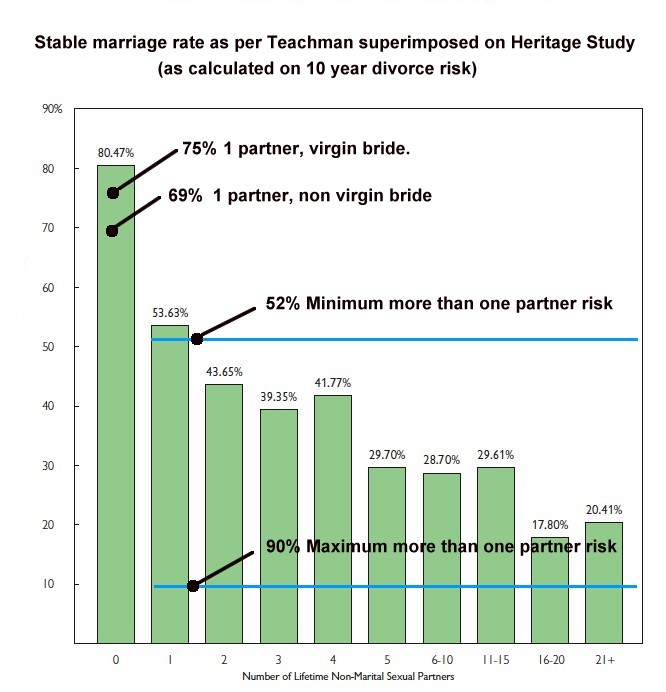
Here’s another recent study that shows that if a woman has more than her husband as a premarital sex partner, her risk of divorce increases.

His findings:

Using nationally representative data from the 1995 National Survey of Family Growth, I estimate the association between intimate premarital relationships (premarital sex and premarital cohabitation) and subsequent marital dissolution. I extend previous research by considering relationship histories pertaining to both premarital sex and premarital cohabitation. I find that premarital sex or premarital cohabitation that is limited to a woman’s husband is not associated with an elevated risk of marital disruption.However, women who have more than one intimate premarital relationship have an increased risk of marital dissolution.

Here’s another study that makes it even more clear.

Findings:

Data from the 1988 US National Survey of Family Growth (NSFG) were utilized to assess the impact of premarital sexual activity on subsequent marital stability. Among white NSFG subjects first married in 1965-85, virgin brides were significantly less to have become separated or divorced (25%) than women who had not been virgins at marriage (35%).

[…]The lower risk of divorce on the part of white women with no premarital sexual experience persisted even after numerous intervening and background variables were controlled.

This study supports what the Bible says about chastity and premarital sex:

1 Cor. 7:8-9:

8 To the unmarried and the widows I say that it is good for them to stay single as I am.

9 But if they cannot exercise self-control, they should marry. For it is better to marry than to burn with passion.

The idea of “burning” here has to do with sexual desire. Here Paul tells all unmarried people that if they cannot control their sexual desires, they need to get married. Why? Because Paul assumes that one cannot fulfill this sexual desire outside of the marital bed. While Paul would love for them to remain single (1 Cor. 7:7), he believes that sex outside of marriage is a destructive sin and cannot be used as a gratifying release of our sexual passions.

Although young people like to complain about “manipulation” and “controlling” when they are approached with facts, presenting evidence is really the only way to persuade them. Although they may respond with anecdotes to refute studies, studies are important because they represent LOTS of data points, not just one or two cherry-picked cases. Hit them with the evidence before they make the wrong decisions.
Woman who had sex with 18 different men shocked that men don’t want to marry her

Does being a virgin before marriage affect marital stabilitity?
Does being a virgin before marriage affect marital stability?

Sunshine Mary linked to a post from Reddit by a 32-year old “progressive” woman who is surprised that 15 years of sleeping around with 18 different guys is not attractive to marriage-minded men.

Excerpt:

My parents are first generation immigrants. I have a younger brother and younger sister. In my family I was always the rebellious one; I would often challenge my parents. My family was very strict, when it came to dating and my siblings usually fell in line. However, I would challenge that norm.

My brother and sister were very repressed with their sexualities as a result, while I lost my virginity at 17 to my then boyfriend. While my brother and followed the traditional Indian path. My brother ended up not having any sexual contact with a girl until he got married at 25 (arranged marriage) and now they have a child together. My sister (too never kissed a boy) has recently gotten married too at 24 with an Indian boy she met at our Temple (both parents approved).

I live in LA, a city where both men and woman tend to marry a bit later in life, and yet I still spent the last years of my 20‘s feeling that somehow, I’d messed up. I had followed the wrong trail and thus, my “important-life-moments” timeline was off. Even with my more progressive friends it began slowly at first, when I was 27 … an engagement post on Facebook, an invite to a wedding—it was happening. People I knew were beginning the next stage of life and saying “I do.”

Throughout my whole life I never really dated any Indian guys; I exclusively dated white guys. However now I realize more than ever that the guys I dated never really took me seriously. They never really viewed me as someone they would eventually marry. I was always just some exotic fun. This part was definitely a realization that has hurt me to the core. I didn’t actually do it to spite Indian men or anything like that. I did what a lot of my white female friends did; I thought I was the same as them, but that could be farther from the truth. Most white guys I ran into wanted white wives.

I am now 32, and seems like everyone in my family has lapped me. I too want a family a marriage. However, now my chance of finding someone is gone. At my age getting an arranged marriage or finding another Indian man to marry me is out of the question. Majority of Indian guys usually get married pretty early. Often either to another Indian girl they meet here, or they go back to India for an arranged marriage. My parents have tried signing me up for a matrimony site, but of the guys I’d meet they would be turned off by my history (drink/eat meat/not a virgin).

[…]Most of my relationships have been long term I have only been with 18 guys and I have been sexually active since I was 17 years old.

She has only had steady sexual relationships with 18 guys in 15 years! That’s not a lot. Is it?

Let’s see what Sunshine Mary says first:

However, the more I think about it, the more it seems to me that articles like hers are a good thing simply because they expose the lie.  Feminists have sold young women a bill of goods, that they can live like men, work like men, have sex like men, and then turn back into women when they feel like it.  We laugh at a woman like this sometimes and make fun of her and say, “Didn’t she know that she’d end up like this?”

No, she didn’t know that.  That’s because when you are 17 years old, you don’t know much, especially in this culture of extended adolescence.  And when you have been told from a very young age that, as a girl, it is your destiny to Have It All exactly When You Want It, I’m sure it is very baffling to find yourself in your thirties with no husband and none in sight, with the dawning realization that your job and lonely apartment are not nearly as fulfilling as being a wife and mother would have been.

[…]Personally, I feel no joy in this woman’s pain.  I don’t think a White Knight should ride in to save her because I think she should suffer the natural consequences of her decisions so that other young women may see and learn from her errors, but I take no pleasure in the fact that she will have this lot in life.  However, what most of us don’t seem to understand is that young women make the terrible choices that they are making because they are told from an early age that these are actually good choices.  Some girls are able to resist that message, which saturates every aspect of the media and schools, but most girls aren’t, and they don’t develop the necessary wisdom until it is too late.

Emphasis hers. And now my turn.

Let me tell you what I think awaits a man who marries a woman like that, who spent her 20s hooking up with hot guys who had no interest in marriage and no demonstrated ability to protect, provide and lead on moral/spiritual issues. She will have convinced herself that she is more attractive than she really is because in her mind she deserves a man as attractive as these men. What other criteria is there for a man? It’s all appearances. I therefore do not recommend that any man marry this woman as she is now. What men need in marriage is respect, affection, affirmation and approval. A woman with a background like this will not have the trust and vulnerability that a marriage-minded man wants. The only way to fix this shattered trust is a long period of chastity. She must choose to form relationships with good protector / provider / moral leader / spiritual leader men and to support those men. That is the only way to fix the damage of promiscuity, if it even can be fixed.

A man can sense how trusting and vulnerable a woman is by how much she trusts and encourages him in his plans. If a woman is constantly putting him down, calling him names, and making excuses for why she doesn’t have to care about his needs and feelings, then that’s just her past promiscuity showing itself. Virgins with good relationships with their fathers don’t put men down like that – they choose good men who are doing good things and they build them up. My recommendation for women who realize that they are making bad choices with men and being negative about the men they choose is to look in the mirror and acknowledge that they are the problem. The solution, then, is to find a good man and work hard at being submissive and supportive, but chastely. Stop choosing men with motorcycles. Stop choosing atheists. Stop choosing drunkards. Stop choosing men who are pro-abortion and pro-gay-marriage. Stop choosing men who want bigger government. Just stop it.

That’s the advice I would give this woman. Choose men who can do the work that men do in a marriage. Find out what a man’s plan is. Build the skills he needs for his plan. Marry him.

What does the new Guzzo study tell us about the instability of cohabitation?

I blogged about a new study on cohabitation earlier in the month, but I only had the abstract. Now more details are out, from Family-Studies.org.

First, some context:

In a new paper, Bowling Green State University sociologist Karen Guzzo analyzes how the odds of cohabitation leading to either getting married or breaking up have changed over the years. Before getting to her findings, let’s review some of the cohabitation trends she highlights in her report (based on prior studies).

  1. The majority of people in their 30s have lived with someone outside of marriage.
  2. Cohabitation, rather than marriage, is now the more common form of first union.
  3. Fewer marriages than in the past start out with the couple having intentions to marry.
  4. People are more likely than ever to cohabit with multiple partners in succession—what I have called “CohabiDating.”
  5. More children than ever before are born to cohabiting couples, and this explains most of the rise in the number of children being born out of wedlock.

Guzzo notes, as have others, that cohabiting has become a normative experience in the romantic and sexual lives of young adults. As young adults put off marriage until later in life, cohabitation has inhabited much of the space that used to be made up of married couples. I think this dramatic change in how relationships form matters for at least two reasons. First, many cohabiting couples have children, but they are less likely than married couples to have planned to have children and they are much less likely to remain together after having children… Second, most people want lasting love in life, and most people still intend to accomplish that in marriage.

Here is the main finding of the new paper:

To simplify and summarize, what Guzzo found is that the increasing diversity in the types of cohabitation and cohabiters does not explain much about why things are so different from the past when it comes to increased odds that cohabiting couples will break up or not marry. Rather, on average, all types of cohabiting couples have become more likely than in the past to break up or not transition into marriage.

Here’s a quote from her paper (pg. 834):

Relative to cohabitations formed between 1990 and 1994, cohabitations formed from 1995–1999, 2000–2004, and 2005 and later were 13%, 49%, and 87%, respectively, more likely to dissolve than remain intact. The lower risk of marriage over remaining intact occurred only for the last two cohabitation cohorts (2000–2004 and 2005 and later), which were about 18% and 31% less likely to marry than remain intact, respectively.

Moving in together is becoming less and less likely to lead to having a future together. That’s not to say that all cohabiters are in the same boat regarding their destination. Those who are engaged (or have clear plans to marry) before moving in together are far more likely to eventually marry—but as Guzzo shows, even they are becoming less likely to do so. Related to this, my colleagues and I have shown, in numerous studies, that couples with clear plans to marry before cohabiting, along with those who marry without cohabiting, tend to have happier marriages and lower odds of divorce than those who move in together before having a clearly settled commitment to the future in marriage. (We believe this is largely because, while cohabiting unions obviously break up often, they are harder to break off than dating relationships because it becomes harder to move out and move on. So some people get stuck in a relationship they would otherwise have not remained in.)

[…]Cohabitation is fundamentally ambiguous. In fact, that is part—but just part—of why I believe it has become so popular. Sure, there are many cohabiting couples for whom living together was understood as a step-up in commitment, but, on average, research shows it is not associated with an increase in dedication to one’s partner.

So those are the findings from the latest study. You can find more studies on cohabitation linked here in my previous post on this topic.