
Tag Archives: Darwinism

New study: enzymes cannot easily evolve to perform other functions

Can atheism explain the origin of life?

This is from Evolution News.

Excerpt:

I am pleased to announce the publication of a new paper from Biologic Institute, a research organization devoted to investigating the limits of unguided evolution and advancing the development of a new paradigm for biology based on intelligent design. This paper, “Enzyme Families — Shared Evolutionary History or Shared Design? A Study of the GABA-Aminotransferase Family,” is the closing chapter of our long-term study of bacterial enzymes to determine if they can be coopted to new functions. The answer to this question is important for the evolution debate. If enzymes can’t be recruited to genuinely new functions by unguided means, no matter how similar they are, the evolutionary story is false.

Published in the journal BIO-Complexity, the work was done by Marci Reeves, Doug Axe, and myself [Ann Gauger].

In a previous paper we described the difficulty of coopting the enzyme Kbl to perform the function of BioF. The two enzymes are very similar in structure (see below) but have different reaction chemistries and different functions in the cell. We wanted to know if a mutated Kbl could replace missing BioF function. After changing nearly every amino acid in Kbl’s active site (where its chemistry is carried out) to look like BioF, Kbl never was able to make the switch to BioF’s function.

In this paper we expanded the story to include nine of the most closely related enzymes to BioF, including one that is supposed to be able to carry out both BioF’s and Kbl’s chemistry. Using random mutagenesis we tested every single-base mutation in those nine genes. None of them was within one mutation of cooption. We went on to test for cooption the two most likely enzymes by generating two-base combinations of mutations. After testing 70 percent of all possible two-base mutations for each enzyme, or about 40 million cells each, that also failed.

What does this mean? In an evolutionary scenario, to get an enzyme to switch functions the first step is to make a spare copy that can be mutated without destroying a function the cell needs. Second, the cell has to overproduce the mutating enzyme, because any newly emerging enzyme will be very bad at the job at first. To compensate there will need to be lots of enzyme around. Third, there is the problem of finding the right combination of mutations by random search.

Taken together, since we found no enzyme that was within one mutation of cooption, the total number of mutations needed is at least four: one for duplication, one for over-production, and two or more single base changes. The waiting time required to achieve four mutations is 1015 years. That’s longer than the age of the universe. The real waiting time is likely to be much greater, since the two most likely candidate enzymes failed to be coopted by double mutations.

Read the rest of the post, they deal with criticisms to the paper.

Here is one Darwinist’s view of this enzyme proble, which they mention in a follow-up post.

Look: (links removed)

Monday we published a paper in the journal BIO-Complexity demonstrating that enzymes can’t evolve genuinely new functions by unguided means. We argue that design by a very sophisticated intelligent agent is the best explanation for their origin. I want to take some time to lay out our argument against Darwinian evolution and for intelligent design. It’s important, because it reveals the logical fallacy in most evolutionary thinking.

Just to give an example of the thinking of ID critics, here is a passage from one of the references in our paper (Kherhonsky et al. (2006) Enzyme promiscuity: Evolutionary and mechanistic aspects.Current Opinion in Chemical Biology 10:498-508):

An oft-forgotten essence of Darwinian processes is that they occur gradually, while maintaining organism fitness throughout. Consequently, a reasonable assumption is that, ever since the emergence of the primordial living forms, very little novelty has evolved at the molecular level. Rather, existing genes were modified, or tinkered with’, to generate new protein structures and functions that are related to those of their ancestors. Unlike ‘out of the blue’ scenarios advocated by the ‘intelligent design’ school, ‘tinkering’ scenarios depend on the availability of evolutionary starting points. The hypothesis that the broad specificity, or promiscuous functions, of existing enzymes provide these starting points was first formalized by Jensen in a review that has inspired many. Jensen proposed that, in contrast to modern enzymes, primitive enzymes possessed very broad specificities. This catalytic versatility enabled fewer enzymes to perform the multitude of functions that was necessary to maintain ancestral organisms. Duplication of genes and divergence led to specialized genes and increased metabolic efficiency. Since Jensen, the structures of >30,000 proteins, and the sequences of hundreds of thousands, have taught us that these processes led to the creation of enzyme families and superfamilies. The vestiges of these divergence processes are the scaffold and active site architecture shared by all family members [6].

To summarize, the key points of that evolutionary argument are:

  1. Evolution is true. That is, enzymes have evolved new functions by a process of random mutation and natural selection.
  2. Modern enzymes can’t evolve genuinely new functions by random mutation and natural selection but can only tinker with existing functions.
  3. Therefore, ancient enzymes must have been different, capable of carrying out a broad range of enzyme activities.
  4. Those enzymes underwent duplication and diverged from one another, becoming specialized.
  5. How do we know this happened? Because we now see a broad array of specialized enzymes. Evolution is the explanation.

This begs the question of whether evolution is true. It is a circular argument unsubstantiated by the evidence and unfalsifiable. No one can know what ancient enzymes actually looked like, and whether they really had such broad catalytic specificities.

That’s insufferable badness.

It’s not enough for Darwinists to take the age of the universe and then assert that anything can happen in that time. The time from the cooling of the Earth to the appearance of first life is on the order of millions of years. There just isn’t time to generate these organic components by chance.

Stephen C. Meyer and Keith Fox debate intelligent design and evolution

From Justin Brierley’s “Unbelievable” podcast.

Details:

Stephen Meyer is a leading proponent of Intelligent Design who directs the Centre for Science and Culture at the Discovery Institute in Seattle. His [first] book “Signature in the Cell” claims to show that the DNA code is the product of intelligent mind, not naturalistic processes. Keith Fox is Professor of Biochemistry at Southampton University. He chairs the UK Christians in Science network but disagrees strongly with ID. They debate how life could have originated and whether design is allowed as an explanation in science.

Summary: (stuff in italics is my snarky paraphrase)

Meyer:

  • background and how he got interested in intelligent design
  • his research focus is on the origin of life – the first replicator
  • summarizes the history of origin of life studies
  • authored the book “Signature in the Cell”
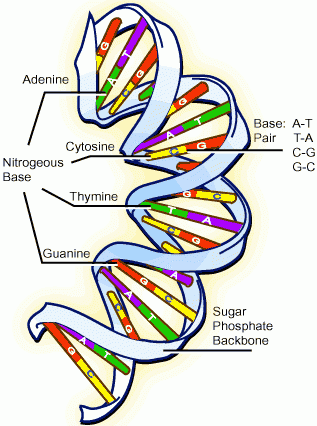
  • the DNA enigma: where did the information in DNA come from?
  • naturalistic explanations of the DNA information have failed
  • but intelligent agents are known to be able to produce information
  • the best explanation of the information in DNA is that an intelligent agent authored it
  • Meyer’s book was named by atheist philosopher of science Thomas Nagel as a Times Literary Supplement Book of the Year in 2010
  • why is design so controversial? Many people think that Darwin explained why nature appears design
  • the Darwinian view is that nature can create the appearance of design using mutation and selection
  • however, Darwinian mechanisms cannot explain the origin of the first living cell, it assumes replication, and the origin of life is about where the first replicator comes from

Fox:

  • Meyer’s argument is not about the evolution of life after the first cell
  • Meyer’s case for design is about the origin of life
  • naturalists do not know a naturalistic explanation for the origin of life
  • there are a number of naturalistic hypotheses for the origin of life, like the RNA-first hypothesis
  • maybe in a few years one of them will turn out to be correct
  • what intelligent design is arguing from a gap in our current naturalistic knowledge to infer that God intervened in nature

Meyer:

  • that’s not what intelligent design is at all
  • the approach ID theorists use is the inference to best explanation
  • you evaluate all explanations, non-intelligent causes and intelligent causes
  • you prefer the best possible explanation
  • we know that minds are capable of producing information just like the information we find in DNA

Fox:

  • living cells replicate, so they have the ability to introduce mutations as they replicate and then some of those mutations can be selected
  • so maybe the process of replicating that living cells do created the first living cell
  • maybe the first living cell created itself, X brought X into being, self-creation, what’s irrational about that?

Meyer:

  • the issue is the origin of life – where did the first living cell come from?
  • you cannot appeal to the operations that a living cell can perform to explain the origin of the first living cell
  • there was no first living cell operating before the first living cell
  • there was no replication, mutation or selection before the first living cell
  • in fact, in my book I show that there is no known naturalistic mechanism that is able to produce the information needed for the first living cell
  • nothing can create itself, that is self-contradictory
Fox:
  • Well, you are just saying that because something is complex that God did it
Meyer:
  • Sadly, no. What I actually said needed to be explained was the information, not complexity
  • And we know from software engineering that the process of adding information to code is performed by programmers
  • in the absence of any adequate naturalistic explanation for information, we are justified in taking the explanation that we are familiar with – namely, intelligent agency – based on our uniform, universal experience of what causes information
Fox:
  • well, maybe we can appeal to the mutation and selection in existing living cells to explain the origin of the first living cell
  • maybe there were living cells before the first living cell, and then these other living cells created the first living cell
Meyer:
  • we can’t keep invoking mutation and selection when those processes are not operating prior to the origin of the first living cell
Fox:
  • well maybe some bare-bones self-replication molecule was a precursor to the first living cell
Meyer:
  • even to generate very limited replicator would require a large amount of information
  • the argument I am making is – where does the evolution come from?
Fox:
  • well, maybe we will think of an explanation for information that is naturalistic in 20 years
  • we’ve thought of explanations to things that were NOT information before
  • so maybe we will be able to think of something to explain information based on our ability to explain NOT information before

Moderator: Change topics: the Dover decision

Meyer:

  • the Discovery Institute opposed the policy that causes the trial
  • the wording of the statute was poor
  • the judge was completely wrong in his decision
  • young earth creationists used the phrase “intelligent design” to cover their agenda
  • intelligent design is an inference using the normal methods of science
Fox:
  • intelligent design is a science stopper because it stops looking for a naturalistic explanation
  • everything in nature must have a naturalistic explanation
  • everything has to be explained using matter and time and chance
  • it just has to be that way!!!!
Meyer:
  • well, what luck would you have explaining an effect like Mt. Rushmore?
  • can you explain that using matter,time and chance?
  • Mt. Rushmore was the product of intelligence, not wind and erosion
  • similarly, there is information in the cell, and we know that intelligence causes information
Fox:
  • So you are saying that we don’t understand and therefore an intelligence is necessary?

Meyer:

  • no I am saying we DO understand and we are making an inference based on that understanding
  • you are the one who is insisting on a material explanation because you pre-suppose materialism
  • we know that minds have causal powers, and we can infer mind as an explanation from information
Fox:
  • well nature is a seamless chain of material causes and effects
Meyer:
  • agents can act without violating the laws of nature
  • even humans can act as intelligent agents to create information in books, and they don’t violate the laws of nature
  • intelligent causes are real, and they explain effects in nature
Fox:
  • you’re trying to impose on science something to do with meaning and purpose
Meyer:
  • no that’s not what we’re doing, we’re inferring from from the fact that we ourselves are known causes of information to the fact that an intelligence cause is the best explanation for information in the cell
Fox:
  • but I am a materialist, I need a materialist explanation
Meyer:
  • mind IS an answer to the how question
  • we infer to mind in many other scientific disciplines, like cryptography, archaeology, etc.
  • a materialist might accuse an archaeologist of engaging in a “scribe-of-the-gaps” argument, but the best explanation of an artifact with information is a scribe
  • we are inferring that mind is the cause from the nature of the effect: information
Moderator: is it appropriate to call DNA “information”

Fox:

  • well DNA is just a molecular polymer, any reference to information is just by analogy
Meyer:
  • DNA is a molecular polymer, but it also exhibits the property of specified complexity
  • the arrangement of bases, which function as machine instructions in a software program, for performings task in the cell
  • we have observed that the property of specified complexity always comes from an intelligence
Fox:
  • well, maybe there are other sequences that would work, so maybe it’s really not uncommon to develop functioning sequences by chance alone, without an intelligence
Meyer:
  • you can measure how precise the functional specificity is in DNA and proteins

Moderator: is Shannon information the same as functional information

Meyer:

  • Shannon information refers to the sequences of digits or symbols that do not necessarily have any function, i.e. – a four character string QSZX has as much Shannon information as WORD. However, only the latter is functional against the pattern of the English language. There are arrangements of DNA bases and amino acids that have the same number of symbols/characters as a functional sequence would have, but they have no biological function – they do not exhibit specified complexity
Fox:
  • Well, maybe there are lots and lots of sequences of DNA and proteins so that it is fairly easy to get a functional one by chance

Meyer:

  • DNA sequences that are functional are extremely rare, protein sequences are even more rare
  • this is not my opinion, this is what the research shows – functional protein sequences are rare
Fox:
  • well maybe there are other functional sequences that are occur before the first functional sequence that are precursors to the first functional sequence
  • maybe there are billions of years of replication, mutation and selection before the first replication, mutation and selection

Meyer:

  • you can’t get to the first selectable functional sequence by appealing to precursor selectable functional sequences – there are no selectable functional sequences before the FIRST one
  • you have to get the first selectable functional sequence by chance alone, because there is nothing to mutate or select before the first replicator
  • the chance hypothesis has been rejected because the minimal amount of information for the simplest replicator is too high to get by chance alone, given the resources, including time, that are available

Moderator: Keith are you confident that naturalism will be able to substantiate these naturalism-of-the-gap speculations that you offer in response to Meyer’s actual science that we have today? 

Fox:

  • well, it is hard to know for sure because it was just a fluke event
  • but there’s nothing irrational or unscientific or miraculous about it – the fluke would have a material explanation
  • there is nothing that we can detect that would implicate God, my speculations about a fluke which I cannot observe or measure or test would all be compatible with an atheistic worldview that omits God as a causal entity

Meyer:

  • where are those material processes that could account for this fluke then?
  • the whole point of this argument is that the information in DNA transcends the material components in the sequence
  • it’s the arrangement of the material parts/letters/characters/symbols/instructions that needs to be explained
Fox:
  • Well, I just have a different philosophy of science that rules out intelligent causation a priori

Meyer:

  • Yes, that’s the difference between us – you pre-suppose that all explanations of natural phenomena must exclude intelligent causes

There is a bit more where Meyer talks about how parts of the cell are implementations of various design patterns (Gang of Four design patterns) that are used by software architects who design software.

Find more posts on Stephen C. Meyer here.

Darwinists thought whale hips were accidents of evolution, then science happened

Another win for reason in the long war between science and naturalistic philosophy.

Science Daily reports.

Excerpt:

Both whales and dolphins have pelvic (hip) bones, evolutionary remnants from when their ancestors walked on land more than 40 million years ago. Common wisdom has long held that those bones are simply vestigial, slowly withering away like tailbones on humans.

New research from USC and the Natural History Museum of Los Angeles County (NHM) flies directly in the face of that assumption, finding that not only do those pelvic bones serve a purpose — but their size and possibly shape are influenced by the forces of sexual selection.

“Everyone’s always assumed that if you gave whales and dolphins a few more million years of evolution, the pelvic bones would disappear. But it appears that’s not the case,” said Matthew Dean, assistant professor at the USC Dornsife College of Letters, Arts and Sciences, and co-corresponding author of a paper on the research that was published online by Evolution on Sept. 3.

[…]”Our research really changes the way we think about the evolution of whale pelvic bones in particular, but more generally about structures we call ‘vestigial.’ As a parallel, we are now learning that our appendix is actually quite important in several immune processes, not a functionally useless structure,” Dean said.

This is not the first time this has happened – as they said, the appendix now has known functionality.

Flashback: ENCODE study falsifies Darwinian prediction that most of the genome is “Junk” DNA.