Tag Archives: Conservative

Ted Cruz refuses to endorse Trump, tells voters to “vote your conscience”

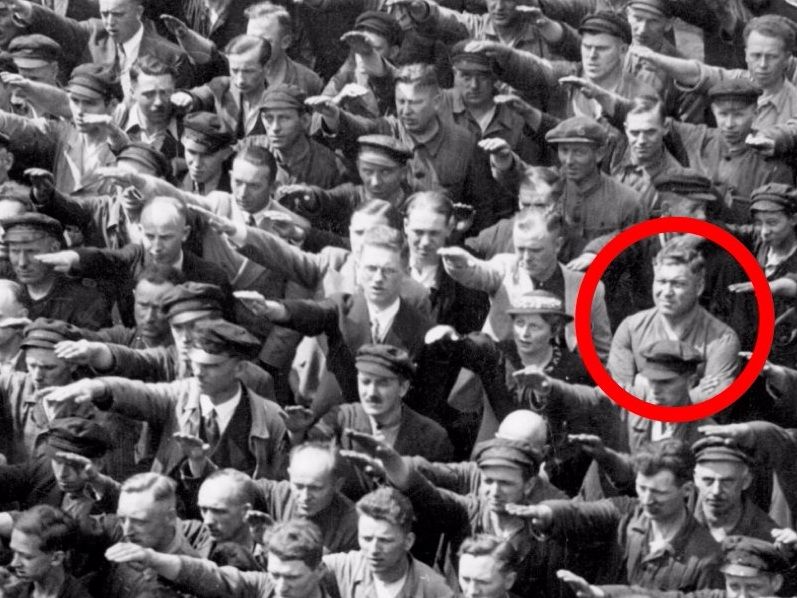
Lone man refuses to give Hitler salute
One single, solitary man refuses to salute Hitler at a Nazi party rally

I have to say something about Ted Cruz’s speech at the Republican national convention in Cleveland, OH.

This article from The Federalist was the best summary:

Ted Cruz knows exactly what he’s doing. On Wednesday night at the Republican National Convention, Cruz walked onto the stage in Cleveland to thunderous applause, smiled, waved, and then openly defied the Republican Party.

Not only did Cruz fail to endorse Donald Trump, in a master stroke of rhetorical understatement he also implored Republicans to “vote your conscience” in November. It was all he needed to say.

Cruz uttered the name of the GOP nominee only once, right at the beginning. “I congratulate Donald Trump on winning the nomination last night,” Cruz told the crowd.

That was it. The very next thing he said was a rhetorical shot across Trump’s bow: “I want to see the principles of our party prevail in November.”

For the rest of his remarks, Cruz’s theme was freedom—not Trump or party unity or even Hillary Clinton. He took up his theme by talking about something he’s been talking about for years: the frustrations of average Americans with what Cruz calls the “Washington cartel.” Recall that early in the primaries, Cruz made common cause with Trump as an outsider candidate, lambasting not just the Obama administration but also a Republican establishment he said was woefully out of step with ordinary Americans.

“Voters are overwhelmingly rejecting big government,” he said. “That’s a profound victory. People are fed up with politicians who don’t listen to them, fed up with a corrupt system that benefits the elites, instead of working men and women.”

He lambasted a “political establishment that cynically breaks its promises and ignores the will or the people,” a shot aimed not just at the Obama administration, but at his GOP establishment rivals in Congress.

But it was clear, to those who have ears to hear, that Cruz was not making a case for Trump. “We’re fighting not for a particular candidate or campaign,” he said. Americans deserves leaders who “stand for principles” and “shared values.”

The closest Cruz came to an endorsement of anyone was a plea for the beleaguered down-ballot Republicans who in many places across the country face tough odds in November with Trump at the top of the GOP ticket.

“To those listening, please, don’t stay home in November,” he said. “Stand, and speak, and vote your conscience, vote for candidates up and down the ticket who you trust to defend our freedom and to be faithful to the Constitution.”

That’s what I’ve been telling people as well. Don’t vote for Trump, but do vote for solid conservatives at every level of government in your home state.

Here is the full speech: (Transcript at Caffeinated Thoughts)


Ted explained his actions like this:

Not everyone who runs for office is a "politician"
Not everyone who runs for office is a “politician”

Donald Trump repeatedly insulted the much better conservatives who were running against him in the primary. Most of those conservatives, like Rubio, have apologized, grovelled, and kissed his ring after they lost. Not Ted Cruz. Ted Cruz is as far above Trump in intelligence and morality as Hyperion to a satyr, to quote Shakespeare. There is no way that Cruz could kowtow to an immoral imbecile like Trump.

Jonah Goldberg says this at National Review:

Well here comes Ted Cruz providing exactly the sort of drama they yearned for and many of these same voices are aghast at Ted Cruz’s effrontery. The word has gone out across the land: This is an outrage! Not since Caligula appointed his horse to the Roman senate has a political figure showed such contempt for decorum and the solemnity of politics!

[…]I understand that Chris Christie will spew whatever fake outrage his masters instruct, like a trained seal barking for another herring. But I don’t see why so many supposedly seasoned political observers are volunteering for service.

[…]This is part of the corruption of Trump. He called Ted Cruz a liar every day and in every way for months (it used to be considered a breach in decorum to straight up call an opponent a liar, never mind use it as a nickname). The insults against his wife, the cavalier birtherism, the disgusting JFK assassination theories about his Dad: These things are known. And yet the big conversation of the day is Ted Cruz’s un-sportsmanlike behavior? For real?

[…]Ted Cruz has never been my favorite politician. And I am not so naïve that I don’t recognize the gamble Cruz is making.

But if the choice is between forgiving Ted Cruz’s obvious political calculation to become the standard bearer of an authentic conservatism or Donald Trump’s lizard-brain narcissism where no principle or cause outranks his own glandular desire to be worshipped, like a conqueror atop the carcass of conservatism, I choose Ted.

If the choice is between, say, congratulating the Boy Scoutish obedience of Mike Pence as he sells off bits and pieces of his soul like jewels from a family heirloom just to survive another day, or Ted Cruz who took the tougher road and refused to join the mewling mobs of toadies, apologists, human weather vanes, difference-splitters and vacillators, I choose Ted.

If the choice is between suspending the rules of decorum, decency, and civility for Donald Trump as he casually bad mouths his own country to the New York Times just as he secures the presidential nomination of the Republican Party or accepting that we are in dark and uncharted waters and conscience must light the way, I choose Ted.

I wasn’t worried about what Cruz would say at the convention. More than anyone else speaking, I trusted him not to stain his honor by endorsing someone he didn’t support, for political gain. There was just no way that someone with the education, achievements, moral character and conservative principles of Ted Cruz would lower himself into the gutter to support a disgusting piece of godless left-wing filth like Donald Trump. Ted Cruz will be back in 2020. Maybe then American voters will care enough to actually look into the backgrounds and achievements of the candidates.

I can only hope that God will give this nation one more chance to turn off of the road to serfdom. But even if he does not, we can’t say that we were not warned.

Related posts

On the issues: assessing the 2016 Republican presidential candidates

Latest Republican presidential primary polls
Latest Republican presidential primary polls (click for larger image)

The PDF is here. (50 pages, but you only have to read about the candidates you might consider voting for)

Unfortunately, radically leftist Politico is the only one with a write-up on it, so here goes:

The hard-line conservative arm of the Heritage Foundation has tough criticism for much of the 2016 field, but high praise for the Texas senator.

The political arm of The Heritage Foundation has released a detailed assessment of the 2016 Republican presidential field — and it offers harsh words for many candidates. But not for Sen. Ted Cruz.

Cruz receives almost exclusively praise for his stances in the 50-page 2016 presidential policy scorecard, the first of its kind produced by Heritage Action. The report grades the candidates across six categories: growth, opportunity, civil society, limited government, favoritism and national security.

Many of the lines in the scorecard appear destined for future attack ads.

Jeb Bush, for instance, is accused of having “kowtowed to the state’s environmental lobby” in Florida. Chris Christie “has shown favoritism toward well-connected real estate developers.” Rand Paul’s “views at times veer outside the conservative mainstream.” And Donald Trump backs “massive tariffs that would damage the American economy.”

Cruz, by contrast, manages to emerge with barely a blemish, receiving only softly worded critiques of his adopting “sound policies advanced by others” rather than crafting his own.

[…]“Cruz has been willing to pay a political price for taking on government favoritism,” the report reads.

The group even forgives Cruz for one of the few trespasses he has made against its positions, voting for a bill that served “as a bargaining chip for [Export-Import Bank] allies to secure reauthorization.” The report credits him for later switching his vote and then publicly attacking Republican Senate Majority Leader Mitch McConnell for allegedly lying about his plans.

Bobby Jindal, who is running hard to the right in Iowa, receives among the more glowing reviews. So does Marco Rubio, who angered the right with his pursuit of a comprehensive immigration plan after first being elected with tea party support.

The two current front-runners in the polls, Ben Carson and Trump, were dinged for their lack of a record on conservative causes and a lack of specifics in their visions. “His unconventional foreign policy prescriptions raise more questions of significant consequence than they answer,” Heritage writes of Trump.

Bush was singled out for some of the most biting critiques. “Has shown favoritism toward Florida special interests and supports amnesty” for undocumented immigrants, reads one bullet point.

In its 2016 assessment, Heritage dings Bush for not supporting recent efforts to defund Planned Parenthood this fall because he said he opposed precipitating a government shutdown. The report accuses him of “playing to President [Barack] Obama’s talking points rather than reinforcing conservatives.”

No, everyone knows that my list of candidates favors governors who have a history of putting in place actual policies that actually affected real people in the real world and got real conservative results. So on that score, Cruz and Rubio way down the list because they have achieved very little:

  1. Scott Walker
  2. Bobby Jindal
  3. Rick Perry
  4. Ted Cruz
  5. Marco Rubio

Ted Cruz’s Twitter feed and his overall feel to me is that all he does is talk, talk, talk. He just doesn’t have the record of Bobby Jindal at putting policies into place. For example, as governor, Jindal actually cut spending. He actually put in place pro-life measures that actually saved lives. He actually put in place a school choice program that helped low-income students get out of failing schools. He actually cut off funding for Planned Parenthood. He actually defended religious liberty. Cruz is just a senator, so he hasn’t got that proven record. I believe he would be conservative, but I feel safer trusting someone with experience.

Having said that, the more I read reports like this Heritage Action Scorecard report, I am finding out that Cruz has been willing to at least pay a price politically for doing the right thing at various times. So, although he does not have the accomplishments that the governors have, he has been willing to push conservative values when it was not to his advantage, politically. I have to admit, there is some value to this in one sense – we know that he would do what he says no matter what. But there is a problem with Cruz. We don’t know whether he is able to create clever policies that will draw the votes of independents and even moderate Democrats. That’s what Walker and Jindal were able to do. So, although I respect what the Heritage Action team have written, I am not changing my rankings.

Tonight’s debate

Be sure and tune in to both debates tonight on Fox Business, as I am expecting Jindal and Cruz to outperform their competitors in their respective debates:

Republican debate – Fox Business/Wall Street Journal

Time – Primary: 9 p.m. ET. Secondary: 7 p.m. ET

Location – Milwaukee Theater, Milwaukee, Wisconsin

Moderators – Gerard Baker, Neil Cavuto, Maria Bartiromo

Primary: All candidates averaging at least 2.5 percent in four most recent national polls by Nov. 4.

Secondary: Remaining candidates averaging at least 1 percent in one of the four most recent polls.

Primary: Donald Trump, Ben Carson, Marco Rubio, Ted Cruz, Jeb Bush, Carly Fiorina, John Kasich, Rand Paul.

Secondary: Chris Christie, Mike Huckabee, Bobby Jindal, Rick Santorum.

Candidates on my list are in bold. The debate will be live-streamed, so you have no excuses for missing it. This one promises to be a good one. The moderators will not be amateurs as with the Democrat-biased CNBC debate.

UK Guardian claim: religious children are meaner than non-religious children

A conflict of worldviews

Here’s what the the radically secular and leftist UK Guardian had to say about a recent study:

Children from religious families are less kind and more punitive than those from non-religious households, according to a new study.

Academics from seven universities across the world studied Christian, Muslim and non-religious children to test the relationship between religion and morality.

They found that religious belief is a negative influence on children’s altruism.

“Overall, our findings … contradict the commonsense and popular assumption that children from religious households are more altruistic and kind towards others,” said the authors of The Negative Association Between Religiousness and Children’s Altruism Across the World, published this week in Current Biology.

“More generally, they call into question whether religion is vital for moral development, supporting the idea that secularisation of moral discourse will not reduce human kindness – in fact, it will do just the opposite.”

Now, whenever I read studies like this that trumpet how great secularism is, I always look more closely to see how they define the terms. Usually, what’s been done is that the study will define the “good” behavior as “leftist” behavior. For example, “punitive” might mean “judging something morally wrong”, which the secular left regards as bad. So, if your starting point is feelings of compassion, moral relativism, non-judgmentalism, then yes – religious people will look bad.

Anyway, here is a response to the Guardian’s article, and the study they cite, from statistician William Briggs.

He writes:

Here’s how to you can replicate their study at home. First, define altruism. Go on, I’ll wait.

Have a definition in mind? I’m sure it’s correct and matches everybody else’s definition in precise detail, details like no-greater-love, supreme sacrifice, kindness, patience, love, and so on, right? Well, maybe not, but never mind. Instead, think about how you would quantify your definition. Quantification makes your definition scientific. Science means unquestionable truth.

Was your answer about quantification the “Dictator game”? Like this (from the Supplementary description)?:

[C]hildren were shown a set of 30 stickers and told to choose their 10 favorite. They were then told “these stickers are yours to keep.” Children were instructed that the experimenter did not have the time to play this game with all of the children in the school, so not everyone would be able to receive stickers. Children were finally shown a set of envelopes and informed that they could give some of their stickers to another child who would not be able to play this game by putting them in one envelope and they could put the stickers they wanted to keep in the other envelope. Experimenters turned around during the child’s choice and children were instructed to inform the experimenter when they were finished. Altruism was calculated as the number of stickers shared out of 10.

Yes, this scientifically captures every possible nuance of the scientific concept of altruism, doesn’t it? Science science science science. Science. It must be science! Scientists wrote this, peer scientists reviewed it, and scientists nod sagely when reading it.

Now define “religiosity” for kids. I’ll wait again.

Have it? Ha ha! That was a trick question. The authors never assessed the “religiosity” of kids; they did it for the kids’ “caregivers” instead. How? The authors asked parents to name their religion. They also asked parents questions like “How often do you experience the ‘divine’ in your everyday life?” They took pseudo-quantified answers from these and combined them scientifically with a quantification of religious attendance and derived a complete scientific quantification of “religiosity.” This was assigned to each kid in the study.

One of my friends in academia who publishes studies with regression analysis writes:

[I] Don’t buy all of his critiques of regression analysis but he is dead on in that the operationizing of the variables in that research is poor. I would also add that the regression model is underspecified.

So that’s two scholars who deal in statistics who don’t like the study. Sociologist Dr. George Yancey also responds to the study’s methodology in detail over at The Stream.

So here are my thoughts: first of all, children typically are little monsters, and they do not understand religion enough to act consistently with it until much later. So it’s a mistake to look at the religion of the parents and assume that in most cases, the children will have accepted that and be operating from that worldview. Second, if you were judging my religiosity at age 12 by talking to my parents, I would not have been considered religious at all, except I was. Third, giving stuff away to strangers is the secular left’s definition of altruism. Earning things through work and then sharing with people you actually know is what conservatives consider “altruism”. The study didn’t ask about how many stickers the religious kids shared with their friends and family when they got home. Conservatives tend to not want to hand out goodies to strangers through some unknown intermediary like big government. We prefer to give to people we know or through private organizations we know. Government is known to waste money on nonsense.

Hypocrisy on the left

There’s a lot of hypocrisy on the secular left. On the one hand, they want to give away lots of taxpayer money to the poor, on the other hand, they personally give far less in charity to the poor. I.e. – they are very generous with other people’s money – especially when they can brag about it to others to appear generous. But in their personal lives, they are often much less generous about giving away their own money. In fact, Arthur Brooks did a study of non-religious and religious people and charitable giving, and he found that the religious people gave away much more than the non-religious people.

Take a look at this video to understand how secular leftists think about “morality” and giving away money:

So, yes – they may sound generous when they are talking about spending someone else’s money, but they themselves are not generous. And that’s not unexpected, since secular leftists believe that this life is all they have, and there is no objective moral standard, nor any accountability to a Creator / Designer when they die. How will you generate a robust notion of generosity, when your story of origins is “survival of the fittest”? You can’t.
