
Tag Archives: College

Tad Hopp accumulated $100,000 of college debt, now he wants a taxpayer bailout

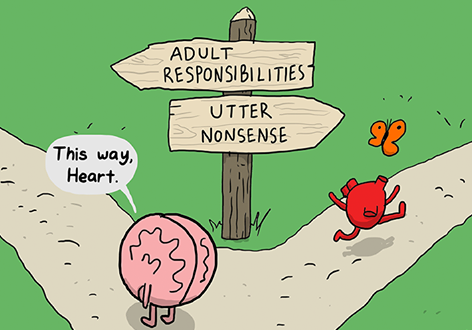
Brain vs Heart, from: theawkwardyeti.com

Here’s an interesting editorial from a “Christian” left blog. (H/T Acton Institute via Lindsay)

The author, Tad Hopp is graduating a PCUSA seminary – an extremely liberal, left-wing denomination.

He writes:

I graduated college in 2007.

[…] I majored in English, not exactly what most people consider a ‘marketable’ or ‘practical’ degree…

[…]I went to a somewhat expensive private school…

[…]I did what many students in their last year of high school do: I went to the school where I felt I was being called…

[…]I do not regret my four years at my undergraduate institution one bit.

[….]When I graduated college, I owed nearly $50,000 in student loan debt and was unemployed for almost six months before I finally found a low-paying office job.

[…]“Can’t find a job? Well, you should have majored in something more ‘practical’, like economics or business or medicine.” Yeah, that would be great…if those were the subjects where my skills and passions lie. They’re not.

[…]I felt called to go to seminary.

[…]I will graduate seminary with close to six figures worth of student loan debt.

Let’s take stock of what he’s said so far:

  • he studied English, a language that he already spoke, which has one of the lowest employment rates
  • he was warned by people who knew something about earning and saving money not to study English
  • he went to a school he couldn’t afford to go to, and he graduated with $50,000 in debt
  • he went to seminary, another subject that doesn’t pay, and added another $50,000 or so of debt
  • he says that he doesn’t have to study subjects that lead to a career because he isn’t “passionate” about them
  • he “followed his heart” by going to the school that he had mystical, emotional, intuitions about = “calling”

My advice to Tad at this point would be for him to take the Bible seriously when it says this:

2 Thessalonians 3:10:

10 For even when we were with you, we used to give you this order: if anyone is not willing to work, then he is not to eat, either.

And 1 Timothy 5:8:

8 But if anyone does not provide for his own, and especially for those of his household, he has denied the faith and is worse than an unbeliever.

The Bible is giving us the goal of working. So what should we do to be able to reach that goal? Why should anyone hire us? What is working really about? It’s those kinds of questions that should guide what we study in school, and what jobs we pursue.

We know what careers have the highest starting salaries and mid-career salaries:

Starting and Mid-Career salaries by profession (click for larger image)

(Source)

Why do some people get paid more than others? The answer is supply and demand. Prices are a way of determining what is most valued by your fellow man. Business owners pay more to people who offer their customers more value. If you really want to serve your neighbor, you have to learn something they really want, but can’t easily obtain. And then you will be paid more. You can’t do what makes you happy. You have to do what makes customers happy. That’s how the free market works – you make money when you provide something of value to others. You make money when you serve others. This is something that is very hard for self-centered, feelings-driven young progressives to grasp. But it’s something older Americans all know.

More Tad:

Is the PCUSA doing anything to address this crisis?

[…]What has our government done to address this issue?

[…]I, like so many in my generation, voted for Obama…

[…]It seems to me that we’ve bought into the lie that student loan debt is brought on by the individual person…

[…]You know what I think might stimulate the economy? Automatically cancelling every single outstanding student loan!

He insists that the results of his own choices aren’t his fault. But didn’t he make the choices about what to study? Didn’t he make the choice to follow his heart? Didn’t he disregard the advice of people who urged him to be practical? Who is to blame, if not he, himself?

Tad needs to push away all his friends who told him to “follow his heart” and stick close by his friends who told him to focus on providing value to others. Don’t look for advice from dreamers, look for advice from doers. Dreamers talk. But doers have demonstrated the ability to create plans that work to achieve results.

By the way, some of you might be wondering how serious this person was about his Christianity. Well, in another post, he comes out as gay. So clearly the Bible is being interpreted in a way where feelings are overturning the plain meanings of words. People who read the Bible closely never come away with the message that they should follow their hearts.

What’s behind the epidemic of false rape accusations on campus?

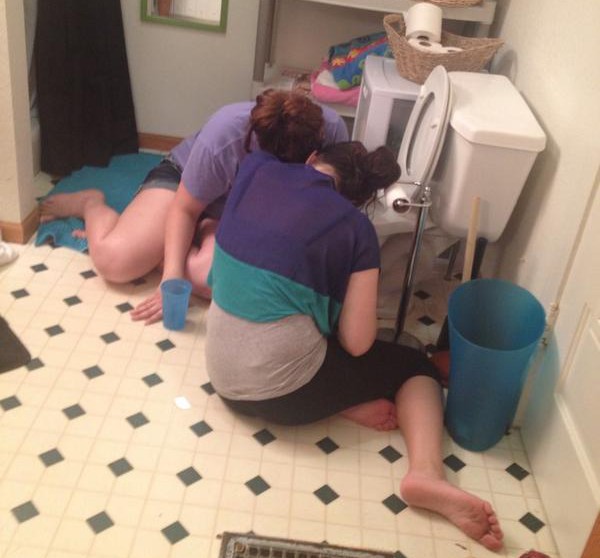
College students puking in toilet

Heather McDonald is concerned about the feminist left’s effort to undermine the presumption of innocence for men accused of rape. She makes an argument in the prestigious City Journal that there is actually a reason why we should not believe women’s rape claims, especially in an age of feminism, until we have the evidence that proves that the man being accused is guilty.

First, she gives an example of the fake rape charge made by the Columbia University student Emma Sulkowicz. I’ll omit the history of consent before, during, and after the sex and go straight to the reason for the false accusation:

It wasn’t until eight months after their August 2012 coupling that Sulkowicz filed a campus-rape charge, alleging that Nungesser had anally raped her while she struggled and told him to stop. She claims that she waited so long to file so as to avoid re-traumatizing herself. Nungesser argues that she was simply chagrined that they had not become an exclusive couple.

Reason magazine actually reported that she texted Nungesser to come over and “f*** me in the butt”. We have that text, and we know that this happened. So what happened? She had painful sex with a guy, and the relationship ended, and she wanted to shame him for breaking up with her after she gave him recreational sex. She felt she was entitled to a relationship after doing so much.

Here’s another one where the consent was documented before during and after the act, and the woman made a false accusation after because she was disappointed that the sex did not result in a relationship:

In September 2013, two freshmen at Occidental College in Southern California had sex after both had been on a 24-hour drinking binge.

Jane reported their coupling to campus authorities only after seeing that John was unaffected emotionally by it, whereas she, having lost her virginity, felt distracted and unable to concentrate.

He was found guilty of rape and expelled.

In another case:

In another case, a female student was caught by her boyfriend while cheating on him with another male student. She then filed a complaint of assault against that second male. The morning after their sexual encounter, they had exchanged texts. He wrote: “How do I compare with your boyfriend?” She responded to the boy she later accused of rape: “You were great.”

Saying no to the hot guy would have deprived her of a pleasurable experience. The rape charge got her out of being sanctioned by her boyfriend and judged by her peers. She probably couldn’t even understand why her boyfriend was angry, or why her friends thought less of her. After all, it’s her right to pursue happiness, and nobody should judge her.

So, what’s really happening? What’s really happening is that women are consenting to sex, sometimes after having chosen to get drunk, then when they sober up and realize how it makes them look to others – their boyfriends, their peers, their family, their pastors – they use rape charges as an excuse to rehabilitate their reputation. Regret over consensual sex is driving the rape accusations.

MacDonald explains:

Our booze-fueled hook-up culture has made relations between men and women messier than ever, leaving many girls and women with pangs of regret—but those regrets do not equal rape. If we were actually in the midst of an “epidemic of sexual assault,” as New Jersey senator Cory Booker asserted the evening of the Ford-Kavanaugh hearings, we would presumably have seen women and girls take protective actions, such as avoiding frat parties and flocking to single-sex schools. None of those protective actions has occurred, however. Either women are too clueless to avoid patent danger, or the epidemic of sexual assault is a fiction. All evidence points to the latter conclusion.

I have some thoughts about this, too.

In my experience dealing with women on college campuses, they tend to want a relationship, but the only men they are attracted to are hot bad boys who refuse to commit to them with marriage before having sex. So, the women give the hot non-committing bad boys the sex, thinking that the sex will be so good that it will lead to a relationship. The alcohol is used to provide an excuse later on, if the sex doesn’t result in a relationship. And if it doesn’t result in a relationship, they accuse the hot bad boy of rape in order to restore their reputation with their friends, (“I’m not a slut”), and punish the hot bad boy for not committing to them.

The more distrust there is between men and women, the fewer men and women will get married. What should we do? We should encourage women to stop drinking so much, to stop choosing men for fun and thrills, to stop having recreational sex, and to stop blaming their own poor choices on men.

UPDATE: Glenn found a great article at The Federalist which talks about women making poor choices, then blaming the bad men they freely chose:

But in the Me Too era and under the burgeoning expectation of enthusiastic consent, the first questions asked are something like, “What kind of horrible man would do this?” and, “How can we make him pay for this crime yucky way he behaved toward women?” Any attempt to ask why a woman would invite a man into her bedroom late into the evening if she didn’t want to have sex with him, accept the offer of a third date after she really didn’t enjoy the first two, or continue a years-long sexual relationship even though sometimes the sex made her feel bad, are considered victim blaming. It is as though we are to believe that the woman involved has no agency, no free will, and no control over her own choices.

A lot of harmful and costly social outcomes happen when women choose bad men, and do bad things with those men. Abortion, divorce, single mother welfare, fatherlessness, and deterring good men from having relationships (because women are seen as crazy and irresponsible). We’d better start holding women accountable to make better decisions about men, and prioritize marriage over fun and thrills.

Jennifer Roback Morse lectures on sex and sexuality at Harvard University

Dr. Jennifer Roback Morse

Dr. Morse delivers a talk based on her book “Smart Sex” at Harvard University.

The MP3 file is here. (21 Mb) (Link in case that doesn’t work)

Topics:

  • the hook-up culture and its effects on men and women
  • cohabitation and its effect on marriage stability
  • balancing marriage, family and career
  • single motherhood by choice and IVF
  • donor-conceived children
  • modern sex: a sterile, recreation activity
  • the real purposes of sex: procreation and spousal unity
  • the hormone oxytocin: when it is secreted and what it does
  • the hormone vassopressin: when it is secreted and what it does
  • the sexual revolution and the commoditization of sex
  • the consumer view of sex vs the organic view of sex
  • fatherlessness and multi-partner fertility
  • how the “sex-without-relationship” view harms children

52 minutes of lecture, 33 minutes of Q&A from the Harvard students. The Q&A is worth listening to – the first question is from a gay student, and Dr. Morse pulls a William Lane Craig to defeat her objection. It was awesome! I never get tired of listening to her talk, and especially on the topics of marriage and family.