Tag Archives: Christianity

New study: As Christianity declines, so do stable relationships and marriage

Man and woman working on a computer upgrade
Man and woman working on a computer upgrade together

Mark Regnerus is a sociologist at the University of Texas, Austin. He publishes a lot of his books with Oxford University Press. So, his research methods are generally seen as reliable. I noticed that he had done a survey of views on religion, sexuality and marriage in 2018, and he published a popular level article about it earlier this week. I think it’s worth taking a look at his findings.

He writes:

Let me offer a word about the survey. I call it the American Political and Social Behavior survey, which interviewed 5,285 Americans in November 2018, just days after the midterm election. The data collection was conducted by Ipsos… a research firm with a very strong record of generating high-quality data for academic projects.

Here are his findings:
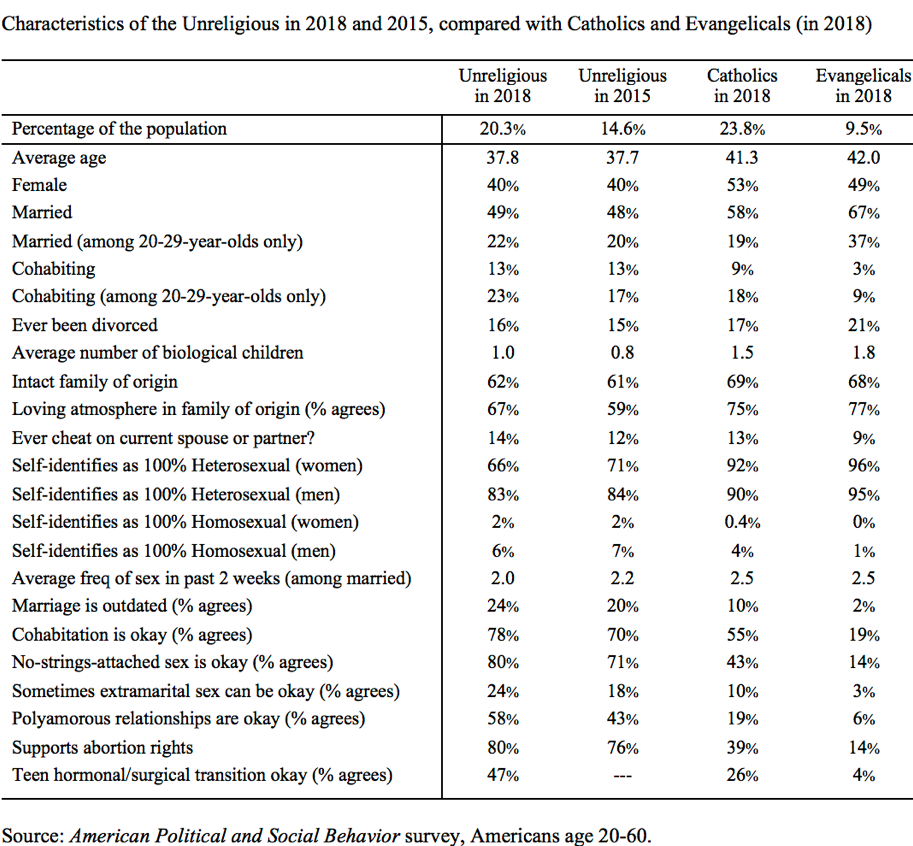
Views of unreligious, Catholic and evangelical Americans
Views of unreligious, Catholic and evangelical Americans (click to expand)

This is interesting:

Even when I limit the group to respondents below age thirty—which is just north of the median age at marriage in the United States—it is notable that 22 percent of the unreligious are married and 23 percent are currently cohabiting, not radically different from the 19 and 18 percent of Catholics that are married and cohabiting, respectively. For comparison, 37 and 9 percent of younger evangelicals are married and cohabiting, respectively. The cohabiting habits of the unreligious, however, have shifted—note the uptick in cohabitation—six percentage points in just under four years. That amounts to a 35 percent increase. Since it’s unlikely that the unreligious have recently changed their minds about the morality or pragmatics of living together, my bet is in the other direction: cohabiting leads many to no longer identify as religious at all.

Got that part in bold? Their attitudes are changing because of their sexual behaviors. So, if you want to reverse the decline of Christianity, we’re going to need to come up with some arguments and evidence to counter the sexual revolution. And on this blog, we’ve done that many times, looking at studies showing the future instability of marriages that occur after cohabitation. I’ve never heard a church preach on that, though. And it’s not something that even many Christian apologists focus on. Most Christian apologists, particularly the women, tend to focus on soft arguments,. They stay away from arguments about morality, because it’s divisive and abrasive to their desired audience. However, if the goal is persuading people that Christianity is a viable worldview, then we need to focus more on sexuality.

More Regnerus:

[O]n each of seven attitude measures I examined, the unreligious are notably more permissive than even the spiritual-but-not-religious (not shown). Nearly 80 percent of unreligious Americans agree (or strongly agree) that cohabitation is okay, no-strings-attached sex is okay, and abortion should be a legal right. This is all unsurprising. But even some of the more radically “progressive” attitudes demonstrate strong support among the unreligious: 24 percent agree that it is “sometimes permissible for a married person to have sex with someone other than his/her spouse.” (I thought perhaps women would differ from men here, but they didn’t—or at least not by much.) Although few Americans are actually in polyamorous living arrangements, the unreligious would support them should someone choose such an arrangement; 58 percent of them agreed that “it is okay for three or more consenting adults to live together in a sexual/romantic relationship,” a percentage that is far more supportive than Catholics or evangelicals. Among the latter, only 6 percent thinks polyamory could be okay.

A more interesting theme, however, is the surge in support for such alternatives. On each statement, note the rise in agreement that has occurred in just under four years. Polyamory tops the list—a 35-percent leap in the share of unreligious who now endorse polyamorous arrangements (from 43 to 58 percent). Even support for extramarital affairs grew by one-third (from 18 to 24 percent). The unreligious aren’t alone here. Catholics, too, have witnessed liberalization in attitudes. Evangelical numbers display a more modest uptick, and from lower starting points.

The non-religious people in my office who were raised Christian like to tell me that the existence of the Christian God isn’t important to them, because they can achieve marriage via cohabitation, and behave like good people without the need for any sort of framework to rationally ground it. They think that you can just pull out God, and the marriage will stay the same. They expect the people they start relationships with to act on Christian morality, even if the worldview was rejected as superstitious nonsense. But as you can see from the data, removing God has an enormous effect on the person’s ability to be stable and faithful.  The truth is that when you take out the vertical relationships with God, then the blueprint for the relationship becomes completely different. Relationships used to be seen as an enterprise where each person’s primary commitment was to lead and protect their spouse before delivering them to God with faith intact. Now, relationships are contingent on continuous happiness.

More Regnerus:

Only 66 percent of unreligious women say they are “100% Despite the permissive reputation of the unreligious, their actual marital sexual frequency is lower than that of Catholic and evangelical couples—at two instances in the past two weeks. As has been documented extensively in the past few years, the frequency of sex among American couples—whether cohabiting or married—has been declining at statistically significant rates. This pattern has not spared the godless.

I think this is interesting. I believe that men are facing an epidemic of sex-withholding from their wives, and I have an idea why that is. Today, women most commonly use sex to “jump start” a relationship with men who they perceive as “high value”, but who refuse to commit to them. This behavior is not focused on men who have commitment abilities, e.g. – provider, moral leader, spiritual leader, accurate worldview rooted in logic and evidence. Instead, most women use sex to get men who have the appearance of high value, e.g. – tall, tattoos, piercings, violent tendencies, exciting, fun, etc. Having established that pattern over and over with no-commitment bad boys, they marry someone who they see as beneath them, and then withhold sex. Commitment isn’t worthy of sex. It’s the man’s appearance and entertainment value that makes him worthy of sex. The comparison of this low-quality man to previous partners makes women more likely to initiate divorce for “unhappiness” later on.


Was Hitler a Christian? Is Nazism similar to Christianity?

A conflict of worldviews

One of the strangest things I have heard from atheists is the assertion that Christianity is somehow connected to the fascism, such as the fascism that existed under Adolf Hitler. Two posts by Jewish author Jonah Goldberg from National Review supply us with the facts to set the record straight.

Let’s start with the first post.

Here are some of the points:

1) Hitler wanted Christianity removed from the public square

Like the engineers of that proverbial railway bridge, the Nazis worked relentlessly to replace the nuts and bolts of traditional Christianity with a new political religion. The shrewdest way to accomplish this was to co-opt Christianity via the Gleichschaltung while at the same time shrinking traditional religion’s role in civil society.

2) Hitler banned the giving of donations to churches

Hitler banned religious charity, crippling the churches’ role as a counterweight to the state. Clergy were put on government salary, hence subjected to state authority. “The parsons will be made to dig their own graves,” Hitler cackled. “They will betray their God to us. They will betray anything for the sake of their miserable little jobs and incomes.”

3) Hitler replaced Christian celebrations with celebrations of the state

Following the Jacobin example, the Nazis replaced the traditional Christian calendar. The new year began on January 30 with the Day of the Seizure of Power. Each November the streets of central Munich were dedicated to a Nazi Passion play depicting Hitler’s Beer Hall Putsch. The martyrdom of Horst Wessel and his “old fighters” replaced Jesus and the apostles. Plays and official histories were rewritten to glorify pagan Aryans bravely fighting against Christianizing foreign armies. Anticipating some feminist pseudo history, witches became martyrs to the bloodthirsty oppression of Christianity.

4) Hitler favored the complete elimination of Christianity

When some Protestant bishops visited the Fuhrer to register complaints, Hitler’s rage got the better of him. “Christianity will disappear from Germany just as it has done in Russia . . . The Germanrace has existed without Christianity for thousands of years . . . and will continue after Christianity has disappeared . . . We must get used to the teachings of blood and race.”

5) Hitler favored the removal of mandatory prayers in schools

In 1935 mandatory prayer in school was abolished…

6) Hitler favored the banning of Christmas carols and nativity plays

…and in 1938 carols and Nativity plays were banned entirely.

7) Hitler abolished religious instruction for children

By 1941 religious instruction for children fourteen years and up had been abolished altogether….

And now the second post.

8) Hitler opposed the ideas of universal truth and objective moral absolutes

…Just as the Nazi attack on Christianity was part of a larger war on the idea of universal truth, whole postmodern cosmologies have been created to prove that traditional religious morality is a scam, that there are no fixed truths or “natural” categories, and that all knowledge is socially constructed.

Practically everything this man believed was 100% anti-Christian. But he fits in fine on the secular left.

Conclusion

Adolf Hitler was a man influenced by two big ideas: evolution and socialism. His party was the national SOCIALIST party. He favored a strong role for the state in interfering with the free market. He was in favor of regulating the family so that the state could have a bigger influence on children. And he favored the idea of survival of the fittest. His ideas are 100% incompatible with Christianity and with capitalism as well. Christians value individual rights and freedoms, small government and the autonomy of the family against the state. The commandments about not coveting and not stealing are incompatible with redistribution of wealth from those who produce to those who “need”. The differences are clear and significant. The Bible favors voluntary charity by individuals and churches. It does not favor redistribution of wealth by a secular government to equalize life outcomes regardless of personal responsibility.

Ignorant atheists and their myths

In a recent debate between Matt Dillahunty and David Robertson, Dillahunty made the claim that Hitler was a Christian, because in a campaign speech, he told a Catholic audience that secular schools were bad, and religious schools were good. Dillahunty thought that this meant that Hitler was a Christian. Robertson asked him when those words were spoken, and whether they formed the basis of any POLICY after Hitler was elected. Dillahunty didn’t know, because he just cited the quotation without knowing anything about the context, or about the historical period. Robertson informed him that the words were spoken in a campaign speech, prior to Hitler’s rise to power, and that nothing in Hitler’s policies ever took the words seriously after he came to power. It was the equivalent of Obama claiming to support natural marriage, then legalizing same-sex marriage once elected. He lied in order to be elected. This kind of ignorance is very prominent in the atheist (“secular humanist”) community, which survives on mythology which is never subjected to rational inquiry. Here’s another good example of this ignorance.

Incidentally, Dillahunty later said, in the same debate no less, that he “didn’t know” if the Holocaust was morally wrong. Right – because on atheism right and wrong are meaningless concepts, rationally speaking. They are reduced to personal preferences only, where each opinion is as valid as the opposite opinion, since there is no objective standard by which to judge different opinions. That’s why atheists can’t make moral judgements about anything, they just have preferences, like their preference for certain foods and certain clothes. Very important to realize this when talking to atheists, because they use moral language to describe their personal feelings and opinions.

Whenever I hear atheists speculating about whether Hitler was a Christian, I immediately know that they have not investigated anything very carefully, and are merely being insulting. It’s not worth having a conversation with people who are stupid AND insulting.

Walter Bradley asks: what is religion really supposed to be about?

Dr. Walter L. Bradley

This lecture is based on the book “Truth in Religion” by famous philosopher Mortimer J. Adler. At the time of writing the book, he was not a Christian, but there is still a lot of value in the book for Christians who are trying to understand what religion should really be about.

About the speaker

The speaker is one of my top 3 favorite speakers of all time in Christian apologetics, Dr. Walter Bradley. (The other two are Dr. Stephen C. Meyer and Dr. Michael Strauss)

Here’s a biography:

Dr. Bradley received his B.S. in Engineering Science and his Ph.D. in Materials Science from the University of Texas in Austin.

Dr. Bradley taught for eight years at the Colorado School of Mines before assuming a position as Professor of Mechanical Engineering at Texas A&M University (TAMU) in 1976.

During his 24 years at Texas A&M, Dr. Bradley served as Head of the Department of Mechanical Engineering at Texas A&M University and as Director of the Polymer Technology Center, and received five College of Engineering Research Awards. He has received over $4,500,000 in research grants and has published over 140 technical articles and book chapters. He has also co-authored “The Mystery Of Life’s Origin: Reassessing Current Theories. He is a Fellow of the American Society for Materials and of the American Scientific Affiliation and serves as a consultant for many Fortune 500 companies.

You can read more about his recent research on how to use coconuts to make car parts in this article from Science Daily.

The MP3 file is here. (31 minutes + Q&A)

Topics:

  • what is pluralism?
  • what is multiculturalism?
  • what is relativism?
  • some propositions are true culturally – just for certain groups in certain times (cultures)
  • some proposition are true trans-culturally – true independently of what anyone wants or feels
  • Mathematical truth is trans-cultural – it is true regardless of cultural fashions
  • Scientific truth is trans-cultural – it is true regardless of cultural fashions
  • Some truths are not like this – cooking traditions, clothing traditions and greeting traditions
  • These kinds of truths are NOT trans-cultural, they vary by culture
  • The question is – is religion true like math and science, or true depending on the culture
  • Some people think that your religion depends on where you were born or what your family believes
  • Religions make conflicting claims about the way the world really is, so they can’t all be true
  • And these conflicts are at the core of the religions – who God is, how can we be related to him, etc.
  • So if religions convey trans-cultural truth, then either one is true or none are true
  • If they are not trying to convey trans-cultural truth, then they are not like math and science
  • Let’s assume that religion is the same as trans-cultural truth
  • How can we know which religion is true? 1) the laws of logic, 2) empirical testing against reality
  • Logical consistency is needed to make the first cut – self-contradictory claims cannot be true
  • To be true trans-culturally, a proposition must at least NOT break the law of non-contradiction
  • According to Mortimer Adler’s book, only Christianity, Judaism and Islam are not self-contradictory
  • All the others can be excluded on the basis of overt internal contradictions on fundamental questions
  • The others that are self-contradictory can be true culturally, but not trans-culturally
  • The way to proceed forward is to test the three non-contradictory religions against science and history
  • One of these three may be true, or they could all be false
  • We can test the three by evaluating their conflicting truth claims about the historical Jesus
  • Famous skeptics have undertaken studies to undermine the historical Jesus presented in the Bible
  • Lew Wallace, Simon Greenleaf and Frank Morrison assessed the evidence as atheists and became Christians
  • There is a lot of opposition in culture to the idea that one religion might be true
  • But if you take the claims of Jesus at face value, he claims to be the unique revelation of God to mankind
  • Either he was telling the truth about that, or he was lying, or he was crazy
  • So which is it?

Why don’t religious people ask if their religion is true?

People seem to be chicken these days about claiming that their religion is true. It’s easier to say that my religion is true for me, and your religion is true for you – reduce it to personal preferences. So long as everyone is sincere about what they believe, then that’s the most important thing, right?

But it is NOT TRUE that you can believe whatever you want as long as you are sincere – sincerity doesn’t mean that you can’t be mistaken. I can jump off the top of the Sears Tower and be sincere in my belief that I will float down like a feather, but that doesn’t make my belief true. If you want to have a good relationship with God, you have to know things about him, not just have sincere beliefs. You have to know whether he exists and what he is like – really. It’s not enough to have sincere beliefs that are not actually true.

I think that God’s existence and character can be assessed and known based on logic and evidence. I think that God exists independently of whether I want him to or not, and I think that his character and desires are not the same as my character and desires. And I don’t really care what my neighbors think of my disagreeing with them, my goal is not to keep silent and to just get along with them and be happier in my community.

God’s first commandment to us is not to love our neighbor – that’s number two. Number one is to love him. And how can we love him, if we don’t want to know him. And how can we love him, if we don’t tell people the truth about him when they ask us?

That message is not going to win us a lot of friends, but our job as Christians is to tell how and why God stepped into history. Jesus expects us to be his ambassadors and to carry out the task of evangelism faithfully, and to suffer with him and – if necessary – to be rejected like he was rejected.