
Tag Archives: Christian Apologetics

If unborn babies don’t have consciousness or don’t feel pain, may we kill them?

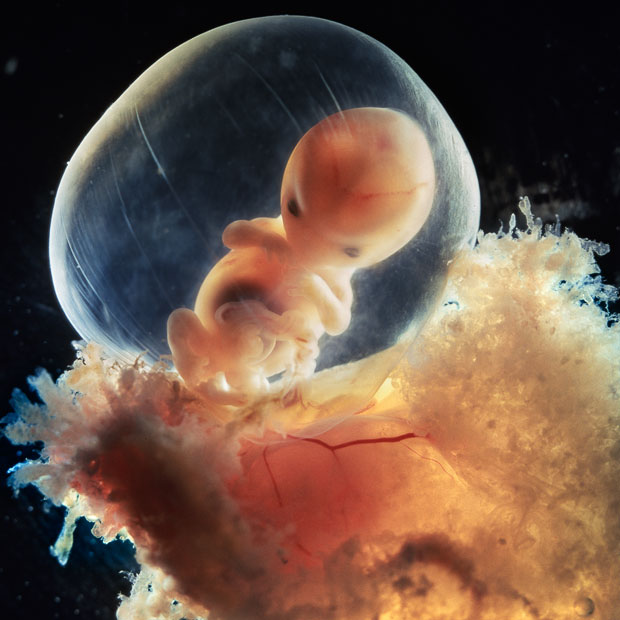
Unborn baby scheming about pro-life apologetics

Was having a conversation by e-mail yesterday with a pro-abortion atheist, and he gave two reasons why he supported abortion in the first and second trimester. First, he said that unborn babies can’t feel pain, so it’s OK to kill them. Second, he said that unborn babies don’t have consciousness, so it’s OK to kill them. I thought it might be useful to link to something that answers both of these objections.

Frank Beckwith is the author of “Defending Life: A Moral and Legal Case Against Abortion Choice“, which was published by Cambridge University Press, a top academic press. But before Cambridge University Press, Beckwith wrote four easy-to-understand essays for the Christian Research Journal. Part IV is the one that has the response to the two questions raised by my atheist friend.

Part I. The Appeal to Pity

Part II. Arguments from Pity, Tolerance, and Ad Hominem

Part III. Is The Unborn Human Less Than Human?

Part IV. When Does a Human Become a Person?

Excerpt:

Some ethicists argue that the unborn becomes fully human sometime after brain development has begun, when it becomes sentient: capable of experiencing sensations such as pain. The reason for choosing sentience as the criterion is that a being that cannot experience anything (i.e., a presentient unborn entity) cannot be harmed. Of course, if this position is correct, then the unborn becomes fully human probably during the second trimester and at least by the third trimester. Therefore, one does not violate anyone’s rights when one aborts a nonsentient unborn entity. [13]

There are several problems with this argument. First, it confuses harm with hurt and the experience of harm with the reality of harm. [14] One can be harmed without experiencing the hurt that sometimes follows from that harm, and which we often mistake for the harm itself. For example, a temporarily comatose person who is suffocated to death “experiences no harm,” but he is nevertheless harmed. Hence, one does not have to experience harm, which is sometimes manifested in hurt, in order to be truly harmed.

Second, if sentience is the criterion of full humanness, then the reversibly comatose, the momentarily unconscious, and the sleeping would all have to be declared nonpersons. Like the presentient unborn, these individuals are all at the moment nonsentient though they have the natural inherent capacity to be sentient. Yet to countenance their executions would be morally reprehensible. Therefore, one cannot countenance the execution of some unborn entities simply because they are not currently sentient.

Someone may reply that while these objections make important points, there is a problem of false analogy in the second objection: the reversibly comatose, the momentarily unconscious, and the sleeping once functioned as sentient beings, though they are now in a temporary state of nonsentience. The presentient unborn, on the other hand, were never sentient. Hence, one is fully human if one was sentient “in the past” and will probably become sentient again in the future, but this cannot be said of the presentient unborn.

There are at least three problems with this response. First, to claim that a person can be sentient, become nonsentient, and then return to sentience is to assume there is some underlying personal unity to this individual that enables us to say that the person who has returned to sentience is the same person who was sentient prior to becoming nonsentient. But this would mean that sentience is not a necessary condition for personhood. (Neither is it a sufficient condition, for that matter, since nonhuman animals are sentient.) Consequently, it does not make sense to say that a person comes into existence when sentience arises, but it does make sense to say that a fully human entity is a person who has the natural inherent capacity to give rise to sentience. A presentient unborn human entity does have this capacity. Therefore, an ordinary unborn human entity is a person, and hence, fully human.

Second, Ray points out that this attempt to exclude many of the unborn from the class of the fully human is “ad hoc and counterintuitive.” He asks us to “consider the treatment of comatose patients. We would not discriminate against one merely for rarely or never having been sentient in the past while another otherwise comparable patient had been sentient….In such cases, potential counts for everything.” [15]

Third, why should sentience “in the past” be the decisive factor in deciding whether an entity is fully human when the presentient human being “is one with a natural, inherent capacity for performing personal acts?” [16] Since we have already seen that one does not have to experience harm in order to be harmed, it seems more consistent with our moral sensibilities to assert that what makes it wrong to kill the reversibly comatose, the sleeping, the momentarily unconscious, and the presentient unborn is that they all possess the natural inherent capacity to perform personal acts. And what makes it morally right to kill plants and to pull the plug on the respirator-dependent brain dead, who were sentient “in the past,” is that their deaths cannot deprive them of their natural inherent capacity to function as persons, since they do not possess such a capacity.

These four essays are a very good introduction to common responses to pro-abortion arguments. I recommend that people get familiar with this, as once you look into it, you will see that the abortion issue can be debated with as much confidence as William Lane Craig defends Christian theism. You will have the same access to scientific evidence and rational arguments on this topic, and so you will have the upper hand. And that’s fun.

The best introductory book on the abortion / right to life issue is “The Case for Life” by pro-life debater Scott Klusendorf. The best comprehensive book is a tie between “The Ethics of Abortion” by Christopher Kaczor, and Frank Beckwith’s “Defending Life: A Moral and Legal Case Against Abortion Choice“.

Is the vastness of the universe evidence against God’s existence?

Christianity and the progress of science

Physicist Hugh Ross writes about it in Salvo Magazine.

First a quick blurb about Hugh Ross:

Hugh Ross launched his career at age seven when he went to the library to find out why stars are hot. Physics and astronomy captured his curiosity and never let go. At age seventeen he became the youngest person ever to serve as director of observations for Vancouver’s Royal Astronomical Society. With the help of a provincial scholarship and a National Research Council (NRC) of Canada fellowship, he completed his undergraduate degree in physics (University of British Columbia) and graduate degrees in astronomy (University of Toronto). The NRC also sent him to the United States for postdoctoral studies. At Caltech he researched quasi-stellar objects, or “quasars,” some of the most distant and ancient objects in the universe.

Now back to the topic “Is the vastness of the universe incompatible with God’s existence?”

Here’s Ross’ introduction:

Scientists seem more difficult to please than the golden-haired girl of fairy-tale fame. While Goldilocks troubled herself over the just-right porridge, chair, and bed, astronomers appear preoccupied with the size of the universe.

In the days before telescopes, when an observer could count a few thousand stars in the night sky, many considered the universe too small and unimpressive to be the work of an almighty, all-knowing Creator. Only an infinite cosmos, they said, would befit an infinite deity. But then, others argued, an infinite cosmos might eliminate the need for a Creator.

Thanks to the Hubble space telescope, scientists now see that the universe contains roughly 200 billion large- and medium-sized galaxies and about a hundred times as many dwarf galaxies. The stars in those galaxies add up to about fifty billion trillion, and they comprise a mere one percent of the mass of the observable universe.

Because of the travel time of light, the universe humans can observe is really the universe of the past. What researchers know about the expansion and geometry of the universe informs us that the universe of today is at least several hundred times more enormous than the universe we can see. The universe is trillions of trillions of times larger and more spectacular than what the earliest astronomers presumed!

And yet, this new knowledge of the vastness of the universe has led to new complaints. In his book, God: The Failed Hypothesis, Victor Stenger says, “If God created the universe as a special place for humanity, he seems to have wasted an awfully large amount of space.” Stephen Hawking, in the best-selling science book of all time, A Brief History of Time, shares Stenger’s view: “Our solar system certainly is a prerequisite for our existence. . . . But there does not seem to be any need for all these other galaxies.” So now the universe is too big to befit the all-wise, all-powerful God of the Bible.

I like how he quotes an atheist physicist to get the challenge right. No sense in caricaturing the claim of your opponent.

I formalized Stenger’s argument like this:

  1. If all things in the universe are not done the way that Victor Stenger likes them, then there is no God.
  2. All things in the universe were not done the way Victor Stenger likes them.
  3. Therefore, there is no God.

I would deny premise 1, there, since there is no reason to believe that’s it’s true.

Anyway, let’s see what Hugh Ross says:

The hot big bang model (now firmly established by observations) tells us that at the moment of cosmic creation, the universe was infinitely or near-infinitely hot and compressed, and all the ordinary matter existed in the form of hydrogen. As the universe expanded, it cooled. The rate at which the universe expanded and cooled depended in large part on its mass—the greater the mass, the slower the expansion and cooling rate. The slower the expansion and cooling rate, the more time the universe would spend in the temperature range (13–150 million degrees Centigrade) at which nuclear fusion can occur.

Because of its mass, the universe spent about twenty seconds in the nuclear fusion temperature range when it was between three and four minutes old. As a result, 24.77 percent of the universe’s hydrogen (by mass) fused into helium. Thus, when stars began to form—about 380,000 years later—they started off composed of about 75 percent hydrogen, 25 percent helium, and trace amounts of deuterium, lithium, and beryllium.

In the nuclear furnaces of the stars themselves, more hydrogen fused into helium, and, in addition to the extra helium, all the rest of the elements that appear in the periodic table were synthesized (created). The capacity of stellar nuclear furnaces to produce an abundance of elements heavier than helium (all but two of the elements) depended critically on how much of the universe’s initial hydrogen was fused into helium and heavier elements during the first several minutes after the cosmic creation event. How much fusion of the universe’s primordial hydrogen actually occurred at this time depended, in turn, on the universe’s mass or mass density.

If the universe’s mass (or cosmic mass density) had been even the slightest bit less than a hundred times the fifty billion trillion stars occupying the observable universe, nuclear fusion during the first several minutes of its existence would have proceeded less efficiently. Thus, the cosmos would have been forever incapable of generating elements heavier than helium—elements such as carbon, nitrogen, oxygen, phosphorus, sodium, and potassium—all of which are essential for any conceivable kind of physical life.

On the other hand, if the universe’s mass had been even the slightest bit greater, nuclear fusion during the first several minutes after its beginning would have been too productive, and all the hydrogen in the universe eventually would have been fused (after just two generations of stars) into elements as heavy as iron or heavier. Again, all the most life-essential elements, including hydrogen itself, would have ceased to exist.

Basically, your body is made up of heavier elements, and if the universe was not as massive as it is (and as old as it is), then there would not be enough heavy elements to make you, or to make massive stars like our Sun which burn steady for long periods of time. We need the heavy elements and we need the steady source of heat.

Dr. Ross has another reason why God would use vast space and long periods of time, and if you want to read that, you can click here. I think that it’s important for us all to get used to the idea that we all need to understand science apologetics. God put these evidences into the universe for us to discover and use.

William Lane Craig lectures on the moral argument at Georgia Tech

Making sense of the meaning of atheism

This video has 3 parts, as well as questions and answers in individual clips.

For those who cannot watch the video, you can read this essay by Dr. Craig which covers exactly the same ground as the video. The essay is for Christians already familiar with basic apologetics.

Part 1 of 3:

Part 2 of 3:

Part 2 of 3:

Here’s a quick couple of quotes from the essay for those who cannot watch:

If there is no God, then any ground for regarding the herd morality evolved by homo sapiens as objectively true seems to have been removed. After all, what is so special about human beings? They are just accidental by-products of nature which have evolved relatively recently on an infinitesimal speck of dust lost somewhere in a hostile and mindless universe and which are doomed to perish individually and collectively in a relatively short time. Some action, say, incest, may not be biologically or socially advantageous and so in the course of human evolution has become taboo; but there is on the atheistic view nothing really wrong about committing incest. If, as Kurtz states, “The moral principles that govern our behavior are rooted in habit and custom, feeling and fashion,”5 then the non-conformist who chooses to flout the herd morality is doing nothing more serious than acting unfashionably.

The objective worthlessness of human beings on a naturalistic world view is underscored by two implications of that world view: materialism and determinism. Naturalists are typically materialists or physicalists, who regard man as a purely animal organism. But if man has no immaterial aspect to his being (call it soul or mind or what have you), then he is not qualitatively different from other animal species. For him to regard human morality as objective is to fall into the trap of specie-ism. On a materialistic anthropology there is no reason to think that human beings are objectively more valuable than rats. Secondly, if there is no mind distinct from the brain, then everything we think and do is determined by the input of our five senses and our genetic make-up. There is no personal agent who freely decides to do something. But without freedom, none of our choices is morally significant. They are like the jerks of a puppet’s limbs, controlled by the strings of sensory input and physical constitution. And what moral value does a puppet or its movements have?

[…]Moreover, if atheism is true, there is no moral accountability for one’s actions. Even if there were objective moral values and duties under naturalism, they are irrelevant because there is no moral accountability. If life ends at the grave, it makes no difference whether one lives as a Stalin or as a saint. As the Russian writer Fyodor Dostoyevsky rightly said: “If there is no immortality, then all things are permitted.”

If you want a much shorter, slicker version of this argument to share, Reasonable Faith has produced this nice 5-minute video that you can tweet or share on your Facebook page or whatever:

The moral argument is the easiest argument in the world to discuss with non-Christians, as everyone has to have an answer to questions like “what makes humans valuable?” and “why should I do the right thing when it goes against my self-interest?” and “will evildoers who escape justice in this life be punished when they die?” and “do humans have free will to make moral choices?” These are interesting questions, and people can just give their opinion and then think about it as they discuss it.

If you want to show this lecture and Q&A to your apologetics group, you can find the DVD here.

You can also read a debate transcript where Dr. Craig puts his ideas to the test, against Dr. Richard Taylor. I found this debate very helpful for answering the question that everyone should be able to answer: “why should I be moral?”
