Mothers who stay at home to look after their children do not need as much financial help as those who work, according to the Treasury.
The insulting claim was inadvertently published yesterday as part of a briefing on the Government’s new childcare plans.
It fuelled accusations that the scheme will deliberately discriminate against traditional single-earner families in an attempt to force more mothers back to work.
Critics described the new policy as a ‘slap in the face for two million stay-at-home mothers’.
The Treasury briefing, designed to help press officers ‘rebut’ criticism, stated: ‘Working families who are struggling with their childcare costs, or families where parents want to go to work but can’t afford to are in greater need of state support for child care than families where one parent chooses to stay at home and look after their children full-time.’
David Cameron and Nick Clegg yesterday confirmed that working couples who each earn less than £150,000 will qualify for child care tax breaks worth up to £1,200 a year per child from 2015.
That means they could have a joint income of nearly £300,000 and still qualify.
They will receive 20 per cent – equivalent to the basic rate of tax – of their yearly childcare costs, up to a total of £6,000 per child. This will save a typical working family with two children under 12 up to £2,400 a year.
Single parents who are employed and earn less than £150,000 will also be eligible.
But, in a move that will anger Tory traditionalists, the Government confirmed that families in which only one parent works will not receive a penny.
David Cameron is also pushing gay marriage really hard, in spite of public opinion. I’m not even sure why he calls himself a conservative.
Eight years after that wonderful engagement party in 1989, I walked away from dear, devoted, loyal Matthew, convinced that somewhere out there, a better, more exciting, more fulfilling life awaited me.
Only there wasn’t.
Now I am 42 and have all the trappings of success – a high-flying career, financial security and a home in the heart of London’s trendy Notting Hill. But I don’t have the one thing I crave more than anything: a loving husband and family.
So what happened? Well, here’s what:
In the summer of 1989, while out for a romantic meal, Matthew proposed properly with a diamond solitaire ring. Two months later, we held our engagement party for 40 friends and family at the little house we were renting at the time.
The following year, we bought a tiny starter home in Grays, Essex, which we moved into with furniture we had begged, borrowed and stolen. We giggled with delight at the thought of this grown-up new life.
I was in my first junior role at a women’s magazine and Matthew worked fitting tyres and exhausts, so our combined salaries of around £15,000 a year meant we struggled to make the mortgage payments. But we didn’t care, telling ourselves that it wouldn’t be long before we were earning more and able to afford weekly treats and a bigger home where we could bring up the babies we had planned.
But then, the housing market crashed and we were plunged into negative equity.
Struggling should have brought us closer together, and at first it did. But as time went on, and my magazine career – and salary – advanced, I started to resent Matthew as he drifted from one dead-end job to another.
I still loved him, but I began to feel embarrassed by his blue-collar jobs, annoyed that, despite his intelligence, he didn’t have a career. Then he bought a lurid blue and pink VW Beetle.
Why couldn’t he drive a normal car? Things that now seem incredibly insignificant began to niggle.
I began to wish he was more sophisticated and earned more. I felt envious of friends with better-off partners, who were able to support them as they started their families.
I stopped seeing Matthew as my equal. I stopped seeing all the qualities that had made me fall in love with him – his fierce intelligence, our shared sense of humour, his determination not to follow the crowd. Instead, I saw someone who was holding me back.
Our sex life had dwindled and nights out together were rare. I stopped appreciating little things he did, like leaving romantic notes on the pillow or scouring secondhand bookshops for novels he knew I’d love. He was my best friend, yet I took him totally for granted.
After festering for weeks about his shortcomings, I told Matthew I was leaving. We spent hours talking and crying as he tried to convince me to stay, but I was adamant.
My parents were horrified that I was walking away from a man they felt was right for me. My father’s words to me that day continue to haunt me. ‘Karen, think carefully about what you’re doing. There’s a lot to be said for someone who truly loves you.’
But, I refused to listen, convinced there would be another, better Mr Right waiting around the corner.
I moved into a rented flat a few miles away in Hornchurch, Essex, and embraced single life with a vengeance. By now I was an editor on a national magazine. Life was one long round of premieres and dinner or drinks parties.
One of the commenters on Facebook said this:
This is what feminism and narcissism (which are rampant in our society) have done to women. Feminism told her that she should work, have a career, climb the ladder – and that this is the most important thing. Marriage and family are goals unworthy of a woman, according to feminism. Narcissism told her that her own goals and desires were the most important thing in the world. Other people and their needs are only important if they coincide with what she wants. If someone is “bringing her down” or “holding her back” they need to get out of the way because her desires are what is most important. So when her marriage required her to actually sacrifice a bit of her own ambition, she walked away from it. What a stupid and self-centered thing to do.
I found another article by her where she spent £5,000 on cosmetic surgery. It’s just strange where she ended up.
Fewer than one in ten women stay at home to look after their children
Latest census figures show 300,000 fewer staying home than thought
Concerns for well-being of mothers and impact on toddlers in day care
Stay-at-home figures dropped from 17 per cent of women 20 years ago
The stay-at-home mother is fast becoming consigned to history, according to the latest census figures.
Returns showed there are 300,000 fewer than officials had previously estimated, with those who devote their lives to bringing up families now reduced to a tiny minority.
Fewer than one in ten women of working age are stay-at-home mothers.
The collapse follows a decade in which governments urged mothers to take jobs on the grounds that working is the route to fulfilment for women and that families with two incomes are much less likely to fall into poverty.
Critics, however, are concerned for the well-being of mothers who might prefer to be with their families, and the impact on increasing numbers of toddlers who spend long hours in day care.
The 2011 census results found there are 1,598,000 women who do not work because they are looking after their home and family – 298,000 fewer than estimates from the Office for National Statistics.
Note that this is applauded by feminist groups, like the UK Labour Party:
The decline in numbers of stay-at-home mothers will be welcomed by ministers as the Labour drive to push mothers into work has continued under the Coalition.
Childcare minister Elizabeth Truss has made a priority of providing cheaper day care to help mothers into jobs.
In an article earlier this year she said it was ‘vital’ for mothers to work, adding: ‘To power ahead Britain needs to look at best practice from overseas to discover how to increase women’s participation, especially for those who are parents.’
But critics say the sky-high level of house prices and the lack of help for two-parent families in the tax and benefit systems means most mothers have to work, whether they like it or not.
Earlier this week I blogged studies that showed the importance of fathers to children. But it’s important to remember that mothers are also important to children, especially in the first few years of the child’s life. And we have studies to back that up as well.
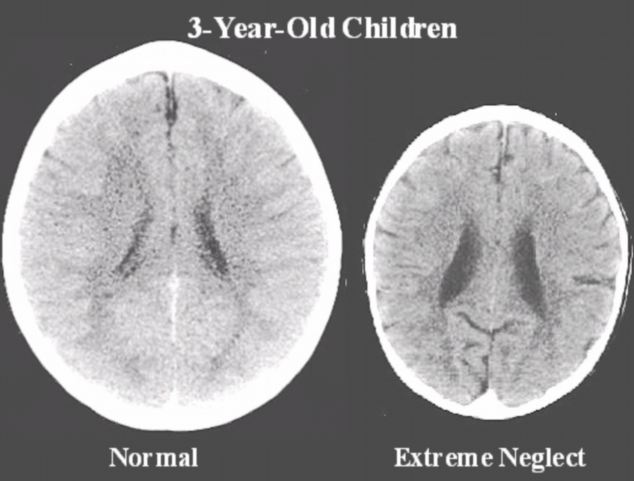
Brain scans of 3-year old children: normal vs neglected
This was discussed before in another article from the UK Daily Mail. (H/T Dina)
Excerpt:
Both of these images are brain scans of a two three-year-old children, but the brain on the left is considerably larger, has fewer spots and less dark areas, compared to the one on the right.
According to neurologists this sizeable difference has one primary cause – the way each child was treated by their mothers.
The child with the larger and more fully developed brain was looked after by its mother – she was constantly responsive to her baby, reported The Sunday Telegraph.
But the child with the shrunken brain was the victim of severe neglect and abuse.
According to research reported by the newspaper, the brain on the right worryingly lacks some of the most fundamental areas present in the image on the left.
The consequences of these deficits are pronounced – the child on the left with the larger brain will be more intelligent and more likely to develop the social ability to empathise with others.
But in contrast, the child with the shrunken brain will be more likely to become addicted to drugs and involved in violent crimes, much more likely to be unemployed and to be dependent on state benefits.
The child is also more likely to develop mental and other serious health problems.
Professor Allan Schore, of UCLA, told The Sunday Telegraph that if a baby is not treated properly in the first two years of life, it can have a fundamental impact on development.
He pointed out that the genes for several aspects of brain function, including intelligence, cannot function.
[…]The study correlates with research released earlier this year that found that children who are given love and affection from their mothers early in life are smarter with a better ability to learn.
The study by child psychiatrists and neuroscientists at Washington University School of Medicine in St. Louis, found school-aged children whose mothers nurtured them early in life have brains with a larger hippocampus, a key structure important to learning, memory and response to stress.
The research was the first to show that changes in this critical region of children’s brain anatomy are linked to a mother’s nurturing, Neurosciencenews.com reports.
The research is published online in the Proceedings of the National Academy of Sciences Early Edition.
Lead author Joan L. Luby, MD, professor of child psychiatry, said the study reinforces how important nurturing parents are to a child’s development.
If we are really interested in providing for the needs of young children, then we have to voluntarily limit the freedom of adults. Traditional marriage is the way that societies have provided for the needs of young children. Marriage puts boundaries on sexual activity (premarital chastity, post-marital fidelity) that are beneficial to children. Children need to have access to their parents over the course of their development.
We should be promoting behaviors and policies that strengthen marriage, like chastity and low tax rates. We should be opposing behaviors and policies that weaken marriages, like hooking-up and no-fault divorce. That’s what we would do if we really had the best interests of children at heart instead of the best interests of adults.

 WINTERY KNIGHT