Tag Archives: Book

A summary of Dr. Laura’s Proper Care and Feeding of Husbands

Sue Bohlin of Probe Ministries read the book and her assessment is here.

Excerpt:

Talk show host Dr. Laura Schlessinger has written a book that is improving thousands of marriages: The Proper Care and Feeding of Husbands.{1} We need this book because millions of wives either don’t know how to love their husbands wisely and well, or they’re too self-centered to see it as important. Dr. Laura credits this dismal condition to forty years of feminist philosophy, “with its condemnation of just about everything male as evil, stupid, and oppressive, and the denigration of female and male roles in families.”{2} While the women’s movement certainly had a hand to play in the disintegration of relationships and the family, I believe the core cause is our sinful self-centeredness, just as the Bible says.{3}

Which is why we need help, and God instructs older women to train younger women to love their husband and children, to be self-controlled and pure, to be busy at home, to be kind, and to be subject to their husbands, so that no one will malign the word of God.{4} The Proper Care and Feeding of Husbands is a great resource for learning these important values and skills.

She talks about men’s needs for direct communication, respect, appreciation, support, and sex.

And ends with this:

I can’t recommend The Proper Care and Feeding of Husbands highly enough. In fact, I gave a copy to my new daughter-in-law! Let me close with one more piece of wisdom from Dr. Laura: “[M]en are simple creatures who come from a woman, are nurtured and brought up by a woman, and yearn for the continued love, admiration and approval of a woman. . . Women need to better appreciate the magnitude of their power and influence over men, and not misuse or abuse it.”{25} Amen!

And here’s another summary of the book that I found.

Full text:

Dr. Laura Schlessinger has written another book that deserves a place on the best seller list with six of her other books, such as Ten Stupid Things Women Do to Mess Up Their Lives and Ten Stupid Things Men Do to Mess Up Their Lives. The Proper Care and Feeding of Husbands, from this unmarried man’s perspective, is an excellent manual for women on how to get want they want from men and marriage and, generally, how to be happy. Dr. Laura makes a number of important, practical points, based on her experience in private practice, from advising her radio callers, and from literally hundreds of letters and emails she received from men and women while she was writing the book. Here are the points that struck this writer, together with commentary:

1. Men Need Women, and This Need Gives Women Huge Influence. Dr. Laura states the point as follows: “[M]en are simple creatures who come from a woman, are nurtured and brought up by a woman, and yearn for the continued love, admiration, and approval from a woman.” Women have great power and influence over men, and wives in particular have tremendous power over their husbands. How they use this power essentially controls the relationship, because women are the masters of most relationships and marriages. That’s why Dr. Laura says that she probably won’t write The Proper Care and Feeding of Wives: wives already have most of the power and their marriages depend, for the most part, on them.

2. Women Err in Favoring Children Over Husband. A friend once told this writer that once a woman has children, her husband is relegated to the moral equivalence of a piece of furniture. How sad if this is true in many marriages. Here’s how Dr. Laura puts it: “Once wives became mothers, they had no time to be wives. The men would even compliment their wives on being great mothers, but expressed considerable pain over not being shown love, affection, or sexual interest. The typical reply from a wife challenged with this was ‘I only have time to take care of one person, and our child is that person. I’m just too tired for you.’ This puts fathers in the ugly and uncomfortable position of feeling competitive with and resentful of their children, whom they love so much.”

3. Men and Women Are Different. That men and women are deeply different ought not to be notable, but for the fact that it is so often challenged today. Dr. Laura says that society tries to make both men and women “unisex.” But men are happiest being men, and women are happiest being women, with few exceptions. The differences start to manifest themselves very early. In one study Dr. Laura mentions, a barrier was placed between 1 year-old babies and their mothers. What did the little boys do? They attempted to get around the barrier or knock it down. The little girls? They cried until their mothers’ picked them up. Men tend to respond to things physically, women verbally. In fact, the two sexes are just right for each other.

4. Not Every Thought and Feeling Needs to be Said. Women tend to be so verbal, so expressive, that they can tire out men easily unless they exercise some restraint. Dr. Laura reports that wives generally overwhelm their husbands with communication. “Husbands imagine (so foolishly) that their wives are telling them something they actually need to know because they’re supposed to do something about it. Otherwise, men can’t imagine why the ‘communication’ is happening at all. It confuses them, frustrates them, and their response is to turn off. That’s when they unfairly become labeled insensitive.” Husbands and fiances are not girlfriends or psychologists, and women who want attention should adjust their communication style accordingly when speaking with them.

5. Men Are Not Mind-Readers. Most men are not very intuitive compared to most women. Many women “get caught up in the absurdly romanticized notion that ‘if he loved me, he’d just know what I’m thinking, what I’d like, what he should say.'” If a woman wants her man to do something, she should just ask him plainly, without nagging, and show appreciation when he does it. To act otherwise, as many women do, shows arrogance and lack of respect for the husband’s difference, and it leads to unhappiness in the marriage and in the family.

6. Man Is an Embodied Soul. No, Dr. Laura didn’t put it that way; “embodied soul” is a Catholic concept. But that concept is what underlies her discussion of how important it is to a man that his wife try to keep up her appearance. What does it mean that we are embodied souls? It means that our bodies are integral parts of who we are. We are not just souls. Our bodies are not like clothing that we can take on or off. There was no time during which we had only souls and not bodies, and in eternity as well we will have bodies. It is through our bodies, in fact, that we communicate to our loved ones and to the rest of the world. One thinks of the beautiful line from the old Anglican marriage rite: bride and groom pledge to each other “with my body I thee worship.” It is ironic, but in many cases men–sex-crazed pigs in the minds of many women–actually have a truer understanding of the beauty of the body and the meaning of the marital embrace than their wives do. “Objectification” may come as much or more from the woman’s side as from the husband’s if the woman sees her own body as being separate from rather than an integral part of herself. Dr. Laura writes: “In reading all the letters from men, I was struck by their depth of senstivity about the issue of women’s appearance. It wasn’t an impersonal, animal reaction (as it is with women the men don’t personally know), it was a deeply personal one. The wife’s comfort with and appreciation of her own body and femininity, and her willingness to share that with her husband, actually fed his sense of well-being, his feeling of being loved as a husband and valued as a ‘man.'”

7. Infidelity by Omission. Brides and grooms make a number of vows, not only of sexual fidelity. Marital vows include and imply words like love, honor, protect, and care for. “[W]hen one breaches those vows by neglect, is that also not a form of infidelity? Perhaps we should start looking at the act of intentionally depriving a spouse of legitimate needs as infidelity, too, because it stems from being unfaithful to the intent of the vows.”

8. In the Bedroom. To her credit, Dr. Laura gives due place to the importance for marriage of the marital act: “The bedroom is the foundation of marriage and family.” St. Josemaria Escriva, founder of Opus Dei, that supposedly conservative institution within the Church, put it this way: “The marriage bed is an altar.” Enough said?

9. Women Should Appreciate Men’s Masculinity. Dr. Laura relates a trip she made recently to a swimming pool. A mom and a dad were wading with their infant child. Mom held the child against her chest, cooed to him, and swooped him up and down. She passed the baby to dad. He turned the baby’s face outward and swooshed him forward and up into the air. “Mom equals protection and nurturance. Dad equals autonomy and adventure. It is the perfect balance that helps produce a functional, secure human being.” Too many women, though, act like Alice Kramdens, constantly belitting their husbands, shooting down their aspirations, treating them like children. Dr. Laura writes: “When a wife treats her man like he’s one of her children, when she puts him down or thwarts his need for autonomy, adventure, risk, competition, challenge, and conquest, she ends up with a sullen, unooperative, unloving, hostile lump.”

10. Thou Shalt Not Covet. Dr. Laura contributes a novel (to this writer) and insightful contemporary application of the commandment, “thou shal not covet.” Specifically, she understands it as a rebuke to people who want it all, especially feminists. “Perhaps the feminist notions about women having power if they do it all has obstructed too many women’s ability to realize that in real life we all make choices, and that the true joy and meaning of life is not in how many things we have or do, but in the sacrifice and commitment we make to others within the context of the choices we’ve made. The Tenth Commandment, about coveting, reminds us that none of us can have everything there is nor everything we want. Without enjoying and appreciating our gifts and blessings, we create a hell on earth for ourselves and for those who love us.”

Please make an effort to buy this book and read it.
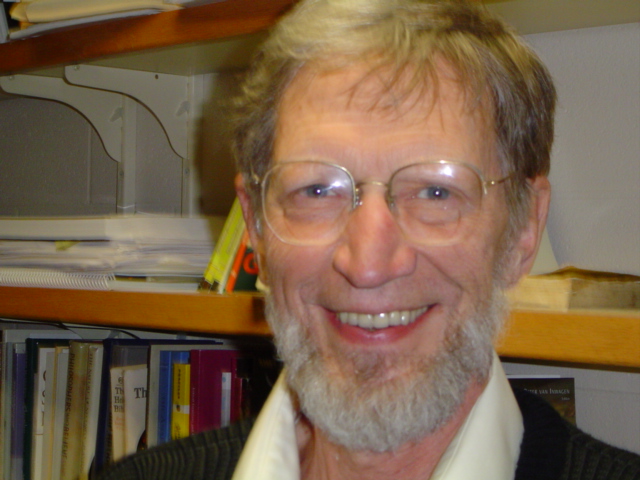
New York Times profiles philosopher Alvin Plantinga and discusses his new book

Christian philosopher Alvin Plantinga

Alvin Plantinga is widely regarded as the top Christian philosopher in the world, and a former head of the largest professional association of philosophers – the American Philosophical Association (APA).

 Mary sent me this article from the New York Times about Alvin Plantinga and his new book, published by Oxford University Press – the top academic press in the world.

Excerpt:

From Calvin [College], and later from the University of Notre Dame, Mr. Plantinga has led a movement of unapologetically Christian philosophers who, if they haven’t succeeded in persuading their still overwhelmingly unbelieving colleagues, have at least made theism philosophically respectable.

“There are vastly more Christian philosophers and vastly more visible or assertive Christian philosophy now than when I left graduate school,” Mr. Plantinga said in a recent telephone interview from his home in Grand Rapids, adding, with characteristic modesty, “I have no idea how it happened.”

Mr. Plantinga retired from full-time teaching last year, with more than a dozen books and a past presidency of the American Philosophical Association to his name. But he’s hardly resting on those laurels. Having made philosophy safe for theism, he’s now turning to a harder task: making theism safe for science.

For too long, Mr. Plantinga contends in a new book, theists have been on the defensive, merely rebutting the charge that their beliefs are irrational. It’s time for believers in the old-fashioned creator God of the Bible to go on the offensive, he argues, and he has some sports metaphors at the ready. (Not for nothing did he spend two decades at Notre Dame.)

In “Where the Conflict Really Lies: Science, Religion and Naturalism,” published last week by Oxford University Press, he unleashes a blitz of densely reasoned argument against “the touchdown twins of current academic atheism,” the zoologist Richard Dawkins and the philosopher Daniel C. Dennett, spiced up with some trash talk of his own.

[…] Longtime readers of Mr. Plantinga, who was raised as a Presbyterian and who embraced the Calvinism of the Christian Reformed Church as a young man, are used to such invocations of theological concepts. And even philosophers who reject his theism say his arguments for the basic rationality of belief, laid out in books like “Warranted Christian Belief” and “God and Other Minds,” constitute an important contribution that every student of epistemology would be expected to know.

But Mr. Plantinga’s steadfast defense of the biochemist and intelligent-design advocate Michael Behe, the subject of a long chapter in the new book, is apparently another matter.

“I think deep down inside he really isn’t a friend of science,” Michael Ruse, a philosopher of science at Florida State University, said of Mr. Plantinga. “I’m not objecting to him wanting to defend theism. But I think he gets his victory at the level of gelding or significantly altering modern science in unacceptable ways.”

Mr. Dennett was even harsher, calling Mr. Plantinga “Exhibit A of how religious beliefs can damage or hinder or disable a philosopher,” not to mention a poor student of biology. Evolution is a random, unguided process, he said, and Mr. Plantinga’s effort to leave room for divine intervention is simply wishful thinking.

“It’s just become more and more transparent that he’s an apologist more than a serious, straight-ahead philosopher,” Mr. Dennett said.

When Mr. Plantinga and Mr. Dennett (who said he has not read Mr. Plantinga’s new book) faced off over these questions before a standing-room-only crowd at a 2009 meeting of the American Philosophical Association, the event prompted ardent online debate over who had landed better punches, or simply been more condescending. (A transcript of the proceedings was published last year as “Science and Religion: Are They Compatible?”)

Mr. Plantinga, who recalled the event as “polite but not cordial,” allowed that he didn’t think much of Mr. Dennett’s line of reasoning. “He didn’t want to argue,” Mr. Plantinga said. “It was more like he wanted to make assertions and tell stories.”

Would you like to know how well Daniel Dennett can debate the naturalism/theism dispute? First of all, Plantinga has debated Dennett, and you can find the audio for it at Apologetics 315.

William Lane Craig also presented several arguments against naturalism to Daniel Dennett in 2007, and Dennett responded by calling it a “first-rate piece of philosophical reasoning”. I link to the exchange and complain about Dennett’s weak response to Craig’s arguments in a previous post.

You may also find this recent interview with Alvin Plantinga, conducted by Brian Auten, informative.

The resurgence of Christian theism in analytical philosophy

Now let’s move from the specific to the aggregate. What is going on with these Christian philosophers?

Well, you can read an excellent article about the resurgence of Christian theism in philosophy departments in the peer-reviewed philosophy journal Philo, which, in my opinion, is the best journal for atheists and agnostic philosophers. The article is authored by the well-known atheist Quentin Smith.

He writes:

THE DESECULARIZATION OF ACADEMIA THAT EVOLVED IN PHILOSOPHY DEPARTMENTS SINCE THE LATE 1960s

By the second half of the twentieth century, universities and colleges had been become in the main secularized. The standard (if not exceptionless) position in each field, from physics to psychology, assumed or involved arguments for a naturalist world-view; departments of theology or religion aimed to understand the meaning and origins of religious writings, not to develop arguments against naturalism. Analytic philosophers (in the mainstream of analytic philosophy) treated theism as an antirealist or non-cognitivist world-view, requiring the reality, not of a deity, but merely of emotive expressions or certain “forms of life” (of course there were a few exceptions, e.g., Ewing, Ross, Hartshorne, etc., but I am discussing the mainstream view).

[…]The secularization of mainstream academia began to quickly unravel upon the publication of Plantinga’s influential book on realist theism, God and Other Minds, in 1967. It became apparent to the philosophical profession that this book displayed that realist theists were not outmatched by naturalists in terms of the most valued standards of analytic philosophy: conceptual precision, rigor of argumentation, technical erudition, and an in-depth defense of an original world-view. This book, followed seven years later by Plantinga’s even more impressive book, The Nature of Necessity, made it manifest that a realist theist was writing at the highest qualitative level of analytic philosophy, on the same playing field as Carnap, Russell, Moore, Grünbaum, and other naturalists. Realist theists, whom hitherto had segregated their academic lives from their private lives, increasingly came to believe (and came to be increasingly accepted or respected for believing) that arguing for realist theism in scholarly publications could no longer be justifiably regarded as engaging in an “academically unrespectable” scholarly pursuit.

Naturalists passively watched as realist versions of theism, most influenced by Plantinga’s writings, began to sweep through the philosophical community, until today perhaps one-quarter or one-third of philosophy professors are theists, with most being orthodox Christians. Although many theists do not work in the area of the philosophy of religion, so many of them do work in this area that there are now over five philosophy journals devoted to theism or the philosophy of religion, such as Faith and Philosophy, Religious Studies, International Journal of the Philosophy of Religion, Sophia, Philosophia Christi, etc. Philosophia Christi began in the late 1990s and already is overflowing with submissions from leading philosophers. Can you imagine a sizeable portion of the articles in contemporary physics journals suddenly presenting arguments that space and time are God’s sensorium (Newton’s view) or biology journals becoming filled with theories defending élan vital or a guiding intelligence? Of course, some professors in these other, non-philosophical, fields are theists; for example, a recent study indicated that seven percent of the top scientists are theists.1 However, theists in other fields tend to compartmentalize their theistic beliefs from their scholarly work; they rarely assume and never argue for theism in their scholarly work. If they did, they would be committing academic suicide or, more exactly, their articles would quickly be rejected, requiring them to write secular articles if they wanted to be published. If a scientist did argue for theism in professional academic journals, such as Michael Behe in biology, the arguments are not published in scholarly journals in his field (e.g., biology), but in philosophy journals (e.g., Philosophy of Science and Philo, in Behe’s case). But in philosophy, it became, almost overnight, “academically respectable” to argue for theism, making philosophy a favored field of entry for the most intelligent and talented theists entering academia today. A count would show that in Oxford University Press’ 2000–2001 catalogue, there are 96 recently published books on the philosophy of religion (94 advancing theism and 2 presenting “both sides”). By contrast, there are 28 books in this catalogue on the philosophy of language, 23 on epistemology (including religious epistemology, such as Plantinga’s Warranted Christian Belief), 14 on metaphysics, 61 books on the philosophy of mind, and 51 books on the philosophy of science.

And how have naturalist philosophers reacted to what some committed naturalists might consider as “the embarrassment” of belonging to the only academic field that has allowed itself to lose the secularization it once had? Some naturalists wish to leave the field, considering themselves as no longer doing “philosophy of mind,” for example, but instead “cognitive science.” But the great majority of naturalist philosophers react by publicly ignoring the increasing desecularizing of philosophy (while privately disparaging theism, without really knowing anything about contemporary analytic philosophy of religion) and proceeding to work in their own area of specialization as if theism, the view of approximately one-quarter or one-third of their field, did not exist. (The numbers “one-quarter” and “one-third” are not the result of any poll, but rather are the exceptionless, educated guesses of every atheist and theist philosophy professor I have asked [the answers varied between “one-quarter” and “one-third”]). Quickly, naturalists found themselves a mere bare majority, with many of the leading thinkers in the various disciplines of philosophy, ranging from philosophy of science (e.g., Van Fraassen) to epistemology (e.g., Moser), being theists. The predicament of naturalist philosophers is not just due to the influx of talented theists, but is due to the lack of counter-activity of naturalist philosophers themselves. God is not “dead” in academia; he returned to life in the late 1960s and is now alive and well in his last academic stronghold, philosophy departments.

Quentin Smith is a good friend of William Lane Craig, who is a philosopher/theologian and the top Christian defender in the world, and probably of all time. Smith is the co-author, with William Lane Craig, of the book “Theism, Atheism, and Big Bang Cosmology“, also published by Oxford University Press. Craig and Smith debated at Harvard University in 2003, and I transcribed the debate for posterity. If some of you are looking for a way to help promote Christian apologetics, you should pick a debate that hasn’t been transcribed and transcribe it. A lot of people read these debate transcripts. I had them printed out in my binder when I was an undergraduate student, in case my professors got boring! I like a good fight.

On a lighter note, my office plant is named Alvin Plantinga. It was grown in water and then given to me by an atheist with whom I work. We discuss these interesting topics over lunch every few months. And so should you. Why not send the New York Times article and the Philo article to an atheist in your office and get the conversation started? There’s enough in this post alone to help you sound like Alvin Plantinga!

Review of the SMU debate on textual reliability with Wallace and Ehrman

From Kacie at “The Well-Thought-Out Life” blog.

Here are the speakers:

Bart Ehrman is a professor and scholar in the field of textual criticism. He literally wrote the book of textual criticism with his own professor, Metzger. Isaac has had his books as textbooks in his graduate studies on textual criticism. He’s also become known on the popular level, though, because he came out of fundamentalism to evangelicalism to liberalism to agnosticism (he’s a Moody and Wheaton grad). At the moment I’d call him an agnostic evangelist, and that’s why he intentionally is willing to do debates like this in the Bible Belt. He wants to engage conservative Christians and directly challenge their beliefs. He’s written books like Jesus, Interrupted, Revealing the Hidden Contradictions in the Bible, and Misquoting Jesus, The Story Behind Who Changed the Bible and Why. His work is quite personal to me not only because of his attendance at Moody, but because his writings have drawn my friends away from Christianity.

On the opposite side you have Daniel Wallace. Wallace is also a textual critic, and on the scholarly level has written the textbook on Greek grammar that everyone uses, Harvard, Princeton, etc. He’s started the Center for Biblical Manuscripts, which is going around the world doing high quality photography of all of the ancient biblical manuscripts so that they are recorded for history. He’s a professor at Isaac’s school and has directly engaged the ideas of Ehrman in an essay, “The Gospel According to Bart: A Review Article of Misquoting Jesus by Bart Ehrman.” He is an evangelical Christian and one of my husband’s professors.

Excerpt:

Isaac and I went to a debate on Saturday night between Bart Ehrman and Daniel Wallace over the topic of “Can we trust the text of the New Testament.”

[…]In any case, this debate had a lot of buzz surrounding it and we bought tickets immediately. The first 500 went fast so they moved the debate to the larger auditorium on the campus of SMU. 1,500 people sold out the place. Why? Because of the speakers. Experts in the field of text criticism with opposite conclusions. I put both of their bios on the bottom of the post. In the crowd I saw DTS students, people with “atheist” on their t-shirts, Isaac’s professors, church staff, and a couple I know where she is a Christian and he’s an atheist.

It was fascinating. Both men were lucid and funny, but it ended up not being a debate so much about the evidence for the New Testament text as it was about presuppositions. I expected Ehrman to attack the text itself, since he is a textual critic and that’s what the title of his books hint at. Instead he sort of argued from our points of ignorance – the first 150 years after the texts were originally written before our early fragments and manuscripts. Ehrman granted so many of Wallace’s points – that the New Testament has a vast amount more evidence supporting it than any other ancient document. That while there are lots of little variants in the text, the vast majority of them make no difference in the actual meaning, and few if any make any difference to Christian theology. That even without the early documentary evidence that we have, the early church fathers quote the scripture so much that you can almost recreate the entire NT from their quotes alone.

What was his point? The statement he made again and again was that while the evidence for the text was good and actually unparalleled, we don’t know for sure. Can we be certain? Is it proven? Wallace kept coming back and pointing out that he wasn’t saying that we could absolutely know for sure or that we couldn’t know for sure – he was just examining the evidence and saying that based on the mountains of evidence it looks as though we probably have a trustworthy text today.

It was fascinating. Wallace sounded like the scientist, since he was the one following where the evidence led him. Wallace gave loads of evidence, often from Ehrman himself, for the unmatched reliability of the NT text, and for the field of text criticism to help solve the places where there are variants – to get back to the “original” text. Most of it Ehrman didn’t disagree with. Ehrman just kept saying that before the earliest fragments begin there’s a gap and so we can’t know for sure that the text is trustworthy.

[…]In the Q & A later someone asked Ehrman what sort of manuscript evidence he would need in front of him to convince him of the reliability of the text. He said that he’d want a copy made within the first week of writing and with .01% variance. Really? So essentially he says it’s not trustworthy unless it’s one step away from the original. Wallace’s first and perhaps most necessary point was that there are three paths to take, and Ehrman walks the far left – radical skepticism. Wallace is a moderate. He may be a theological conservative, but his approach to the text is moderate.

If you want to see a nice debate feature Ehrman on textual reliability, you can listen to the Ehrman-Williams debate. I recommend a lot of debates, but this one is one of the best I have heard on this topic. At least read my snarky summary, it’s one of my favorite snarky summaries.