Tag Archives: Book

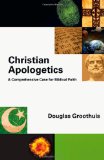
Douglas Groothuis’ 752-page Christian apologetics book is now under $22

Christian Apologetics

Looking for a good textbook on apologetics that covers everything you need to know? Check out Dr. Groothuis’ book. It’s now under $22 on Amazon.

Here are the chapters:

Part I: Apologetic Preliminaries
1 Introduction: Hope, Despair and Knowing Reality
2 The Biblical Basis for Apologetics
3 Apologetic Method: Evaluating Worldviews
4 The Christian Worldview
5 Distortions of the Christian Worldview–or the God I Don’t Believe In
6 Truth Defined and Defended
7 Why Truth Matters Most: Searching for Truth in Postmodern Times
8 Faith, Risk and Rationality: The Prudential Incentives to Christian Faith

Part II: The Case for Christian Theism
9 In Defense of Theistic Arguments
10 The Ontological Argument
11 Cosmological Arguments: A Cause for the Cosmos
12 The Design Argument: Cosmic Fine-Tuning
13 Origins, Design and Darwinism
14 Evidence for Intelligent Design
15 The Moral Argument for God
16 The Argument from Religious Experience
17 The Uniqueness of Humanity: Consciousness and Cognition
18 Deposed Royalty: Pascal’s Anthropological Argument
19 Jesus of Nazareth: How Historians Can Know Him and Why It Matters by Craig L. Bloomberg
20 The Claims, Credentials and Achievements of Jesus Christ
21 Defending the Incarnation
22 The Resurrection of Jesus

Part III: Objections to Christian Theism
23 Religious Pluralism: Many Religions, One Truth
24 Apologetics and the Challenge of Islam
25 The Problem of Evil: Dead Ends and the Christian Answer
26 Conclusion: Take It to the Streets

Appendix 1 Hell on Trial
Appendix 2 Apologetic Issues in the Old Testament by Richard S. Hess

Here’s a review of the book by Michael D. Stark.

Introduction:

Contemporary Christians interested in apologetics can now turn to another text that is bound to become one of the most-used textbooks in apologetics. Douglas Groothuis’ Christian Apologetics: A Comprehensive Case for the Biblical Faith (InterVarsity, 2011) may have more breadth both in content and wisdom than any apologetics text to date. The subtitle is justified as the book, over 700 pages and 26 chapters long (not including two appendixes), presents the need for apologetics and explores the main philosophical arguments for the existence of God. Unlike other apologetics texts, Groothuis includes chapters examining truth in postmodern society, religious pluralism, and a tactful approach to dealing with Islam. Furthermore, biblical scholars (and Denver Seminary colleagues) Richard Hess and Craig Blomberg build on an already strong text by writing chapters on apologetics in the Old Testament (Appendix 2) and a historical approach to the person of Christ and the gospels, respectively.

Here’s a snip from the review:

The chapter on cosmological arguments is superb and only further qualifies Groothuis as a proficient thinker. This chapter without question is the chapter I learned the most from. Groothuis engages very difficult scientific and philosophical concepts and communicates them in a way that even the beginner will be able to grasp. Though there are many different versions of the cosmological argument, the chapter hones in on the kalam cosmological argument as put forth by William Lane Craig. The kalam argument is superior to other cosmological arguments in that it supposedly secures the theistic doctrine of ex nihilo if the arguments proves successful (note: a minor quibble of this chapter is that Groothuis purports that the Thomistic cosmological argument does not endorse ex nihilo. I believe this to be false). This specific chapter was sensational – however I was left disappointed that no time was given to addressing the cosmological argument posited by Aquinas. In some respects, the Thomistic cosmological argument is the simplest form for people new to apologetics. The Thomistic version does not get into the technical issues of the metaphysics of time and Big Bang cosmology that the kalam version uses, nor does it require knowledge of the principle of sufficient reason that the Leibnizian version necessitates. While the kalam and Leibnizian versions are logical and sound arguments, they may confusing to people new to apologetics. Because of this, beginners ought to take the time to read this chapter slowly and more than once because of the finer technical details.

Chapters 12-14 are devoted to the design argument and issues relating to it. Groothuis opposes macroevolution and thus goes to great extent to battle Darwinism. Those interested in the philosophy of science will be drawn to these chapters. The chapter focused on intelligent design relies heavily on the work of William Dembski and Michael Behe. These chapters serve as a valuable introduction for those new to discussion between Christian and naturalistic sciences.

Chapter 15 is perhaps the most successful chapter of the entire book as it deals with the moral argument. It is my belief that the moral argument is the most successful argument for the existence of God as it appeals to everyone, Christian, atheist, and non-Christian religious persons. Ethical theory may perhaps be the most widely debated philosophical topic throughout history and thus Groothuis could have taken many approaches when discussing the moral argument. The way he structured his chapter, however, is nearly flawless. Building off his chapter examining truth in the postmodern culture (chapter 7), Groothuis correlates the denial of objective truth to the ridding of objective moral value. He unmercifully attacks moral relativism and brilliantly shows its dangers. He states that cultural relativism reduces to individual relativism, which, in turn, ultimately rests on nihilism. The setup of this reductio ad absurdum points the reader to a moral system that does not reduce to nihilism. Thus, a worldview that embraces objective moral truths must be embraced. Groothuis makes the claim that the source of objective moral truths is found in the absolute Being – God. Groothuis puts for the notion that God is the source of all perfect moral code because he himself is incapable of an evil act as it would be a contradiction of God’s Being.

I think that the big advantage you get from Doug Groothuis is his worldview. He has the most fully-integrated worldview of any Christian scholar I know.

I bought one copy of Dr. Groothuis’ book, but I gave it away. So I got myself another one. It’s a must have. My favorite four apologetics books are this one, “Philosophical Foundations for a Christian Worldview” by William Lane Craig and J.P. Moreland, Michael Licona’s “The Resurrection of Jesus” and Stephen C. Meyer’s “Signature in the Cell”. I think that if you add Wayne Grudem’s “Politics According to the Bible” to that list, then that’s a very practical set of tools.

A summary of Dr. Laura’s Proper Care and Feeding of Husbands

Sue Bohlin of Probe Ministries read “The Proper Care and Feeding of Husbands“, and her assessment is here.

Excerpt:

Talk show host Dr. Laura Schlessinger has written a book that is improving thousands of marriages: The Proper Care and Feeding of Husbands.{1} We need this book because millions of wives either don’t know how to love their husbands wisely and well, or they’re too self-centered to see it as important. Dr. Laura credits this dismal condition to forty years of feminist philosophy, “with its condemnation of just about everything male as evil, stupid, and oppressive, and the denigration of female and male roles in families.”{2} While the women’s movement certainly had a hand to play in the disintegration of relationships and the family, I believe the core cause is our sinful self-centeredness, just as the Bible says.{3}

Which is why we need help, and God instructs older women to train younger women to love their husband and children, to be self-controlled and pure, to be busy at home, to be kind, and to be subject to their husbands, so that no one will malign the word of God.{4} The Proper Care and Feeding of Husbands is a great resource for learning these important values and skills.

She talks about men’s needs for direct communication, respect, appreciation, support, and sex.

And ends with this:

I can’t recommend The Proper Care and Feeding of Husbands highly enough. In fact, I gave a copy to my new daughter-in-law! Let me close with one more piece of wisdom from Dr. Laura: “[M]en are simple creatures who come from a woman, are nurtured and brought up by a woman, and yearn for the continued love, admiration and approval of a woman. . . Women need to better appreciate the magnitude of their power and influence over men, and not misuse or abuse it.”{25} Amen!

And here’s another summary of the book that I found.

Full text:

Dr. Laura Schlessinger has written another book that deserves a place on the best seller list with six of her other books, such as Ten Stupid Things Women Do to Mess Up Their Lives and Ten Stupid Things Men Do to Mess Up Their Lives. The Proper Care and Feeding of Husbands, from this unmarried man’s perspective, is an excellent manual for women on how to get want they want from men and marriage and, generally, how to be happy. Dr. Laura makes a number of important, practical points, based on her experience in private practice, from advising her radio callers, and from literally hundreds of letters and emails she received from men and women while she was writing the book. Here are the points that struck this writer, together with commentary:

1. Men Need Women, and This Need Gives Women Huge Influence. Dr. Laura states the point as follows: “[M]en are simple creatures who come from a woman, are nurtured and brought up by a woman, and yearn for the continued love, admiration, and approval from a woman.” Women have great power and influence over men, and wives in particular have tremendous power over their husbands. How they use this power essentially controls the relationship, because women are the masters of most relationships and marriages. That’s why Dr. Laura says that she probably won’t write The Proper Care and Feeding of Wives: wives already have most of the power and their marriages depend, for the most part, on them.

2. Women Err in Favoring Children Over Husband. A friend once told this writer that once a woman has children, her husband is relegated to the moral equivalence of a piece of furniture. How sad if this is true in many marriages. Here’s how Dr. Laura puts it: “Once wives became mothers, they had no time to be wives. The men would even compliment their wives on being great mothers, but expressed considerable pain over not being shown love, affection, or sexual interest. The typical reply from a wife challenged with this was ‘I only have time to take care of one person, and our child is that person. I’m just too tired for you.’ This puts fathers in the ugly and uncomfortable position of feeling competitive with and resentful of their children, whom they love so much.”

3. Men and Women Are Different. That men and women are deeply different ought not to be notable, but for the fact that it is so often challenged today. Dr. Laura says that society tries to make both men and women “unisex.” But men are happiest being men, and women are happiest being women, with few exceptions. The differences start to manifest themselves very early. In one study Dr. Laura mentions, a barrier was placed between 1 year-old babies and their mothers. What did the little boys do? They attempted to get around the barrier or knock it down. The little girls? They cried until their mothers’ picked them up. Men tend to respond to things physically, women verbally. In fact, the two sexes are just right for each other.

4. Not Every Thought and Feeling Needs to be Said. Women tend to be so verbal, so expressive, that they can tire out men easily unless they exercise some restraint. Dr. Laura reports that wives generally overwhelm their husbands with communication. “Husbands imagine (so foolishly) that their wives are telling them something they actually need to know because they’re supposed to do something about it. Otherwise, men can’t imagine why the ‘communication’ is happening at all. It confuses them, frustrates them, and their response is to turn off. That’s when they unfairly become labeled insensitive.” Husbands and fiances are not girlfriends or psychologists, and women who want attention should adjust their communication style accordingly when speaking with them.

5. Men Are Not Mind-Readers. Most men are not very intuitive compared to most women. Many women “get caught up in the absurdly romanticized notion that ‘if he loved me, he’d just know what I’m thinking, what I’d like, what he should say.'” If a woman wants her man to do something, she should just ask him plainly, without nagging, and show appreciation when he does it. To act otherwise, as many women do, shows arrogance and lack of respect for the husband’s difference, and it leads to unhappiness in the marriage and in the family.

6. Man Is an Embodied Soul. No, Dr. Laura didn’t put it that way; “embodied soul” is a Catholic concept. But that concept is what underlies her discussion of how important it is to a man that his wife try to keep up her appearance. What does it mean that we are embodied souls? It means that our bodies are integral parts of who we are. We are not just souls. Our bodies are not like clothing that we can take on or off. There was no time during which we had only souls and not bodies, and in eternity as well we will have bodies. It is through our bodies, in fact, that we communicate to our loved ones and to the rest of the world. One thinks of the beautiful line from the old Anglican marriage rite: bride and groom pledge to each other “with my body I thee worship.” It is ironic, but in many cases men–sex-crazed pigs in the minds of many women–actually have a truer understanding of the beauty of the body and the meaning of the marital embrace than their wives do. “Objectification” may come as much or more from the woman’s side as from the husband’s if the woman sees her own body as being separate from rather than an integral part of herself. Dr. Laura writes: “In reading all the letters from men, I was struck by their depth of senstivity about the issue of women’s appearance. It wasn’t an impersonal, animal reaction (as it is with women the men don’t personally know), it was a deeply personal one. The wife’s comfort with and appreciation of her own body and femininity, and her willingness to share that with her husband, actually fed his sense of well-being, his feeling of being loved as a husband and valued as a ‘man.'”

7. Infidelity by Omission. Brides and grooms make a number of vows, not only of sexual fidelity. Marital vows include and imply words like love, honor, protect, and care for. “[W]hen one breaches those vows by neglect, is that also not a form of infidelity? Perhaps we should start looking at the act of intentionally depriving a spouse of legitimate needs as infidelity, too, because it stems from being unfaithful to the intent of the vows.”

8. In the Bedroom. To her credit, Dr. Laura gives due place to the importance for marriage of the marital act: “The bedroom is the foundation of marriage and family.” St. Josemaria Escriva, founder of Opus Dei, that supposedly conservative institution within the Church, put it this way: “The marriage bed is an altar.” Enough said?

9. Women Should Appreciate Men’s Masculinity. Dr. Laura relates a trip she made recently to a swimming pool. A mom and a dad were wading with their infant child. Mom held the child against her chest, cooed to him, and swooped him up and down. She passed the baby to dad. He turned the baby’s face outward and swooshed him forward and up into the air. “Mom equals protection and nurturance. Dad equals autonomy and adventure. It is the perfect balance that helps produce a functional, secure human being.” Too many women, though, act like Alice Kramdens, constantly belitting their husbands, shooting down their aspirations, treating them like children. Dr. Laura writes: “When a wife treats her man like he’s one of her children, when she puts him down or thwarts his need for autonomy, adventure, risk, competition, challenge, and conquest, she ends up with a sullen, unooperative, unloving, hostile lump.”

10. Thou Shalt Not Covet. Dr. Laura contributes a novel (to this writer) and insightful contemporary application of the commandment, “thou shal not covet.” Specifically, she understands it as a rebuke to people who want it all, especially feminists. “Perhaps the feminist notions about women having power if they do it all has obstructed too many women’s ability to realize that in real life we all make choices, and that the true joy and meaning of life is not in how many things we have or do, but in the sacrifice and commitment we make to others within the context of the choices we’ve made. The Tenth Commandment, about coveting, reminds us that none of us can have everything there is nor everything we want. Without enjoying and appreciating our gifts and blessings, we create a hell on earth for ourselves and for those who love us.”

PCF Husbands is the best basic book on marriage. Easy to read, tons of wisdom.

A review of Lawrence Krauss’ book “A Universe From Nothing”

Lawrence Krauss is a physicist who affirms that the entire physical universe appeared out of nothing. How well does his theory hold up?

This review of Krauss’ book was written by a non-theist in the liberal New York Times.

Excerpt:

Lawrence M. Krauss, a well-known cosmologist and prolific popular-science writer, apparently means to announce to the world, in this new book, that the laws of quantum mechanics have in them the makings of a thoroughly scientific and adamantly secular explanation of why there is something rather than nothing.

[…]Never mind. Forget where the laws came from. Have a look instead at what they say. It happens that ever since the scientific revolution of the 17th century, what physics has given us in the way of candidates for the fundamental laws of nature have as a general rule simply taken it for granted that there is, at the bottom of everything, some basic, elementary, eternally persisting, concrete, physical stuff. Newton, for example, took that elementary stuff to consist of material particles. And physicists at the end of the 19th century took that elementary stuff to consist of both material particles and electro­magnetic fields. And so on. And what the fundamental laws of nature are about, and allthe fundamental laws of nature are about, and all there is for the fundamental laws of nature to be about, insofar as physics has ever been able to imagine, is how that elementary stuff is arranged. The fundamental laws of nature generally take the form of rules concerning which arrangements of that stuff are physically possible and which aren’t, or rules connecting the arrangements of that elementary stuff at later times to its arrangement at earlier times, or something like that. But the laws have no bearing whatsoever on questions of where the elementary stuff came from, or of why the world should have consisted of the particular elementary stuff it does, as opposed to something else, or to nothing at all.

The fundamental physical laws that Krauss is talking about in “A Universe From Nothing” — the laws of relativistic quantum field theories — are no exception to this. The particular, eternally persisting, elementary physical stuff of the world, according to the standard presentations of relativistic quantum field theories, consists (unsurprisingly) of relativistic quantum fields. And the fundamental laws of this theory take the form of rules concerning which arrangements of those fields are physically possible and which aren’t, and rules connecting the arrangements of those fields at later times to their arrangements at earlier times, and so on — and they have nothing whatsoever to say on the subject of where those fields came from, or of why the world should have consisted of the particular kinds of fields it does, or of why it should have consisted of fields at all, or of why there should have been a world in the first place. Period. Case closed. End of story.

What does it mean? It means this. Physical laws are merely a description of how physical entities operate. They do not explain where the physical entities being described came from. Physical laws are like traffic laws – they describe how cars are supposed to drive around on roads – but they don’t create the cars!

In any case, if you would like to find out how well Krauss’ ideas hold up in a debate, you can watch him debate William Lane Craig right here:

Or listen to the debate and read my very very snarky summary here.

The debate itself was a slaughter. Krauss was one of the least rational opponents Craig has ever faced.