
Tag Archives: Biology

Paul Copan challenges Richard Dawkins on determinism and rationality

This is from Parchment & Pen. There is an MP3 file linked in the post. (H/T Apologetics 315)

Excerpt:

Last week, Richard Dawkins spoke here in Ft. Lauderdale at Nova Southeastern University on “The Fact of Evolution.” The following week, I spoke on “The Fact of God”—also delivered at Nova Southeastern.

[…]I asked Dawkins how he could claim that the naturalist id rationally superior to the theist since, according to his book River Out of Eden, all of us are dancing to the music of our DNA. Our beliefs are the product of non-rational, deterministic physical forces beyond our control—whether we’re theists or naturalists. In fact, if the naturalist is right, it’s only by accident—not because he’s more intellectually virtuous than the theist. That is, the naturalist has accidental true belief (which is not knowledge) rather than warranted true belief (which is knowledge).

Dawkins gave the odd reply that it’s kind of like Republicans and Democrats—with each group thinking they’re right and the other group wrong. But on what grounds could either side think they are more rational than the other? Dawkins then added that he supposed that whatever view “works” the correct one to hold. But here’s the problem: what “works” is logically distinct from “true” or “matching up with reality”—since we may hold to a lot of false beliefs that help us survive and reproduce, even if they are false. Indeed, naturalistic evolution is interested in survival and reproduction—the “four F’s” (fighting, feeding, fleeing, and reproducing). Truth, the naturalist philosopher Patricia Churchland argues, is secondary to these pursuits According to another such naturalist, the late Richard Rorty, truth is “utterly unDarwinian.”

[…]…how can Dawkins condemn “religious” people who fly planes into buildings since they are just dancing to their DNA—just like the naturalist is? They’re just doing what nature has programed them to do. We can further ask: Why isn’t Dawkins denouncing atrocities done in the name of atheism—like those of Stalin, Pol Pot, or Mao Tse-tung? Dawkins gives the impression that it’s only people of “religion” who carry out horrendous evils. Of course, if Dawkins is right, these mass murderers could not justly be condemned since they too were wired by nature to act as they did.

Paul then excerpts a segment from an interview with Dawkins:

Dawkins:….What I do know is that what it feels like to me, and I think to all of us, we don’t feel determined. We feel like blaming people for what they do or giving people the credit for what they do. We feel like admiring people for what they do. None of us ever actually as a matter of fact says, “Oh well he couldn’t help doing it, he was determined by his molecules.” Maybe we should… I sometimes… Um… You probably remember many of you would have seen Fawlty Towers. The episode where Basil where his car won’t start and he gives it fair warning, counts up to three, and then gets out of the car and picks up a tree branch and thrashes it within an edge of his life. Maybe that’s what we all ought to… Maybe the way we laugh at Basil Fawlty, we ought to laugh in the same way at people who blame humans. I mean when we punish people for doing the most horrible murders, maybe the attitude we should take is “Oh they were just determined by their molecules.” It’s stupid to punish them. What we should do is say “This unit has a faulty motherboard which needs to be replaced.” I can’t bring myself to do that. I actually do respond in an emotional way and I blame people, I give people credit, or I might be more charitable and say this individual who has committed murders or child abuse of whatever it is was really abused in his own childhood. ….

Manzari: But do you personally see that as an inconsistency in your views?

Dawkins: I sort of do. Yes. But it is an inconsistency that we sort of have to live with otherwise life would be intolerable. But it has nothing to do with my views on religion it is an entirely separate issue.

There’s a fuller explanation in the post – I just pulled out some parts to give you the idea.

This is something Christians need to get used to. Atheism should not smuggle in Christian beliefs. Atheism has to stand and fall on materialism, determinism, life ending at the grave, and moral subjectivism. There is no free will on atheism. There are no moral values or moral obligations on atheism. There is no rationality on atheism. There is no meaning in life on atheism. There is no purpose to life on atheism. There is no accountability for sin on atheism. There is no self-sacrificial love on atheism. There is no reward for virtue and self-sacrifice on atheism. It is a worldview
Can intelligent design be front-loaded at the creation of the universe?

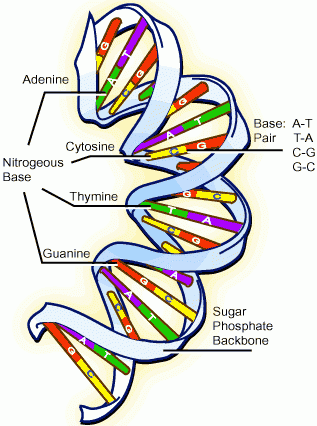
Structure of DNA
Structure of DNA

This video introduction to intelligent design packs a lot of information into a very small video. (H/T Brian Auten from Apologetics 315)

When it comes to the science of DNA, theistic evolutionists and atheists agree: matter, law and chance are sufficient to evolve DNA. No intelligence is needed to sequence the base pairs or the amino acids. That agreement that intelligent causes are not needed to explain DNA is why I call theistic evolution “functional atheism”.

Theistic evolutionists express subjective opinions about God that no one can investigate using science. These untestable opinions about God are similar to the opinions of little children about Santa Claus. And yet they insist that they be taken seriously alongside the people who actually think Christianity is objective knowledge, not subjective opinion.

To defuse a theistic evolutionist, simply ask them for  fully materialistic and naturalistic explanation for the first living organism – the origin of life. And then watch how they avoid answering the question. For even Richard Dawkins has no idea how life could begin, if only purely naturalistic, materialistic causes are allowed in the explanation.

Theistic evolutionists hate talking about evidence. They want to talk their private feelings and beliefs and experiences in order to reassure you that they are just like you. Don’t let them talk about religion – stick to what science can show. Demand evidence that the material processes can do the creating that the theistic evolutionists think that material processes can do.

Here’s an easy article that you can read that explains a bit more about what the video discussed. Here is one is a bit more difficult. These are mentoring articles for Christians.

If you want to read some serious research, then read this post and listen to this interview which are both about the work of Doug Axe.

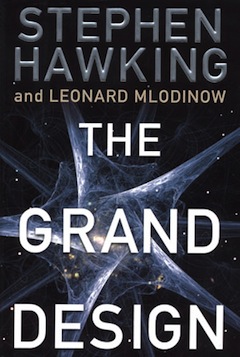
Book review of Stephen Hawking’s “The Grand Design” by Edgar Andrews

First, who is Edgar Andrews?

Professor Edgar H. Andrews (BSc, PhD, DSc, FInstP, FIMMM, CEng, CPhys.) is Emeritus Professor of Materials at the University of London and an international expert on the science of large molecules. In 1967 he set up the Department of Materials at Queen Mary College, University of London, and served both as its Head and later as Dean of Engineering. He has published well over 100 scientific research papers and books, together with two Bible Commentaries and various works on science and religion and on theology. His book From Nothing to Nature has been translated into ten languages.

Edgar Andrews was an international consultant to the Dow Chemical Company (USA) for over thirty years and to the 3M Company (USA) for twenty years. He was a non-executive director of Denbyware PLC throughout the 1970s and for five years a member of the Scientific Advisory Board of Neste Oy, the national oil company of Finland.

And now an excerpt from the book review: (H/T Apologetics 315)

Hawking and Mlodinow declare: ‘According to M-theory, ours is not the only universe. Instead, M-theory predicts that a great many universes were created out of nothing. Their creation does not require the intervention of some supernatural being or god. Rather, these multiple universes arise naturally from physical law. They are a prediction of science’ (p.9).

So what is this magical M-theory? The authors are rather coy about it. ‘M-theory’, they say, ‘Is not a theory in the usual sense. It is a whole family of different theories, each of which is a good description of observations only in some range of physical situations’ (p.8). Theoretical physicist Lee Smolin is more explicit: ‘… we still do not know what M-theory is, or whether there is any theory deserving of the name’ (The trouble with physics, Allen Lane, 2007, p.146).

The fact is that M-theory is an untestable mathematical construction which many scientists believe has no bearing on physical reality. But that doesn’t deter our authors because they don’t believe in ‘objective reality’ anyway. What we think is ‘real’, they say, is simply a model assembled in our brains from raw data input by our senses. But, confusingly, the authors then claim that the best models are those that reflect the way things really do happen in the real world — appealing to the very objective reality they say does not exist! Confused? Me too.

But it gets worse. They claim that M-theory (whatever it might be) predicts not one universe but a multiverse — a vast collection of universes which cannot be observed or known to us in any way. On their own criterion, this makes M-theory a very bad model indeed. So it’s hardly a useful replacement for God.

Here’s a better book to read if you want to understand how belief in God relates to experimental science.

My Dad just finished reading his book “Who Made God?” and called me up to tell me how much he liked the book. My Dad is not a scientist, yet he read the whole thing and learned a lot about science. This is the book for people who haven’t read a thing about science and religion. It’s easy to understand because he explains the same thing over and other giving more and more detail. Even a child can understand the first explanation, and then he keeps layering on details until he gets up to the state-of-the-art.

Remember Brian Auten of Apologetics 315 picked this book as his favorite of 2010. You can’t go wrong!

My Dad is now reading my copy of “Is God Just a Human Invention?” by Jonathan Morrow and Sean McDowell. I’m working on “Is God a Moral Monster?” by Paul Copan. I like books where difficult questions are asked and then careful answers are given. Then when people ask me the same questions, I can answer them using what I’ve learned – and often phrase the question even more clearly and forcefully than they did when they asked me.