Tag Archives: Big Bang

Stephen C. Meyer and Keith Fox debate intelligent design and evolution

From Justin Brierley’s “Unbelievable” podcast.

Details:

Stephen Meyer is a leading proponent of Intelligent Design who directs the Centre for Science and Culture at the Discovery Institute in Seattle. His [first] book “Signature in the Cell” claims to show that the DNA code is the product of intelligent mind, not naturalistic processes. Keith Fox is Professor of Biochemistry at Southampton University. He chairs the UK Christians in Science network but disagrees strongly with ID. They debate how life could have originated and whether design is allowed as an explanation in science.

Summary: (stuff in italics is my snarky paraphrase)

Meyer:

  • background and how he got interested in intelligent design
  • his research focus is on the origin of life – the first replicator
  • summarizes the history of origin of life studies
  • authored the book “Signature in the Cell”
  • the DNA enigma: where did the information in DNA come from?
  • naturalistic explanations of the DNA information have failed
  • but intelligent agents are known to be able to produce information
  • the best explanation of the information in DNA is that an intelligent agent authored it
  • Meyer’s book was named by atheist philosopher of science Thomas Nagel as a Times Literary Supplement Book of the Year in 2010
  • why is design so controversial? Many people think that Darwin explained why nature appears design
  • the Darwinian view is that nature can create the appearance of design using mutation and selection
  • however, Darwinian mechanisms cannot explain the origin of the first living cell, it assumes replication, and the origin of life is about where the first replicator comes from

Fox:

  • Meyer’s argument is not about the evolution of life after the first cell
  • Meyer’s case for design is about the origin of life
  • naturalists do not know a naturalistic explanation for the origin of life
  • there are a number of naturalistic hypotheses for the origin of life, like the RNA-first hypothesis
  • maybe in a few years one of them will turn out to be correct
  • what intelligent design is arguing from a gap in our current naturalistic knowledge to infer that God intervened in nature

Meyer:

  • that’s not what intelligent design is at all
  • the approach ID theorists use is the inference to best explanation
  • you evaluate all explanations, non-intelligent causes and intelligent causes
  • you prefer the best possible explanation
  • we know that minds are capable of producing information just like the information we find in DNA

Fox:

  • living cells replicate, so they have the ability to introduce mutations as they replicate and then some of those mutations can be selected
  • so maybe the process of replicating that living cells do created the first living cell
  • maybe the first living cell created itself, X brought X into being, self-creation, what’s irrational about that?

Meyer:

  • the issue is the origin of life – where did the first living cell come from?
  • you cannot appeal to the operations that a living cell can perform to explain the origin of the first living cell
  • there was no first living cell operating before the first living cell
  • there was no replication, mutation or selection before the first living cell
  • in fact, in my book I show that there is no known naturalistic mechanism that is able to produce the information needed for the first living cell
  • nothing can create itself, that is self-contradictory
Fox:
  • Well, you are just saying that because something is complex that God did it
Meyer:
  • Sadly, no. What I actually said needed to be explained was the information, not complexity
  • And we know from software engineering that the process of adding information to code is performed by programmers
  • in the absence of any adequate naturalistic explanation for information, we are justified in taking the explanation that we are familiar with – namely, intelligent agency – based on our uniform, universal experience of what causes information
Fox:
  • well, maybe we can appeal to the mutation and selection in existing living cells to explain the origin of the first living cell
  • maybe there were living cells before the first living cell, and then these other living cells created the first living cell
Meyer:
  • we can’t keep invoking mutation and selection when those processes are not operating prior to the origin of the first living cell
Fox:
  • well maybe some bare-bones self-replication molecule was a precursor to the first living cell
Meyer:
  • even to generate very limited replicator would require a large amount of information
  • the argument I am making is – where does the evolution come from?
Fox:
  • well, maybe we will think of an explanation for information that is naturalistic in 20 years
  • we’ve thought of explanations to things that were NOT information before
  • so maybe we will be able to think of something to explain information based on our ability to explain NOT information before

Moderator: Change topics: the Dover decision

Meyer:

  • the Discovery Institute opposed the policy that causes the trial
  • the wording of the statute was poor
  • the judge was completely wrong in his decision
  • young earth creationists used the phrase “intelligent design” to cover their agenda
  • intelligent design is an inference using the normal methods of science
Fox:
  • intelligent design is a science stopper because it stops looking for a naturalistic explanation
  • everything in nature must have a naturalistic explanation
  • everything has to be explained using matter and time and chance
  • it just has to be that way!!!!
Meyer:
  • well, what luck would you have explaining an effect like Mt. Rushmore?
  • can you explain that using matter,time and chance?
  • Mt. Rushmore was the product of intelligence, not wind and erosion
  • similarly, there is information in the cell, and we know that intelligence causes information
Fox:
  • So you are saying that we don’t understand and therefore an intelligence is necessary?

Meyer:

  • no I am saying we DO understand and we are making an inference based on that understanding
  • you are the one who is insisting on a material explanation because you pre-suppose materialism
  • we know that minds have causal powers, and we can infer mind as an explanation from information
Fox:
  • well nature is a seamless chain of material causes and effects
Meyer:
  • agents can act without violating the laws of nature
  • even humans can act as intelligent agents to create information in books, and they don’t violate the laws of nature
  • intelligent causes are real, and they explain effects in nature
Fox:
  • you’re trying to impose on science something to do with meaning and purpose
Meyer:
  • no that’s not what we’re doing, we’re inferring from from the fact that we ourselves are known causes of information to the fact that an intelligence cause is the best explanation for information in the cell
Fox:
  • but I am a materialist, I need a materialist explanation
Meyer:
  • mind IS an answer to the how question
  • we infer to mind in many other scientific disciplines, like cryptography, archaeology, etc.
  • a materialist might accuse an archaeologist of engaging in a “scribe-of-the-gaps” argument, but the best explanation of an artifact with information is a scribe
  • we are inferring that mind is the cause from the nature of the effect: information
Moderator: is it appropriate to call DNA “information”

Fox:

  • well DNA is just a molecular polymer, any reference to information is just by analogy
Meyer:
  • DNA is a molecular polymer, but it also exhibits the property of specified complexity
  • the arrangement of bases, which function as machine instructions in a software program, for performings task in the cell
  • we have observed that the property of specified complexity always comes from an intelligence
Fox:
  • well, maybe there are other sequences that would work, so maybe it’s really not uncommon to develop functioning sequences by chance alone, without an intelligence
Meyer:
  • you can measure how precise the functional specificity is in DNA and proteins

Moderator: is Shannon information the same as functional information

Meyer:

  • Shannon information refers to the sequences of digits or symbols that do not necessarily have any function, i.e. – a four character string QSZX has as much Shannon information as WORD. However, only the latter is functional against the pattern of the English language. There are arrangements of DNA bases and amino acids that have the same number of symbols/characters as a functional sequence would have, but they have no biological function – they do not exhibit specified complexity
Fox:
  • Well, maybe there are lots and lots of sequences of DNA and proteins so that it is fairly easy to get a functional one by chance

Meyer:

  • DNA sequences that are functional are extremely rare, protein sequences are even more rare
  • this is not my opinion, this is what the research shows – functional protein sequences are rare
Fox:
  • well maybe there are other functional sequences that are occur before the first functional sequence that are precursors to the first functional sequence
  • maybe there are billions of years of replication, mutation and selection before the first replication, mutation and selection

Meyer:

  • you can’t get to the first selectable functional sequence by appealing to precursor selectable functional sequences – there are no selectable functional sequences before the FIRST one
  • you have to get the first selectable functional sequence by chance alone, because there is nothing to mutate or select before the first replicator
  • the chance hypothesis has been rejected because the minimal amount of information for the simplest replicator is too high to get by chance alone, given the resources, including time, that are available

Moderator: Keith are you confident that naturalism will be able to substantiate these naturalism-of-the-gap speculations that you offer in response to Meyer’s actual science that we have today? 

Fox:

  • well, it is hard to know for sure because it was just a fluke event
  • but there’s nothing irrational or unscientific or miraculous about it – the fluke would have a material explanation
  • there is nothing that we can detect that would implicate God, my speculations about a fluke which I cannot observe or measure or test would all be compatible with an atheistic worldview that omits God as a causal entity

Meyer:

  • where are those material processes that could account for this fluke then?
  • the whole point of this argument is that the information in DNA transcends the material components in the sequence
  • it’s the arrangement of the material parts/letters/characters/symbols/instructions that needs to be explained
Fox:
  • Well, I just have a different philosophy of science that rules out intelligent causation a priori

Meyer:

  • Yes, that’s the difference between us – you pre-suppose that all explanations of natural phenomena must exclude intelligent causes

There is a bit more where Meyer talks about how parts of the cell are implementations of various design patterns (Gang of Four design patterns) that are used by software architects who design software.

Find more posts on Stephen C. Meyer here.

Physicist Michael Strauss discusses Christianity and science at Stanford University

This is one of my favorite lectures, by one of the people I admire the most for his scientific work and robust, evangelical Christian faith.

About Michael Strauss:

His full biography is here. (I removed his links from my excerpt text below)

Excerpt:

I had an interest in science and theology, so in 1977 I chose to go to Biola University where I could study both subjects in detail. I thoroughly enjoyed college and participated in intramural sports, was elected to student government, served as a resident assistant, competed in forensics, and studied a lot. As I neared college graduation my dual interest continued so I applied to seminary and to graduate school. After graduating summa cum laude from Biola, I decided to pursue a graduate degree in physics at UCLA.

During my first few years of graduate school, I developed an increased interest in quantum mechanics and subatomic physics and decided to do research in a field that dealt with these subjects. I joined a High Energy Physics experimental group doing research at the Stanford Linear Accelerator Center (SLAC) and moved to the San Francisco Bay Area to actively participate in research at SLAC. I graduated in 1988 with my Ph.D in High Energy Physics (a.k.a. Elementary Particle Physics). If you would like to know more about High Energy Physics, the Particle Data Group at Lawrence Berkeley Laboratory has a very nice interactive adventure that teaches you all about the subject. My research advisor was professor Charles Buchanan and my disertation was titled “A Study of Lambda Polarization and Phi Spin Alignment in Electron-Positron Annihilation at 29 GeV as a Probe of Color Field Behavior.”

After graduation, I accepted a post-doctoral research position with the University of Massachusetts at Amherst. I continued to do research at SLAC where I joined the SLD experiment. My research interests centered on the SLD silicon pixel vertex detector. I wrote most of the offline software for this device, and did physics analysis which used the vertex detector, including tagging b quark events for flavor specific QCD (Quantum Chromodynamics) analysis. In the seven years I was employed by UMASS, I only spent 3 days on the Amherst campus. The rest of the time was spent in California.

[…]In August 1995, I accepted a job as an Assistant Professor of Physics at the University of Oklahoma (OU) in Norman, Oklahoma. The University of Oklahoma has a vibrant high energy physics research group involved in experiments at the Fermi National Accelerator Center (Fermilab), and CERN. I joined the DØ experiment at Fermilab where I continue to do research in elementary particle physics. As a member of the DØ collaboration I have made contributions to the testing of silicon sensors for the upgraded vertex detector, to the track finding algorithms, to a measurement of the photon production cross section which probes the gluon content of protons, and to other QCD measurements. I am currently studying properties of B mesons that contain a b-quark, the production cross section of jets coming from quarks and gluons, and other QCD analyses. At CERN, I am a collaborator on the ATLAS detector.

I received tenure in 2001 and was promoted to the rank of Professor in the summer of 2010. Most of the time at OU I have taught introductory physics classes to physics majors, engineers, and life science majors. In these classes I have used a number of interactive techniques to facilitate student participation and learning. I have been privileged to win a few awards for my teaching. In 1999, the Associated Students selected me as the Outstanding Professor in the College of Arts and Science, and in 2000 I was awarded the BP AMOCO Foundation Good Teaching Award. In 2002, I was given the Regents Award for Superior Teaching. I received the Carlisle Mabrey and Lurine Mabrey Presidential Professorship in 2006 which is given to “faculty members who excel in all their professional activities and who relate those activities to the students they teach and mentor.”

He seems to have done a fine job of integrating his faith with a solid career in physics research. It would be nice if we were churning out more like him, but that would require the church to get serious about the integration between science and faith.

The lecture:

Dr. Strauss delivered this lecture at Stanford University in 1999. It is fairly easy to understand, and it even includes useful dating tips, one of which I was able to try out recently at IHOP, and it worked.

Here is a clip:

The full video can be watched on Vimeo:

UPDATE: I pulled the MP3 audio from the lecture in case anyone wants just the audio.

Summary:

What does science tell us about God?
– the discoveries of Copernicus made humans less significant in the universe
– the discoveries of Darwin should that humans are an accident
– but this all pre-modern science
– what do the latest findings of science say about God?

Evidence #1: the origin of the universe
– the steady state model supports atheism, but was disproved by the latest discoveries
– the oscillating model supports atheism, but was disproved by the latest discoveries
– the big bang model supports theism, and it is supported by multiple recent discoveries
– the quantum gravity model supports atheism, but it pure theory and has never been tested or confirmed by experiment and observation

Evidence #2: the fine-tuning of physical constants for life
– there are over 100 examples of constants that must be selected within a narrow range in order for the universe to support the minimal requirements for life
– example: mass density
– example: strong nuclear force (what he studies)
– example: carbon formation

Evidence #3: the fine-tuning of our planet for habitability
– the type of galaxy and our location in it
– our solar system and our star
– our planet
– our moon

It’s a good lecture explaining basic arguments for a cosmic Creator and Designer. If you add the origin of life and the Cambrian explosion (Stephen C. Meyer’s arguments), then you will be solid on science apologetics. That’s everything a rank-and-file Christian needs.

Positive arguments for Christian theism

Sean Carroll debates William Lane Craig on cosmology and God’s existence

Carroll was as good of a speaker as Craig in terms of style. Very easy to listen to, very quick on his feet, very civil. There was no clear winner on style.

It was difficult to assess the truth value of scientific points being made, especially for the layperson. I explained a few of them in my posts earlier this week, but I think laypeople might struggle with them if they are hearing about these things for the first time.

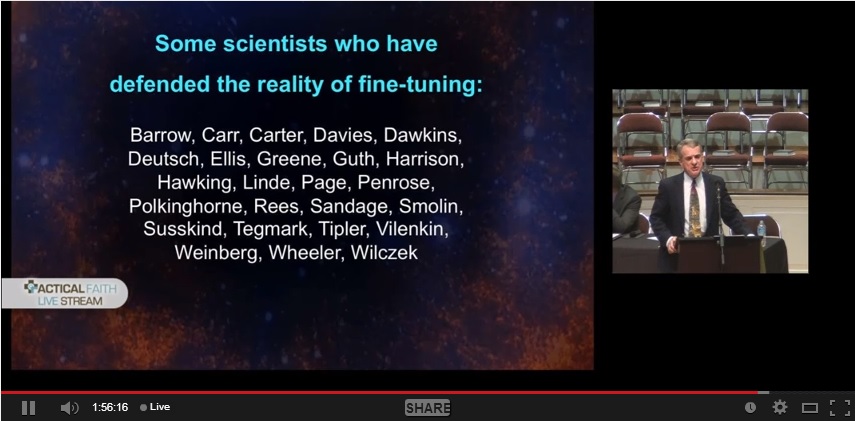
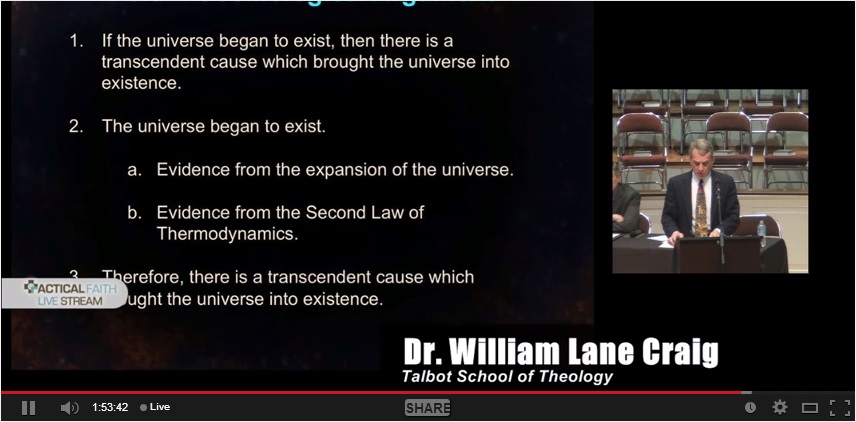
A couple of Craig’s slides: (click for larger images)

Slide 1 of 2:

Dr. Craig slide #1 of 2

Slide 2 of 2:

Dr. Craig slide #2 of 2

Quick summary: (this is not complete, because I couldn’t get everything they were saying noted)

Dr. Craig defended two arguments: 1) the kalam cosmological argument and the fine-tuning argument.

Dr. Craig supported the origin of the universe with 1) the expansion of the universe and 2) the second law of thermodynamics.

Dr. Craig said that the BGV theorem supports a beginning for the universe.

Dr. Craig said that the consensus of scientists did not accept Carroll’s naturalistic cosmology, quoting Stephen Hawking in support.

Dr. Craig said that multiverse models fall victim to the Boltzmann brain problem, where we should observe Boltzmann brains coming into existence and then phasing out again far more probably than embodied minds. But we observe embodied minds, and no Boltzmann brains.

Dr. Carroll said that science cannot study metaphysical questions.

Dr. Carroll said that science is about making models that may or may not be consistent with the experimental data.

Dr. Carroll said that the BGV theorem does not support a beginning for the universe.

Dr. Carroll proposed 17 alternative cosmologies, but did not provide a shred of scientific evidence for any of them, the way that Craig did for the standard model.

Dr. Carroll refuted Dr. Craig’s citation of Stephen Hawking, and Craig yielded the point.

Dr. Carroll speculated that science might progress to the point where the fine-tuning can be explained without an intelligent cause, and he gave an example of where that happened (inflation).

Dr. Craig argued that all 17 of the models suggested by Carroll either conflicted with evidence, had serious problems or did require a beginning.

Dr. Craig argued that Carroll’s own model required a beginning.

Dr. Craig argued that Carroll’s own model fell victim to the Boltzmann brain problem.

Dr. Craig argued that Carroll’s own model violated the second law of thermodynamics.

Dr. Craig re-stated his point that the baby universe spawning in Carroll’s model was speculative and incomplete, and cited Christopher Weaver’s work.

Dr. Carroll denied that things that pop into being out of nothing require a transcendent cause.

Dr. Carroll reiterated that science can only make naturalistic models, and that he did not have to answer questions about ultimate causes.

Dr. Carroll showed a photo of Alan Guth expressing his opinion that the universe is “probably” eternal. No evidence was given for this assertion.

Dr. Carroll said that the fine-tuning was not done in an optimal way, because one fine-tuned value was lower than it needed to be, and it should be exactly what it needed to be if God did it.

Dr. Carroll said that a finely-tuned universe is more probably in naturalism than in theism, because God can do anything he wants and doesn’t need a fine-tuned universe.

Dr. Carroll said he would stop defending his model now, and would instead defend Aguirre-Gratton.

Dr. Craig gave three reasons why the universe popping into being out of nothing requires a transcendent cause.

First, he said that nothing cannot cause anything to happen, because nothing is nothing.

Second, he said that if things pop into being out of nothing, then why don’t we see it happening all the time with other things.

Third, he said that we have no reason to dismiss the causal principle, especially when it is the basis of scientific inquiry and has been so fruitful in the progress of science.

Dr. Craig reiterated that baby universes in Carroll’s model would be dominated by Boltzmann brains, and we don’t observe that.

Dr. Craig said that even on the quantum gravity models that Carroll mentioned, there would still be a beginning.

Dr. Carroll said that Craig mustn’t say “popped into being” but instead that “there was a first moment of time”.

Dr. Carroll said that his model does indeed violate the second law of thermodynamics “YES!”.

At this point Carroll stopped talking about the topic of the debate and started expressing personal opinions about religion. It’s funny how often atheists do this in debates.

Dr. Carroll said that most theists don’t believe in God because of cosmology, but because of community and feelings.

Dr. Carroll said that science had learned a lot in the last 2000 years, so theism was false.

Dr. Carroll said that most philosophers don’t think that God exists, so theism was false.

Dr. Carroll said microscopes and telescopes were absent 2000 years ago, so theism was false.

Dr. Carroll said that religion should be about community and feelings, not about what is true.

Conclusion:

My conclusion was that Carroll lost because he is just satisfied to throw theories out and not to argue that they are true by citing evidence. Carroll never seemed to be interested in finding out what is true, but instead he just wanted to tell a story that didn’t include God, and assert that by Occam’s Razor, his story was a better explanation. I am not impressed with theoretical speculations, although the layperson might be. I kept waiting for him to respond to Craig’s points about how his model was falsified by experimental evidence and observations, e.g. – the Boltzmann brains or the baby universe generation, and he never cited the evidence I wanted him to cite. Craig did have some evidence for his views, but he could have been stronger in making his case. He could have shown the e-mail from Vilenkin that stated that he had understood the BGV theorem, and was using it correctly, for example.

For me the winning side comes down to evidence. The standard model is the standard model because of scientific evidence. Until that evidence is overturned, then speculative models are of no interest to anyone who is evidence-driven. Speculations are not science. A philosophical presupposition of metaphysical naturalism is not science.

The nice thing is that Robin Collins, one of Craig’s respondents, went deep into the science of the fine-tuning, especially on one of my favorite data points, the cosmic microwave background radiation. The paper he presented is now posted on his web site (H/T Christian Apologetics Alliance). I posted about the CMBR before in my post about particle physicist Michael Strauss lecture on cosmology and fine-tuning at Stanford University and the his more recent lecture at the University of Texas. Note that Strauss is an experimental physicist, not a theoretical physicist like Carroll.

Here’s another review of the debate by Randy Everist of Possible Worlds blog. He explains the back-and-forth over Boltzmann brains and the BGV theorem in more detail.