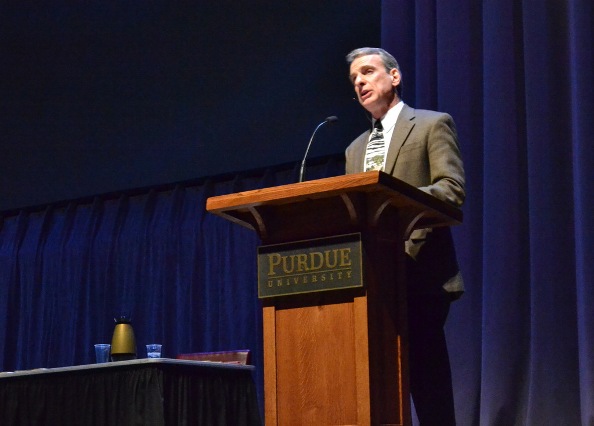
William Lane Craig lecturing to university students
Here’s the lecture, which was given in 2004 at the University of Colorado, Boulder.
This lecture might be a little advanced for beginners, but if you stretch your mind first, you shouldn’t tear anything. (Note: standard disclaimers apply if you do tear something!)
The description of the video states:
This is quite simply one of the best lectures William Lane Craig (a philosopher of science) has given. Craig explores the origins of the universe. He argues for a beginning of the universe, while refuting scientific models like the Steady State Theory, the Oscillating Theory, Quantum Vacuum Fluctuation Model, Chaotic Inflationary Theory, Quantum Gravity Theory, String Theory, M-Theory and Cyclic Ekpyrotic Theory.
A Templeton Foundation lecture at the University of Colorado, Boulder, laying out the case from contemporary cosmology for the beginning of the universe and its theological implications. Includes a lengthy Q & A period which features previous critics and debate opponents of Dr. Craig who were in attendance, including Michael Tooley, Victor Stenger, and Arnold Guminski.
Craig has previously debated famous atheists Stenger and Tooley previously. And they both asked him questions in the Q&A time of this lecture. Imagine – having laid out your entire case to two people who have debated you before and who know your arguments well. What did they ask Craig, and how did he respond?
The scientific evidence
The Big Bang cosmology that Dr. Craig presents is the standard model for how the universe came into being. It is a theory based on six lines of experimental evidence.
Scientific evidence:
Einstein’s theory of general relativity (GTR)
the red-shifting of light from distant galaxies implies an expanding universe
the cosmic background radiation (which also disproves the oscillating model of the universe)
the second law of thermodynamics applied to star formation theory
hydrogen-helium abundance predictions
radioactive element abundance predictions
It’s probably a good idea to be familiar with these if you are presenting this argument, because experimental science is a reliable way of knowing about reality.
Published research paper
This lecture by Dr. Craig is based on a research paper published in an astrophysics journal, and was delivered to an audience of students and faculty, including atheist physicist Victor Stenger and prominent atheist philosopher Michael Tooley, at the University of Colorado at Boulder.
Both cosmology and philosophy trace their roots to the wonder felt by the ancient Greeks as they contemplated the universe. The ultimate question remains why the universe exists rather than nothing. This question led Leibniz to postulate the existence of a metaphysically necessary being, which he identified as God. Leibniz’s critics, however, disputed this identification, claiming that the space-time universe itself may be the metaphysically necessary being. The discovery during this century that the universe began to exist, however, calls into question the universe’s status as metaphysically necessary, since any necessary being must be eternal in its existence. Although various cosmogonic models claiming to avert the beginning of the universe predicted by the standard model have been and continue to be offered, no model involving an eternal universe has proved as plausible as the standard model. Unless we are to assert that the universe simply sprang into being uncaused out of nothing, we are thus led to Leibniz’s conclusion. Several objections to inferring a supernatural cause of the origin of the universe are considered and found to be unsound.
Dr. Graham Oppy, the moderator, is a well-known atheist philosopher. He let Dr. Krauss speak for 21 minutes and 40 seconds, which is why my summary of Krauss is so long.
The video:
Summary
After careful consideration, I decided not to be snarky at all in this summary. What you read below is what happened. There may be some small mistakes, but I will fix those if people tell me about them. I also included some quotes and timestamps for the more striking things that Dr. Krauss said.
The debate itself starts at 4:50 with Dr. Craig’s opening speech. He does use slides to show the structure of his arguments.
Dr. Craig’s opening speech. (4:50)
The kalam cosmological argument:
God is the best explanation of the origin of the universe
The Borde Guth Vilenkin theorem supports the absolute beginning of the universe
Even if our universe is part of a multiverse, the multiverse itself would have to have an absolute beginning
Speculative cosmologies try to challenge the Big Bang theory, but none of them – even if true – can establish that the past is eternal
Only two types of things could explain the origin of spece, time, matter and energy – either abstract objects or minds
Abstract objects do not cause effects, but minds do cause effects (we do it ourselves)
A mind is the best explanation for the origin of the universe
The unreasonable effectiveness of mathematics:
The underlying structure of nature is mathematical – mathematics is applicable to nature
Mathematical objects can either be abstract objects or useful fiction
Either way, there is no reason to expect that nature should be linked to abstract objects or fictions
But a divine mind that wants humans to understand nature is a better explanation for what we see
The cosmic fine-tuning for the existence of intelligent life
There are two kinds of finely-tuned initial conditions: 1) cosmological constants and 2) quantities
These constants and quantities have to be set within a narrow range in order to permit intelligent life
There are three explanations for this observation: law, chance or design
Law is rejected because they are put in at the beginning or matter – they don’t emerge from matter
Chance must be rejected, because they odds are just too long unless you appeal to a world-ensemble
We do not observe what the world ensemble hypothesis predicts that we should observe
Design is the best explanation for finely-tuned constants and quantities
The existence of objective moral values and duties
Our experience of morality (values and duties) is that it is objectively real and incumbent on us
When someone goes into a classroom and shoots at innocent children, that is objectively wrong
On naturalism, moral values and moral duties do not exist – they are conventional and variable by time and place
The best explanation for the existence of objective moral values and duties is that God exists
The historicity of the resurrection of Jesus
There are three widely-accepted facts that are best explained by the resurrection hypothesis
1) the empty tomb, 2) the post-mortem appearances, 3) the early church’s belief in the resurrection
Naturalistic attempts to explain these 3 boilerplate facts fail
The best explanation of the 3 minimal facts is that God raised Jesus from the dead
The immediate experience of God
Belief in God is a “properly basic” belief – rational even without arguments because of experience of God
Seems to be saying that logical arguments can prove false things “it’s nonsense”
Dr. Craig distorted a podcast that some group made on pain receptors
Dr. Craig’s faith is so strong that it causes him to distort what this group said
Discussion: (44:35)
I will not be summarizing everything that was said, just a few main points.
The segment from 52:18 to 57:12 about the Vilenkin e-mail on the BVG theorem is a must-see. Krauss is standing up and gesticulating while Craig is calmly trying to quote a paper by Vilenkin that shows that Krauss is misrepresenting Vilenkin. Krauss constantly interrupts him. After a while, when Craig exposes him as having misrepresented Vilenkin and gets him to admit that all current eternal models of the universe are probably wrong, he quietens down and can’t even look at Craig in the face.
Cosmological argument:
Craig: The e-mail says any universe that is expanding, on average, requires a beginning
Craig: There are two models – Aguirre & Gratton and Carroll & Chen – where there is a period of contraction before the expansion
Craig: The two models are the ones cited in the e-mail that Dr. Krauss showed
Craig: In the very paper by Vilenkin that I cited, he says that both of those models don’t work
Krauss: (agitated and interrupting) Vilenkin said that they have to make an assumption about entropy that they have no rationale for
(as Craig starts to talk Krauss makes an exaggerated, disrespectful gesture and sits down in a huff)
Craig: Yes, an unwarranted assumption means that they don’t have EVIDENCE for their theories being correct
Krauss: (agitated and interrupting) “All the evidence suggests that the universe had a beginning but WE DON’T KNOW!!!!!!!” (raising his voice)
Craig: I’m not saying that we know that the universe had a beginning with certainty
Craig: I am saying that the beginning of the universe is more probably true than false based on the evidence we have
Craig: And you agree with me about that – you think the universe had a beginning
Krauss: (agitated and interrupting) (Unintelligible)
Moderator: One at a time
Craig: In your Vilenkin e-mail slide, at the end of the paragraph where the two models are mentioned that Vilenkin specifically shows…
(I am guessing that Craig is going to ask why so much of what Vilenkin wrote has been cut out of the e-mail that Krauss showed)
Krauss: (agitated and interrupting) Because it was technical…
Moderator: Lawrence! Hang on a sec!
Craig: He specifically shows that these models are not past eternal, and that they require a beginning just like the others…
Krauss: (agitated and interrupting) We can do the math if you want
Craig: Now wait. I couldn’t help notice that there on your slide there was a series of ellipsis points indicating missing text…
Krauss: (agitated and interrupting) “Yeah, because it was technical!”
Craig: “I wonder what you deleted from the original letter”
Krauss: (agitated and interrupting) “I just told you!”
Craig: “Now wait. Could it have been something like this: (reads a quote from Vilenkin) ‘You can evade the theorem by postulating that the universe was contracting prior to some time. This sounds as if there is nothing wrong with having contraction prior to expansion. But the problem is that a contracting universe is highly unstable. Small perturbations would cause it to develop all sorts of messy singularities, so it would never make it to the expanding phase.’
Craig: “That’s Vilenkin.”
Krauss: “In this paper, that’s absolutely right”
Krauss: But it’s ok for theories to assume things that we know are wrong – they are still good theories – it’s unknown
(Craig turns away and looks through his papers)
Craig: “Isn’t it true that the only viable quantum gravity models on order today involve a beginning – have a finite past?”
Krauss: “No”
Craig: “Well, can you give us one then”
Krauss: (talks about a variety of possible eternal models) “In my experience in science, all of them are probably wrong”
Krauss: “You know most theories are wrong, which is why, you know, it’s hard”
Craig: “Right”
I noticed that a huge number of atheist web sites are taking the Vilenkin quote that Krauss used out of context, like this one and this one. There are probably a lot more of them like that, which I think is interesting. That’s why we have these debates, I guess. To set the record straight about who accuses people of being dishonest, and who is actually dishonest.
Fine-tuning:
Krauss tried to argue that he had explained the fine-tuning with the Higgs particle, but Dr. Craig said that only applied to the cosmological constant, not all the other examples of fine-tuning. Krauss said that it wasn’t impressive that this universe permitted life and that “It would have been much more surprising if we evolved in a universe in which we couldn’t live”. Krauss argued the fine-tuning was only for “Life like us”. But Dr. Craig explained that the fine-tuning is what allows us to have the basics of any kind of life, like slow-burning stars, chemical diversity, etc. – things that are required for basic minimal life functions in any living system. Craig said that he was working with the current physical laws of this universe (F = ma, etc.) and that he was looking at what changed if we changed those even slightly. Krauss tried to say that if he changed things like the mass of particles then the strength of forces would change. (But the forces aren’t laws!) Krauss argued that the cosmological constant would be even better for life if it was zero, and Craig said that the life permitting range did include zero, but that the range of life-permitting values was narrow.
Jesus’ existence:
Craig reponded to the mystery religions charge, the charge that the evidence for the minimal facts is too late/too weak, the charge that grief visions explained the evidence better, and Hume’s argument against miracles. Craig brought up the early creed from 1 Cor 15:3-7 and explained to Krauss that it was 5 years after the events, and that Jewish standards of oral transmission were strong enough to ensure that the creed was reliable, and most of the eyewitnesses would still have been alive.
Audience Q and A: (1:21:09)
The first topic is the grounding of morality. Krauss agrees that there is no objective morality and no objective moral oughts. He also said that that standards of behavior are arbitrary, and that they change over time and they are adopted for promoting social order. Dr. Craig pressed the point that science itself would collapse without ethical values. It assumes them, but cannot ground them.
The next topic was free will. Krauss is a determinist. Craig asked him how he could reconcile moral responsibility with determinism.
The next topic was the effectiveness of mathematics. Krauss didn’t have an explanation for it and didn’t think it needed one. Then they got into whether the Genesis has been verified by science and whether it is meant to be taken literally.
The next topic was whether philosophy makes any progress. Craig gave the example of verificationism being rejected as too narrow, and self-refuting. Krauss: “I’m going to come to the defense of philosophy for the first time”. Craig: “That’s amazing!” Krauss said that science provides new knowledge. Craig said there were some things that could be known apart from science.
Dr. Michael Strauss is a practicing particle physics employed as a professor at University of Oklahoma. He does research in particle physics at CERN, a large hadron collider. It’s safe to assume that he knows something about experimental physics.
When my children were young, I would often drive to the home of the person babysitting my kids, usually a young teenage girl, pick her up, then drive her back to my house. In the car I would ask questions about her interests or her school. In addition, I would sometimes ask a question that intrigued me since I am a scientist and a Christian, “Do you think the Big Bang is a theistic theory or an atheistic theory?” Now that question is not on most people’s list of babysitter interview questions, but I was interested to know their answer even though it would not affect their monetary tip. Every time I asked this question I always got the same answer, that the Big Bang is an atheistic theory. This is just one example of the fact that many kids growing up in an evangelical church environment have the perception that the Big Bang is an idea which removes God as the creator. It seems that many Christians may disdain the Big Bang.
Subsequent conversations with people of all ages have shown me that many individuals (1) don’t really understand what the Big Bang is, (2) don’t know the scientific evidence for the Big Bang, and (3) don’t comprehend the theistic significance of the Big Bang. So let’s explore these ideas a little bit.
Here is his overview of the scientific evidence for the Big Bang:
There are three primary observations that are best explained by the Big Bang. First, the universe is expanding so that it must have had a beginning of expansion in the past. Second, because the universe was once very hot, we can still see the remnants of that heat in the Cosmic Microwave Background (CMB) radiation. The latest measurements of the CMB spectrum made by the Planck satellite (shown above) agrees almost perfectly with theoretical calculations using the standard Big Bang cosmological model (see the plot at the end of this post). Third, the theory predicts the amount of primordial light elements that should have been created in the first few minutes of the Big Bang, like hydrogen and helium. Again the observations and the theoretical calculations align almost exactly. A few other observations are supported by Big Bang predictions, like the distribution of galaxies and primordial gas. The agreement between what we measure and what is expected from a Big Bang is so remarkable that just about all scientists accept the Big Bang as the origin of our universe, despite its implication that the universe had a beginning.
Does this scientific evidence support theism, or atheism?
Because we don’t have any observations that tell us exactly what happened “in the beginning” of our universe, we can only speculate. But let me point out the obvious. All of the observations we do have, and all the theoretical calculations, and even some projective calculations like the Borde-Guth-Vilenkin theorem (which I should probably blog about at some time) give credence to the conclusion that all of the space, time, matter, and energy of this universe had a beginning. The Big Bang is a misnomer for it is not some kind of explosion since there was nothing that existed to explode. It is the origin of the universe. So if this universe had a beginning, then the cause of the universe can not be a part of the universe. The cause must be transcendent, like the Christian idea of God. Is the fact that all the evidence points to our universe having a transcendent cause proof for God? No, but it is extremely powerful evidence. If one hundred years ago you had predicted that scientists would obtain unambiguous evidence about the history of the universe for 13.8 billion years, all of its lifetime except the first fraction of a second, and that all of the evidence would point to an actual beginning consistent with a transcendent cause, I don’t think anyone would have taken you seriously. But that is exactly what has happened. Theists could not have outlined a better scenario to support theism. The scientific facts are completely consistent with the statement, “In the beginning God created the heavens and the earth.”
Now I’ve had conversations with atheists about this scientific evidence during my lifetime. And the conversations always go like this: I lay out the experimental evidence and theoretical evidence for a cosmic beginning, and they start to talk about science fiction: Star Wars and Star Trek. But there are also famous atheists who have tried to account for the Big Bang cosmology in their atheistic worldview.
Here’s Oxford University professor of physical chemistry (and atheist) Peter Atkins explaining how he grounds the Big Bang cosmology:
Easy! Nothing actually exists, according to Peter Atkins.
You don’t get to start with the laws of physics in the Big Bang cosmology. You don’t get to start with an electron. You don’t get to start with a quantum vacuum, nor even quantum foam. You start with nothing: no matter, no energy, no space, and no time. From that state, the universe begins to exist. Atheists hate the Big Bang cosmology. And they also hate the fine-tuning of the initial conditions of the Big Bang that allows the universe to support complex, embodied intelligent life. (Another miraculous evidence for God that is opposed by the anti-science fundamentalists).
I see resistance against the use of scientific evidence to support the existence of God from many pious pastors like Al Mohler, Russell Moore, etc. Some pastors think that you can just read the Bible out loud to someone and it will convert them to Christianity, as if the words of the Bible, in and of themselves, were some sort of incantation. It’s sort of like the “burning of the bosom” that Mormons are supposed to have when reading the Mormon Bible, which Mormons use in place of evidence, since they don’t have any. Many fideist pastors adopt this Mormon approach to trusting in God. Never mind that Jesus offered his resurrection as evidence of his claims to divinity to skeptics. Apparently, These pious pastors know better than Jesus how to evangelize non-Christians, and they’ve decided that the magic words fideist approach is better than use of scientific and historical evidence. It’s really annoying that the pious pastors have so much more influence in churches than the witness of experimental science, which is just God speaking to us through nature. I’d trust scientific evidence over an uneducated fundamentalist pastor any day of the week.



 WINTERY KNIGHT