Tag Archives: Benefits

NY state public schools spend the most money but get lousy results

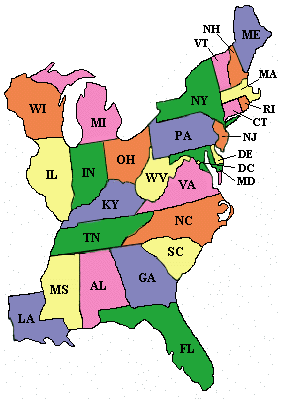
Eastern United States Map

From the New York Post. (H/T Jammie Wearing Fool)

Excerpt:

New York state’s school systems deserve an F — in financial accountability.

State taxpayers spend substantially more money on education than any other state in the nation but get far less in return on their investment, according to a shocking new federal study released yesterday.

New York schools on average spent $18,126 per student in the 2008-2009 school year — tops in the nation, the Census Bureau reports.

That’s nearly $2,000 more than the $16,271 spent in neighboring New Jersey and 80 percent higher than the national average of $10,499.

But the Empire State’s four-year high-school graduation rate of 73.5 percent ranked a lowly 39th in the nation, two points below the national average, according to a separate analysis by the National Center for Education Statistics.

By comparison, Massachusetts — which spends $4,000 less per student — has an 83 percent graduation rate.

New York has doubled its per-student spending over 10 years. For five consecutive years the state has spent the most per student in the nation.

[…]One main reason for New York’s sky-high spending is it pays its teachers significantly more in salaries and benefits than any other state.

New York spent $12,524 per student to cover instructional salaries and benefits, nearly double the national average of $6,369. Even New Jersey, Connecticut and Massachusetts spent $3,000 less per student than New York did on teacher pay and benefits.

Teacher unions are one of the main Democrat special interest groups. Teacher unions oppose being held accountable by parents. They don’t want to have their pay and benefits be conditional on producing quality educations for children. They just want to be able to collect exorbitant salaries and benefits while they indoctrinate your children with leftist politics and liberal values. They don’t care what parents want, and they don’t care about whether your children learn anything that will allow them to achieve independence and prosperity.

Must-see videos on education policy

Related posts

New Jersey per-pupil cost is $17,800

Eastern United States Map

From the Wall Street Journal. (H/T Michele Bachmann)

Excerpt:

The Christie administration has recalculated the amount it says New Jersey public school districts spend per pupil, increasing the state average rate by several thousand dollars to more than $17,800.

The figure, from the 2009-10 school year, has been adjusted to include costs such as transportation, federal funding, debt payments and legal judgments that can vary greatly from district to district. In the 2008-09 school year, using the previous calculation, the state average was $13,200 per student.

The Christie administration says the new figure is more transparent and complete.

[…]Gov. Chris Christie has frequently said that Newark schools spend nearly $25,000 per student, despite what he calls failing results. The new spending guide shows Newark’s spending at nearly $23,000 per student, up from about $17,600 under previous estimates.

Compare that with the average tuition with higher-performing private or parochial schools.

Excerpt:

AVERAGE PRIVATE SCHOOL TUITION: $8,549

Elementary: $6,733
Secondary: $10,549
Combined: $10,045
(Digest 2009, Chapter 2, Table 59)

AVERAGE CATHOLIC SCHOOL TUITION: $6,018

Elementary: $4,944
Secondary: $7,826
Combined: $9,066
(Digest 2009, Chapter 2, Table 59)

I think we need to put in a national voucher system, or, failing that, we should abolish the federal Department of Education completely and leave education to the states and municipalities.

This post was linked by:

Must-see videos on education policy

Related posts

Carrie Lukas does the math on the male-female pay gap

Carrie Lukas
Carrie Lukas

A popular article by Carrie Lukas, writing in the Wall Street Journal. (H/T Mary)

Excerpt:

The unemployment rate is consistently higher among men than among women. The Bureau of Labor Statistics reports that 9.3% of men over the age of 16 are currently out of work. The figure for women is 8.3%. Unemployment fell for both sexes over the past year, but labor force participation (the percentage of working age people employed) also dropped. The participation rate fell more among men (to 70.4% today from 71.4% in March 2010) than women (to 58.3% from 58.8%). That means much of the improvement in unemployment numbers comes from discouraged workers—particularly male ones—giving up their job searches entirely.

Men have been hit harder by this recession because they tend to work in fields like construction, manufacturing and trucking, which are disproportionately affected by bad economic conditions. Women cluster in more insulated occupations, such as teaching, health care and service industries.

[…]The Department of Labor’s Time Use survey shows that full-time working women spend an average of 8.01 hours per day on the job, compared to 8.75 hours for full-time working men. One would expect that someone who works 9% more would also earn more. This one fact alone accounts for more than a third of the wage gap.

Choice of occupation also plays an important role in earnings. While feminists suggest that women are coerced into lower-paying job sectors, most women know that something else is often at work. Women gravitate toward jobs with fewer risks, more comfortable conditions, regular hours, more personal fulfillment and greater flexibility. Simply put, many women—not all, but enough to have a big impact on the statistics—are willing to trade higher pay for other desirable job characteristics.

Men, by contrast, often take on jobs that involve physical labor, outdoor work, overnight shifts and dangerous conditions (which is also why men suffer the overwhelming majority of injuries and deaths at the workplace). They put up with these unpleasant factors so that they can earn more.

Recent studies have shown that the wage gap shrinks—or even reverses—when relevant factors are taken into account and comparisons are made between men and women in similar circumstances. In a 2010 study of single, childless urban workers between the ages of 22 and 30, the research firm Reach Advisors found that women earned an average of 8% more than their male counterparts. Given that women are outpacing men in educational attainment, and that our economy is increasingly geared toward knowledge-based jobs, it makes sense that women’s earnings are going up compared to men’s.

My favorite book on feminism, economics and marriage is Carrie Lukas’ “The Politically Incorrect Guide to Women, Sex and Feminism“. If you don’t have the book, then please go out and buy one for you, and one for a young, unmarried woman in your life. Books like this one are for women who are serious about making their marriages last. And men can read them, too – so that we’ll know what to look for in women. There is nothing more attractive to a marriage-minded man than a fiscally conservative woman.

Here’s an interview of Carrie Lukas conducted by famous men’s rights activist Bernard Chapin. The next time you see men reading the Sports Illustrated Swimsuit Issue, take a closer look. On the inside of that magazine we are often concealing a copy of Carrie Lukas’ book. When Carrie Lukas talks about economics and policy, men think about marriage.