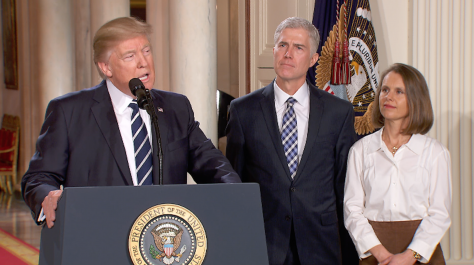
If there’s one thing that Trump is doing right, it’s nominating originalist judges

Trump picks a strict constructionist for Supreme Court vacancy

Well, so far Trump’s done many things right and many things wrong. Although I think more of the right things are actions (cleaning up regulations, energy development, etc. ) and the wrong things are just horribly damaging tweets. The best actions surely include his habit of nominating judges who will interpret the law as written, instead of pushing a political agenda.

Far-left ABC News reports on the most important judicial pick – Supreme Court Justice Neil Gorsuch.

Excerpt:

More than 2,000 conservatives in tuxedos and gowns recently filled Union Station’s main hall for a steak dinner and the chance to cheer the man who saved the Supreme Court from liberal control.

Justice Neil Gorsuch didn’t disappoint them, just as he hasn’t in his first seven months on the Supreme Court.

“Tonight I can report that a person can be both a publicly committed originalist and textualist and be confirmed to the Supreme Court,” Gorsuch said to sustained applause from members of the Federalist Society…

[…]The 50-year-old justice has been almost exactly what conservatives hoped for and liberals dreaded when he joined the court in April. He has consistently, even aggressively, lined up with the court’s most conservative justices. He has even split with Chief Justice John Roberts, viewed by some as insufficiently conservative because of his two opinions upholding President Barack Obama’s health law.

The article notes that liberal legal groups are very unhappy with Gorsuch’s constant focus on what the Constitution says. They don’t like him asking lawyers questions about the Constitution.

More:

Leonard Leo, the Federalist Society executive vice president who has advised Trump on judicial picks, also took issue with Gorsuch’s critics when he introduced the justice at the dinner. “They mischaracterize candor and a demand for rigorous analysis as polarizing,” Leo said.

Gorsuch and Leo embraced on the podium, in front of an adoring crowd of like-minded lawyers, judges and academics. The Federalist Society, which counted Scalia among its earliest backers, has helped Trump identify candidates for federal judgeships and has members in legal jobs across his administration.

Gorsuch made no apologies either for the substance of his questions and writing, or his style. He talked at length about the importance of seeking out the meaning of the Constitution and laws as they were understood when they written.

“Originalism has regained its place at the table of constitutional interpretation, and textualism in the reading of statutes has triumphed. And neither one is going anywhere on my watch,” Gorsuch said.

He went on to note that “some pundits have expressed bewilderment” about the questions he asks in court.

“But while I have you here tonight, I thought I might just settle the matter once and for all by taking a poll. … Should I just keep on asking about the text and original meaning of the Constitution?” he asked.

The response was predictably and overwhelmingly in favor.

Before Gorsuch was nominated and confirmed, I liked Justice Clarence Thomas best. He was the most faithful to the original meaning of the Constitution – better than Scalia.
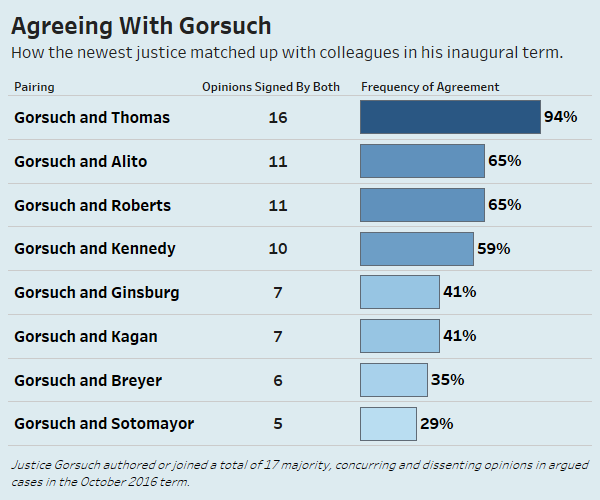
Gorsuch and Thomas stick to the original meaning of the Constitution

Now that Gorsuch is on the bench, he’s been tracking with Thomas. According to this article from Law 360, he votes with Thomas 94% of the time. Much higher than any of the centrist and liberal judges. The liberal writer of the Law 360 article is predictably horrified that Gorsuch is so good on religious liberty in particular:

As the most controversial rulings came down near the end of the term, however, Justice Gorsuch splintered off from most of his conservative colleagues and exclusively joined Justice Thomas in five separate opinions.

On Monday, for instance, Justice Gorsuch and Justice Thomas supported each other’s concurrences in the major religious freedom case, Trinity Lutheran v. Comer. The pair joined Chief Justice Roberts’ majority opinion holding that a Missouri playground-funding program closed to religious groups was unconstitutional, but they criticized the court for limiting the scope of its ruling.

In Trinity Lutheran, the court found that a widely available public program that discriminates on the basis of religious status violates the free exercise clause of the First Amendment. The court refused to say, however, whether a program that withholds public funds from groups that would use that money for religious purposes similarly violates the free exercise clause.

In doing so, Justice Roberts made an unworkable distinction, Justice Gorsuch said. “I don’t see why it should matter whether we describe that benefit, say, as closed to Lutherans (status) or closed to people who do Lutheran things (use),” he said. “It is free exercise either way.”

Justice Gorsuch’s desire for an expanded free exercise clause would likely come as a crushing blow to liberal groups and other advocates of church-state separation.

That’s the most important issue to me – my religious liberty. My right to live an authentic Christian life without being bullied by secular leftists in the government. I want people on the Supreme Court to defend my right to behave like a Christian in public.

The conservative Daily Signal had an article up describing even more good news about new judicial nominations.

Excerpt:

On Friday, President Donald Trump announced the addition of five individuals to his outstanding list of potential candidates for a future Supreme Court vacancy.

As was the case with the lists Trump put out during his presidential campaign, these new additions to the list are conservative men and women who are committed to interpreting the Constitution according to its original public meaning.

While there are currently no vacancies on the Supreme Court, rumors abound that Justice Anthony Kennedy may retire in the near future.

Whatever mess Trump makes with his Tweets, you have to love this judicial nominees. We would never have gotten nominees like this with Hillary Clinton. And what’s even better is that Trump will be making more judicial nominations in the next 12 months than Obama did in his entire 8 years in office, according to the radically leftist Washington Post. (H/T Curby)

Excerpt:

 Conservatives have a new court-packing plan, and in the spirit of the holiday, it’s a turducken of a scheme: a regulatory rollback hidden inside a civil rights reversal stuffed into a Trumpification of the courts. If conservatives get their way, President Trump will add twice as many lifetime members to the federal judiciary in the next 12 months (650) as Barack Obama named in eight years (325). American law will never be the same. 

That’s good news for liberty, bad news for big government coercion.

Can atheists condemn slavery as immoral? Do atheists believe that slavery is wrong?

A long journey through the night

Note: For a Christian response to the complaint that the Bible doesn’t condemn slavery, see this article and this article for slavery in the Old Testament, and this article for slavery in the New Testament. These are all by Christian philosopher Paul Copan. You can watch a lecture with Paul Copan on the slavery challenge here, and buy a book where he answers the challenge in more detail. There is also a good debate on whether the Bible condones slavery here, featuring David Instone-Brewer and Robert Price. My post is not a formal logical essay on this issue, it is more that I am outraged that atheists, who cannot even rationally ground objective morality, insist on criticizing the morality of the Bible. I think that atheists who are serious about finding the truth about these issues should check out those links, if they are interested in getting to the truth of these matters.

In other posts, I’ve argued that without an objective moral standard of what is right and wrong, any judgments about right and wrong are just individual opinions. So, when an atheist says slavery is wrong, what he really means is that he thinks slavery is wrong for him, in the same way that he thinks that,say, that chocolate ice cream is right for him. He isn’t saying what is wrong objectively, because on atheism there are no objective moral rules or duties. He is speaking for himself: “I wouldn’t own a slave, just like I wouldn’t eat broccoli – because it’s yucky!”. But he has no rational argument against other people owning slaves in other times and places, because their justification for owning slaves is the same as his justification for not owning slaves : personal preference and cultural conventions.

So do atheists oppose slavery? Do they believe in an objective human right to liberty? Well, there are no objective human rights of any kind on atheism. Human beings are just accidents in an accidental universe, and collections of atoms do not mysteriously accrue “rights”. There is no natural right to liberty on atheism. Now consider abortion, which is favored by most atheists. Like slavery, abortion declares an entire class of human beings as non-persons in order to justify preserving their own happiness and prosperity by means of violence. That’s exactly what slavery does, except abortion is worse than slavery, because you actually kill the person you are declaring as a non-person instead of just imprisoning them.

So how many atheists have this pro-abortion view that it is OK to declare unborn children  as non-persons so they can kill them?

Well, according to Gallup, the “non-religious” are the group most likely to support abortion. In fact, 68% favor legalized abortion, compared to only 19% who oppose it.

Take a look at the Gallup poll data from 2012:

Atheists are OK with the strong killing the weak
Most atheists are OK with the strong killing the weak

The Gallup numbers might actually be low, because “No religion” might include people who are spiritual, but not religious. But what about atheists alone?

As a group, atheists tend to be among the most radical supporters of legalized abortion. The Secular Census of 2012 found that 97% of atheists vote for abortion. There are almost no pro-life atheists. Why is it that atheists look at unborn children and think it’s OK to kill them? Well, let’s see what atheists scholars think about morality, and from that we’ll find out why they think abortion is morally permissible.

Atheist scholars think morality is nonsense

Atheist William Provine says atheists have no free will, no moral accountability and no moral significance:

Let me summarize my views on what modern evolutionary biology tells us loud and clear — and these are basically Darwin’s views. There are no gods, no purposes, and no goal-directed forces of any kind. There is no life after death. When I die, I am absolutely certain that I am going to be dead. That’s the end of me. There is no ultimate foundation for ethics, no ultimate meaning in life, and no free will for humans, either.

Source: http://www.arn.org/docs/orpages/or161/161main.htm

Atheists Michael Ruse says atheists have no objective moral standards:

The position of the modern evolutionist is that humans have an awareness of morality because such an awareness of biological worth. Morality is a biological adaptation no less than are hands and feet and teeth. Considered as a rationally justifiable set of claims about an objective something, ethics is illusory. I appreciate when someone says, ‘Love thy neighbor as thyself,’ they think they are referring above and beyond themselves. Nevertheless, such reference is truly without foundation. Morality is just an aid to survival and reproduction, . . . and any deeper meaning is illusory.(Michael Ruse, “Evolutionary Theory and Christian Ethics,” in The Darwinian Paradigm (London: Routledge, 1989), pp. 262-269).

Atheist Richard Dawkins says atheists have no objective moral standards:

In a universe of blind physical forces and genetic replication, some people are going to get hurt, other people are going to get lucky, and you won’t find any rhyme or reason in it, or any justice. The universe that we observe has precisely the properties we should expect if there is, at bottom, no design, no purpose, no evil and no good, nothing but blind, pitiless indifference… DNA neither knows nor cares. DNA just is. And we dance to its music. (Richard Dawkins, River Out of Eden: A Darwinian View of Life (1995))

Most atheists are like this – although some affirm objective morality, without really having a rational basis for it. In general though, when atheists use moral language to condemn God, the Bible, or Christians, it’s very important to understand that it is just theater. They are trying to use words that describe realities that they do not even believe in, usually with the goal of getting you to stop judging them for their own sin. I blogged about two examples of this before – Richard Carrier and Michael Shermer.

Let’s take a closer look at Richard Dawkins’ statement that there is “no evil and no good”.

Richard Dawkins and morality

Here’s Richard Dawkins’ view of abortion:

Richard Dawkins explains morality on atheism

But wait! He goes even further than mere abortion:

Dawkins believes in Darwinian evolution. Survival of the fittest. The strong kill the weak. Where is protection for the unborn in that narrative?

Richard Dawkins even advocates for adultery.

So, what Dawkins really believes is that morality is nonsense. But in order to get you to stop condemning abortion, adultery, infanticide and a whole host of other atheistic misbehaviors, he will try to condemn you using moral language to stop you from making moral judgments. But the goal here is to intimidate you into not judging. By his own words, he thinks that the whole notion of objective moral values and objective moral duties is just nonsense.

Who does oppose slavery?

How did slavery end?

Dinesh D’Souza explains:

Slavery was mostly eradicated from Western civilization–then called Christendom–between the fourth and the tenth century. The Greco-Roman institution of slavery gave way to serfdom. Now serfdom has its problems but at least the serf is not a “human tool” and cannot be bought and sold like property. So slavery was ended twice in Western civilization, first in the medieval era and then again in the modern era.

In the American South, Christianity proved to be the solace of the oppressed. As historian Eugene Genovese documents in Roll, Jordan, Roll, when black slaves sought to find dignity during the dark night of slavery, they didn’t turn to Marcus Aurelius or David Hume; they turned to the Bible. When they sought hope and inspiration for liberation, they found it not in Voltaire or D’Holbach but in the Book of Exodus.

The anti-slavery movements led by Wilberforce in England and abolitionists in America were dominated by Christians. These believers reasoned that since we are all created equal in the eyes of God, no one has the right to rule another without consent. This is the moral basis not only of anti-slavery but also of democracy.

And, in fact, you can see Christians pushing the culture hard against abortion today, just as we did with slavery. We also oppose frivolous divorce, and redefining marriage in a way that normalizes removing mothers and/or fathers away from their children. Defending the weak is what we do.

Book review of R.C. Sproul’s “If there’s a God, why are there atheists?”

I have a key that will unlock a puzzling mystery

Brian Auten has a book review posted up at Apologetics 315.

The book is “If There’s A God, Why Are There Atheists?”, by theologian R.C. Sproul. R.C. Sproul is one of my favorite theologians. The book in question has a very, very special place in my heart, because I think that it is one of the major reasons why I was able to resist pernicious ideas like religious pluralism and postmodernism for so long. Once you put on the glasses of Romans 1 and see for the first time what man is really doing with respect to God, you can never see things the same again. I’ll say more about this at the end, but let’s see what Brian wrote first.

The review

So often, you hear atheists complaining about religion is nothing but wish-fulfillment or some sort of crutch for people who are frightened by a variety of things. They think that God is invented to solve several problems. 1) how does the world work?, 2) is there meaning to suffering and evil?, 3) why should I be moral?, and 4) what will happen to me and my loved ones when I die?. On the atheistic view, God is just a crutch that people cling to out of weakness and ignorance. But is this really the case?

Sproul starts the book by investigating three atheists who sought to explain religious belief as a result of psychological factors.

Brian writes:

Before tackling the psychology of atheism, Sproul spends a chapter on the psychology of theism, from the perspective of Freud’s question “If there is no God, why is there religion?”11 What follows is an overview of various psychological explanations of theistic belief: Feuerbach’s “religion is a dream of the human mind.”12 Marx’s belief that religion is “due to the devious imagination of particular segment of mankind.”13 And Nietzche’s idea that “religion endures because weak men need it.”14 The author properly reiterates: “We must be careful to note that the above arguments can never be used as proof for the nonexistence of God. They can be useful for atheists who hear theists state that the only possible explanation for religion is the existence of God.”15 That being said, Sproul also reveals what these arguments presume:

Their arguments already presupposed the nonexistence of God. They were not dealing with the question, Is there a God? They were dealing with the question, Since there is no God, why is there religion?16

Sproul points out the weaknesses of each of these approaches and says “there are just as many arguments showing that unbelief has its roots in the psychological needs of man.”

Wow, could that really be true? What are the real reasons why people reject God? Does the Bible have anything to say about what those reasons are?

Brian cites Sproul’s contention:

The New Testament maintains that unbelief is generated not so much by intellectual causes as by moral and psychological ones. The problem is not that there is insufficient evidence to convince rational beings that there is a God, but that rational beings have a natural hostility to the being of God.

[…]Man’s desire is not that the omnipotent, personal Judeo-Christian God exist, but that He not exist.

In Romans 1:18-23, the apostle Paul explains what is really going on:

18The wrath of God is being revealed from heaven against all the godlessness and wickedness of men who suppress the truth by their wickedness,

19since what may be known about God is plain to them, because God has made it plain to them.

20For since the creation of the world God’s invisible qualities—his eternal power and divine nature—have been clearly seen, being understood from what has been made, so that men are without excuse.

21For although they knew God, they neither glorified him as God nor gave thanks to him, but their thinking became futile and their foolish hearts were darkened.

22Although they claimed to be wise, they became fools

23and exchanged the glory of the immortal God for images made to look like mortal man and birds and animals and reptiles.

On this blog, I regularly present many, many arguments for theism in general, and Christian theism in particular:

Sproul explains why atheists cannot allow themselves to live according to the evidence that is presented to them:

The cumulative effect of this knowledge that is clearly seen is to leave men ‘without excuse.’ Herein lies the basis of the universal guilt of man. No one can claim ignorance of the knowledge of God. No one can cite insufficient evidence for not believing in God. Though people are not persuaded by the evidence, this does not indicate an insufficiency in the evidence, but rather an insufficiency in man.

[…]The basic stages of man’s reaction to God can be formulated by means of the categories of trauma, repression, and substitution.

[…]If God exists, man cannot be a law unto himself. If God exists, man’s will-to-power is destined to run head-on into the will of God.

And this is the force that is animating atheists today. They don’t want to be accountable to God in a relationship, no matter what the evidence is. They have to deny it, so that they can be free to get the benefits of a universe designed for them, without having to give any recognition or acknowledgement back. If they have to lie to themselves to deny the evidence, they will do it. Anything to insulate themselves from the Creator and Designer who reveals himself in Jesus Christ.

The rest of the book review, and the book, deals with explaining in detail how atheists respond to an all-good, all-powerful, all-knowing Creator/Designer. I encourage you to click through and read the whole book review. You can read the review, and the book, and then investigate for yourself whether atheists really are like that.

My survey of atheists

By the way, did you all see my survey of atheists that I did a while back? It’s relevant because one of the questions I asked to my volunteers was “How you begin to follow Christ if it suddenly became clear to you that Christianity was objectively true?”. I got some very strange responses that dovetail nicely with Sproul’s book.

Here are a few of the responses:

  • I would not follow. My own goals are all that I have, and all that I would continue to have in that unlikely situation. I would not yield my autonomy to anyone no matter what their authority to command me.
  • I would not follow, because God doesn’t want humans to act any particular way, and he doesn’t care what we do.
  • I would not follow. Head is spinning. Would go to physician to find out if hallucinating.
  • I hope I would be courageous enough to dedicate my life to rebellion against God.
  • I would not have to change anything unless forced to and all that would change is my actions not my values.  I would certainly balk at someone trying to force me to change my behavior as would you if you were at the mercy of a moral objectivist who felt that all moral goodness is codified in the Koran.
  • He would have to convince me that what he wants for me is what I want for me.

This is all part of my series discussing whether morality is rationally grounded by atheism.

Well Spent Journey did a similar survey of atheists, inspired by mine, and got this result on the relevant question:

12. How would you begin to follow Jesus if it became clear to you that Christianity was true?

– Would follow (5)
– Wouldn’t follow (6)
– Might follow the teachings of Jesus, but that isn’t Christianity (2)
– It would depend on how this truth was revealed (3)
– Christianity can’t be true (3)
– No answer given (4)

…What would be the hardest adjustment you would have to make to live a faithful, public Christian life?

– Adjusting wouldn’t be that difficult; would eagerly welcome knowing that Christianity was true (2)
– Praying, since it seems weird, creepy, and strange
– Trying to figure out how the Bible became so corrupted

– Trying to convince myself that the God of the Bible is deserving of worship (2)
– Don’t think it would be possible to adjust

– No clear response, or not applicable (16)

Yes, they really think like that! Just ask an atheist questions and you’ll see how “objective” they really are. Atheism is entirely psychological. It’s adopted in order to feel sufficient and to operate with autonomy, with the goal of self-centered pleasure-seeking above all. Evidence has nothing to do with it.