
Survey: young, unmarried women explain why they avoid having children

This article comes from the leftist Huffington Post.

They write:

The Huffington Post and YouGov asked 124 women why they choose to be childfree. Their motivations ranged from preferring their current lifestyles (64 percent) to prioritizing their careers (9 percent) — a.k.a. fairly universal things that have motivated men not to have children for centuries. To give insight into the complex, layered decisions women make, HuffPost asked childfree readers to discuss the reasons they have chosen not to have kids and gathered 270 responses here.

They grouped the responses into 5 categories:

  1. I want to prioritize my career
  2. I don’t like children
  3. I had a bad relationship with my parents
  4. I don’t want the financial responsibility
  5. I like my life as it is

And here are some interesting quotations:

Category 1:

I am a first-generation college graduate in my family. My mother was a single mom my entire childhood, and I was there to see that struggle. Being a parent, for a woman, means for life. Being a parent, for men, seems to be something very different. I understand raising children is a big life change and I don’t want to sell myself short on my potential to become something more and maybe even create change. I am childfree because I want to travel, move, pursue my career wholly and be able to push myself to be an inspiration to other women. If a child comes into my life, it won’t be until I am happy and successful in my work life, and not until I am secure with my finances and a marriage. I don’t want to one day wake up as an old woman wishing I had waited to have children so I could live my own life first, make mistakes, learn new things and find myself. Today kids are not for me.

Category 2:

I’m nearly 47; my boyfriend (domestic partner) of 17 years is nearly 50. I’ve never been pregnant and have taken every precaution to remain childfree. I tolerate other people’s children when I have to. I’m happiest when there are NO children around. I definitely don’t want them in my home. I like my life as it is. My boyfriend and I are both scientists. We also raise snakes and spiders! We like to travel. We travel to ride roller coasters (members of ACE — American Coaster Enthusiasts) and to attend rock concerts. I am also a performer in a senior winter guard. My plate overfloweth! I see no reason to procreate. I would be unhappy. Why be unhappy?

Category 3:

I have a great relationship with my husband. We have the time and money to travel, and that gives us precious memories. I had a bad relationship with my dad, and maybe I’m scared to treat my children like that. I’m very happy with my decision. I have a great relationship with myself too.

Category 4:

My spouse and I have talked in depth about having children. However, we both decided that our desire to travel the world is a financial burden in itself. If we have kids, we will never have the means to travel, and at the end of our life, we would rather be 100 percent committed to fulfilling our own realistic dreams rather than only able to provide a subpar life for a child. Comes down to the fact we are selfish, but at least we recognize this and made the choice early enough to avoid damaging a kid

Category 5:

The thought of having to do kiddie crap every weekend makes me want to shoot myself. I like having the extra money to save for retirement and not worry about braces, summer camp or college tuition. I can travel on a moment’s notice. I can give my all to my job and not have to worry about daycare, sick days, or having to leave my co workers to pick up my slack. I’m the “cool aunt” to all my nieces and nephews. I have more time to do the things that make me happy and productive. My relationship with my guy is not strained due to the constant neediness of children. I don’t want to put my body through pregnancy and childbirth. I can give my dog all the attention he needs and deserves.

If I had to choose one comment to represent the entire survey, it would be this one:

The moment you have children, you’re life ceases to be about yourself. Kids always take priority and I feel like I can do more for this world than just generate offspring.

I think this is the real reason why young, unmarried women choose not to prepare or plan for marriage and children . Marriage and children “some day” is like planning for your retirement by winning the lottery. It’s a way for the woman to signal to her family and friends that she will eventually want the responsibility of a husband and kids, but not right now.

We need to move beyond a survey to quantify this, and this U.S. Census data does that:
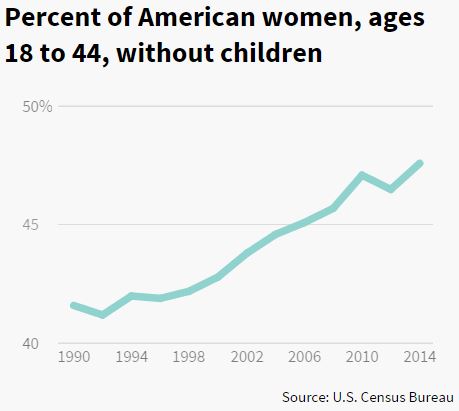
Childless by choice, not because of men
Childless by choice, not because of men failing to “man up”

These quotations are very troubling to me. I’ve been serious about obtaining STEM degrees, saving money by not traveling, and making a plan to have a marriage and family that will serve God. I haven’t used my freedom to buy alcohol or to play the field sexually. I don’t see women being serious about choosing men who are serious about marriage – especially men who are financially prepared to pay for things like houses and children. A lot of women are even interested in men who are younger than they are, despite the fact that these men have not proven themselves in their careers and finances.

How can young, unmarried women be sincere about wanting marriage and children “some day” if they waste their 20s and 30s on men who aren’t prepared for the financial responsibility? And that’s not even to mention the fidelity responsibility – men who have self-control before marriage are more able to be faithful after marriage. It seems as if a faithful man who can provide for a family is that last thing that women want. Even if a man does find one who wants to get married, the financial situation between a marriage-minded man and a woman who has spent all her time traveling is going to be a huge mismatch.

Young, unmarried women seem to oppose marriage because they know it will impose responsibilities, expectations and obligations on them. And their parents, relatives, friends and co-workers are doing nothing to detect and counter this attitude. As Lindsay argued on this blog before, the marriage / children plan is an excellent way for Christians to make a difference. But it does take work – work that some young, unmarried women are deliberately avoiding.

Jordan Peterson tweets an article about the minimal facts approach to the resurrection

Jordan Peterson is aware of the best case for the resurrection of Jesus - are you?
Dr. Jordan Peterson is aware of the best case for the resurrection – are you?

Wow.

Jordan Peterson is now known to be aware of the strongest case for the resurrection, because he’s tweeted about it. Let’s see what he tweeted and what’s in the article.

It’s this article, written by Dr. Gary Habermas, which was published at The Stream:

Not too long ago I listed six of these events in a dialogue with an agnostic New Testament scholar. I used the historical facts that 1) Jesus died by crucifixion, 2) his early followers had experiences a short time later that they thought were appearances of Jesus, 3) and as a result, they were transformed to the point of being willing to die for this message. Further, two former unbelievers 4) James the brother of Jesus and 5) Saul of Tarsus (later the apostle Paul) both similarly thought that they had seen the risen Jesus, as well; and 6) This Gospel message of the death and resurrection of Jesus Christ began to be taught very soon after these events.

Some might be surprised to hear that the agnostic scholar with whom I was dialoguing not only agreed with the historical nature of these six events, without exceptions, but he even added that each one was very well-recognized.

How come?

Perhaps the chief reason for the widespread agreement comes from recent critical recognition that the New Testament contains dozens of brief snippets of information from the earliest church teaching — preserved from the first 20 years before the first canonical books were written. Scholars call these “creedal texts” or traditions. The best known of them is 1 Corinthians 15:3-7 which scholars agree originated no later than the early to mid-30s AD, or within just five years of the life of Christ. There is also 1 Corinthians 8:6 and 11:23-25, Romans 1:3-4, 10:9, and Philippians 2:6-11. That’s not all of them. Among the many others are Luke 24:34 and the Acts sermon summaries. These texts actually predate by many years the works in which they appear.

Another avenue comes from the regular use of different tools and rules used by historians and others to recognize the occurrence of past historical facts. These are often called the criteria of authenticity. Here are six of these that help explain how scholars come to this kind of agreement:

  1. Some events are established by the reliable testimonies from people who were close to or who even participated in the events.
  2. Sometimes the witnesses reported these things very soon afterwards, rather than waiting years to do so.
  3. On other occasions, these events are attested by two or even more independent sources.
  4. Sometimes, enemies who actually oppose the occurrences and would have preferred that they had not happened, might agree that they nonetheless did so.
  5. Or the accounts may be told in a way that is so embarrassing to those telling it, or to their loved ones or their cause, that the best explanation for them saying it is simply that it’s the truth.
  6. Another test preferred by some scholars is the result of an event fitting well with or exhibiting similarities to other occurrences that are known to have occurred (coherence).

There are other historical tools and rules as well, but these are among the best-known ones. Often, two or even several of these additional reasons are present and endorse the same event from different angles. Once in a while, the list of confirmatory reasons can get quite lengthy. In such cases, it becomes more and more difficult to deny the factual nature of the reports. So actually, agreement among dissimilar scholars can be fairly common.

If you’ve ever seen debates with atheist scholars like James Crossley, Bart Ehrman, Gerd Ludemann, etc., you know that they agree with some or all of these “minimal facts”.

Now, this post is about Jordan Peterson. How come he is tweeting this argument? Well, I think part of the reason is that Peterson is a brilliant scholar, and he’s going to find out about pretty much everything that he sets out to investigate. I have been told that the New Testament is an area of interest for him. I can’t help but believe that his recent dialog with the venerable Christian scholar William Lane Craig might have put him on the right track.

Here is that dialog, in case you missed it:

I would like all my readers to pray for Jordan Peterson. Ask God to do what God does best – putting people into a time and place where they can find out something about him that leads to a relationship with himself.

If you want a place to start, read Acts 17:24-26 and then ask God to engineer Jordan Peterson’s life in such a way that he finds the answers to his questions from the people he meets and situations he finds himself in. God is a master architect and a brilliant general.  Looking back on my life, I can clearly see how carefully he led me to know things about him, and then to know him. We just have to ask God to do what he does for Jordan Peterson. Asking is free. It might be a good idea to pray for wisdom for Dr. Peterson, as well.

William Lane Craig debates Peter Atkins: Does God Exist?

Here is the video of a debate with Peter Atkins, from the Reasonable Faith speaking tour in the UK:

This is a must-see debate. It was extremely fun to watch.

Details:

On Wednesday 26th October 2011 William Lane Craig debated Peter Atkins on the topic: Does God Exist? This debate took place at the University of Manchester  as part of the UK Reasonable Faith Tour with William Lane Craig. The debate was chaired by Christopher Whitehead, Head of Chemistry School at the University. Post-debate discussion was moderated by Peter S Williams, Philosopher in Residence at the Damaris Trust, UK.

Dr. William Lane Craig:

William Lane Craig (born August 23, 1949) is an American analytic philosopher, philosophical theologian, and Christian apologist. He is known for his work on the philosophy of time and the philosophy of religion, specifically the existence of God and the defense of Christian theism. He has authored or edited over 30 books including The Kalam Cosmological Argument (1979), Theism, Atheism and Big Bang Cosmology(co-authored with Quentin Smith, 1993), Time and Eternity: Exploring God’s Relationship to Time (2001), and Einstein, Relativity and Absolute Simultaneity (co-edited with Quentin Smith, 2007).

Craig received a Bachelor of Arts degree in communications from Wheaton College, Illinois, in 1971 and two summa cum laudemaster’s degrees from Trinity Evangelical Divinity School in Deerfield, Illinois, in 1975, in philosophy of religion and ecclesiastical history. He earned a Ph.D. in philosophy under John Hick at the University of Birmingham, England in 1977 and a Th.D. underWolfhart Pannenberg at the University of Munich in 1984.

Dr. Peter Atkins:

Peter William Atkins (born 10 August 1940) is a British chemist and former Professor of Chemistry at the University of Oxford and a Fellow of Lincoln College. He is a prolific writer of popular chemistry textbooks, including Physical Chemistry, Inorganic Chemistry, and Molecular Quantum Mechanics. Atkins is also the author of a number of science books for the general public, including Atkins’ Molecules and Galileo’s Finger: The Ten Great Ideas of Science.

Atkins studied chemistry at the University of Leicester, obtaining a bachelor’s degree in chemistry, and – in 1964 – a PhD for research into electron spin resonance spectroscopy, and other aspects of theoretical chemistry. Atkins then took a postdoctoral position at the UCLA as aHarkness Fellow of the Commonwealth fund. He returned to Oxford in 1965 as fellow and tutor of Lincoln College, and lecturer in physical chemistry (later, professor of physical chemistry).

You can get the audio of the debate here, along with links to their previous debate from 1998. This debate is accessible and understandable to novice-level Christians.

I am happy when debates like this come out. I have friends who are Christians who doubt the importance of apologetics in evangelism, because they don’t think that apologists can prove anything or win arguments. I have friends who are skeptical of using arguments that assume a 14-billion year old universe, because they think that the Big Bang is compatible with atheism (!). I have friends who think that philosophical arguments have no persuasive force. I have friends who think that nothing can be proven from history, beyond a reasonable doubt. I have co-workers who ask me whether anyone wins these debates. I think that this debate answers all of those questions.

This debate clearly shows why Christians should not shy away from studying science, philosophy and history. We will not discover anything that harms Christian theism by thinking logically and by looking at the evidence. To the contrary, it is the atheist who makes war on the progress of science, and who is forced to resist the clear experimental evidence, and to resort to baseless speculations and blind faith. If you want to see a good debate with an intelligent atheist, I recommend watching the debate between William Lane Craig and Peter Millican instead. But if you want to see a really, really overwhelming defeat for atheism, watch this debate. It is very clear at the end of this debate why Richard Dawkins refused to debate William Lane Craig at Oxford.

SUMMARY OF THE OPENING SPEECHES

I only had time to summarize the first two speeches. Keep in mind that Dr. Craig always shines in his rebuttals, and this debate is no different. So you’ll want to watch those rebuttals. Dr. Atkins literally says in this debate in his first rebuttal “There was nothing here originally. There is nothing here now. But it is an interesting form of nothing which seems to be something.” And the audience laughs nervously. This debate is like that. You will see a clear winner and clear loser in this debate. This fight is decided by knockout.

William Lane Craig opening speech:

1. the origin of the universe
2. the moral argument
3. the resurrection of Jesus

Peter Atkins opening speech:

1. Dr. Craig is stupid, lazy and evil:
– Dr. Craig’s arguments are old: from the 11th century! Old arguments can’t be true
– Dr. Craig is just asserting that “God did it” because he is lazy
– Dr. Craig feels pressured to agree with the theistic majority
– Dr. Craig needs a psychological crutch to comfort him
– Dr. Craig is fearful of death
– Dr. Craig is just wishing for an eternal life of bliss
– Dr. Craig is driven by his heart, and not by his head

2. Origin of the universe:
– Maybe the universe is eternal and has no beginning – we don’t know
– Maybe mommy universes can give birth to daughter universes
– It is naive to think that a cause is needed to cause the creation of the universe from nothing
– Science is just about to show how it is possible that something appears out of nothing without cause
– Some scientists have already begun to speculate about about how something can come into being out of nothing
– Maybe nothing is not really nothing, but it is actually something
– It would be admitting defeat to say that God created the universe out of nothing

3. Fine-Tuning:
– It could be the case that the fundamental constants are not variable
– It could be the case that the fine-tuning of the cosmic constants is a happy accident
– It could be the case that there are billions of billions of unobservable universes that are not fine tuned
– It could be the case that the cosmic constants in these billions and billions of unobservable universes are all random so that some are fine-tuned
– Anyone who infers that an intelligence is the best explanation of a finely-tuned set of life-permitting cosmic constants is lazy

4. Purpose:
– Philosophers and theologians are stupid
– I don’t think that there is purpose in the universe
– I think that the universe is more grand if there is no purpose, so there is no purpose

5. Miracles:
– I don’t think that miracles happen
– The resurrection is a fabrication
– It could be the case that Jesus didn’t exist
– It could be the case that Jesus wasn’t really crucified
– It could be the case that Jesus didn’t  really die after being crucified
– It could be the case that the disciples stole his body
– It could be the case that the women went to the wrong hole in the ground
– the gospels are political propaganda written long after the events they are reporting on

6. Theodicy:
– God has no morally sufficient reason for allowing humans to perform actions that result in suffering
– God has no morally sufficient reason for allowing nature to cause suffering

7. Morality:
–  customs and conventions emerges arbitrarily in different times and places based on an awareness of the consequences of actions, as well as various anecdotes and experiences
–  these customs and conventions are decided based on the goal for survival, in much the same way as politeness and manners emerge for decorum and to avoid offense
– it is childish to presume that there is an umpire God who decides moral values and duties

8. Religious believers are stupid, lazy and evil:
– the notion of God has arisen because people are stupid and want to be comforted
– there are no arguments or evidences for belief in God
– people who believe in God do not think, but instead take refuge in incomprehensible nonsense