

Police investigate anti-LGBT hate crime: man asked Catholic school to not fly pride flag

Story from The College Fix:

A Canadian university instructor is under investigation by law enforcement for the “crime” of asking a Catho1ic school board not to recognize G4y Pride Month nor fly the rainbow flag at its schools.

He sent the request to the Toronto Catho1ic District School Board last Thursday. I’ve reported before on how the entire Canadian Catho1ic education system is pro-abortion and also opposed to chastity and natural marriage. This includes supporting LG8T lifestyles, and using the secular government as a weapon against anyone who supports Biblical views of sexuality and marriage. Yes, I mean the Catho1ic schools are doing this.

More:

“Sending up g4y pride flags and recognizing g4y pride month are a sign that their message holds a place in our schools and that their message is not to be contradicted,” Mai11et continued. “Flags are flown by those who hold control. Sending signals that support g4y pride messages is contrary to the teachings of the Church and have no place in our schools.”

The pro-LG8T YouTube channel D1gnity L1ghthouse posted Mai11et’s comments to its page, and shortly thereafter people on social media went after him for his “hom0phobia.” Eventually, the Toronto Police were contacted.

They quote Life Site News for this:

The H4te Crime Unit is working with the divisional investigator to determine whether or not the comments made during the meeting would constitute hate propaganda charges,” [Police Constable Jenifferj1t] Sidhu said.

“This is currently an active investigation. The identity of the person who is alleged to have made comments has not been confirmed by TPS [Toronto Police Service], as [sic] this time,” she added.

I’m sure that the constable in charge of the hate crime investigation has a taxpayer-funded degree, and her salary is paid by taxes. Some of the people who pay her taxes disagree with her on morality. And her response to that is to investigate them for hate crimes. And she is very happy to use the money they give her for that purpose. After all, Christianity is a mental disorder to be stamped out by the state. We should be happy to pay her to her to do that excellent work.
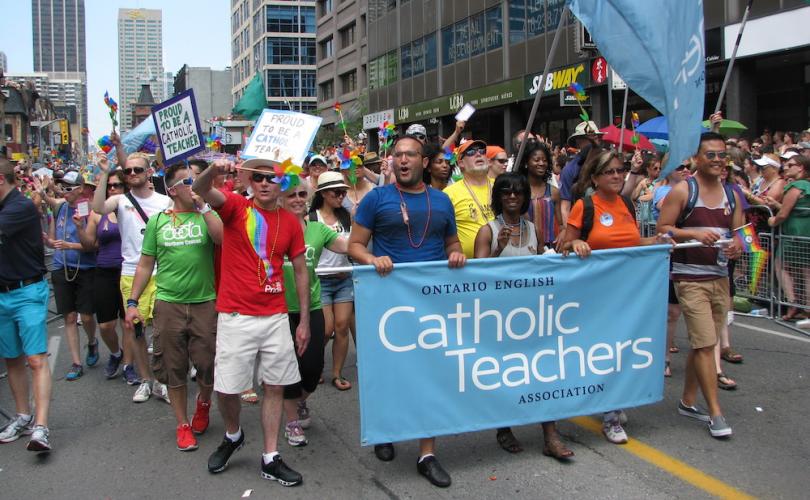
Catho1ic teachers march in favor of g4y rights and perverted sex education
Catho1ic teachers marching in favor of g4y rights

The complainant’s employer – a secular university – was also informed about his views.

I thought this was interesting from the LSN article – comments from politicians and school board leaders:

Toronto City Councilor Kristyn Wong-T4m accused Mai11et on Twitter of calling for LG8T allies to be “killed.”

[…]A number of TCDSB trustees also revealed on Twitter their disdain for Mai11et’s presentation.

“There are consequences for those who spread hatred & profess to be Catho1ic-you know who you are. Some feel holier than Pope and want to make us feel like lesser Catho1ics. I stand with Pope: God created us all in his image,” Trustee Maria Rizz0, Ward 5, tweeted March 6.

Rizz0 tweeted hours later that “No one should use bible as a weapon to advance their fundamentalist views to spread hatred at 2SLG8TQ+ students and smilies [sic].”

Trustee Markus de Domenic0 also weighed in on Twitter on March 6, indirectly accusing Mai11et of “hate and bigotry.”

“I take hope knowing the vast majority of Catho1ics are loving, accepting people who believe in the teachings of Christ. We do not support hate and bigotry. We do not use the bible as a vile weapon against others. I stand with the Pope: God created us all in His image,” he wrote.

I looked at some of these tweets, and also found this tweet from a Catho1ic school tweeting a picture of Ruth Bader-Ginsburg for International Women’s Day. My view of Catho1icism was already pretty low, but seeing how many Catholic leaders don’t accept the Bible isn’t exactly helping. Remember, Joe Biden was able to pass himself off as Catho1ic to Catho1ic voters. Catholic voters didn’t see any problem with his views on infanticide and LG8T totalitarianism.

I wonder if LG8T activists understand how they will be viewed when they respond to disagreement like this. It seems to me that they would be much better off if they tried to make someone like Dave Rubin their spokesman. But in my experience, they tend to see dissenters from their views in a more totalitarian way. They are only too happy to bring in government to stifle and subdue anyone who disagrees with them.

As a Christian, it would never occur to me to use police to force someone to accept my views on morality, e.g. – chastity.  I would be uncomfortable overpowering someone, threatening them with unemployment or jail. But for the police in Toronto, this is totally normal. Bible-believing Christians are good enough to pay their salaries, but not good enough to have human rights.

We’ve seen this before in countries with socialism and atheism took over, and dissenters were not treated very well. But they are so steeped in their own dogmas, that they can’t possible think about human rights or principles. They have to win. They have to stop anyone from disagreeing with them, or living in any way that they don’t approve of.

New study: there is no gay gene that causes homosexuality

I heard one of the authors of this new study commenting on how he was a gay man, and the purpose of his research was to show a genetic basis for homosexuality, in order to make it equal to race. His goal was to make it impossible to disagree with homosexual behavior, because homosexual behavior would be seen as natural and normal. Let’s see if his new study helps him out.

The blog of the peer-reviewed journal PLOS One reported on the new study, which was published in the prestigious journal Science.

Excerpt:

The once-prevailing concept of a “gay gene” dictating sexual orientation has been put to rest in a powerhouse study published today in Science. The work brilliantly illustrates the very nature of science: evolving with the input of new data, especially the large-scale contributions of bioinformatics and crowd-sourcing.

“We formed a large international consortium and collected data for more than 500,000 people, comparing DNA and self-reported sexual behavior. This is approximately 100 times bigger than any previous study on this topic,” said lead author Andrea Ganna, of the Institute of Molecular Medicine in Finland and an instructor at Massachusetts General Hospital and Harvard Medical School, opening a news conference earlier this week.

[…]The investigation estimates a genetic contribution to same-sex sexual behavior as under 1 percent, thanks to analysis of a trove of data from the UK Biobank and the consumer genetic testing company 23andme.

So, there you have it, there is no gay gene. But this is of course something we’ve known for decades, as all the previous studies had found the same thing.

The normal way that people do these studies is to analyze identical twins, and see how often both identical twins are gay.

Eight major studies of identical twins in Australia, the U.S., and Scandinavia during the last two decades all arrive at the same conclusion: gays were not born that way.

“At best genetics is a minor factor,” says Dr. Neil Whitehead, PhD. Whitehead worked for the New Zealand government as a scientific researcher for 24 years, then spent four years working for the United Nations and International Atomic Energy Agency. Most recently, he serves as a consultant to Japanese universities about the effects of radiation exposure. His PhD is in biochemistry and statistics.

Identical twins have the same genes or DNA. They are nurtured in equal prenatal conditions. If homosexuality is caused by genetics or prenatal conditions and one twin is gay, the co-twin should also be gay.

“Because they have identical DNA, it ought to be 100%,” Dr. Whitehead notes. But the studies reveal something else. “If an identical twin has same-sex attraction the chances the co-twin has it are only about 11% for men and 14% for women.”

Because identical twins are always genetically identical, homosexuality cannot be genetically dictated. “No-one is born gay,” he notes. “The predominant things that create homosexuality in one identical twin and not in the other have to be post-birth factors.”

Dr. Whitehead believes same-sex attraction (SSA) is caused by “non-shared factors,” things happening to one twin but not the other, or a personal response to an event by one of the twins and not the other.

By the way, a previous study also found that transgender behavior was not genetic, but was clearly linked to environmental factors such as peer approval and social media.

Here is the report from Science Daily:

This month, a Brown University researcher published the first study to empirically describe teens and young adults who did not have symptoms of gender dysphoria during childhood but who were observed by their parents to rapidly develop gender dysphoria symptoms over days, weeks or months during or after puberty.

[…]The study was published on Aug. 16 in PLOS ONE.

Littman surveyed more than 250 parents of children who suddenly developed gender dysphoria symptoms during or after puberty.

[…]“Of the parents who provided information about their child’s friendship group, about a third responded that more than half of the kids in the friendship group became transgender-identified,” Littman said. “A group with 50 percent of its members becoming transgender-identified represents a rate that is more 70 times the expected prevalence for young adults.”

A previous study also found that children are more likely to be gay if they are raised by gay adults. It was reported in AOL News.

Excerpt:

Walter Schumm knows what he’s about to do is unpopular: publish a study arguing that gay parents are more likely to raise gay children than straight parents. But the Kansas State University family studies professor has a detailed analysis that past almost aggressively ideological researchers never had.

[…]His study on sexual orientation, out next month, says that gay and lesbian parents are far more likely to have children who become gay. “I’m trying to prove that it’s not 100 percent genetic,” Schumm tells AOL News.

His study is a meta-analysis of existing work. First, Schumm extrapolated data from 10 books on gay parenting… [and] skewed his data so that only self-identified gay and lesbian children would be labeled as such.

[…]Schumm concluded that children of lesbian parents identified themselves as gay 31 percent of the time; children of gay men had gay children 19 percent of the time, and children of a lesbian mother and gay father had at least one gay child 25 percent of the time.

[…]Finally, Schumm looked at the existing academic studies… In all there are 26 such studies. Schumm ran the numbers from them and concluded that, surprisingly, 20 percent of the kids of gay parents were gay themselves. When children only 17 or older were included in the analysis, 28 percent were gay.

It’s very important for people to understand that there is a trend in society to make every behavior traditionally seen as sinful into something caused by genetics. The twin goals of this effort are to insulate the behaviors from criticism, and to minimize evaluation of the effects of these behaviors on society as a whole. The genetic argument was used extensively to normalize same-sex marriage and transgenderism. I have seen the genetic argument used to defend other behaviors like pedophilia and incest. But the scientific research does nothing to support any of these arguments. What’s amazing is how a majority of people in the Unites have such false beliefs about the scientific research. They vastly overestimate the number of gay people, and also the influence of genetics.

What criteria do historians use to get to the minimal facts about the historical Jesus?

Have you ever heard Gary Habermas, Michael Licona or William Lane Craig defend the resurrection of Jesus in a debate by saying that the resurrection is the best explanation for the “minimal facts” about Jesus? The lists of minimal facts that they use are typically agreed to by their opponents during the debates. Minimal facts are the parts of the New Testament that meet a set of strict historical criteria. These are the facts that skeptical historians agree with, totally apart from any religious beliefs.

So what are the criteria that skeptical historians use to derive a list of minimal facts about Jesus?

Dr. Craig explains them in this article.

Excerpt:

The other way, more influential in contemporary New Testament scholarship, is to establish specific facts about Jesus without assuming the general reliability of the Gospels. The key here are the so-called “Criteria of Authenticity” which enable us to establish specific sayings or events in Jesus’ life as historical. Scholars involved in the quest of the historical Jesus have enunciated a number of these critieria for detecting historically authentic features of Jesus, such as dissimilarity to Christian teaching, multiple attestation, linguistic semitisms, traces of Palestinian milieu, retention of embarrassing material, coherence with other authentic material, and so forth.

It is somewhat misleading to call these “criteria,” for they aim at stating sufficient, not necessary, conditions of historicity. This is easy to see: suppose a saying is multiply attested and dissimilar but not embarrassing. If embarrassment were a necessary condition of authenticity, then the saying would have to be deemed inauthentic, which is wrong-headed, since its multiple attestation and dissimilarity are sufficient for authenticity. Of course, the criteria are defeasible, meaning that they are not infallible guides to authenticity. They might be better called “Indications of Authenticity” or “Signs of Credibility.”

In point of fact, what the criteria really amount to are statements about the effect of certain types of evidence upon the probability of various sayings or events in Jesus’ life. For some saying or event S and evidence of a certain type E, the criteria would state that, all things being equal, the probability of S given E is greater than the probability of S on our background knowledge alone. So, for example, all else being equal, the probability of some event or saying is greater given its multiple attestation than it would have been without it.

What are some of the factors that might serve the role of E in increasing the probability of some saying or event S? The following are some of the most important:

(1) Historical congruence: S fits in with known historical facts concerning the context in which S is said to have occurred.

(2) Independent, early attestation: S appears in multiple sources which are near to the time at which S is alleged to have occurred and which depend neither upon each other nor a common source.

(3) Embarrassment: S is awkward or counter-productive for the persons who serve as the source of information for S.

(4) Dissimilarity: S is unlike antecedent Jewish thought-forms and/or unlike subsequent Christian thought-forms.

(5) Semitisms: traces in the narrative of Aramaic or Hebrew linguistic forms.

(6) Coherence: S is consistent with already established facts about Jesus.

For a good discussion of these factors see Robert Stein, “The ‘Criteria’ for Authenticity,” in Gospel Perspectives I, ed. R. T. France and David Wenham (Sheffield, England: JSOT Press, 1980), pp. 225-63.

Notice that these “criteria” do not presuppose the general reliability of the Gospels. Rather they focus on a particular saying or event and give evidence for thinking that specific element of Jesus’ life to be historical, regardless of the general reliability of the document in which the particular saying or event is reported. These same “criteria” are thus applicable to reports of Jesus found in the apocryphal Gospels, or rabbinical writings, or even the Qur’an. Of course, if the Gospels can be shown to be generally reliable documents, so much the better! But the “criteria” do not depend on any such presupposition. They serve to help spot historical kernels even in the midst of historical chaff. Thus we need not concern ourselves with defending the Gospels’ every claim attributed to Jesus in the gospels; the question will be whether we can establish enough about Jesus to make faith in him reasonable.

And you can see Dr. Craig using these criteria to defend minimal facts in his debates. For example, in his debate with Ehrman, he alludes to the criteria when making his case for the empty tomb.

Here, he uses multiple attestation and the criteria of embarrassment:

Among the reasons which have led most scholars to this conclusion are the following:

1. The empty tomb is also multiply attested by independent, early sources.

Mark’s source didn’t end with the burial, but with the story of the empty tomb, which is tied to the burial story verbally and grammatically. Moreover, Matthew and John have independent sources about the empty tomb; it’s also mentioned in the sermons in the Acts of the Apostles (2.29; 13.36); and it’s implied by Paul in his first letter to the Corinthian church (I Cor. 15.4). Thus, we have again multiple, early, independent attestation of the fact of the empty tomb.

2. The tomb was discovered empty by women.

In patriarchal Jewish society the testimony of women was not highly regarded. In fact, the Jewish historian Josephus says that women weren’t even permitted to serve as witnesses in a Jewish court of law. Now in light of this fact, how remarkable it is that it is women who are the discoverers of Jesus’ empty tomb. Any later legendary account would certainly have made male disciples like Peter and John discover the empty tomb. The fact that it is women, rather than men, who are the discoverers of the empty tomb is best explained by the fact that they were the chief witnesses to the fact of the empty tomb, and the Gospel writers faithfully record what, for them, was an awkward and embarrassing fact.

There are actually a few more reasons for believing in the empty tomb that he doesn’t go into in the debate, but you can find them in his written work. For example, in his essay on Gerd Ludemann’s “vision” hypothesis. That essay covers the reasons for all four of his minimal facts.

So, if you are going to talk about the resurrection with a skeptic, you don’t want to invoke the Bible as some sort of inerrant/inspired Holy Book. You want to look at it as a historical book, and use historical criteria to get to some facts that critical historians would accept. From that, it’s possible to make a case for the resurrection, which is the guarantee that the words of Jesus are authoritative. Including the words of Jesus where he describes the Bible as a whole as God’s revelation of Himself to his creatures.

Here is the approach I use when talking to non-Christian co-workers:

  1. Explain the criteria that historians use to get their lists of minimal facts
  2. Explain your list of minimal facts
  3. Defend your list of minimal facts using the criteria
  4. Cite skeptics who admit to each of your minimal facts, to show that they are widely accepted
  5. List some parts of the Bible that don’t pass the criteria (e.g. – guard at the tomb, Matthew earthquake)
  6. Explain why those parts don’t pass the criteria, and explain that they are not part of your case
  7. Challenge your opponent to either deny some or all the facts, or propose a naturalistic alternative that explains the facts better than the resurrection
  8. Don’t let your opponent attack any of your minimal facts by attacking other parts of the Bible (e.g. – the number of angels being one or two, etc.)

And remember that there is no good case for the resurrection that does not make heavy use of the early creed in 1 Corinthians 15:3-8. That passages is universally accepted as early, eyewitness testimony from Paul, and represents the core of early Christian beliefs about the death and resurrection of Jesus. Everyone who takes evidence seriously has to account for that early creed, which passes the historical tests I outlined above.

The best essay on the minimal facts criteria that I’ve read is the one by Robert H. Stein in “Contending with Christianity’s Critics“. It’s a good short essay that goes over all the historical criteria that are used to derive the short list of facts from which we infer the conclusion “God raised Jesus from the dead”. That whole book is really very, very good.