Often, Christians, Jews and other religious people are swayed to vote for left-leaning parties in elections. The leftists promise all kinds of goodies that they will provide, freeing us from the responsibility to provide for ourselves. And they promise that it won’t cost us a thing, because they will take the money from our rich neighbors, or from some other group of people who, they tell us, have no right to their own money. Well, what happens when religious people trust the secular government and vote them into power in order to get these goodies?
MONTREAL — The 3- and 4-year-olds at the Childcare Center of Hebrew Foundation were always excited on Fridays. They’d get to re-create the rituals their parents typically perform for Friday night dinner, an integral part of the Jewish Sabbath, or Shabbat.
On a rotating basis, each child would be designated, if female, to light candles and say a blessing or, as a boy, bless the challah bread. The “wine” would be grape juice.
But on Friday, there was no Shabbat simulation. And there probably never will be again, if the Quebec government can help it.
“My 4-year-old daughter is devastated she can’t do her Shabbat next year,” said Sandy Jesion, who sends his child to the daycare in Dollard-des-Ormeaux, a Montreal suburb where he lives.
Nor are there any more prayers before the mid-morning snack. No stories about Noah’s Ark. No recounting of the parting of the seas.
Don Surber writes:
But the center could prevent this if it refused government money.
From the Toronto Star: “As of last Wednesday, subsidized daycare and early-childhood learning centres in Quebec have had to abide by a new directive prohibiting religious activities, which the government expects to foster the integration of all children.”
Don’t get me wrong. Canadians should fight this. But the Childcare Center of Hebrew Foundation is not helpless. It could tell Quebec where it can shove that money.
Notice though, that a much better solution that not taking the subsidies is to NOT VOTE FOR THE TAXES in the first place. Vote to shrink government, and then you get to keep your own money and spend it as you see fit. Your employer gets to keep the money, so that he will be able to raise your salary, or to not LAY YOU OFF in a recession. It is never a good idea for religious people to give a secular government their money, or even their neighbor’s money. The secular government can never spend the money as efficiently as private citizens can. It’s your money – you keep it and spend it on helping others the way YOU think is best. And if you want to have a religious education, then that’s your decision. Don’t let the government use your money and then make that decision FOR YOU. Don’t let someone else take your money, or your neighbor’s money, or your employer’s money, and then use it to PUSH THEIR VIEW ONTO YOUR CHILDREN. You keep your money and raise your own children. You call the shots with the money you earn.
A Gallup poll released last week showed Mr. Cain with the highest voter intensity score of any Republican presidential contender — far higher than Ms. Palin, a former governor of Alaska, or Mr. Romney, a former governor of Massachusetts. While Mr. Cain’s name recognition was at 37 percent, it had risen 16 points since March.
Many pundits and voters declared him the winner of the first Republican debate last month. And he won the straw polls at the Tea Party Patriots convention in February and the Conservative Values Conference in Iowa in March.
If few people think Mr. Cain can win the nomination, he is satisfying voters’ desire to fall in love with a candidate. Their passion for him says as much about what the Republican field is lacking as it does about any specifics he is offering.
He captivates with his talk radio certainty, his pulpit cadences, and what he describes as his “common-sense business solutions” that make it sound as though solving the nation’s debt crisis is as simple as streamlining the number of pizza toppings on offer, as he did to improve performance at Godfather’s.
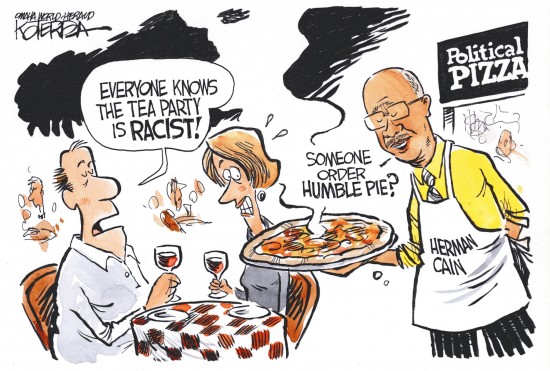
His rags-to-riches personal story and his talk of an “empowerment agenda” appeals to voters who believe that the federal budget has been corrupted by a culture of entitlement that no longer values sweat equity. As a black conservative, he appeals to Tea Party supporters who are angry at being tagged racists for their disagreements with the nation’s first black president. And in a country increasingly sour on Washington, his lack of political experience has become a calling card.
“Tea Party people love him,” said Jenny Beth Martin, the co-founder of Tea Party Patriots.
[…]Mr. Cain, 65, grew up poor in Georgia, his father working three jobs to finally buy a house for his family. Mr. Cain worked his way through Morehouse College and earned a master’s degree at Purdue University before becoming a vice president at Pillsbury.
Advised by the president of the company that he had to take a different route if he wanted to be a president of a company himself, Mr. Cain quit and entered the Burger King training program, where potential executives are trained from the grill up, working as “Whopper floppers” and cleaning bathrooms. Soon he was in charge of his region, and within a couple of years Pillsbury asked him to help turn around the Godfather’s chain, which he eventually joined in buying.
He became a folk hero among Republicans in 1994, when he challenged President Bill Clinton on his health care legislation during a televised town-hall-style meeting: “If I’m forced to do this, what will I tell all those people whose jobs I’m forced to eliminate?”
He ran for the Senate in Georgia in 2004, coming in second in the Republican primary ahead of a more seasoned politician, and parlayed his success into a career as a talk radio host.
[…]Liberals, he said, “are scared to death of me. They don’t want me to go up against their beloved Obama. I have done stuff, fixed stuff, can explain stuff and run stuff. He’s been a community organizer, he’s got failed policies. He reads from the teleprompter, I don’t. I’ve got common-sense solutions, he passes 2,700-page legislation. The contrast would be so obvious, and when you get past all of the quantitative stuff, they can’t use race to cover for him.”
Mr. Cain predicts he will finish in the top three or better in Iowa, New Hampshire and South Carolina. More and more voters seem to agree.
At a lunch in Concord, Kevin Attar, a small-business owner, listened to Mr. Cain’s pitch, then said: “I think this country is ready for someone with your platform. How do we get more people to know who you are?”
Mr. Cain urged him to spread the word.
He excused himself from the table, telling his guests he had someone to greet upstairs.
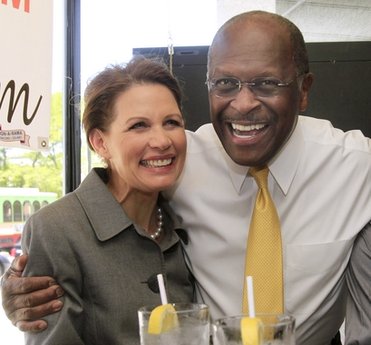
There, Ms. Bachmann, a congresswoman from Minnesota, was doing a radio interview. Mr. Cain put his arm around her and smiled for the assembled cameras. “She can run, that’s great,” he boomed. “The more the merrier. She’s a great friend. I have a lot of respect for her.”
Ms. Bachmann, finally allowed a word in, joked, “That’s why he supports me.”
“Did you all get what you need for pictures?” Mr. Cain asked. “Here, let me give you one more.”
He put his arm around Ms. Bachmann again, leaned far forward and smiled bigger than anyone in the room.
She’s Mrs. Bachmann, you stupid New York Times person. Oh well.
And I actually found the pictures:
Cain/Bachmann 2012?
And another from earlier:
Bachmann/Cain 2012?
If I get Bachmann/Cain, or even Cain/Bachmann, I am going to be a very happy Knight. I’ll be Summery Knight, then. Well… for a little while. Then back to being gloomy and judgmental.
Herman Cain and Michele Bachmann continue to earn the highest Positive Intensity Scores, at 25% and 21%, respectively. Below these two, several other candidates have Positive Intensity Scores in the 14 to 16 range, including two of the best-known candidates, Sarah Palin and Mitt Romney, and two who are less well-known — Tim Pawlenty and Rick Santorum.
That’s good news!
Fiscal assessments of the candidates
You can read Club For Growth’s assessment of Herman Cain’s fiscal conservatism. Club For Growth had mixed reviews of Newt Gingrich and Tim Pawlenty, but they are very positive about Herman Cain, based on his speeches. Cain does not have a record, so he is a bit more of a gamble. We don’t know if he would do what he says! But if he does what he says then he gets an A grade. By the way, these reports are excellent to print out and leave them out on your desk. (Read them first). We need to be getting into discussions with people in the office NOW. Be passionate about these policies! Memorize them, understand them, and explain them.
Once again, Michele Bachmann is my first choice, then Herman Cain, then Tim Pawlenty. This is strictly on policy. You can learn more about Michele Bachmann in this post, in which I beg her to run for President.
This week, Texas Gov. Rick Perry signed a law that will help free Lone Star State businesses from the threat of frivolous lawsuits by enacting “loser-pays” tort reform. Prior to the legislation, litigants faced a no-lose situation, while defendants stood to lose everything—even for the most outrageous, bizarre and wrongful accusations.
Even when defendants won, the legal fees associated with protecting themselves could add up to tens of thousands of dollars. As a result, many pre-emptively settled out of court, as the settlement payment would be less than the legal fees. Under Texas’s new legislation, however, litigants will be forced to pay for the defendant’s attorney fees if the case is determined groundless. This will compel would-be litigants to consider the practicality of their complaint before taking legal action, and it will protect defendants from the dire financial impact of frivolous cases.
The Texas legislation should serve as a national model, especially as we recover from the Great Recession. America has the most expensive civil-justice system in the world, costing $255 billion in 2008, or nearly 2% of gross domestic product, according to a 2009 study by the firm Towers Perrin (now Towers Watson). That’s more than twice as much as any other industrialized nation as a percent of the GDP.
Small businesses—the engines of our economy and the creators of 64% of American jobs—are usually the target of frivolous lawsuits. In fact, small businesses paid 81% of business tort liability costs in 2008. On average, a small business earning $1 million must spend $20,000 annually on lawsuits—money they could have otherwise spent on product development or new job creation.
Softening the threat of frivolous lawsuits sparks economic activity. In 2003, for example, Texas put limits on non-economic damages in medical malpractice cases. Since then, the number of doctors applying to practice in the Lone Star State has jumped by 60%. The same can be expected of businesses that no longer have to fear the financial impacts of civil-lawsuit abuse.
One of the reasons why we are in an economic mess is because we have not reined in the excesses of the trial lawyers. And the Democrats will never be able to rein them in because they are the core of the Democrat party, along with labor unions, teacher unions, word-smithing academics, criminals, welfare recipients and Hollywood celebrities. The sheltered, non-productive segments of society, who have never had to run a business or make payroll.
Let me add this tort reform law (loser pays) to the other list of policies we need at the national level:
National right-to-work law
National photo ID required for voting
National voucher system for education
National voucher for health care
Nation cap on damages for lawsuits
allow Opt-out of Social Security
allow Opt-out of Medicare
allow Opt-out of Medicaid
allow Opt-out of unemployment insurance
Flat income tax at 10% below 50,000 and 25% over 50,000, with no deductions except for charity and retirement contributions
Zero capital gains tax, phased in over four years
Tax-free savings accounts with no restrictions on withdrawals, limit $5,000 per year
I hope the Republicans will campaign on these ideas.